The scale of modern elder financial exploitation is staggering. According to the FBI’s latest tracking, older Americans lose over $7.7 billion annually to fraudsters, with individual victims losing an average of $120,000. While sophisticated digital and artificial intelligence (AI) voice-cloning scams are rapidly escalating, data reveals that roughly 70% of financial abuse is actually committed by individuals known to the senior, such as predatory caregivers or dishonest family acquaintances.
As a fiduciary, I assess risk objectively. Protecting your family’s generational wealth means moving beyond reactive concern and implementing proactive, data-informed safeguards.
Step-by-Step Defense Protocol
Implementing structural guardrails across your family’s accounts creates an immediate barrier against bad actors. Follow this order of operations to establish maximum protection:
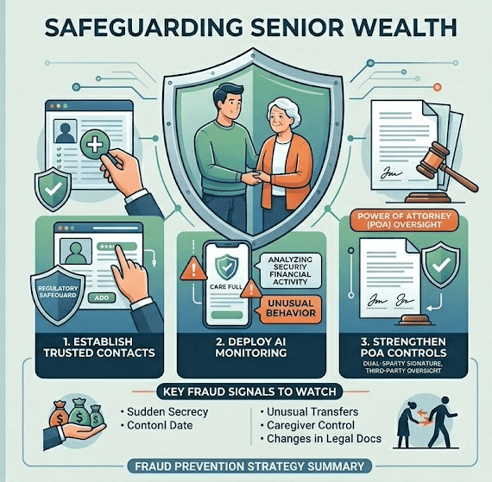
1.Establish Trusted Contacts: Immediate Priority.
Contact major financial custodians—such as Fidelity or Charles Schwab—to formally add a “Trusted Contact” to your family member’s accounts. Under FINRA Rule 2165, this provides institutions with a compliant regulatory framework to halt suspicious transactions and contact you directly without violating privacy laws.
Do not rely on standard bank alerts, which often miss specialized elder fraud patterns. Integrate a dedicated safety platform like Carefull. This AI-driven service links existing bank accounts to continuously analyze transactional data, flagging unusual cash-draining habits, missed bills, or home title changes.
Seniors with multiple accounts scattered across different institutions face significantly higher exposure. Consolidate these assets into a single primary custodian. This vastly simplifies oversight, limits data exposure, and allows you to establish unified security alerts.
4.Restructure Power of Attorney (POA) Controls: Legal Guardrails.
Review existing estate planning documents. A standard POA can inadvertently act as a license to steal if left unmonitored. Ensure your family’s legal documents include accountability provisions, such as requiring dual signatures or independent third-party CPA oversight for large asset liquidations.
Identifying the Behavioral Red Flags
Preventing loss requires recognizing changes in behavior before assets leave an account. Watch closely for these primary indicators:
Financial Anomalies: Uncharacteristic out-of-state wire requests, sudden ATM withdrawals by a companion, or sudden attempts to purchase untraditional retail assets like gift cards or cryptocurrency.
Social Isolation: A new “friend” or caregiver who insists on managing the senior’s schedule, acts as an intermediary during financial conversations, or encourages secrecy regarding financial decisions.
The Bottom Line: Fraudsters rely entirely on isolation and administrative complexity. By centralizing accounts at major custodians, adding verified trusted contacts, and utilizing automated tools like Carefull, you build a structural defense system that protects your family’s long-term financial health. Take the time to review these accounts with your loved ones and put these administrative blockades in place.
Please comment or send an email if you have any questions.
Just ran some numbers on historical initial public offerings (IPOs) to provide a data-driven perspective on what the future might hold for highly anticipated market debuts like SpaceX, OpenAI, and Anthropic. While the media buzz surrounding mega-tech listings often generates massive retail excitement, the historical data over the last 25 years tells a much more cautious story for the 12 months following a company’s public debut.
Data-Driven Insights: The 12-Month Post-IPO Track Record
When evaluating historical IPO performance over the past two and a half decades, the data consistently refutes the myth of guaranteed first-year gains. Financial studies reveal several critical trends regarding how companies perform in the 365 days after hitting the public markets:
The “First-Day Pop” vs. Long-Term Reality: Historically, IPOs are known for significant first-day underpricing, giving early institutional investors an average initial “pop” of roughly 15% (Lowry et al., 2017). However, for everyday investors buying shares on the open market after day one, the subsequent 12 months frequently see a reversal of fortune.
Systemic Underperformance: Extensive long-run historical data indicates that, on average, IPOs tend to underperform broad market benchmarks—such as the S&P 500 or industry-specific indices—during their first one to three years (Ang et al., 2006).
The Size and Age Factors: Performance varies wildly based on a company’s maturity at the time of the listing. Smaller, younger startups exhibit severe average underperformance, with cumulative average abnormal returns dropping significantly in the first year (Siev & Qadan, 2022). Conversely, large, heavily capitalized, and older firms tend to manage the transition to public markets with far less volatility, though they still frequently lag behind established market peers in the short term (Siev & Qadan, 2022).
The “Star Performer” Statistical Outliers: The broader average of IPO performance is heavily weighed down by a high failure rate. Statistically, the vast majority of IPOs underperform, while the overall asset class is propped up by a tiny minority (roughly 2%) of “star performers” that achieve monumental returns (Ang et al., 2006).
What This Means for upcoming IPOs such as SpaceX, OpenAI, and Anthropic:
Applying this decision-making framework to the dominant tech private giants of today yields specific strategic takeaways:
Risk & Valuation Variable
Strategic Application to Upcoming Mega-Tech IPOs
Institutional Maturity
Unlike the speculative tech listings of the 1999–2000 dot-com bubble, firms like SpaceX, OpenAI, and Anthropic will enter the public markets as massive, heavily capitalized enterprises with massive global footprints. According to historical trends, their large size and operational age should structurally protect them from the extreme 40%+ drop-offs seen in smaller, speculative IPOs (Siev & Qadan, 2022).
The Hype Premium
Because these brands carry unprecedented cultural and technological visibility, their IPOs will likely face intense public demand. This historically leads to severe initial underpricing (to benefit institutional insiders) followed by a retail-driven valuation peak on day one, which frequently leads to a cooling-off period and negative market-adjusted returns over the subsequent 12 months.
The “Long Shot” Bet
Investors backing OpenAI or Anthropic are implicitly betting that these firms will become the absolute “star outliers” of the decade (Ang et al., 2006). While the historical probability of any random IPO becoming a permanent market leader is low, companies with profound structural moats stand the best statistical chance of breaking the traditional 12-month underperformance trend.
The historical data over the last 25 years sends a clear warning to investors: buying into the immediate 12-month aftermath of a high-profile tech IPO is statistically a losing proposition compared to holding a broad-market index. While mega-cap innovators like SpaceX or OpenAI possess the scale to avoid the catastrophic first-year collapses of smaller startups, history dictates that the safest, most optimized administrative path for retail capital is often patience—waiting for the initial regulatory, insider lockup, and hype cycles to clear before establishing a long-term position.
Please comment or send an email if you have any questions.
Joe Baker, CFP®
Baker Asset Management, LLC
joebaker@bakerassetmanagement.com
References
Ang, A., Gu, L., & Hochberg, Y. V. (2006). Is IPO underperformance a peso problem? National Bureau of Economic Research. https://doi.org/10.3386/w12203
Cited by: 81
Lowry, M., Michaely, R., & Volkova, E. (2017). Initial Public Offerings: A synthesis of the literature and directions for future research. Foundations and Trends® in Finance, 11(3-4), 154-320. https://doi.org/10.1561/0500000050
Cited by: 334
Siev, S., & Qadan, M. (2022). Call me when you grow up: Firms’ age, size, and IPO performance across sectors. Journal of Risk and Financial Management, 15(12), 586. https://doi.org/10.3390/jrfm15120586
Building long-term wealth requires more than just picking the right stocks; it requires picking the right tax structures. For high earners, the IRS often closes the front door to tax-free growth. Fortunately, the “backdoor” remains wide open.
Here is the 2026 blueprint for executing a Backdoor Roth conversion with precision.
🚪What is a Backdoor Roth?
A Backdoor Roth isn’t a specific type of account, it’s a strategy.
By law, if your income exceeds certain limits, you are barred from contributing directly to a Roth IRA. However, there are no income limits on contributing to a Traditional IRA or on converting those funds to a Roth. By combining these two steps, you effectively “bypass” the income cap, allowing your money to grow tax-free for decades.
📈Why It Matters in 2026
Tax-advantaged space is a finite resource. In 2026, the contribution limits and income thresholds have shifted, making this strategy more valuable than ever:
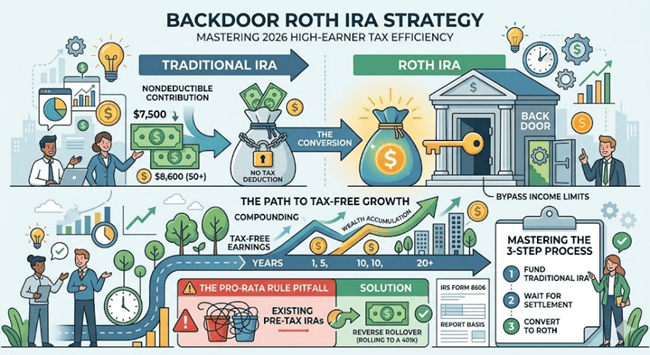
2026 Contribution Limit:$7,500 (or $8,600 if you are age 50 or older).
The “Front Door” Income Caps: In 2026, the ability to contribute directly to a Roth begins to phase out if your Modified Adjusted Gross Income (MAGI) exceeds:
$153,000 (Single)
$242,000 (Married Filing Jointly)
⏳When is the “Best Age” to Start?
The short answer: The best age to start is the very first year your income exceeds the direct contribution limits.
Because Roth IRAs grow tax-free, time is your greatest ally. The earlier you start, the more “tax-free compounding” cycles your money undergoes.
Early Career (20s-30s): If you are a high-earning young professional, starting now can result in hundreds of thousands of dollars in tax savings by retirement.
The “Sweet Spot” (50+): At age 50, the IRS allows “catch-up” contributions (bringing your 2026 total to $8,600). If you haven’t started yet, this is the time to maximize your contributions while you are likely in your peak earning years.
The 5-Year Rule: Remember that every conversion starts its own 5-year clock before earnings can be withdrawn tax-free. Starting earlier ensures you clear these hurdles well before you actually need the cash.
🛠️How to Execute (The 3-Step Process)
Fund a Traditional IRA: Open a Traditional IRA and make a nondeductible contribution. This means you don’t take a tax deduction for the contribution (since you’ve already paid tax on that income).
The “Waiting Period”: While not strictly a legal requirement, I typically recommend waiting until the funds fully clear—usually a few business days—before moving to the next step.
The Conversion: Instruct your custodian to move the funds from the Traditional IRA into your Roth IRA.
Expert Tip: Convert the funds as soon as they settle. If the money sits in the Traditional IRA and earns even a few dollars in interest, those earnings will be taxable upon conversion. We want the “basis” and the “conversion amount” to be as identical as possible.
⚠️The “Pro-Rata” Rule: The Biggest Pitfall
This is where most high earners get caught. The IRS views all of your Traditional, SEP, and SIMPLE IRAs as one giant bucket.
If you have $92,500 in an old Rollover IRA (pre-tax) and you add a $7,500 non-deductible contribution (after-tax), the IRS sees a $100,000 total balance. If you try to convert just that $7,500, they will claim only 7.5% of it is tax-free. You would owe income tax on the other 92.5%.
The Solution: Before executing a backdoor conversion, we must look for a “Reverse Rollover”, moving those pre-tax IRA balances into your current employer’s 401(k). 401(k) balances are excluded from this calculation.
📝Reporting to the IRS
Precision in paperwork is mandatory. You must file IRS Form 8606 with your tax return. This form tracks your “basis” (the after-tax money) so the IRS knows you’ve already paid taxes on that contribution and shouldn’t be taxed again during the conversion.
Summary Checklist
Verify your 2026 MAGI exceeds the direct Roth limits.
Confirm you have zero existing pre-tax IRA balances (check old SEP/SIMPLE/Rollover accounts).
Contribute up to $7,500 (or $8,600) to a non-deductible Traditional IRA.
Convert to Roth once funds settle.
Ensure your tax preparer files Form 8606.
At the end of the day, the Backdoor Roth is about more than just a single year’s contribution; it’s about the compounding power of tax-free growth over the course of your career. While the process is straightforward, the “Pro-Rata” rule and filing requirements leave zero room for error. If you’re ready to secure this tax-advantaged space for 2026 but aren’t sure how your existing IRA balances might impact the strategy, make sure you talk to a tax professional before you move forward.
Please comment or send an email if you have any questions.
Social Security isn’t failing because of a lack of math; it’s stalling because of a lack of movement in Washington. While the program’s trust funds are undeniably shrinking, this is a crisis of legislative willpower rather than a lack of solutions. The 2025 Trustees Report makes it clear that the “safety net” is held up by a fraying rope, but Congress still holds the scissors—and the spool of thread. To save the program, lawmakers must stop treating Social Security as a political “third rail” and start treating it as a standard legislative repair project.
The Current Trajectory (2025 Trustees Report)
According to the Social Security Board of Trustees’ 2025 Annual Report, the timeline for action has narrowed. The report underscores that without intervention from the Capitol, the following milestones are inevitable:
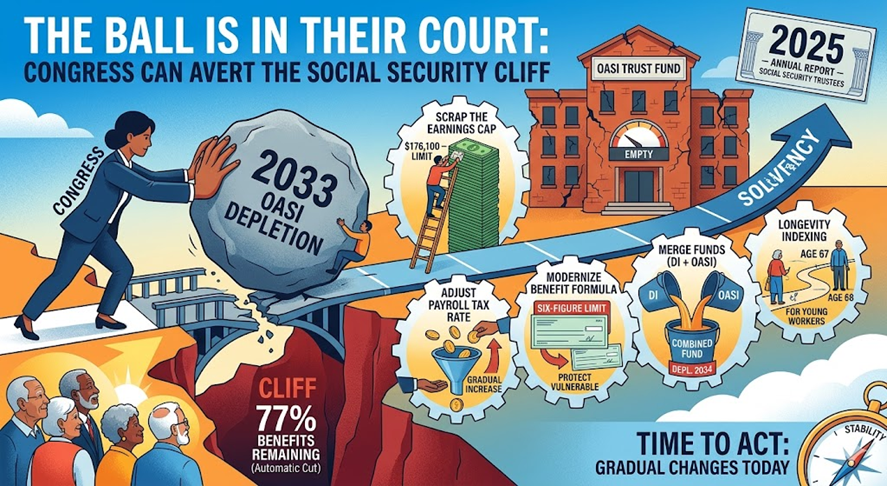
The 2033 Deadline: The Old-Age and Survivors Insurance (OASI) Trust Fund—the primary source for retiree benefits—is projected to be depleted in 2033.
The Enforced Benefit Cut: Under current law, once reserves are gone, the Social Security Administration cannot pay full benefits. By 2033, incoming tax revenue would only cover 77% of scheduled payments, resulting in an immediate 23% cut for all beneficiaries unless Congress changes the law.
Growing Deficit: The 75-year actuarial deficit has risen to 3.82% of taxable payroll, meaning the gap Congress needs to bridge is larger than it was just one year ago.
The Congressional “Fix-It” List
Congress has several specific levers they can pull to stabilize the system for the next 75 years without cutting benefits for those who rely on them most. Fixing the program will likely require a “grand bargain” involving these components:
Scrapping the Earnings Cap: Currently, Social Security taxes are only collected on income up to $176,100 (for 2025). High earners stop paying into the system once they hit that mark. Congress could eliminate this cap or create a “donut hole” (e.g., taxing income above $250,000) to ensure the wealthiest Americans contribute at the same rate as the middle class. I feel this is the best way to fix the problem and can be implemented quickly.
Gradual Payroll Tax Adjustments: The 12.4% payroll tax (split between you and your employer) hasn’t moved in decades. A tiny, phased-in increase—such as 0.1% per year—would be barely noticeable on a weekly paycheck but would pour billions back into the trust fund over time.
Modernizing the Benefit Formula (The “Six-Figure Limit”): Lawmakers are currently debating a cap on maximum benefits for high-income couples (e.g., a $100,000 limit). By slowing benefit growth for the top 1–5% of earners, Congress can redirect funds to keep the program solvent for everyone else.
Longevity Indexing: For younger generations, Congress could index the retirement age to life expectancy. This would mean the age moves by mere months over several decades, reflecting the reality that we are living longer than the workers of 1935.
The math behind Social Security is straightforward; the politics are what’s complicated. We don’t need a miracle to save Social Security; we need a Congress that is willing to trade short-term political points for long-term national stability. By acting now, lawmakers can implement small, gradual changes that protect current retirees and guarantee a future for the next generation. The 2033 “cliff” is seven years away—it’s time for Washington to pick up the tools and get to work.
Please comment or send an email if you have any questions.
For years, high-earning professionals aged 50 and older have relied on pre-tax catch-up contributions to shave thousands off their annual tax bills while fortifying their retirement nests. However, a major change recently occurred, as the SECURE 2.0 Act officially mandated that “high earners”—defined as those with prior-year (2025) wages exceeding $150,000—must transition their catch-up contributions exclusively to a Roth (after-tax) basis. While this removes the immediate tax deduction you may be accustomed to, it also unlocks a powerful opportunity for entirely tax-free growth and withdrawals in your later years. Understanding these new rules is no longer optional; it is a critical step in preserving your retirement strategy’s efficiency.
How Compensation Affects Your Company Match
When it comes to employer matching, the most important thing to know is that your company matches dollars, not tax types. Here is how your compensation and contribution choices interact with that match:
Match Calculation is Based on Gross Pay: Your employer typically matches a percentage of your eligible compensation (e.g., 50% of the first 6% you contribute). This calculation uses your gross, pre-tax pay, even if your own contributions are made on a Roth (after-tax) basis.
The $360,000 Salary Cap: For 2026, the IRS has set the compensation limit at $360,000. This means any income you earn above this amount cannot be used by your employer to calculate matching contributions.
Roth vs. Traditional Match Placement: Traditionally, employer matches are deposited into a pre-tax account, regardless of whether your contribution was Roth or traditional. However, under newer rules, some employers may now allow you to receive the match directly into your Roth account. If you choose this “Roth match” option, those matching dollars will be treated as taxable income in the year they are received.
Catch-Up Contributions and Matching: Most companies only match your “regular” contributions (up to the standard $24,500 limit for 2026) and do not provide additional matching on catch-up amounts. It is vital to check your specific plan document to see if your catch-up dollars trigger any extra employer funds.
Also in 2026, the “super catch-up” provision offers a significant boost for older savers.
Higher Limit: Participants aged 60, 61, 62, or 63 (by the end of the calendar year) can contribute up to $11,250 in catch-up contributions for 2026.
Total Potential Savings: When combined with the standard elective deferral limit of $24,500, these individuals can save a total of $35,750.
Comparison to Standard Catch-up: This is an increase over the standard $8,000 catch-up limit available to other participants aged 50 and older.
Age Cliff: Once a participant turns 64, their eligible catch-up amount reverts to the standard limit (e.g., $8,000 for 2026).
Roth Requirement for High Earners: Just like the standard catch-up, if your prior-year FICA wages exceeded $150,000, these super catch-up contributions must be made on a Roth basis.
Plan Optionality: It is important to note that employers are not required to offer the super catch-up; it is an optional plan feature.
Here is a table that compares different 2026 contribution limits based on age and income levels.
2026 401(k) Contribution Limits Comparison
Age Group
Standard Limit
Catch-up Amount
Total Limit
Roth Requirement (if 2025 Wages >$150k)
Under 50
$24,500
$0
$24,500
N/A
50 – 59
$24,500
$8,000
$32,500
Yes (Catch-up portion only)
60 – 63 (Super Catch-up)
$24,500
$11,250
$35,750
Yes (Catch-up portion only)
64 and Older
$24,500
$8,000
$32,500
Yes (Catch-up portion only)
Standard Limit: The base elective deferral for all participants increases to $24,500 in 2026.
Catch-up Eligibility: Participants aged 50 or older can contribute an additional $8,000.
Super Catch-up Enhancement: Under the SECURE 2.0 Act, those aged 60–63 receive a higher catch-up limit of $11,250.
Combined Annual Limit: The total limit for all contributions (employee plus employer match/profit sharing) is capped at $72,000 (plus any applicable catch-up).
High Earner Definition: The $150,000 threshold is based on FICA wages (Box 3 of your W-2) from the same employer in the preceding year.
2026 Total Possible Savings by Age
If you maximize both the combined (employee plus employer contributions) annual limit and your age-based catch-up, your total account additions can reach:
Age 50–59: $80,000 ($72,000 limit + $8,000 catch-up).
Age 60–63: $83,250 ($72,000 limit + $11,250 super catch-up).
Age 64+: $80,000 ($72,000 limit + $8,000 catch-up).
The 2026 mandatory Roth catch-up rule represents a significant pivot in how high earners must approach their peak saving years. While losing the upfront tax break on those extra contributions might sting today, the trade-off is a growing pool of assets that the IRS can never touch again. Whether you are hitting the $150k wage threshold or entering the “Super Catch-Up” age bracket, the key to 2026 is early coordination with your payroll department and financial advisor to ensure your contributions are coded correctly and your retirement trajectory remains on track.
Please comment or send an email if you have any questions.
Deciding when to claim Social Security involves balancing immediate financial needs against long-term benefit growth. While you can start as early as age 62, your monthly payment increases for every month you delay until age 70, making the difference in the benefit amount significant in most cases. It’s a high-stakes decision because the choice you make now is largely permanent and affects how much you’ll receive every month for the rest of your life. To help cut through the confusion, here’s a simple step-by-step logic flow to help you decide which age makes the most sense for your health, your work life, and your family.
Social Security Claiming Flowchart
Do you have an immediate, urgent need for cash to meet basic living expenses?
YES: Claim at age 62. Note that your benefits will be permanently reduced by up to 30% compared to your full retirement age.
NO: Go to Step 2.
Are you still working and earning above the annual limit ($24,480 in 2026)?
YES: Consider waiting until your Full Retirement Age (FRA). If you claim before FRA while working, Social Security may temporarily withhold $1 for every $2 you earn above the annual limit.
NO: Go to Step 3.
What is your health status and expected longevity?
POOR HEALTH / LOW LONGEVITY (Expected life < 77 years): Claim early. Taking smaller payments for more years often results in a higher total lifetime value if you do not expect to live past your late 70s.
GOOD HEALTH / FAMILY LONGEVITY (Expected life > 81 years): Wait until Age 70. Delaying past your FRA earns you 8% more in Delayed Retirement Credits for every year you wait, maximizing your monthly check for life.
AVERAGE: Go to Step 4.
Are you married and the higher-earning spouse?
YES: Wait until age 70. This maximizes the survivor benefit for your spouse if you pass away first.
NO: Claim at FRA (Age 66-67). This provides 100% of your earned benefit without reductions or further delays.
Don’t forget that The Social Security site has a plethora of good information and tools to help you make the best decision for your situation.
At the end of the day, the goal is to maximize your peace of mind. If you need the money now or have health concerns, taking benefits early is a perfectly valid safety net. However, if you are healthy and can afford to wait, ‘buying’ a bigger paycheck by delaying can be the best insurance policy against outliving your savings. Use these guidelines as a starting point but always check your latest earnings statement on the SSA website to see the exact dollar amounts you’re working with.
Please comment or send an email if you have any questions.
Starting in 2025, a new temporary federal tax break known as the “Senior Bonus Deduction “is available to taxpayers aged 65 and older. Enacted under the One Big Beautiful Bill Act (OBBBA), this provision is designed to provide additional tax relief through the 2028 tax year.
Key Features of the 2025 Senior Deduction
Deduction Amount: Eligible individuals can deduct up to $6,000 from their taxable income.
Married Couples: If both spouses are 65 or older and file a joint return, they can claim a combined deduction of $12,000.
“Stackable” Benefit: This deduction is in addition to the regular standard deduction and the existing “additional standard deduction” for seniors.
Accessibility: You can claim this deduction regardless of whether you take the standard deduction or itemize your deductions.
Eligibility and Income Limits
The full deduction is only available to those under specific income thresholds based on their Modified Adjusted Gross Income (MAGI):
Filing Status
Full Deduction Income Limit
Phase-Out Range
Single / Head of Household
Up to $75,000
$75,001 – $175,000
Married Filing Jointly
Up to $150,000
$150,001 – $250,000
Phase-Out Rule: For every $1 your MAGI exceeds the limit, the deduction is reduced by 6 cents until it reaches zero.
Age Requirement: You must be 65 or older by December 31, 2025.
Exclusion: The deduction is not available to those who use the “Married Filing Separately” status.
Impact on Social Security
While often discussed as a “No Tax on Social Security” measure, the law does not technically eliminate federal taxes on Social Security benefits. Instead, the $6,000 deduction serves to lower your overall taxable income, which for many seniors with modest incomes effectively offsets the portion of their Social Security that would have been taxed.
Maximum Combined Deductions for 2025
For a senior taking the standard deduction, the total amount of income sheltered from federal tax in 2025 could reach:
Single (65+):$23,750 ($15,750 base + $2,000 age-based + $6,000 new bonus).
Married (Both 65+):$46,700 ($31,500 base + $3,200 age-based + $12,000 new bonus).
Please comment or send an email if you have any questions.
The Federal Open Market Committee (FOMC) just cut its benchmark interest rate, known as the federal funds rate, by a quarter-point (0.25%), bringing the target range to between 4.00% and 4.25%.
This can be considered a continuation of an easing cycle (period of lowering interest rates) that started back in September of 2024 but had been paused at the beginning of this year due to the uncertainty of how the new administration’s trade and immigration policies were going to affect prices and unemployment.
Since then, the data has shown that inflation has picked up mainly due to tariffs but not as much as expected. Our businesses are not passing on the full cost of the tariffs to their customers….for now. However, the labor market has weakened significantly in that same time span. Typically, when inflation picks up, raising rates helps cool it down. When unemployment increases, lowering rates is the standard response to help support employment. This dilemma of rising inflation and rising unemployment, aka stagflation, put the FOMC in a quandary for most of 2025.
Ultimately, at their last meeting, the FOMC chose to prioritize the battle against rising unemployment and restarted their easing cycle by cutting rates.
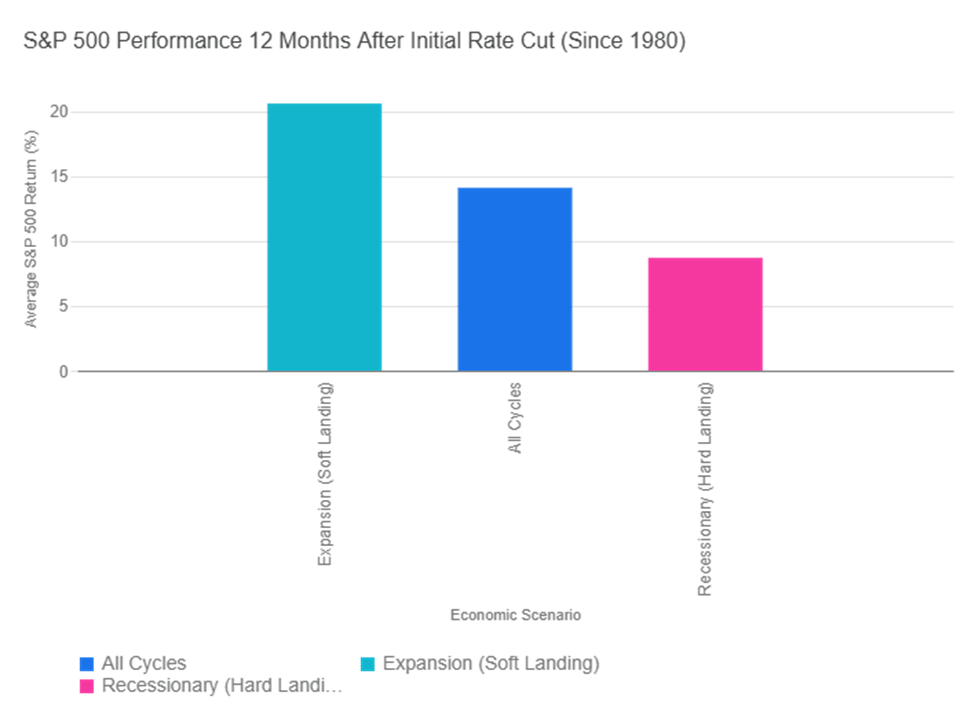
So, how will this affect the stock market? Historically, the market has performed well when interest rates are cut. The graph below illustrates the historical performance of the S&P 500 Index in the 12 months following the Federal Reserve’s first interest rate cut in a new cycle (since 1980). The returns vary significantly based on the underlying economic conditions, but they have always been good for stocks.
If we consider the start of the easing cycle to be September of 2024, we are now at a full year following the first rate cut. Interestingly enough, the S&P 500 has returned about 15.3% for that period, which coincides with its historical returns, as seen on the graph.
Does that mean we are due for a pullback? Not necessarily. If we continue on the trajectory of the soft landing that we were headed for at the beginning of this year, stock prices could continue to move higher. But, if inflation persists and unemployment continues to rise, we could be heading for a downturn.
The S&P 500 is also approaching a significant milestone: 3 years of consecutive double-digit returns. Stringing together three or more years of positive double-digit returns is rare but it happens.
Period (Start Year)
Length of Streak (Years)
Early 1930s (e.g., 1933–1936)
4
World War II / Post-War (e.g., 1942–1945)
4
Post-War Boom (e.g., 1949–1955)
7
Mid-1960s (e.g., 1963–1967)
5
1990s Tech Boom (1995–1999)
5
Post-Financial Crisis (e.g., 2012–2014)
3
Post-Pandemic Era (2019–2021)
3
We will see if stocks can make history as we head into the home stretch of 2025.
Please comment or send an email if you have any questions.
Retirement marks a significant financial transition, and with it comes a shift in how federal income taxes are managed. Unlike the years of employment where taxes were typically withheld from each paycheck, retirees often find that their income sources, such as distributions from retirement accounts, investment earnings, and even Social Security benefits, may not have taxes automatically deducted. This necessitates understanding and potentially paying estimated federal taxes, a system designed to ensure that income tax is paid throughout the year rather than in a single lump sum at the time of filing. Navigating these obligations is crucial for retirees to avoid potential penalties and interest imposed by the Internal Revenue Service (IRS) for underpayment.
Many individuals transitioning into retirement may find the concept of estimated taxes unfamiliar, especially if their primary income source for most of their working lives was through wages with automatic withholding. This change in tax responsibility can be a significant adjustment, requiring a proactive approach to tax planning and payment. Furthermore, the diverse nature of retirement income, which can include pensions, annuities, investment portfolios, and Social Security benefits, often makes tax obligations more intricate than during active employment. Each of these income streams has its own set of tax rules and varying degrees of potential withholding, demanding careful management of one’s overall tax situation. By taking a proactive stance in understanding and managing estimated tax obligations, retirees can achieve greater financial security and enjoy their retirement years with the assurance of having met their tax responsibilities, thereby avoiding unexpected tax bills.
How do retirees know if they have to pay estimated taxes?
The fundamental question for retirees is whether they are required to pay estimated federal income taxes. Generally, the rule is that a retiree must pay estimated tax if they anticipate owing at least $1,000 in federal income tax for the year, after accounting for any withholding and refundable credits. Here is a list of the most common forms of income that are not subject to automatic federal income tax withholding:
Taxable distributions from traditional IRAs, 401(k) plans, and other pre-tax retirement accounts may not have sufficient withholding to cover total tax liability.
Interest income, excluding tax-free municipal bonds, generally lacks automatic withholding.
Dividend income, whether ordinary or qualified, typically does not have automatic withholding either.
Capital gains from sales of investments like stocks, bonds, or real estate are usually not subject to withholding at the point of sale.
Rental income often requires estimated tax payments as it is treated as self-employment income for tax purposes.
Self-employed retirees, including freelancers and consultants, should also make estimated tax payments for both income tax and self-employment tax.
Retirees can choose to have federal taxes withheld from Social Security benefits; otherwise, the taxable portion may need estimated tax payments.
How do retirees calculate payments for estimated taxes?
Calculating estimated federal income tax requires retirees to project their expected income, deductions, and credits for the entire current tax year. The primary tool for this process is IRS Form 1040-ES, “Estimated Tax for Individuals”. This form includes worksheets designed to guide taxpayers through the necessary calculations.
Here is a quick summary of the steps to calculate estimated taxes for retirees:
The first step in calculating estimated tax is to estimate total income from all taxable sources anticipated for the year.
Next, estimate any adjustments to income they may be eligible for, such as deductions for contributions to a traditional IRA (if applicable, for instance, for a non-working spouse), health savings account (HSA) contributions, and if self-employed, the deduction for one-half of their self-employment tax.
Following this, retirees need to estimate their deductions, deciding whether to take the standard deduction or to itemize deductions. Seniors who are age 65 or older may be entitled to a higher standard deduction.
Once total deductions are estimated, they are subtracted from the estimated adjusted gross income (AGI) to arrive at the estimated taxable income.
The next step involves calculating the estimated income tax based on the estimated taxable income and the applicable tax brackets for their filing status for the current tax year.
After estimating their total tax liability, retirees should then estimate any tax credits they may be eligible for, such as the Credit for the Elderly or the Disabled , or other credits like the retirement savings contributions credit (Saver’s Credit) if they are still contributing to retirement accounts. These credits directly reduce the amount of tax owed. The total estimated tax is then calculated by subtracting the total estimated tax credits from the total estimated tax liability.
Finally, retirees need to account for any anticipated tax withholding from sources like pensions, annuities, or Social Security benefits throughout the year. If the remaining tax liability, after subtracting withholding, is $1,000 or more, this is the estimated tax payment that will likely need to be made in four quarterly installments.
The worksheets included with the instructions for Form 1040-ES provide a structured framework to assist retirees in performing these calculations. Additionally, the IRS offers an online tool called the Tax Withholding Estimator, which can be particularly helpful for retirees in estimating the tax on their Social Security benefits and pension payments. Given the complexities involved, especially in the initial years of retirement or if a retiree’s financial situation is multifaceted, seeking guidance from a qualified tax advisor is highly recommended.
How do retirees pay their estimated taxes?
Estimated federal income taxes are generally due in four installments throughout the year :
Payment Period
Due Date
January 1–March 31
April 15
April 1–May 31
June 15
June 1–August 31
September 15
September 1–Dec. 31
January 15 of next year
Retirees have several options for paying their estimated federal income taxes to the IRS. One convenient method is IRS Direct Pay, which allows for electronic funds withdrawal directly from a checking or savings account without any fees. Payments can also be made using a debit card, credit card, or digital wallet through third-party payment processors authorized by the IRS, although these processors may charge a small convenience fee. For those who prefer traditional methods, payments can be made by mail by sending the Form 1040-ES payment voucher along with a check or money order payable to the U.S. Treasury to the address specified in the form instructions for their state.
Regardless of the payment method chosen, it is crucial to ensure that payments are made on time to avoid potential penalties for underpayment. Even if a retiree later overpays their taxes, penalties may still be assessed for underpayments made earlier in the year. While the standard payment schedule is quarterly, retirees have the option to pay more frequently, such as monthly or bi-weekly, as long as the total amount due for each quarter is paid by the respective deadline. This can aid in budgeting and managing cash flow throughout the year.
To summarize, understanding how to calculate and pay estimated federal taxes is a critical aspect of financial management for retirees. By determining whether estimated taxes are necessary, accurately calculating the estimated amount, paying on time through the various available methods, and exploring alternatives like adjusting withholding, retirees can fulfill their tax obligations effectively. Also, implementing smart tax planning strategies throughout retirement can potentially reduce their overall tax liability and simplify their tax management. Utilizing the wealth of resources provided by the IRS and considering professional advice when needed will empower retirees to navigate their tax responsibilities successfully and enjoy their retirement with greater financial peace of mind.
Please comment or send an email if you have any questions.
There is a program offered by the IRS that allows you to file your federal taxes through an associated tax preparer for free! The IRS Free File program is a public-private partnership between the IRS and a group of tax software companies called the Free File Alliance. It allows eligible taxpayers to prepare and file their federal income tax returns online for free. Here’s how it works:
1. Eligibility:
Income: The main requirement is your Adjusted Gross Income (AGI). For the 2024 tax year (filing in 2025), the AGI limit is $84,000. This applies to all filing statuses (single, married filing jointly, etc.).
Other factors: Some participating companies may have additional eligibility requirements, such as age or state residency.
Choose a provider: The IRS website provides a list of participating companies and their specific offerings on this page: https://apps.irs.gov/app/freeFile/.
3. Preparing and Filing:
Create an account: Once you’ve chosen a provider, you’ll be redirected to their website to create an account.
Follow the instructions: The software will guide you through the process of entering your tax information.
File electronically: When you’re finished, the software will transmit your return electronically to the IRS.
Key Features of IRS Free File:
Free federal return: Participating companies cannot charge you to prepare and e-file your federal tax return if you qualify.
Guided experience: The software uses a question-and-answer format to help you complete your return accurately.
Error checks: Built-in checks help catch mistakes and ensure your return is complete.
Direct deposit: You can choose to receive your refund via direct deposit for faster processing.
Important Notes:
State taxes: While federal filing is free, some providers may charge for state tax preparation.14 Check with your chosen provider for details.
Support: The level of customer support offered may vary between providers.
Accuracy: Always review your return carefully before filing, even with the help of software.
This is a great service that is most certainly underutilized by eligible tax filers and can potentially save you some hard-earned cash.
Please comment or send an email if you have any questions.