The IPO Reality Check: What History Tells Us About Post-Debut Performance

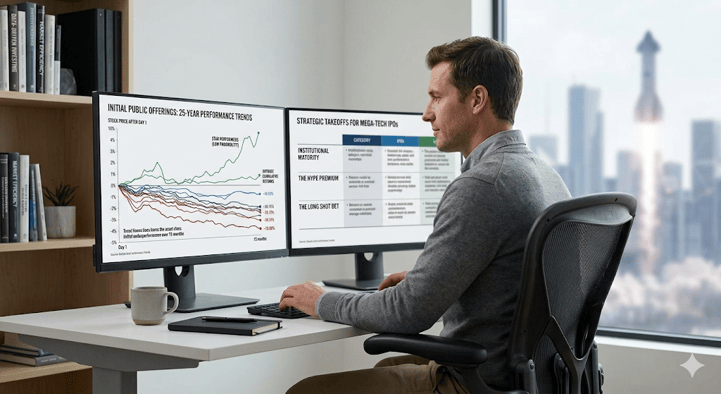
Just ran some numbers on historical initial public offerings (IPOs) to provide a data-driven perspective on what the future might hold for highly anticipated market debuts like SpaceX, OpenAI, and Anthropic. While the media buzz surrounding mega-tech listings often generates massive retail excitement, the historical data over the last 25 years tells a much more cautious story for the 12 months following a company’s public debut.

Data-Driven Insights: The 12-Month Post-IPO Track Record

When evaluating historical IPO performance over the past two and a half decades, the data consistently refutes the myth of guaranteed first-year gains. Financial studies reveal several critical trends regarding how companies perform in the 365 days after hitting the public markets:

  • The “First-Day Pop” vs. Long-Term Reality: Historically, IPOs are known for significant first-day underpricing, giving early institutional investors an average initial “pop” of roughly 15% (Lowry et al., 2017). However, for everyday investors buying shares on the open market after day one, the subsequent 12 months frequently see a reversal of fortune.
  • Systemic Underperformance: Extensive long-run historical data indicates that, on average, IPOs tend to underperform broad market benchmarks—such as the S&P 500 or industry-specific indices—during their first one to three years (Ang et al., 2006).
  • The Size and Age Factors: Performance varies wildly based on a company’s maturity at the time of the listing. Smaller, younger startups exhibit severe average underperformance, with cumulative average abnormal returns dropping significantly in the first year (Siev & Qadan, 2022). Conversely, large, heavily capitalized, and older firms tend to manage the transition to public markets with far less volatility, though they still frequently lag behind established market peers in the short term (Siev & Qadan, 2022).
  • The “Star Performer” Statistical Outliers: The broader average of IPO performance is heavily weighed down by a high failure rate. Statistically, the vast majority of IPOs underperform, while the overall asset class is propped up by a tiny minority (roughly 2%) of “star performers” that achieve monumental returns (Ang et al., 2006).

What This Means for upcoming IPOs such as SpaceX, OpenAI, and Anthropic:

Applying this decision-making framework to the dominant tech private giants of today yields specific strategic takeaways:

Risk & Valuation VariableStrategic Application to Upcoming Mega-Tech IPOs
Institutional MaturityUnlike the speculative tech listings of the 1999–2000 dot-com bubble, firms like SpaceX, OpenAI, and Anthropic will enter the public markets as massive, heavily capitalized enterprises with massive global footprints. According to historical trends, their large size and operational age should structurally protect them from the extreme 40%+ drop-offs seen in smaller, speculative IPOs (Siev & Qadan, 2022).
The Hype PremiumBecause these brands carry unprecedented cultural and technological visibility, their IPOs will likely face intense public demand. This historically leads to severe initial underpricing (to benefit institutional insiders) followed by a retail-driven valuation peak on day one, which frequently leads to a cooling-off period and negative market-adjusted returns over the subsequent 12 months.
The “Long Shot” BetInvestors backing OpenAI or Anthropic are implicitly betting that these firms will become the absolute “star outliers” of the decade (Ang et al., 2006). While the historical probability of any random IPO becoming a permanent market leader is low, companies with profound structural moats stand the best statistical chance of breaking the traditional 12-month underperformance trend.

The historical data over the last 25 years sends a clear warning to investors: buying into the immediate 12-month aftermath of a high-profile tech IPO is statistically a losing proposition compared to holding a broad-market index. While mega-cap innovators like SpaceX or OpenAI possess the scale to avoid the catastrophic first-year collapses of smaller startups, history dictates that the safest, most optimized administrative path for retail capital is often patience—waiting for the initial regulatory, insider lockup, and hype cycles to clear before establishing a long-term position.

Please comment or send an email if you have any questions.

Joe Baker, CFP®

Baker Asset Management, LLC

joebaker@bakerassetmanagement.com


References

Ang, A., Gu, L., & Hochberg, Y. V. (2006). Is IPO underperformance a peso problem? National Bureau of Economic Research. https://doi.org/10.3386/w12203

Cited by: 81

Lowry, M., Michaely, R., & Volkova, E. (2017). Initial Public Offerings: A synthesis of the literature and directions for future research. Foundations and Trends® in Finance, 11(3-4), 154-320. https://doi.org/10.1561/0500000050

Cited by: 334

Siev, S., & Qadan, M. (2022). Call me when you grow up: Firms’ age, size, and IPO performance across sectors. Journal of Risk and Financial Management, 15(12), 586. https://doi.org/10.3390/jrfm15120586

Cited by: 19
Investing in the $630 Billion Race to Power AI

We often think of Artificial Intelligence as something ethereal—code floating in the “cloud.” But the reality of 2026 is grounded in steel, concrete, and energy supply. With Big Tech “hyperscalers” like Microsoft, Amazon, Meta, and Google projected to spend between $600 and $650 billion this year alone on infrastructure, we are witnessing an industrial buildout that economists argue now rivals the railroad expansion of the 1850s. While the first phase of the AI revolution was defined by who could design the smartest chip, the next phase will be defined by who can physically power it. The opportunity for investors is no longer just about the model; it is about the massive machine required to run it.

What is an AI Data Center?

Unlike traditional data centers that store files and run websites, AI data centers are designed for massively parallel computing. This creates unprecedented heat and power density. (Geek alert) While a standard server rack consumes 5–10 kW, a modern rack equipped with NVIDIA Blackwell or H100 GPUs demands 40 kW to over 100 kW. This physical constraint is forcing a complete redesign of the data centers needed in the AI world.

The Builders & Locations

The build-out is led by the “Hyperscalers”—Microsoft, Amazon (AWS), Google, and Meta—who are racing to secure land and power. Because these facilities consume gigawatts of electricity (enough to power small cities), they are moving away from congested hubs like Northern Virginia to regions with available power and land.

  • The Power Belt (Ohio, Indiana, Midwest): Emerging as a prime location due to grid capacity and land availability.
  • Texas: Attracting massive investment due to its independent energy grid and renewable abundance.
  • Nuclear Sites: Data centers are increasingly being built “behind the meter” at nuclear plants (e.g., Pennsylvania) to guarantee 24/7 zero-carbon power.

Investment Opportunities: The “Picks & Shovels”

Investors are looking beyond the chipmakers to the companies building the physical infrastructure. This includes thermal management (cooling), power distribution, and real estate.

TickerCompanyPrimary RoleInvestment Thesis
VRTVertiv HoldingsLiquid CoolingMarket leader in thermal management; essential for cooling NVIDIA’s hot chips.
ETNEaton CorpPower MgmtCritical electrical infrastructure (transformers, switchgear) for grid upgrades.
CEGConstellation EnergyNuclear PowerOwner of largest US nuclear fleet; prime partner for baseload AI power deals.
DLRDigital RealtyData Center REITGlobal landlord for data centers with strong hyperscaler relationships.
MODModine MfgThermal SystemsPivot from automotive cooling to high-growth data center thermal solutions.
ANETArista NetworksAI NetworkingProvides the ultra-fast ethernet switches needed to connect GPU clusters.

Investment Note: This list is for informational purposes only and does not constitute financial advice. Stocks in this sector, particularly pure plays like Vertiv, have seen significant volatility.


As the AI race accelerates, the primary bottleneck has shifted from silicon availability to energy reliability. With modern GPU racks consuming over 100 kW of power—ten times the standard of a decade ago—the digital economy is colliding with the physical limits of the power grid. For the astute investor, this signals a clear pivot: the most durable long-term value may not be found in the volatile software wars, but in the “picks and shovels” of the infrastructure supply chain—the liquid cooling systems, the copper interconnects, and the baseload nuclear power that keep the lights on. The code is written, but the concrete is just beginning to pour.

Please comment or send an email if you have any questions.

Joe Baker, CFP®

Baker Asset Management, LLC

joebaker@bakerassetmanagement.com

Streamlining Healthcare: AI’s Cost-Saving Innovations

AI is being adopted across the U.S. healthcare system—by insurers, hospitals, and medical professionals—to drive down costs, which has the potential to translate into lower healthcare premiums for U.S. citizens.

The primary ways AI contributes to cost reduction are through administrative efficiency, improved clinical outcomes, and fraud prevention.


🏥 Hospitals & Medical Professionals

AI can reduce costs for providers by increasing efficiency and improving the quality of care, which lowers expenses associated with errors, unnecessary procedures, and long hospital stays.

  • Boosted Administrative Efficiency:
    • Automation of Tasks: AI tools can automate nearly 45% of administrative tasks in healthcare, such as eligibility verification, prior authorization, and billing, which is projected to save the sector billions annually.
    • Clinical Documentation: AI-powered scribes and voice-to-text tools reduce the time clinicians spend on post-visit charting and paperwork, allowing them to spend more time with patients.
    • Operational Optimization: AI helps manage hospital resources by predicting staffing needs, patient flow, and bed capacity, leading to better utilization of costly resources and reduced administrative overhead.
  • Improved Clinical Care & Outcomes:
    • Early & Accurate Diagnosis: AI algorithms can analyze medical images (like CT scans and mammograms) and patient data with high speed and accuracy, leading to earlier detection of diseases like cancer.Early detection prevents conditions from escalating, which is far less expensive to treat.
    • Reduced Medical Errors: AI can monitor care in real-time, comparing clinician actions against safety protocols and alerting them to missed steps, thereby preventing costly errors like medication mishaps or hospital-acquired infections.
    • Personalized and Preventive Care: AI analyzes comprehensive patient data (including genetics, lifestyle, and claims history) to identify high-risk patients and recommend timely, tailored, and proactive interventions, reducing the need for expensive emergency or late-stage treatments.

⚕️ Health Insurers

Insurers are leveraging AI to manage risk, streamline operations, and prevent financial losses, which directly impacts the costs used to calculate premiums.

  • Fraud, Waste, and Abuse Detection:
    • AI-powered systems can analyze vast amounts of claims data to detect suspicious patterns and irregularities that traditional methods often miss, helping to flag and prevent billions of dollars lost to healthcare fraud annually.
  • Streamlined Claims Processing:
    • AI automates the review, assessment, and processing of insurance claims, reducing manual errors, speeding up turnaround times, and lowering operational costs for the insurer.
  • Accurate Risk and Cost Prediction:
    • Insurers use predictive analytics to forecast health outcomes and future utilization more accurately. This allows for more precise risk assessment, which can lead to fairer, better-priced premiums, and better-managed care plans.
  • Enhanced Customer Service:
    • AI-powered virtual assistants and chatbots handle routine member inquiries about benefits, costs, and finding in-network providers, reducing the need for costly human call center support.

The combination of these efficiencies—from reducing administrative waste to preventing expensive diseases and cracking down on fraud—creates substantial cost savings (some estimates suggest hundreds of billions annually). If these savings are consistently realized and passed on to the consumer, they can significantly moderate or lower the cost of healthcare premiums. The savings are a certainty. Passing on the savings to us in the form of lower premiums and cost of care is the more important question.

Please comment or send an email if you have any questions.

Joe Baker, CFP®

Baker Asset Management, LLC

joebaker@bakerassetmanagement.com