
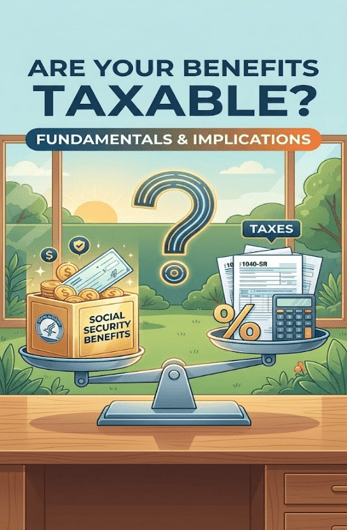
A Comprehensive Guide: Are Your Social Security Benefits Taxable?

You may have paid Social Security taxes throughout your working years, so it is natural to wonder whether those benefits can be taxed again in retirement. The answer is that, for many people, some portion of Social Security benefits can be subject to federal income tax.

It is one of the most common questions pre-retirees and new retirees ask. The rules are not always intuitive, and misunderstanding them can lead to an unexpected tax bill that affects your retirement income plan.

That is why this guide is designed to help you understand when Social Security benefits may be taxable, how the calculation works, and what it can mean for your broader financial strategy.

The Key Concept: “Combined Income”

The IRS uses a specific formula to calculate your income for Social Security tax purposes. Your Social Security number (SSN) does not determine your taxability; rather, it’s about your total financial picture.

To understand if your benefits are taxable, you must first determine your Combined Income, also known as Modified Adjusted Gross Income (MAGI).

The Combined Income Formula:

Combined Income = Adjusted Gross Income (AGI) + Nontaxable Interest + 50% of Your Social Security Benefits

Think of it as adding all your taxable income (like wages, pensions, and capital gains) plus your tax-exempt interest income (e.g., from municipal bonds), and then adding exactly half of your total Social Security benefits.

Navigating Federal Income Brackets

Once you have your Combined Income, the IRS uses three income thresholds to calculate the percentage of your benefits that are taxable at the federal level. The limits are different for individuals and married couples filing jointly:

If You File as “Single,” “Head of Household,” or “Qualifying Widow(er)”:

  • Under $25,000: 0% of your benefits are taxable. (Congratulations, you might get all your Social Security tax-free!)
  • $25,000 to $34,000: Up to 50% of your benefits may be subject to tax.
  • Over $34,000: Up to 85% of your benefits may be taxable.

If You File as “Married Filing Jointly”:

  • Under $32,000: 0% of your benefits are taxable.
  • $32,000 to $44,000: Up to 50% of your benefits may be subject to tax.
  • Over $44,000: Up to 85% of your benefits may be taxable.

Note on “Up to”: The 50% and 85% are maximums. The calculation is dynamic. For illustrative examples of precise tax situations, you would need to run detailed scenarios, but these brackets give you the essential ranges.

Don’t Forget About State Taxes

While federal rules apply across the entire country, state-level rules vary significantly.

  • Across the United States: The vast majority of states (42 states plus Washington, D.C.) exempt Social Security benefits from state income taxes entirely. However, a small handful of states—including Colorado, Connecticut, Minnesota, Montana, New Mexico, Rhode Island, Utah, and Vermont—still tax a portion of Social Security income based on state-specific thresholds.

If you are considering moving or splitting time between states in retirement, factoring state-level taxation into your plan is just as vital as federal planning.

What This Means for Your Financial Strategy

Understanding these rules is about more than just a tax form. It affects everything from your monthly cash flow to your overall retirement strategy.

1. Unexpected Taxes

A larger-than-expected tax bill can reduce the cash flow you thought you had available for spending.

2. Withdrawal Strategy

Where you draw income from matters. Pulling too much from taxable accounts or traditional retirement accounts can increase your provisional income and make more of your Social Security benefits taxable.

3. RMDs

Required minimum distributions can create a ripple effect. If RMDs raise your income enough, they can increase the taxable portion of your Social Security benefits as well.

4. Coordination Matters

Planning withdrawals from Traditional IRAs, Roth IRAs, brokerage accounts, and other sources together can help create a more tax-efficient retirement plan.

Taking the Next Step

These rules are manageable once you understand the framework, but they can still be complicated when you apply them to your own numbers. Your situation may also change over time as income, investment returns, tax law, and retirement needs change.

If you are making retirement income decisions, it is wise to consult a qualified financial professional or tax professional. They can help you run scenarios using your actual figures and build a withdrawal strategy that fits your goals.

The bottom line: Social Security benefits are not always tax-free in retirement, and the amount subject to tax depends on your overall income picture. With the right planning, you can better understand the rules and make smarter decisions about your retirement cash flow.

Please comment or send an email if you have any questions.

Joe Baker, CFP®

Baker Asset Management, LLC

joebaker@bakerassetmanagement.com
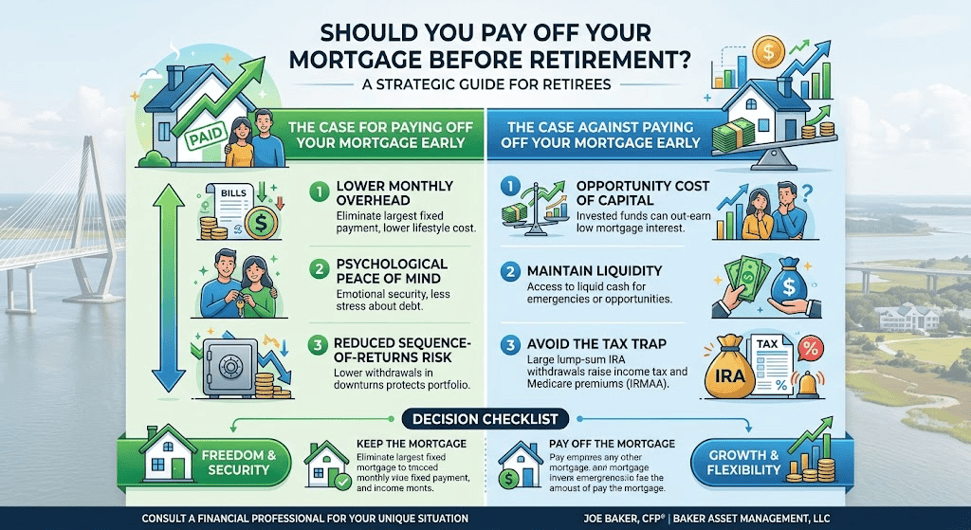
Should You Pay Off Your Mortgage Before You Retire?

For generations, the ultimate retirement milestone was the “mortgage-burning party”—that moment you paid off your final home loan statement and officially owned your piece of property free and clear.

Entering retirement completely debt-free sounds like a no-brainer. But as with most things in financial planning, the actual answer to “Should I pay off my mortgage before I retire?” isn’t always a simple yes or no.

While eliminating a monthly mortgage payment provides undeniable psychological comfort, writing a massive check to clear your home loan can sometimes work against your overall financial flexibility.

If you’re approaching retirement and weighing this decision, here are the core trade-offs to consider before making a move.

The Case FOR Paying Off Your Mortgage

1. Lower Monthly Overhead

Your mortgage is likely your single largest recurring monthly expense. Eliminating principal and interest payments drastically lowers the baseline income you need each month to maintain your lifestyle. Lower required income means smaller withdrawals from your portfolio.

2. Protection Against “Sequence-of-Returns” Risk

One of the biggest risks in early retirement is a major market downturn right after you stop working. If the market drops and you still have high fixed expenses (like a mortgage), you are forced to sell depreciated investments to pay your bills. By eliminating the mortgage, you lower your mandatory distributions, allowing your investment accounts more room to recover during lean market years.

3. Unbeatable Peace of Mind

The emotional benefit of owning your home outright cannot be overstated. For many retirees, knowing that their housing is secure—regardless of what happens to the stock market or the economy—is worth more than any theoretical mathematical gain.

The Case AGAINST Paying Off Your Mortgage

1. The Opportunity Cost of Capital

If you secured a low fixed mortgage rate in past years, the math may favor keeping the loan. If your mortgage rate is sitting at 3% or 4%, but your diversified investment portfolio or high-yield cash vehicles are earning a higher return, your money may work harder for you staying invested rather than locked up in home equity.

2. Illiquidity: You Can’t Eat Real Estate

Home equity is illiquid wealth. Money used to pay down a mortgage is tied up in bricks and mortar. If an unexpected medical emergency, home repair, or family need arises, accessing that home equity quickly isn’t easy—especially once you no longer have a earned income to qualify for a traditional home equity loan. Having liquid cash or accessible taxable investments provides a safety cushion that a paid-off house cannot.

3. The Tax Trap of Large Lump-Sum Withdrawals

If you don’t have enough liquid cash sitting in a bank account and need to withdraw funds from a Traditional IRA or 401(k) to pay off the mortgage balance, be extremely careful. That withdrawal counts as ordinary income. A single large distribution can instantly push you into a significantly higher tax bracket, trigger higher Medicare premium surcharges (IRMAA), and create a hefty tax bill that wipes out any savings on mortgage interest.

A Quick Checklist: Which Side Are You On?

It may make sense to KEEP your mortgage if:

  • You hold a very low fixed interest rate.
  • Paying it off would drain your liquid emergency reserves.
  • Clearing the balance requires pulling a large lump sum out of a taxable retirement account.

It may make sense to PAY OFF your mortgage if:

  • You have excess idle cash sitting in low-interest savings accounts that can cover the balance without tax consequences.
  • Carrying debt causes you significant stress or anxiety.
  • Eliminating the payment is essential for your retirement cash flow to balance out.

The Bottom Line

There is no one-size-fits-all answer. The choice between mathematical optimization and emotional peace of mind comes down to your personal risk tolerance, tax profile, and retirement cash flow goals.

Before making a large lump-sum payment on your mortgage, it’s always wise to run the numbers to see how it impacts your long-term retirement projections and tax liability.

Please comment or send an email if you have any questions.

Joe Baker, CFP®

Baker Asset Management, LLC

joebaker@bakerassetmanagement.com
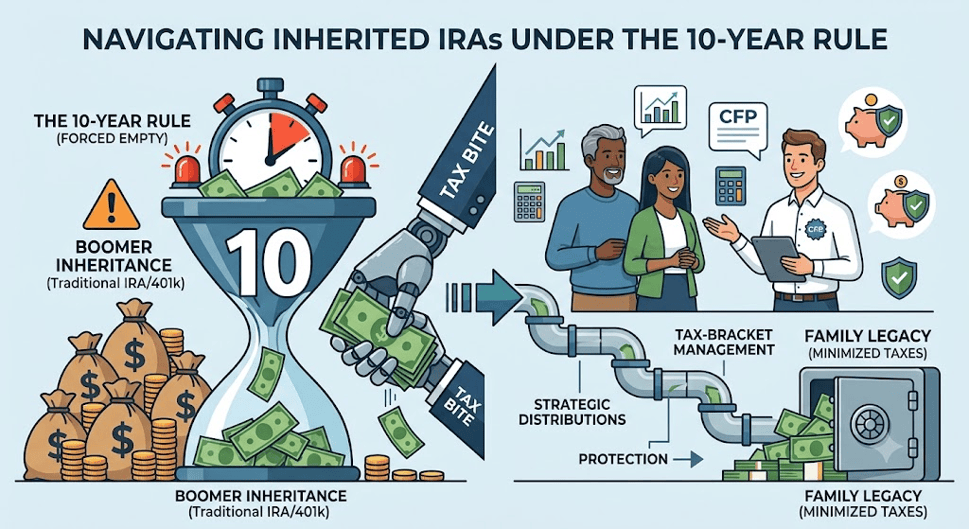
What You Need to Know If You Inherit an IRA

The Great Wealth Transfer is officially underway. Over the next two decades, Baby Boomers are projected to pass down tens of trillions of dollars to Gen X and Millennial heirs. A significant portion of this wealth is sitting inside tax-deferred retirement accounts—specifically Traditional IRAs and 401(k)s.

While receiving an inheritance can be life-changing, inheriting a retirement account comes with a maze of tax laws. Following the SECURE Act and finalized IRS regulations, the rules governing inherited IRAs have fundamentally changed. If you expect to leave or receive an inherited IRA, understanding these rules is critical to avoiding a massive tax bite.

The Death of the “Stretch IRA”

For decades, non-spouse beneficiaries (such as adult children or grandchildren) enjoyed a tax perk known as the Stretch IRA. Heirs could take small, required minimum distributions (RMDs) calculated over their own life expectancies. This allowed the remaining account balance to grow tax-deferred for 30, 40, or even 50 years.

Congress effectively eliminated the Stretch IRA for most non-spouse beneficiaries. Instead, most heirs are now subject to the 10-Year Rule, which requires the entire account balance to be depleted by December 31st of the 10th year following the original owner’s death.

How the 10-Year Rule Works (And the “RMD Catch”)

How you manage an inherited Traditional IRA over that 10-year window depends heavily on whether the original account owner had reached their Required Beginning Date for RMDs (currently age 73) before passing away:

Owner’s Status at PassingDistribution Requirement for Non-Spouse BeneficiaryTax Impact
Died BEFORE Age 73Flexible 10-Year Window: No mandatory annual withdrawals are required in years 1–9. The entire account must simply be emptied by the end of Year 10.Income tax is owed on withdrawals in the year they are taken.
Died ON or AFTER Age 73Mandatory Annual RMDs: You must take annual RMDs in years 1–9 based on your life expectancy and fully empty the account by Year 10.Income tax is owed on each annual distribution.
Inherited Roth IRA10-Year Draining Rule: Account must be emptied by Year 10, but no annual RMDs are required during years 1–9 regardless of the owner’s age.100% Tax-Free distributions (assuming the Roth account met the 5-year holding rule).

Note on Exceptions: Surviving spouses, minor children of the account owner, disabled or chronically ill individuals, and beneficiaries not more than 10 years younger than the deceased qualify as “Eligible Designated Beneficiaries” and may still use lifetime distribution rules under specific conditions.

The “Tax Bomb” Risk for Heirs

The biggest trap of the 10-Year Rule is the unexpected tax bump.

Gen Xers and Millennials inheriting IRAs are often in their peak earning years (ages 40 to 60). Adding $50,000 to $100,000+ per year in taxable IRA distributions on top of a high salary can push heirs into significantly higher federal and state tax brackets. Furthermore, waiting until Year 10 to withdraw a lump sum can result in a massive single-year tax liability.

Don’t Forget the State Tax Twist

While federal rules dictate when you must take distributions, state laws determine how much extra cut the government takes. State income taxes vary drastically across the country, making location a critical factor in your withdrawal strategy. For instance, heirs living in Texas pay 0% state income tax on inherited IRA distributions, leaving only federal tax to manage. In contrast, beneficiaries in California face steep top income tax rates (up to 13.3%), which can severely compound the tax hit on forced 10-year withdrawals. States like South Carolina (top rate around 6.2%) and New York fall in between—neither state charges a separate inheritance tax, but both tax traditional IRA distributions as ordinary state income (though both offer specific state tax exemptions for seniors that may apply under certain conditions). If you or your heirs reside in a high-tax state, tax-bracket management becomes doubly important.

Smart Strategies to Minimize the Tax Hit

  1. Stagger Withdrawals Intentionally: Rather than taking nothing for nine years and triggering a massive tax bill in Year 10, spread distributions evenly over the decade to keep yourself within lower tax brackets.
  2. Utilize Low-Income or Gap Years: If you plan to retire, take a sabbatical, or experience a lower-income year during the 10-year window, schedule larger inherited IRA withdrawals during those specific years.
  3. Proactive Planning for Account Owners (Lifetime Roth Conversions): If you are currently planning your estate, consider executing systematic Roth conversions during your lifetime. Paying the tax now at your current tax bracket allows your heirs to inherit tax-free growth and tax-free withdrawals.

The Bottom Line

Inheriting an IRA can provide a significant boost to your long-term financial security, but without a coordinated strategy, income taxes can erode a substantial portion of your family’s legacy.

Whether you are looking to update your current estate plan or have recently inherited an account, consulting with a financial advisor can help ensure you keep as much of that wealth as possible.

Please comment or send an email if you have any questions.

Joe Baker, CFP®

Baker Asset Management, LLC

joebaker@bakerassetmanagement.com
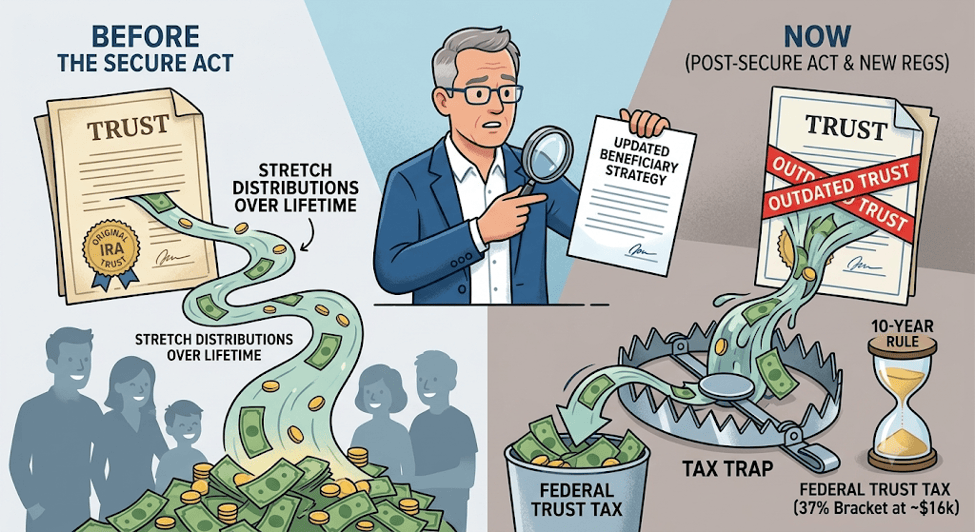
Updating Your Estate Plan: Why Naming a Trust as Your IRA Beneficiary Needs a Checkup

If you created a trust years ago to pass your IRA to children or grandchildren, the ground beneath your estate plan has fundamentally shifted.

Under older tax law, naming a trust as your IRA beneficiary allowed your heirs to “stretch” distributions—and the tax burden—gradually over their lifetimes. Today, under the post-SECURE Act framework, those rules have been replaced with strict deadlines that could trigger unexpected tax bills if left unchecked.

The Problem: Compressed Trust Tax Brackets

Many older trusts were drafted as “accumulation trusts,” which allow the trustee to hold IRA distributions inside the trust for asset protection. While protection remains valuable, the tax cost has skyrocketed:

  • Individual Tax Brackets: An individual doesn’t reach the top 37% federal marginal tax bracket until their income exceeds $600,000 (or over $750,000 for married couples filing jointly).
  • Trust Tax Brackets: A trust hits the top 37% tax bracket at just over $16,000 of retained income.

If your inherited traditional IRA pushes hundreds of thousands of dollars into a trust over a short period, the IRS takes a significantly larger bite than if the funds were distributed directly or managed through an updated structure.

The 10-Year Rule Factor

Most non-spouse beneficiaries must now fully deplete an inherited IRA by December 31 of the 10th year following the owner’s death. Furthermore, if you pass away after reaching your Required Beginning Date (RBD), your beneficiaries are required to take annual distributions in years 1 through 9 before liquidating the balance in year 10.

Without proactive coordination, forcing large distributions into an outdated trust structure can needlessly drain family wealth.

Strategic Solutions to Consider

  1. Review Conduit vs. Accumulation Language: Ensure trust provisions match current legal definitions for “see-through” status while balancing creditor protection against tax drag.
  2. Lifetime Roth Conversions: Converting traditional IRA assets to a Roth IRA during your lifetime allows the account to pass tax-free to heirs. Inherited Roth IRAs are still subject to the 10-year rule, but distributions come out completely tax-free.
  3. Re-evaluate Direct Beneficiary Designations: For mature heirs who do not require legal protection, direct designations may be far more tax efficient.

If you haven’t reviewed your estate plan and beneficiary designations recently, now is the time to align them with current tax law and your overall financial goals.

Please comment or send an email if you have any questions.

Joe Baker, CFP®

Baker Asset Management, LLC

joebaker@bakerassetmanagement.com
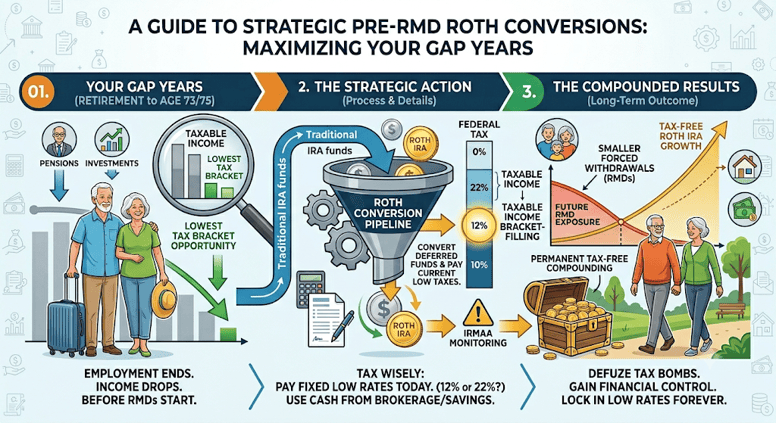
Maximizing Your Gap Years: How Pre-RMD Roth Conversions Protect Your Wealth

The Bottom Line: Waiting until age 73 or 75 to let the government dictate your retirement withdrawals is a costly tax mistake. By executing strategic Roth IRA conversions during your early retirement “gap years,” you can systematically minimize your Traditional IRA balance, shrink future Required Minimum Distributions (RMDs), and lock in historically low tax rates.

The Hidden Tax Trap of Retirement

Many retirees believe that once they stop working, their tax planning is finished. Unfortunately, a major tax trap awaits in your 70s: Required Minimum Distributions (RMDs). If you have spent decades building a substantial nest egg in a tax-deferred Traditional IRA or 401(k), the IRS will eventually force you to withdraw specific percentages annually, regardless of whether you need the cash. These forced distributions are taxed as ordinary income and can easily push you into a significantly higher marginal tax bracket, trigger higher Medicare premiums (IRMAA), and increase the taxation of your Social Security benefits.

The Window of Opportunity: Your “Gap Years”

The optimal time to defuse this tax bomb is during your “gap years”, the golden window after you retire but before your forced RMDs begin. During this period, your earned income drops off, frequently dropping you into the lowest tax brackets you will see for the rest of your life.

The core strategy is simple: Bracket Filling. You intentionally withdraw money from your Traditional IRA, convert it into a Roth IRA, and pay ordinary income tax on that amount today. The goal is to maximize the amount converted at the lowest current marginal rates (the 10% and 12% brackets, or up to the 22% bracket depending on your wealth targets), ensuring that the converted funds grow tax-free and can be withdrawn completely tax-free later in life.

2026 Federal Income Tax Brackets (Marginal Rates)

To implement this effectively, we must evaluate the current federal tax structure. Below are the key ordinary income brackets for the 2026 tax year:

  • 10% Bracket: Single: $0 to $12,400 | Married Filing Jointly: $0 to $24,800
  • 12% Bracket: Single: $12,401 to $50,400 | Married Filing Jointly: $24,801 to $100,800
  • 22% Bracket: Single: $50,401 to $105,700 | Married Filing Jointly: $100,801 to $211,400
  • 24% Bracket: Single: $105,701 to $201,775 | Married Filing Jointly: $211,401 to $403,550

Here’s a few examples to illustrate this strategy.

Scenario A: The Single Filer

Consider a retired single filer with a guaranteed taxable income of $35,000 from a pension and dividends. This lands them squarely within the 12% bracket ($12,401 to $50,400).

  • The Opportunity: The top of the 12% bracket is $50,400.
  • The Calculation: $50,400 − $35,000 = $15,400 of available “headroom.”
  • The Action: Convert exactly $15,400 from their Traditional IRA to a Roth IRA.
  • The Result: The entire $15,400 is taxed at a modest 12%. This fund is now insulated from future tax increases, and the Traditional IRA balance is reduced by $15,400, shrinking future RMD exposure.

Scenario B: Married Filing Jointly

Consider a retired couple filing jointly with a combined base taxable income of $70,000 from investments and social security. They are currently in the 12% bracket ($24,801 to $100,800).

  • The Opportunity: The top of the 12% bracket is $100,800.
  • The Calculation: $100,800 − $70,000 = $30,800 of available headroom.
  • The Action: Convert exactly $30,800 from their Traditional IRA to their Roth IRA.
  • The Result: They lock in a 12% federal tax rate on $30,800. If they waited until RMDs kicked in alongside Social Security, their forced distributions could easily push their taxable income past $100,800, forcing those same dollars to be taxed at 22% or higher.

Critical Guardrails

While the numbers are highly compelling, Roth conversions require precise execution. To ensure compliance and optimize the financial impact, keep these rules in mind:

  • Pay Taxes from Cash, Not the IRA: To maximize the mathematics of a conversion, the income tax generated by the conversion should be paid using cash from non-retirement checking or brokerage accounts. Using IRA assets to pay the tax reduces the compounding power of your tax-free bucket.
  • Watch the IRMAA Thresholds: Roth conversions increase your Adjusted Gross Income (AGI). If your AGI crosses specific thresholds, it can trigger Medicare Part B and Part D premium surcharges (IRMAA) two years later. Always analyze this boundary before converting assets.
  • The 5-Year Rule: Converted earnings and principal must remain in the Roth IRA for at least five years (or until you reach age 59½) to be withdrawn tax-free. Because this strategy targets pre-RMD retirees, the time horizon aligns perfectly, but meticulous record-keeping is vital.

Summary & Next Steps

Roth conversions are not a one-time event; they are a multi-year, proactive tactical strategy. By intentionally paying tax at a known, lower rate today, you seize control of your lifetime tax liability and build a flexible, tax-free financial legacy. Every individual situation requires custom financial projection modeling to guarantee that a conversion does not inadvertently push you into an unfavorable tax cliff.

Please comment or send an email if you have any questions.

Joe Baker, CFP®

Baker Asset Management, LLC

joebaker@bakerassetmanagement.com
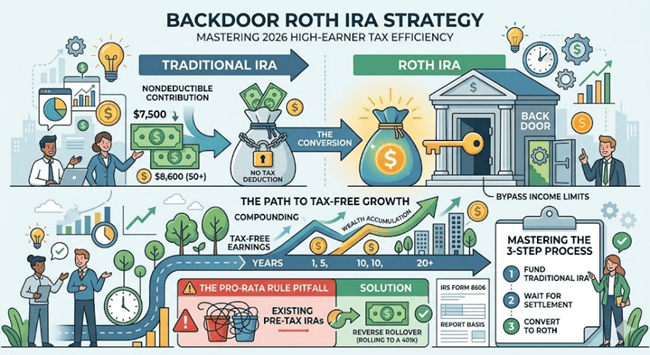
Mastering the Backdoor Roth: A 2026 High-Earner’s Strategy

Building long-term wealth requires more than just picking the right stocks; it requires picking the right tax structures. For high earners, the IRS often closes the front door to tax-free growth. Fortunately, the “backdoor” remains wide open.

Here is the 2026 blueprint for executing a Backdoor Roth conversion with precision.


🚪What is a Backdoor Roth?

A Backdoor Roth isn’t a specific type of account, it’s a strategy.

By law, if your income exceeds certain limits, you are barred from contributing directly to a Roth IRA. However, there are no income limits on contributing to a Traditional IRA or on converting those funds to a Roth. By combining these two steps, you effectively “bypass” the income cap, allowing your money to grow tax-free for decades.

📈Why It Matters in 2026

Tax-advantaged space is a finite resource. In 2026, the contribution limits and income thresholds have shifted, making this strategy more valuable than ever:

  • 2026 Contribution Limit: $7,500 (or $8,600 if you are age 50 or older).
  • The “Front Door” Income Caps: In 2026, the ability to contribute directly to a Roth begins to phase out if your Modified Adjusted Gross Income (MAGI) exceeds:
    • $153,000 (Single)
    • $242,000 (Married Filing Jointly)

⏳When is the “Best Age” to Start?

The short answer: The best age to start is the very first year your income exceeds the direct contribution limits.

Because Roth IRAs grow tax-free, time is your greatest ally. The earlier you start, the more “tax-free compounding” cycles your money undergoes.

  • Early Career (20s-30s): If you are a high-earning young professional, starting now can result in hundreds of thousands of dollars in tax savings by retirement.
  • The “Sweet Spot” (50+): At age 50, the IRS allows “catch-up” contributions (bringing your 2026 total to $8,600). If you haven’t started yet, this is the time to maximize your contributions while you are likely in your peak earning years.
  • The 5-Year Rule: Remember that every conversion starts its own 5-year clock before earnings can be withdrawn tax-free. Starting earlier ensures you clear these hurdles well before you actually need the cash.

🛠️How to Execute (The 3-Step Process)

  1. Fund a Traditional IRA: Open a Traditional IRA and make a nondeductible contribution. This means you don’t take a tax deduction for the contribution (since you’ve already paid tax on that income).
  2. The “Waiting Period”: While not strictly a legal requirement, I typically recommend waiting until the funds fully clear—usually a few business days—before moving to the next step.
  3. The Conversion: Instruct your custodian to move the funds from the Traditional IRA into your Roth IRA.

Expert Tip: Convert the funds as soon as they settle. If the money sits in the Traditional IRA and earns even a few dollars in interest, those earnings will be taxable upon conversion. We want the “basis” and the “conversion amount” to be as identical as possible.

⚠️The “Pro-Rata” Rule: The Biggest Pitfall

This is where most high earners get caught. The IRS views all of your Traditional, SEP, and SIMPLE IRAs as one giant bucket.

If you have $92,500 in an old Rollover IRA (pre-tax) and you add a $7,500 non-deductible contribution (after-tax), the IRS sees a $100,000 total balance. If you try to convert just that $7,500, they will claim only 7.5% of it is tax-free. You would owe income tax on the other 92.5%.

The Solution: Before executing a backdoor conversion, we must look for a “Reverse Rollover”, moving those pre-tax IRA balances into your current employer’s 401(k). 401(k) balances are excluded from this calculation.

📝Reporting to the IRS

Precision in paperwork is mandatory. You must file IRS Form 8606 with your tax return. This form tracks your “basis” (the after-tax money) so the IRS knows you’ve already paid taxes on that contribution and shouldn’t be taxed again during the conversion.


Summary Checklist

  • Verify your 2026 MAGI exceeds the direct Roth limits.
  • Confirm you have zero existing pre-tax IRA balances (check old SEP/SIMPLE/Rollover accounts).
  • Contribute up to $7,500 (or $8,600) to a non-deductible Traditional IRA.
  • Convert to Roth once funds settle.
  • Ensure your tax preparer files Form 8606.

At the end of the day, the Backdoor Roth is about more than just a single year’s contribution; it’s about the compounding power of tax-free growth over the course of your career. While the process is straightforward, the “Pro-Rata” rule and filing requirements leave zero room for error. If you’re ready to secure this tax-advantaged space for 2026 but aren’t sure how your existing IRA balances might impact the strategy, make sure you talk to a tax professional before you move forward.

Please comment or send an email if you have any questions.

Joe Baker, CFP®

Baker Asset Management, LLC

joebaker@bakerassetmanagement.com

A High Earner’s Guide to the 2026 $150k Threshold and Super Catch-Ups

For years, high-earning professionals aged 50 and older have relied on pre-tax catch-up contributions to shave thousands off their annual tax bills while fortifying their retirement nests. However, a major change recently occurred, as the SECURE 2.0 Act officially mandated that “high earners”—defined as those with prior-year (2025) wages exceeding $150,000—must transition their catch-up contributions exclusively to a Roth (after-tax) basis. While this removes the immediate tax deduction you may be accustomed to, it also unlocks a powerful opportunity for entirely tax-free growth and withdrawals in your later years. Understanding these new rules is no longer optional; it is a critical step in preserving your retirement strategy’s efficiency.

How Compensation Affects Your Company Match

When it comes to employer matching, the most important thing to know is that your company matches dollars, not tax types. Here is how your compensation and contribution choices interact with that match:

  • Match Calculation is Based on Gross Pay: Your employer typically matches a percentage of your eligible compensation (e.g., 50% of the first 6% you contribute). This calculation uses your gross, pre-tax pay, even if your own contributions are made on a Roth (after-tax) basis.
  • The $360,000 Salary Cap: For 2026, the IRS has set the compensation limit at $360,000. This means any income you earn above this amount cannot be used by your employer to calculate matching contributions.
  • Roth vs. Traditional Match Placement: Traditionally, employer matches are deposited into a pre-tax account, regardless of whether your contribution was Roth or traditional. However, under newer rules, some employers may now allow you to receive the match directly into your Roth account. If you choose this “Roth match” option, those matching dollars will be treated as taxable income in the year they are received.
  • Catch-Up Contributions and Matching: Most companies only match your “regular” contributions (up to the standard $24,500 limit for 2026) and do not provide additional matching on catch-up amounts. It is vital to check your specific plan document to see if your catch-up dollars trigger any extra employer funds.

Also in 2026, the “super catch-up” provision offers a significant boost for older savers.

  • Higher Limit: Participants aged 60, 61, 62, or 63 (by the end of the calendar year) can contribute up to $11,250 in catch-up contributions for 2026.
  • Total Potential Savings: When combined with the standard elective deferral limit of $24,500, these individuals can save a total of $35,750.
  • Comparison to Standard Catch-up: This is an increase over the standard $8,000 catch-up limit available to other participants aged 50 and older.
  • Age Cliff: Once a participant turns 64, their eligible catch-up amount reverts to the standard limit (e.g., $8,000 for 2026).
  • Roth Requirement for High Earners: Just like the standard catch-up, if your prior-year FICA wages exceeded $150,000, these super catch-up contributions must be made on a Roth basis.
  • Plan Optionality: It is important to note that employers are not required to offer the super catch-up; it is an optional plan feature.

Here is a table that compares different 2026 contribution limits based on age and income levels.

2026 401(k) Contribution Limits Comparison

Age GroupStandard LimitCatch-up AmountTotal LimitRoth Requirement (if 2025 Wages >$150k)
Under 50$24,500$0$24,500N/A
50 – 59$24,500$8,000$32,500Yes (Catch-up portion only)
60 – 63 (Super Catch-up)$24,500$11,250$35,750Yes (Catch-up portion only)
64 and Older$24,500$8,000$32,500Yes (Catch-up portion only)
  • Standard Limit: The base elective deferral for all participants increases to $24,500 in 2026.
  • Catch-up Eligibility: Participants aged 50 or older can contribute an additional $8,000.
  • Super Catch-up Enhancement: Under the SECURE 2.0 Act, those aged 60–63 receive a higher catch-up limit of $11,250.
  • Combined Annual Limit: The total limit for all contributions (employee plus employer match/profit sharing) is capped at $72,000 (plus any applicable catch-up).
  • High Earner Definition: The $150,000 threshold is based on FICA wages (Box 3 of your W-2) from the same employer in the preceding year.

2026 Total Possible Savings by Age

If you maximize both the combined (employee plus employer contributions) annual limit and your age-based catch-up, your total account additions can reach:

  • Age 50–59: $80,000 ($72,000 limit + $8,000 catch-up).
  • Age 60–63: $83,250 ($72,000 limit + $11,250 super catch-up).
  • Age 64+: $80,000 ($72,000 limit + $8,000 catch-up).

The 2026 mandatory Roth catch-up rule represents a significant pivot in how high earners must approach their peak saving years. While losing the upfront tax break on those extra contributions might sting today, the trade-off is a growing pool of assets that the IRS can never touch again. Whether you are hitting the $150k wage threshold or entering the “Super Catch-Up” age bracket, the key to 2026 is early coordination with your payroll department and financial advisor to ensure your contributions are coded correctly and your retirement trajectory remains on track.

Please comment or send an email if you have any questions.

Joe Baker, CFP®

Baker Asset Management, LLC

joebaker@bakerassetmanagement.com

Be Prepared for 2026 Tax Season Scams

Scammers love tax season almost as much as they look forward to the holidays. In both cases, a seasonal flurry of financial transactions and activity provides cover and opportunities they can use to try to defraud investors and advisor firms.

We all try to be extra-vigilant during these periods. But unfortunately, today’s scams are more sophisticated and subtle than in previous years—with some offering no obvious red flags. The reason? AI.

Gone are the days of misspelled emails from dodgy addresses: these days, many fraudsters send professional, personalized communications that appear to come from trusted sources.

AI allows scammers to create realistic communications that feel timely and in line with legitimate communications you receive from trusted institutions, including polished emails, convincing phone calls, and messages tailored to you. These tactics are designed to create a sense of urgency, encouraging you to act quickly without verifying the request.

Real-World Examples of Tax Scams

“Refund on hold” texts or emails
Taxpayers may receive a notice that their refund can’t be paid until their personal information is verified. A link leads the victim to a realistic-looking fake website designed to capture personal or banking details.

Tax professional impersonation phone calls
Scammers use calm, professional-sounding human or AI voices to impersonate professionals from the IRS, a tax preparer, or a financial institution. These authoritative voices reference real names and firms to appear credible, and encourage recipients to take urgent action to “pay back taxes,” “claim a refund,” or “verify their information,” which of course leads to the theft of data or assets.

Personalized “action required” emails
These messages, which may advertise an unclaimed tax refund, a tax account update, or an important notice from the IRS, may include the victim’s name and top-of-mind tax season topics, making the message seem legitimate, and encouraging quick action without double-checking.

REMEMBER: tax authorities do not initiate contact by email, phone calls or text to request sensitive information. The IRS initiates most contacts through regular mail, not phone calls, and will never demand immediate payment or threaten arrest over the phone.

How to protect yourself

  • Pause before acting—urgency is a common scam tactic.
  • Verify any communications—if the “IRS” has contacted you, visit IRS.gov. and check the message you’ve received using a legitimate phone number.
  • Avoid clicking links or opening attachments in unexpected messages.
  • When in doubt, don’t respond—talk to your advisor or tax professional first.

Scams will continue to evolve as technology advances. Staying alert, slowing down, and verifying requests can help protect your personal and financial information.

Please comment or send an email if you have any questions.

Joe Baker, CFP®

Baker Asset Management, LLC

joebaker@bakerassetmanagement.com

Beyond the Barrel: Why the Strait of Hormuz is the Chokepoint for Global Industry

The Strait of Hormuz is often called the “world’s most important oil artery,” but its role in the global economy extends far beyond just crude oil. As of March 2026, the ongoing conflict involving the U.S., Israel, and Iran has effectively turned this narrow waterway into a “nightmare scenario” for global trade. Beyond the millions of barrels of crude, the Strait is the exit point for 20% of the world’s Liquefied Natural Gas (LNG), nearly a third of the global seaborne fertilizer trade, and a massive 8% of the world’s aluminum supply. From the essential chemicals like sulfur that power our mines and farms to the refined fuels that keep global shipping afloat, the blockade of Hormuz isn’t just an energy crisis, it is a total systemic disruption of the materials that build our cities, feed our populations, and power our technology.

Below are the main commodities that pass through the Strait and how the current war is impacting their supply and pricing.

1. Energy: The Lifeblood of the Global Economy

The Strait of Hormuz is the primary conduit for energy moving from the Persian Gulf to the rest of the world.

Crude Oil & Petroleum Liquids: Roughly 20–21 million barrels per day (bpd)—about 20% of global consumption—transit the Strait.

Impact: Since the escalation on February 28, 2026, oil prices have been highly volatile. Brent crude spiked from around $70 to a peak of nearly $120 per barrel before stabilizing near $90.

Supply: Most exports go to Asia (China, India, Japan, South Korea). With the Strait effectively under blockade, these nations are facing immediate supply shortages.

Liquefied Natural Gas (LNG): About 20% of the world’s seaborne LNG passes through the Strait, almost all of it from Qatar.

Impact: QatarEnergy recently declared force majeure and suspended production at its main facilities following regional attacks. This has caused European natural gas futures to jump by over 70% in early March.


2. Agriculture: The Fertilizer Crisis

While less discussed than oil, the Strait is a critical chokepoint for the materials that grow the world’s food.

Fertilizers (Urea, Ammonia, Phosphates): Between 25% and 33% of the global seaborne trade in fertilizer raw materials passes through the Strait.

Impact: Regional producers like Saudi Arabia and Iran are massive exporters of urea. The “soft closure” of the Strait has halted these shipments, causing benchmark Egyptian urea prices to rise by more than 25%.

Economic Ripple: Because half of global food production relies on synthetic fertilizers, this disruption is expected to push up the prices of household staples like bread, pasta, and animal feed globally.


3. Industrial Metals: The Aluminum Squeeze

The Gulf region has become a major hub for high-grade industrial metals, which are now trapped behind the blockade.

Aluminum: The Gulf produces about 8% of the world’s aluminum. Smelters in Bahrain, Qatar, and the UAE rely on the Strait for both exporting finished metal and importing raw materials like bauxite and alumina.

Impact: Qatari smelters (like Qatalum) have begun shutting down due to gas supply suspensions. This “dual squeeze”—blocking both raw material imports and finished metal exports—has sent aluminum prices soaring on the London Metal Exchange.


4. The Middle East: The World’s Sulfur Engine

The Persian Gulf region accounts for approximately 50% of the global seaborne sulfur trade. It is produced primarily as a byproduct of natural gas processing and oil refining at massive hubs like Ras Laffan (Qatar) and Ruwais (UAE).

Impact: Closing the Strait of Hormuz halts both the fuel and the feedstock for sulfuric acid—the most produced chemical on Earth. Without this acid, we lose the ability to extract copper and cobalt. No copper or cobalt means no EV batteries, no power transformers, and no data center hardware.


In summary, the crisis in the Strait of Hormuz is a stark reminder that our globalized economy is only as resilient as its most narrow corridor. We have long viewed this waterway through the lens of oil prices, but the events of March 2026 have proven that the stakes are far more complex. When the Strait closes, the world loses more than just fuel; it loses the LNG heating European homes, the aluminum framing our modern architecture, the fertilizers sustaining global agriculture, and even the airfreight capacity that moves our electronics and medicines. The ‘Hormuz Factor’ is not merely an energy shock—it is a systemic threat to the physical materials that build and feed our world. Let’s hope we can get a quick resolution to this ill-advised war.

Please comment or send an email if you have any questions.

Joe Baker, CFP®

Baker Asset Management, LLC

joebaker@bakerassetmanagement.com

The Social Security Break-Even: Is Waiting Until Age 70 Worth the Risk?

Deciding when to claim Social Security involves balancing immediate financial needs against long-term benefit growth. While you can start as early as age 62, your monthly payment increases for every month you delay until age 70, making the difference in the benefit amount significant in most cases. It’s a high-stakes decision because the choice you make now is largely permanent and affects how much you’ll receive every month for the rest of your life. To help cut through the confusion, here’s a simple step-by-step logic flow to help you decide which age makes the most sense for your health, your work life, and your family.

Social Security Claiming Flowchart

  1. Do you have an immediate, urgent need for cash to meet basic living expenses?
    • YES: Claim at age 62. Note that your benefits will be permanently reduced by up to 30% compared to your full retirement age.
    • NO: Go to Step 2.
  2. Are you still working and earning above the annual limit ($24,480 in 2026)?
    • YES: Consider waiting until your Full Retirement Age (FRA). If you claim before FRA while working, Social Security may temporarily withhold $1 for every $2 you earn above the annual limit.
    • NO: Go to Step 3.
  3. What is your health status and expected longevity?
    • POOR HEALTH / LOW LONGEVITY (Expected life < 77 years): Claim early. Taking smaller payments for more years often results in a higher total lifetime value if you do not expect to live past your late 70s.
    • GOOD HEALTH / FAMILY LONGEVITY (Expected life > 81 years): Wait until Age 70. Delaying past your FRA earns you 8% more in Delayed Retirement Credits for every year you wait, maximizing your monthly check for life.
    • AVERAGE: Go to Step 4.
  4. Are you married and the higher-earning spouse?
    • YES: Wait until age 70. This maximizes the survivor benefit for your spouse if you pass away first.
    • NO: Claim at FRA (Age 66-67). This provides 100% of your earned benefit without reductions or further delays.

Don’t forget that The Social Security site has a plethora of good information and tools to help you make the best decision for your situation.

At the end of the day, the goal is to maximize your peace of mind. If you need the money now or have health concerns, taking benefits early is a perfectly valid safety net. However, if you are healthy and can afford to wait, ‘buying’ a bigger paycheck by delaying can be the best insurance policy against outliving your savings. Use these guidelines as a starting point but always check your latest earnings statement on the SSA website to see the exact dollar amounts you’re working with.

Please comment or send an email if you have any questions.

Joe Baker, CFP®

Baker Asset Management, LLC

joebaker@bakerassetmanagement.com