Be Prepared for 2026 Tax Season Scams

Scammers love tax season almost as much as they look forward to the holidays. In both cases, a seasonal flurry of financial transactions and activity provides cover and opportunities they can use to try to defraud investors and advisor firms.

We all try to be extra-vigilant during these periods. But unfortunately, today’s scams are more sophisticated and subtle than in previous years—with some offering no obvious red flags. The reason? AI.

Gone are the days of misspelled emails from dodgy addresses: these days, many fraudsters send professional, personalized communications that appear to come from trusted sources.

AI allows scammers to create realistic communications that feel timely and in line with legitimate communications you receive from trusted institutions, including polished emails, convincing phone calls, and messages tailored to you. These tactics are designed to create a sense of urgency, encouraging you to act quickly without verifying the request.

Real-World Examples of Tax Scams

“Refund on hold” texts or emails
Taxpayers may receive a notice that their refund can’t be paid until their personal information is verified. A link leads the victim to a realistic-looking fake website designed to capture personal or banking details.

Tax professional impersonation phone calls
Scammers use calm, professional-sounding human or AI voices to impersonate professionals from the IRS, a tax preparer, or a financial institution. These authoritative voices reference real names and firms to appear credible, and encourage recipients to take urgent action to “pay back taxes,” “claim a refund,” or “verify their information,” which of course leads to the theft of data or assets.

Personalized “action required” emails
These messages, which may advertise an unclaimed tax refund, a tax account update, or an important notice from the IRS, may include the victim’s name and top-of-mind tax season topics, making the message seem legitimate, and encouraging quick action without double-checking.

REMEMBER: tax authorities do not initiate contact by email, phone calls or text to request sensitive information. The IRS initiates most contacts through regular mail, not phone calls, and will never demand immediate payment or threaten arrest over the phone.

How to protect yourself

  • Pause before acting—urgency is a common scam tactic.
  • Verify any communications—if the “IRS” has contacted you, visit IRS.gov. and check the message you’ve received using a legitimate phone number.
  • Avoid clicking links or opening attachments in unexpected messages.
  • When in doubt, don’t respond—talk to your advisor or tax professional first.

Scams will continue to evolve as technology advances. Staying alert, slowing down, and verifying requests can help protect your personal and financial information.

Please comment or send an email if you have any questions.

Joe Baker, CFP®

Baker Asset Management, LLC

joebaker@bakerassetmanagement.com

How to Pay NO TAXES on your Long-Term Capital Gains

How to Avoid Capital Gains Tax in Mutual Funds

With positive returns in the stock market over the last three years, investors are most likely sitting on some unrealized capital gains in their taxable brokerage accounts. Read on if you are thinking about locking in some of those gains and how to minimize federal taxes on them.

First, let’s get some definitions out of the way.

A capital gain is the profit realized from the sale of a capital asset, such as stocks or bonds, for a price greater than what you paid for it, aka its cost basis.

For example, if a stock was purchased for $100 plus a $5 fee and was later sold for $150 with a $5 fee, the cost basis would be $105, and the net proceeds would be $145, resulting in a realized capital gain of $40.

For this gain to be considered long-term, you would need to have held the asset for more than one year. For example, if an asset is purchased on March 20, 2024, a sale on March 20, 2025, would be a short-term transaction, while a sale one day later on March 21, 2025, would be a long-term transaction.

Now, here’s the important part. These gains are subject to special, significantly lower tax rates of 0%, 15%, or 20%. These are typically lower than your ordinary income tax rate, which could be as high as 37%.

The following table details the specific income limits for 2025 to qualify for the various long-term capital gains (LTCG) tax rates.

Tax Filing Status0% Rate Taxable Income15% Rate Taxable Income20% Rate Taxable Income
SingleUp to $48,350$48,351 to $533,400Over $533,400
Married Filing JointlyUp to $96,700$96,701 to $600,050Over $600,050
Head of HouseholdUp to $64,750$64,751 to $566,700Over $566,700
Married Filing SeparatelyUp to $48,350$48,351 to $300,000Over $300,000

So, to be able to avoid LTCG tax in 2025, you will need to have taxable income of less than $48,300 for single filers and less than $96,700 if you’re married. It’s important to note that we are looking at taxable income, which is typically found at the bottom of your 1040 form (Line 15 on the 2024 Form 1040). Taxable income is calculated as adjusted gross income (AGI) minus standard or itemized deductions. This means an individual can strategically reduce their taxable income to fit within the 0% bracket.

For example, a single filer with a gross income of $65,000 using the standard deduction of $15,750 for 2025 and a 401k contribution of $10,900 could get their taxable income to $38,350, $10,000 below the $48,350 threshold. Therefore, a realized LTCG of $10,000 can be added to the taxable income, which would be taxed at 0% since the total taxable income is below the $48,350 threshold.

The decision to sell some winners and realize LTCGs in 2025 is not an isolated one; it must be coordinated with all other income, deduction, and contribution decisions for the year. Obviously, this strategy works best for those that already have a low taxable income, such as retirees.

Before taking any action, it is recommended to consult with a qualified tax professional, financial advisor, or attorney who can provide personalized guidance.

Please comment or send an email if you have any questions.

Joe Baker, CFP®

Baker Asset Management, LLC

joebaker@bakerassetmanagement.com

Don’t Forget to Review your Beneficiaries

Talking about your beneficiaries means talking about death, specifically your death. Planning for your death may sound like the worst thing ever but it is really an incredibly thoughtful act on your part and will help to minimize stress for your family and loved ones when you ultimately check out.

Beneficiaries are typically assigned to retirement accounts (401k, IRAs, etc.), life insurance and annuity policies, as well as transfer-on-death (TOD) accounts. Naming beneficiaries on these accounts allow these assets to avoid the probate process after your death. If you don’t name any beneficiaries, these accounts will be passed on to your estate where they will go through probate based on your state laws. Probate is a legal proceeding that determines who will get your stuff. It is a lengthy, complex process that can be pretty expensive.

If you have a will, probate will use that to determine how your assets get divvied up. If you don’t have a will, also known as intestate, the state will do the best they can to determine who gets what. Suffice it to say, naming beneficiaries is the way to go. Getting this done before you pass away will make things simpler, quicker, and cheaper for your heirs during a very stressful time.

Naming beneficiaries can also be a very simple and inexpensive estate plan for most people, especially if you title your real estate property as a TOD asset.

You should name both primary and contingent beneficiaries. The primary beneficiary is first in line to receive your assets. If the primary beneficiary passes away before you, the contingent beneficiary will receive those assets, depending on your selection of per capita or per stirpes (see explanation below). You can have as many primary and contingent beneficiaries as you want.

Now, here is the most overlooked section of the beneficiary page: Choosing per stirpes or per capita.

Per stirpes (derived from the Latin word for roots) means that if a beneficiary dies before you die, the deceased beneficiary’s children inherit your money.

Per capita (Latin for each head) means that if a beneficiary dies before you die, their share of the inheritance goes back to the estate and gets divided among the other living beneficiaries.

Choosing which one of these for your beneficiaries is very important and should be considered carefully. In the most basic instance, you should elect per stirpes on your beneficiary designations to ensure that your heirs’ heirs receive their share.

I mentioned transfer-on-death (TOD) accounts earlier and just wanted to review what they are and when to use them. TOD is used for taxable accounts, and it allows you to assign beneficiaries just as you do with retirement accounts, annuities, and life insurance. This allows your taxable accounts to bypass the probate process, which is quicker, cheaper, and less stressful for your heirs.

Also, there are about 25 states that currently offer a TOD deed for real estate property. This is a huge time and money saver for your heirs because the property automatically passes down to your beneficiaries named on the deed.

Finally, remember to review your beneficiaries at least annually and certainly after any major life events, such as death, divorce, marriage, adoption, etc.

Please comment or send an email if you have any questions.

Joe Baker, CFP®

Baker Asset Management, LLC

joebaker@bakerassetmanagement.com
Don’t Forget About Your Capital Loss Carryover When Filing Your 2024 Taxes This Year

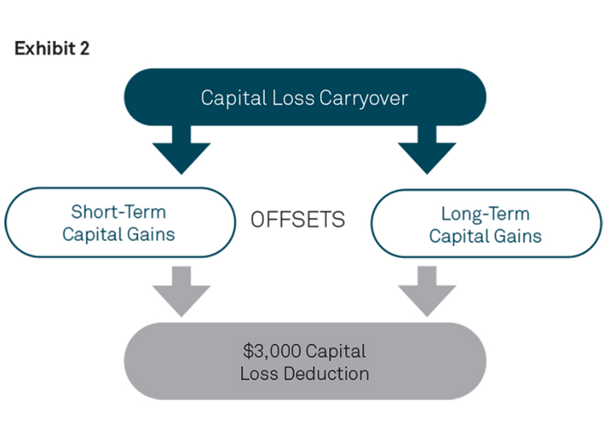
Most investors may not have to worry about capital loss carryover when filing their 2024 federal income taxes since the last two years have been extremely profitable for them. However, because 2022 was such a bad year for the markets, many investors who sold back then may have had more capital losses than capital gains for that year. The good news is that they could have used those excess losses to reduce their capital gains in 2023 and even some of their ordinary income (up to $3,000). If there were still losses left over, they can be used towards offsetting any realized capital gains in 2024 as well as $3,000 of ordinary income.

Capital loss carryover is a tax rule that lets you use investment losses from one year to reduce your taxable income in future years. Before going any further, keep in mind that this rule only applies to taxable accounts, not retirement accounts, such as IRAs.

Here’s how it works:

1. Calculating your net capital loss:

  • First, you need to calculate your net capital loss for the year. This is the difference between your capital gains (money you made on investments) and your capital losses (money you lost on investments). If it’s less than zero, meaning you have more losses than gains, you can offset some of your income.
  • You can only deduct up to a certain amount of net capital losses in a single year. This limit is currently $3,000.

2. Carryover of unused losses:

  • If your net capital loss is greater than the allowable deduction ($3,000), the unused portion automatically carries over to future tax years.
  • There is no time limit to how long you can carry over capital losses.
  • You can use the carryover to:
    • (1) Offset capital gains in future years.
    • (2) Deduct up to $3,000 against your ordinary income in future years.

3. Applying the carryover:

  • Each year, you calculate your net capital loss again, considering any new gains and losses.
  • You can use your current year’s net capital loss first to offset any capital gains you have.
  • Then, you can apply any remaining unused carryover from previous years to further reduce your taxable income.

4. Important points to remember:

  • Capital losses are categorized as short-term or long-term based on how long you held the investment before selling. Short-term losses can only offset short-term gains, while long-term losses can offset both short-term and long-term gains.
  • Wash sales are a strategy where you sell an investment at a loss and then repurchase it shortly after. This is generally not allowed and can prevent you from claiming the capital loss.
  • It’s important to keep accurate records of your capital gains and losses for tax purposes.

Here’s an example:

In 2022, you had $10,000 in capital losses and no capital gains. You deducted $3,000 of your losses to offset your ordinary income, and the remaining $7,000 carried over to 2023. In 2023, you had $3,000 in capital gains. You can first use your $7,000 loss carryover to completely offset these gains. You then have $4,000 remaining in your carryover that you can offset $3,000 of your ordinary income with, leaving you with $1,000 capital loss carryover to use to offset any gains in 2024.

I hope this explanation helps. Remember, it’s always a good idea to consult with a tax professional for advice specific to your situation.

Please comment or send an email if you have any questions. Thanks!

Joe Baker, CFP®

Baker Asset Management, LLC

joebaker@bakerassemanagement.com

The Pros and Cons of Living Trusts

This is always a great time of the year to review your financial picture.

One of the items that you might be considering, or have considered before, is whether or not to establish a revocable living trust to hold your assets.

A revocable living trust is a legal document created by you (the grantor) while you are alive and of sound mind and body. Just like a will, a living trust spells out exactly what your desires are with regard to your assets, your dependents, and your heirs. But a won’t go into effect until after you die, whereas a living trust is already in effect.

There is little difference to owning your assets in your name or in your living trust’s name while you are alive and well. The benefits occur after you die or if you become incapable of handling your own affairs.

Here is a list of some of the benefits of having a living trust:

  • Avoids probate – This is probably the biggest reason people have a living trust. The trust bypasses the costly and time-consuming process of probate, which is conducted by the state courts of your residence when you die and has the authority to decide how to divvy up your assets.
  • Provides privacy – a living trust is not made public, so upon your death, your estate will be distributed in private. A will, on the other hand, is public record and so all transactions will be public as well.
  • Maintains control – If you become incapacitated in a way that you can no longer manage your assets, your handpicked successor trustee can manage your affairs without court intervention, and since the trust is revocable, if you dispute your incapacity, you can retain control yourself.

There are disadvantages as well:

  • Cost – A living trust can cost anywhere between $500 – $4,000, depending on the complexity. This is the price that you pay for the money saved by avoiding probate, which can typically run around 4% of your total estate value.
  • Bookkeeping – In order for your living trust to be of use, you have to transfer your assets into it. That means opening new accounts with the trust as owner for your bank and investment accounts. Also, transferring deeds and title for property into the trust name, which can be time consuming.

In summary, if you have a large family and/or a large number of assets, you may want to consider establishing a revocable living trust. It could save you and your family not just a lot of money, but also a ton of undue stress and strain on you and your family during difficult times.

If you have questions or want to know if you should establish a living trust, just shoot me an email.

Joe Baker, CFP®

Baker Asset Management, LLC

joebaker@bakerassetmanagement.com

U.S. Balance Sheets Are Looking Good

I was looking at some data last week to see if the U.S. still had a good chance of avoiding a recession and came upon some interesting charts that I wanted to share with you.

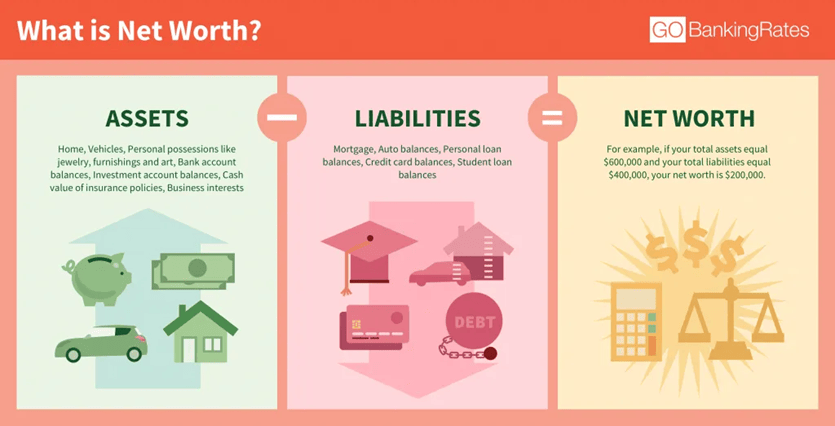
The first chart takes a look at the average and median net worth of U.S. citizens categorized by age as of 2023. Remember, net worth is just your assets minus your liabilities. The illustration above gives a great example of how net worth is calculated.

You can see there is quite a difference between average and median values. That’s because there are a bunch of households that are extremely wealthy and that will skew the average higher. The more realistic values are the ones in the Median Net Worth column. These amounts are calculated simply by locating the middle value of all the net worth values in that age group. That said, both show that the net worth of U.S. households is the highest that it’s ever been.

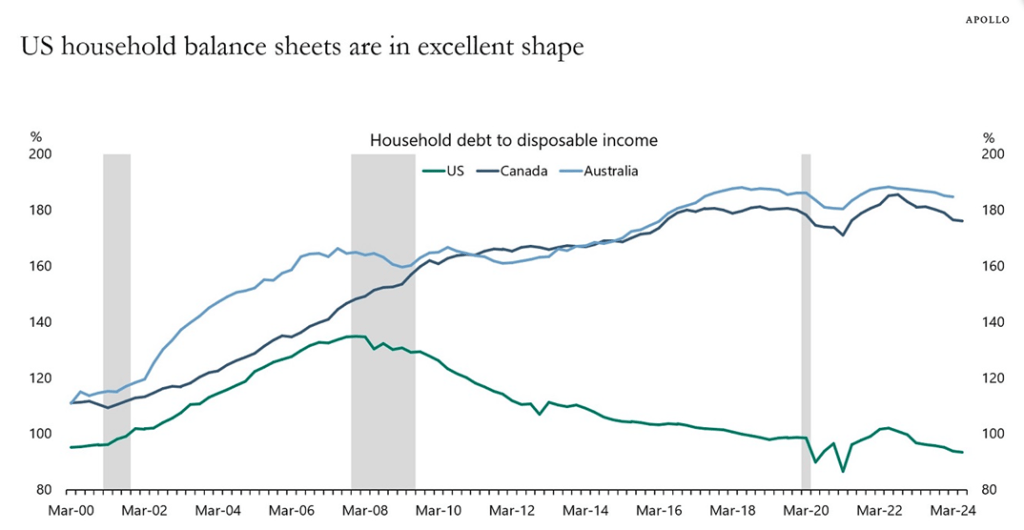
This next chart compares our household debt as a percentage of disposable income to our buddies in Canada and Australia. The lower the percentage, the better:

As you can see, we are below 100% which means that we have enough disposable income to pay off our debts. Also, we are in much better shape than our Canadian and Australian friends.

This is good news any way you slice it. The combination of rising asset values (homes, stocks, etc.), decent job growth, solid wage growth, and the Fed cutting interest rates, almost ensures that there is no recession on the horizon.

Please comment or send an email if you have any questions.

Joe Baker, CFP®

Baker Asset Management, LLC

joebaker@bakerassemanagement.com

How to Get Paid by the IRS to Save for Retirement

Do you want to get paid by the IRS for contributing to your IRA or other retirement plans? Well, you can because they will pay you to save for retirement.

There is a little-known tax rule that has been around since 2002 called the Retirement Savings Contributions Credit (Saver’s Credit). This tax credit essentially pays you to put money into your IRA, Roth IRA, 401k, TSA, and most other retirement plans. Here’s a quick summary of how it works:

Eligibility

You are eligible for the credit if you meet certain criteria:

  • Income limits: Your adjusted gross income (AGI) must be below a certain threshold. The exact threshold varies depending on your filing status and whether you are a qualifying individual.
  • Contributions: You must make qualifying contributions to a traditional or Roth IRA, or to an eligible employer-sponsored retirement plan.
  • Age: You must be at least 18 years old and not a full-time student.

Credit Amount

As with most tax credits, the amount is based on your adjusted gross income (AGI) in the year that you contribute. The maximum amount of the credit is 50% of the amount that you contribute to your retirement plan. The maximum contribution amount that can qualify for the credit is $2,000, making the maximum credit $1,000. Here is an example:

Jill, who works at a retail store, is married and earned $41,000 in 2024. Jill’s spouse was unemployed in 2024 and didn’t have any earnings. Jill contributed $2,000 to her IRA for 2024. After deducting her IRA contribution, the adjusted gross income shown on her joint return is $39,000. Jill may claim a 50% credit of $1,000 for her $2,000 IRA contribution on her 2024 tax return.

The following table shows how much of a credit that you are eligible for:

2024 Saver’s Credit Rates and Filing Status

For those that are eligible, it is like getting a match from the government on your contribution. Every little bit helps!

Please comment or send an email if you have any questions.

Joe Baker, CFP®

Baker Asset Management, LLC

joebaker@bakerassemanagement.com

Letter of Final Instruction – Don’t Leave This World Without It

The Letter of Final Instruction (LOFI) should be a major part of everyone’s estate plan.  Unfortunately, I rarely see one when reviewing a client’s financial documents.

The LOFI isn’t a legal document like a will or trust.  It is simply a document that provides your family with guidance upon your death on little things that wouldn’t necessarily go into a legal document.  It is a godsend for family members, especially after a sudden, unexpected death.  I have seen many a family become completely stressed out and overwhelmed when dealing with the aftermath of a death of a loved one.

The LOFI provides important information to heirs, such as location of safe deposit box keys, insurance policy info, financial account numbers, online passwords, etc.  It also allows you to direct where you want your personal belongings to go to, such as your 100-year-old china set or your vintage ‘65 Mustang.  These items typically aren’t specified in a will or trust.  However, you can reference a LOFI in a will or living trust.  That way, if you need to make changes, you can simply change the LOFI without having to amend the will or trust, since that takes the assistance of an attorney.

The LOFI should be distributed to all immediate family members and updated annually, if needed.  I keep mine as a pdf file on my computer as well as a hard copy that I leave on my desk when I travel.

If you want to get started on writing up your LOFI, here is a link to a very comprehensive checklist of what you should include: https://www.cals.uidaho.edu/edcomm/pdf/CIS/CIS0958.pdf.

You can also just do an internet search for letters of final instructions, and you’ll find a bunch of resources to use.

Get going on this, even if you don’t have a will.  Something is better than nothing.  Having a LOFI for your family will give you peace of mind and will help your heirs deal with settling your estate without all the stress and confusion.

Joe Baker, CFP®

Baker Asset Management, LLC

joebaker@bakerassetmanagement.com
FDIC and Trusts: What You Need To Know

A new rule regarding FDIC insurance for trust accounts became effective on April 1, 2024, that could impact anyone with a trust account held at an FDIC-member bank. The new rule simplifies insurance coverage for trust accounts by:

  • Reducing the number of insurance rules for trust accounts
  • Eliminating complexities from the revocable and irrevocable trust rules
  • Utilizing the same familiar, straightforward insurance calculation for both revocable and irrevocable trusts

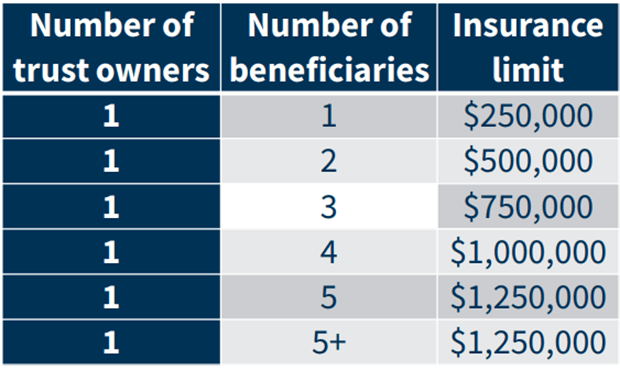
The new rule provides insurance of a trust account(s) of $250,000 per beneficiary, for up to five beneficiaries, for a total of $1,250,000.

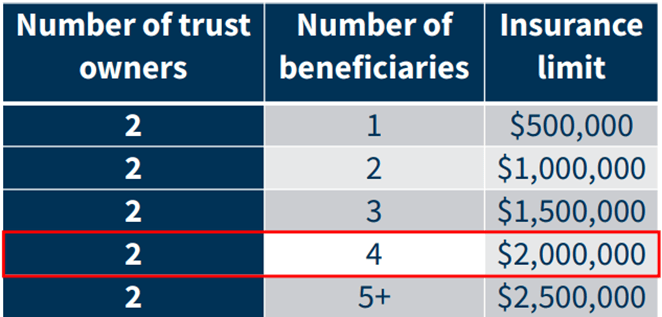
This is per each trust owner for each bank. However, many trusts have multiple owners. So, for example, if you own a trust with your spouse (two owners) and the trust has four beneficiaries, FDIC insures up to $2,000,000 (2 owners x 4 beneficiaries x $250,000).

It’s important to note that $1,250,000 remains the maximum insurance, per bank, for a single owner, regardless of how many trusts and/or beneficiaries that they have at that particular bank. That means if a person has, say, a revocable living trust and an irrevocable charitable trust, those trusts are combined to determine how much the owner is insured for those combined assets.

Although this new rule was enacted to simplify the FDIC insurance rules regarding trust accounts, it still has its complexities. I would definitely recommend working with your financial advisers to maximize coverage for your financial assets.

Please comment or send an email if you have any questions. Thanks!

Joe Baker, CFP®

Baker Asset Management, LLC

joebaker@bakerassemanagement.com