
Safeguarding Wealth: How to Protect Aging Family Members from Financial Fraud

The scale of modern elder financial exploitation is staggering. According to the FBI’s latest tracking, older Americans lose over $7.7 billion annually to fraudsters, with individual victims losing an average of $120,000. While sophisticated digital and artificial intelligence (AI) voice-cloning scams are rapidly escalating, data reveals that roughly 70% of financial abuse is actually committed by individuals known to the senior, such as predatory caregivers or dishonest family acquaintances.

As a fiduciary, I assess risk objectively. Protecting your family’s generational wealth means moving beyond reactive concern and implementing proactive, data-informed safeguards.

Step-by-Step Defense Protocol

Implementing structural guardrails across your family’s accounts creates an immediate barrier against bad actors. Follow this order of operations to establish maximum protection:

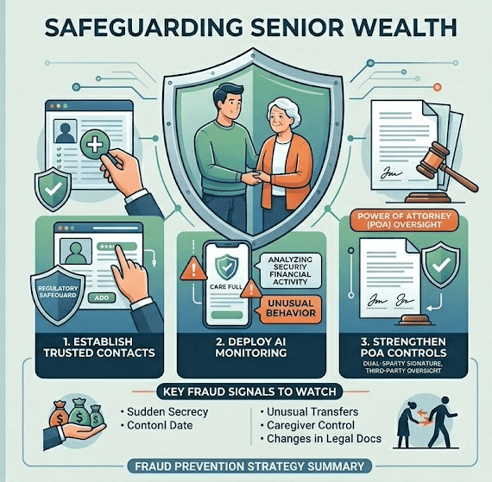
1.Establish Trusted Contacts: Immediate Priority.

Contact major financial custodians—such as Fidelity or Charles Schwab—to formally add a “Trusted Contact” to your family member’s accounts. Under FINRA Rule 2165, this provides institutions with a compliant regulatory framework to halt suspicious transactions and contact you directly without violating privacy laws.

2.Deploy Dedicated Monitoring Systems: Continuous Oversight.

Do not rely on standard bank alerts, which often miss specialized elder fraud patterns. Integrate a dedicated safety platform like Carefull. This AI-driven service links existing bank accounts to continuously analyze transactional data, flagging unusual cash-draining habits, missed bills, or home title changes.

3.Consolidate Fragmented Accounts: Streamline Administration.

Seniors with multiple accounts scattered across different institutions face significantly higher exposure. Consolidate these assets into a single primary custodian. This vastly simplifies oversight, limits data exposure, and allows you to establish unified security alerts.

4.Restructure Power of Attorney (POA) Controls: Legal Guardrails.

Review existing estate planning documents. A standard POA can inadvertently act as a license to steal if left unmonitored. Ensure your family’s legal documents include accountability provisions, such as requiring dual signatures or independent third-party CPA oversight for large asset liquidations.

Identifying the Behavioral Red Flags

Preventing loss requires recognizing changes in behavior before assets leave an account. Watch closely for these primary indicators:

  • Financial Anomalies: Uncharacteristic out-of-state wire requests, sudden ATM withdrawals by a companion, or sudden attempts to purchase untraditional retail assets like gift cards or cryptocurrency.
  • Social Isolation: A new “friend” or caregiver who insists on managing the senior’s schedule, acts as an intermediary during financial conversations, or encourages secrecy regarding financial decisions.

The Bottom Line: Fraudsters rely entirely on isolation and administrative complexity. By centralizing accounts at major custodians, adding verified trusted contacts, and utilizing automated tools like Carefull, you build a structural defense system that protects your family’s long-term financial health. Take the time to review these accounts with your loved ones and put these administrative blockades in place.

Please comment or send an email if you have any questions.

Joe Baker, CFP®

Baker Asset Management, LLC

joebaker@bakerassetmanagement.com
Be Prepared for 2026 Tax Season Scams

Scammers love tax season almost as much as they look forward to the holidays. In both cases, a seasonal flurry of financial transactions and activity provides cover and opportunities they can use to try to defraud investors and advisor firms.

We all try to be extra-vigilant during these periods. But unfortunately, today’s scams are more sophisticated and subtle than in previous years—with some offering no obvious red flags. The reason? AI.

Gone are the days of misspelled emails from dodgy addresses: these days, many fraudsters send professional, personalized communications that appear to come from trusted sources.

AI allows scammers to create realistic communications that feel timely and in line with legitimate communications you receive from trusted institutions, including polished emails, convincing phone calls, and messages tailored to you. These tactics are designed to create a sense of urgency, encouraging you to act quickly without verifying the request.

Real-World Examples of Tax Scams

“Refund on hold” texts or emails
Taxpayers may receive a notice that their refund can’t be paid until their personal information is verified. A link leads the victim to a realistic-looking fake website designed to capture personal or banking details.

Tax professional impersonation phone calls
Scammers use calm, professional-sounding human or AI voices to impersonate professionals from the IRS, a tax preparer, or a financial institution. These authoritative voices reference real names and firms to appear credible, and encourage recipients to take urgent action to “pay back taxes,” “claim a refund,” or “verify their information,” which of course leads to the theft of data or assets.

Personalized “action required” emails
These messages, which may advertise an unclaimed tax refund, a tax account update, or an important notice from the IRS, may include the victim’s name and top-of-mind tax season topics, making the message seem legitimate, and encouraging quick action without double-checking.

REMEMBER: tax authorities do not initiate contact by email, phone calls or text to request sensitive information. The IRS initiates most contacts through regular mail, not phone calls, and will never demand immediate payment or threaten arrest over the phone.

How to protect yourself

  • Pause before acting—urgency is a common scam tactic.
  • Verify any communications—if the “IRS” has contacted you, visit IRS.gov. and check the message you’ve received using a legitimate phone number.
  • Avoid clicking links or opening attachments in unexpected messages.
  • When in doubt, don’t respond—talk to your advisor or tax professional first.

Scams will continue to evolve as technology advances. Staying alert, slowing down, and verifying requests can help protect your personal and financial information.

Please comment or send an email if you have any questions.

Joe Baker, CFP®

Baker Asset Management, LLC

joebaker@bakerassetmanagement.com
What to Know to Sidestep Scammers This Tax Season

Tax time is one of the most active times of year for fraud scams—in addition to the high volume of tax-related transactions, they also leverage taxpayers’ fear of the IRS to pressure investors for money and information, pretending they work for the tax authorities. Even the most diligent and well-informed tax professionals can fall victim to these scams.

For those reasons, remaining calm, alert, and aware of common tax season scams is vital. Please review the facts below to help educate yourself about these threats.

Be sure you know these facts about the IRS:

  • The IRS contacts taxpayers by mail first; it does not initiate contact via unexpected phone call, voicemail, text, email, or social media.
  • The IRS does not request personal or financial information.
  • You can look up the names of official notices and letters on the IRS website.
  • The IRS cannot revoke driver’s licenses, business licenses, or immigration status.
  • The IRS cannot threaten to immediately bring in local law enforcement.
  • Avoid any mailing or online offers to help set up a taxpayer’s IRS Online account, as well as transacting with fake charities, sites or groups offering misleading tax information or bogus tax forms and any tax preparers promising huge tax refunds, or especially those who will not provide their IRS PTIN. Carefully review misleading offers of fuel tax credit, Form 8944, compromise ‘mills’, or Employee Retention Credit (ERC), as these programs are intended for limited groups and specific criteria must be met.

AI scams are on the rise—be on the lookout this tax season

Artificial Intelligence (AI) is technology that enables machines to mimic certain human-like behaviors. Three types of AI are particularly useful to scammers:

  • Chatbots: AI-powered bots can engage in realistic, long-term conversations, tricking victims in romance and phishing scams.
  • Voice Cloning: AI can mimic real voices, making family emergency scams more believable.
  • Deepfakes: AI-generated videos can impersonate real people, leading to fraud and misinformation.

Here are some AI-powered scams to watch out for:

  • Phishing attacks— watch this video prepared by Charles Schwab Corporation to learn what to watch out for with these common scams.
  • Family emergency scams and romance scams—to help you understand and fight these threats, check out this scam brochure.

Best practices for avoiding any scam:

  • It’s important to always verify the legitimacy of any communication; whether it is visiting a website, email, phone call or mailed letter.
  • Avoid clicking on links offering you something for nothing, any messages asking for log in credentials, and hang up on calls asking for personal information, charitable donations or offering unsolicited tech support.
  • If you receive a suspicious call, hang up, don’t send them money, don’t provide personal information.
  • Hang up on gift card scams. And never use a gift card to pay for any money request, whether it’s for the IRS, Social Security, a family member in trouble or any tech company.
  • Scammers will insert urgency in the situation – take your time and speak with someone you trust if unsure of the validity of the caller.

Please comment or send an email if you have any questions. Thanks!

Joe Baker, CFP®

Baker Asset Management, LLC

joebaker@bakerassetmanagement.com