
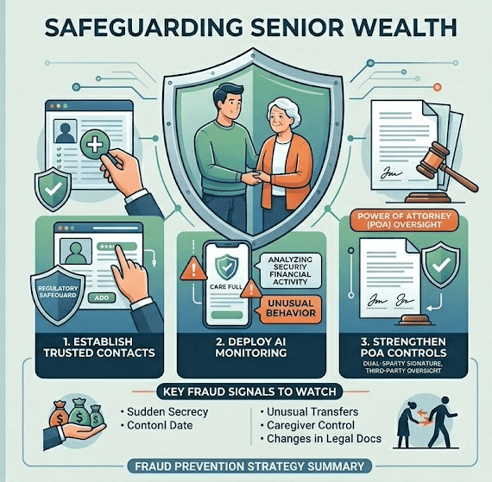
The scale of modern elder financial exploitation is staggering. According to the FBI’s latest tracking, older Americans lose over $7.7 billion annually to fraudsters, with individual victims losing an average of $120,000. While sophisticated digital and artificial intelligence (AI) voice-cloning scams are rapidly escalating, data reveals that roughly 70% of financial abuse is actually committed by individuals known to the senior, such as predatory caregivers or dishonest family acquaintances.
As a fiduciary, I assess risk objectively. Protecting your family’s generational wealth means moving beyond reactive concern and implementing proactive, data-informed safeguards.
Step-by-Step Defense Protocol
Implementing structural guardrails across your family’s accounts creates an immediate barrier against bad actors. Follow this order of operations to establish maximum protection:
1.Establish Trusted Contacts: Immediate Priority.
Contact major financial custodians—such as Fidelity or Charles Schwab—to formally add a “Trusted Contact” to your family member’s accounts. Under FINRA Rule 2165, this provides institutions with a compliant regulatory framework to halt suspicious transactions and contact you directly without violating privacy laws.
2.Deploy Dedicated Monitoring Systems: Continuous Oversight.
Do not rely on standard bank alerts, which often miss specialized elder fraud patterns. Integrate a dedicated safety platform like Carefull. This AI-driven service links existing bank accounts to continuously analyze transactional data, flagging unusual cash-draining habits, missed bills, or home title changes.
3.Consolidate Fragmented Accounts: Streamline Administration.
Seniors with multiple accounts scattered across different institutions face significantly higher exposure. Consolidate these assets into a single primary custodian. This vastly simplifies oversight, limits data exposure, and allows you to establish unified security alerts.
4.Restructure Power of Attorney (POA) Controls: Legal Guardrails.
Review existing estate planning documents. A standard POA can inadvertently act as a license to steal if left unmonitored. Ensure your family’s legal documents include accountability provisions, such as requiring dual signatures or independent third-party CPA oversight for large asset liquidations.
Identifying the Behavioral Red Flags
Preventing loss requires recognizing changes in behavior before assets leave an account. Watch closely for these primary indicators:
- Financial Anomalies: Uncharacteristic out-of-state wire requests, sudden ATM withdrawals by a companion, or sudden attempts to purchase untraditional retail assets like gift cards or cryptocurrency.
- Social Isolation: A new “friend” or caregiver who insists on managing the senior’s schedule, acts as an intermediary during financial conversations, or encourages secrecy regarding financial decisions.
The Bottom Line: Fraudsters rely entirely on isolation and administrative complexity. By centralizing accounts at major custodians, adding verified trusted contacts, and utilizing automated tools like Carefull, you build a structural defense system that protects your family’s long-term financial health. Take the time to review these accounts with your loved ones and put these administrative blockades in place.
Please comment or send an email if you have any questions.
Joe Baker, CFP®
Baker Asset Management, LLC
joebaker@bakerassetmanagement.com

