
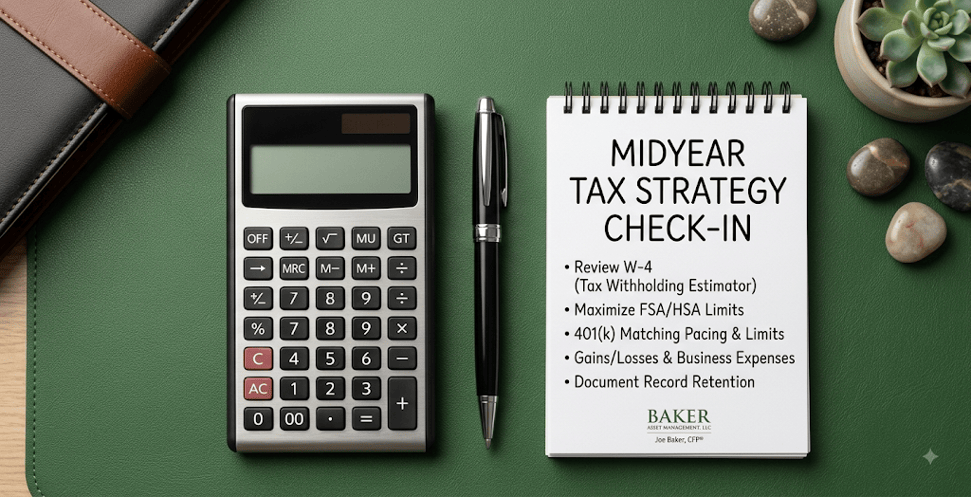
Summer is the ideal time to conduct a midyear financial check-up. Waiting until December leaves very little room to adjust strategy and waiting until tax filing season means it is already too late.
Taking a proactive approach now allows you to optimize your tax position, capture available incentives, and ensure your investment strategy directly aligns with your long-term goals.
Here are 5 key tax and financial check-ins to perform today while there is still time to take action.
1. Review Your Tax Withholdings (IRS Form W-4)
If you changed jobs, got married, welcomed a child, or experienced a significant shift in income this year, update your IRS Form W-4 with your employer.
- Avoid large tax surprises: Underwithholding results in unexpected bills and potential penalties at year-end.
- Stop giving the IRS an interest-free loan: A huge refund means you overpaid throughout the year. The IRS does not pay interest on your money. Redirecting that excess cash flow into high-yield savings or investment strategies allows your money to work for you.
- Action item: Use the IRS Tax Withholding Estimator online or review your recent pay stubs to verify that your withholdings match your actual year-to-date income.
2. Maximize Pre-Tax Account Limits (FSAs & HSAs)
Review your current contribution levels and balances for employer-sponsored benefit accounts.
- Flexible Spending Accounts (FSAs): Check your remaining balances for healthcare and dependent care FSAs. Because FSA funds operate on a “use-it-or-lose-it” basis (with limited rollover or grace period options), plan out your qualified medical, dental, or dependent care expenses now rather than rushing at year-end.
- Health Savings Accounts (HSAs): Unlike FSAs, HSA balances roll over indefinitely. If you participate in a high-deductible health plan, aim to max out your HSA contributions to capture triple-tax benefits: tax-deductible contributions, tax-deferred growth, and tax-free withdrawals for qualified medical expenses.
3. Audit Your 401(k) Pacing and Matching
While IRA contributions can be made until the April tax filing deadline, 401(k) salary deferrals must be completed through payroll by December 31.
- Employer Match Optimization: Ensure your contributions are paced evenly across all pay periods to capture your employer’s full match. Maxing out your 401(k) too early in the year can cause you to miss out on employer matching dollars in later paychecks unless your plan includes a “true-up” provision.
- Catch-Up Contributions: If you are age 50 or older, review your payroll deductions to ensure you are utilizing catch-up contribution limits across your retirement accounts.
4. Strategize Capital Gains, Losses, and Business Expenses
Midyear provides enough year-to-date data to accurately project your marginal tax bracket.
- Tax-Loss Harvesting: If you hold investments in taxable brokerage accounts, evaluate opportunities to offset realized capital gains with capital losses.
- Roth Conversions: If your income is lower than usual this year, executing a partial Roth conversion can move funds into a tax-free growth bucket at a lower tax rate.
- Business Owners & Side Hustles: Review business income and expenses. Ensure all legitimate deductions are tracked through dedicated business accounts. If operating as an S-Corporation, evaluate your expected annual income to ensure your mix of reasonable salary and distributions remains compliant and tax-efficient.
5. Streamline and Update Your Financial Records
Proactive tax planning relies entirely on clean, real-time financial data.
- Maintain Clean Books: Reconcile your business and personal accounts monthly using software like Quicken or QuickBooks to spot errors and monitor cash flow.
- Track Property Basis: Keep digital copies of closing documents and receipts for major home upgrades or rental property improvements. You will need these to calculate your cost basis accurately when selling.
- Document Retention: Store tax records, receipts, and supporting documents in a secure, organized system. As a general rule, retain records supporting tax returns for at least 3 to 7 years.
Please comment or send an email if you have any questions.
Joe Baker, CFP®
Baker Asset Management, LLC
joebaker@bakerassetmanagement.com


