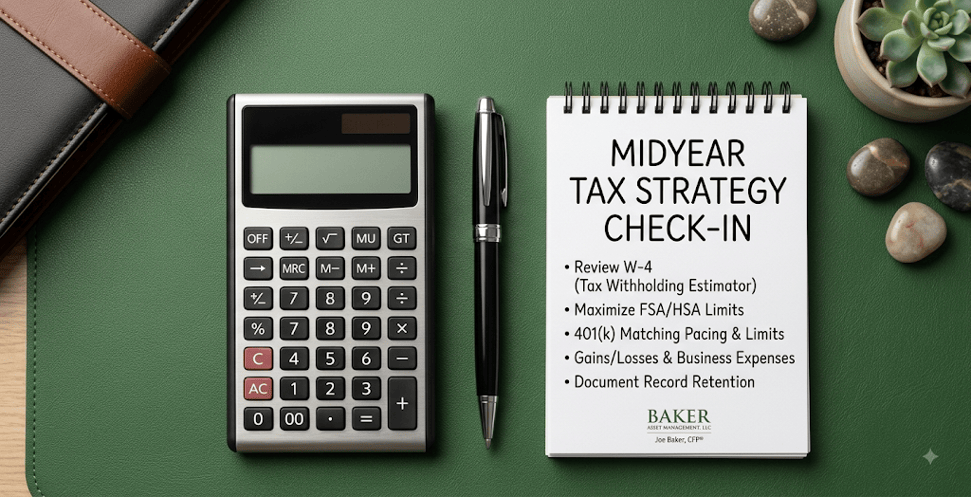
Midyear Tax Check-In: 5 Strategic Moves to Make Right Now

Summer is the ideal time to conduct a midyear financial check-up. Waiting until December leaves very little room to adjust strategy and waiting until tax filing season means it is already too late.

Taking a proactive approach now allows you to optimize your tax position, capture available incentives, and ensure your investment strategy directly aligns with your long-term goals.

Here are 5 key tax and financial check-ins to perform today while there is still time to take action.

1. Review Your Tax Withholdings (IRS Form W-4)

If you changed jobs, got married, welcomed a child, or experienced a significant shift in income this year, update your IRS Form W-4 with your employer.

  • Avoid large tax surprises: Underwithholding results in unexpected bills and potential penalties at year-end.
  • Stop giving the IRS an interest-free loan: A huge refund means you overpaid throughout the year. The IRS does not pay interest on your money. Redirecting that excess cash flow into high-yield savings or investment strategies allows your money to work for you.
  • Action item: Use the IRS Tax Withholding Estimator online or review your recent pay stubs to verify that your withholdings match your actual year-to-date income.

2. Maximize Pre-Tax Account Limits (FSAs & HSAs)

Review your current contribution levels and balances for employer-sponsored benefit accounts.

  • Flexible Spending Accounts (FSAs): Check your remaining balances for healthcare and dependent care FSAs. Because FSA funds operate on a “use-it-or-lose-it” basis (with limited rollover or grace period options), plan out your qualified medical, dental, or dependent care expenses now rather than rushing at year-end.
  • Health Savings Accounts (HSAs): Unlike FSAs, HSA balances roll over indefinitely. If you participate in a high-deductible health plan, aim to max out your HSA contributions to capture triple-tax benefits: tax-deductible contributions, tax-deferred growth, and tax-free withdrawals for qualified medical expenses.

3. Audit Your 401(k) Pacing and Matching

While IRA contributions can be made until the April tax filing deadline, 401(k) salary deferrals must be completed through payroll by December 31.

  • Employer Match Optimization: Ensure your contributions are paced evenly across all pay periods to capture your employer’s full match. Maxing out your 401(k) too early in the year can cause you to miss out on employer matching dollars in later paychecks unless your plan includes a “true-up” provision.
  • Catch-Up Contributions: If you are age 50 or older, review your payroll deductions to ensure you are utilizing catch-up contribution limits across your retirement accounts.

4. Strategize Capital Gains, Losses, and Business Expenses

Midyear provides enough year-to-date data to accurately project your marginal tax bracket.

  • Tax-Loss Harvesting: If you hold investments in taxable brokerage accounts, evaluate opportunities to offset realized capital gains with capital losses.
  • Roth Conversions: If your income is lower than usual this year, executing a partial Roth conversion can move funds into a tax-free growth bucket at a lower tax rate.
  • Business Owners & Side Hustles: Review business income and expenses. Ensure all legitimate deductions are tracked through dedicated business accounts. If operating as an S-Corporation, evaluate your expected annual income to ensure your mix of reasonable salary and distributions remains compliant and tax-efficient.

5. Streamline and Update Your Financial Records

Proactive tax planning relies entirely on clean, real-time financial data.

  • Maintain Clean Books: Reconcile your business and personal accounts monthly using software like Quicken or QuickBooks to spot errors and monitor cash flow.
  • Track Property Basis: Keep digital copies of closing documents and receipts for major home upgrades or rental property improvements. You will need these to calculate your cost basis accurately when selling.
  • Document Retention: Store tax records, receipts, and supporting documents in a secure, organized system. As a general rule, retain records supporting tax returns for at least 3 to 7 years.

Please comment or send an email if you have any questions.

Joe Baker, CFP®

Baker Asset Management, LLC

joebaker@bakerassetmanagement.com

How to Pay NO TAXES on your Long-Term Capital Gains

How to Avoid Capital Gains Tax in Mutual Funds

With positive returns in the stock market over the last three years, investors are most likely sitting on some unrealized capital gains in their taxable brokerage accounts. Read on if you are thinking about locking in some of those gains and how to minimize federal taxes on them.

First, let’s get some definitions out of the way.

A capital gain is the profit realized from the sale of a capital asset, such as stocks or bonds, for a price greater than what you paid for it, aka its cost basis.

For example, if a stock was purchased for $100 plus a $5 fee and was later sold for $150 with a $5 fee, the cost basis would be $105, and the net proceeds would be $145, resulting in a realized capital gain of $40.

For this gain to be considered long-term, you would need to have held the asset for more than one year. For example, if an asset is purchased on March 20, 2024, a sale on March 20, 2025, would be a short-term transaction, while a sale one day later on March 21, 2025, would be a long-term transaction.

Now, here’s the important part. These gains are subject to special, significantly lower tax rates of 0%, 15%, or 20%. These are typically lower than your ordinary income tax rate, which could be as high as 37%.

The following table details the specific income limits for 2025 to qualify for the various long-term capital gains (LTCG) tax rates.

Tax Filing Status0% Rate Taxable Income15% Rate Taxable Income20% Rate Taxable Income
SingleUp to $48,350$48,351 to $533,400Over $533,400
Married Filing JointlyUp to $96,700$96,701 to $600,050Over $600,050
Head of HouseholdUp to $64,750$64,751 to $566,700Over $566,700
Married Filing SeparatelyUp to $48,350$48,351 to $300,000Over $300,000

So, to be able to avoid LTCG tax in 2025, you will need to have taxable income of less than $48,300 for single filers and less than $96,700 if you’re married. It’s important to note that we are looking at taxable income, which is typically found at the bottom of your 1040 form (Line 15 on the 2024 Form 1040). Taxable income is calculated as adjusted gross income (AGI) minus standard or itemized deductions. This means an individual can strategically reduce their taxable income to fit within the 0% bracket.

For example, a single filer with a gross income of $65,000 using the standard deduction of $15,750 for 2025 and a 401k contribution of $10,900 could get their taxable income to $38,350, $10,000 below the $48,350 threshold. Therefore, a realized LTCG of $10,000 can be added to the taxable income, which would be taxed at 0% since the total taxable income is below the $48,350 threshold.

The decision to sell some winners and realize LTCGs in 2025 is not an isolated one; it must be coordinated with all other income, deduction, and contribution decisions for the year. Obviously, this strategy works best for those that already have a low taxable income, such as retirees.

Before taking any action, it is recommended to consult with a qualified tax professional, financial advisor, or attorney who can provide personalized guidance.

Please comment or send an email if you have any questions.

Joe Baker, CFP®

Baker Asset Management, LLC

joebaker@bakerassetmanagement.com
Don’t Forget About Your Capital Loss Carryover When Filing Your 2024 Taxes This Year

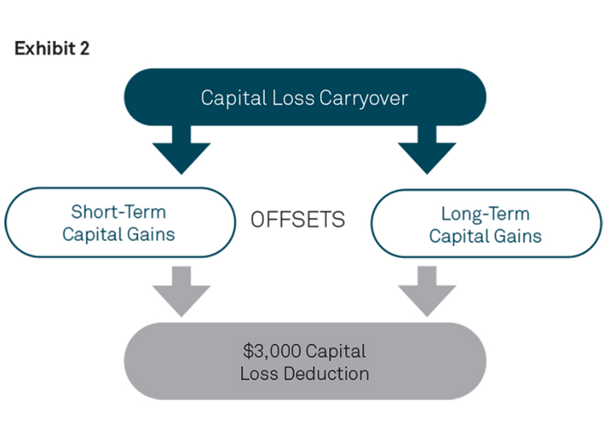
Most investors may not have to worry about capital loss carryover when filing their 2024 federal income taxes since the last two years have been extremely profitable for them. However, because 2022 was such a bad year for the markets, many investors who sold back then may have had more capital losses than capital gains for that year. The good news is that they could have used those excess losses to reduce their capital gains in 2023 and even some of their ordinary income (up to $3,000). If there were still losses left over, they can be used towards offsetting any realized capital gains in 2024 as well as $3,000 of ordinary income.

Capital loss carryover is a tax rule that lets you use investment losses from one year to reduce your taxable income in future years. Before going any further, keep in mind that this rule only applies to taxable accounts, not retirement accounts, such as IRAs.

Here’s how it works:

1. Calculating your net capital loss:

  • First, you need to calculate your net capital loss for the year. This is the difference between your capital gains (money you made on investments) and your capital losses (money you lost on investments). If it’s less than zero, meaning you have more losses than gains, you can offset some of your income.
  • You can only deduct up to a certain amount of net capital losses in a single year. This limit is currently $3,000.

2. Carryover of unused losses:

  • If your net capital loss is greater than the allowable deduction ($3,000), the unused portion automatically carries over to future tax years.
  • There is no time limit to how long you can carry over capital losses.
  • You can use the carryover to:
    • (1) Offset capital gains in future years.
    • (2) Deduct up to $3,000 against your ordinary income in future years.

3. Applying the carryover:

  • Each year, you calculate your net capital loss again, considering any new gains and losses.
  • You can use your current year’s net capital loss first to offset any capital gains you have.
  • Then, you can apply any remaining unused carryover from previous years to further reduce your taxable income.

4. Important points to remember:

  • Capital losses are categorized as short-term or long-term based on how long you held the investment before selling. Short-term losses can only offset short-term gains, while long-term losses can offset both short-term and long-term gains.
  • Wash sales are a strategy where you sell an investment at a loss and then repurchase it shortly after. This is generally not allowed and can prevent you from claiming the capital loss.
  • It’s important to keep accurate records of your capital gains and losses for tax purposes.

Here’s an example:

In 2022, you had $10,000 in capital losses and no capital gains. You deducted $3,000 of your losses to offset your ordinary income, and the remaining $7,000 carried over to 2023. In 2023, you had $3,000 in capital gains. You can first use your $7,000 loss carryover to completely offset these gains. You then have $4,000 remaining in your carryover that you can offset $3,000 of your ordinary income with, leaving you with $1,000 capital loss carryover to use to offset any gains in 2024.

I hope this explanation helps. Remember, it’s always a good idea to consult with a tax professional for advice specific to your situation.

Please comment or send an email if you have any questions. Thanks!

Joe Baker, CFP®

Baker Asset Management, LLC

joebaker@bakerassemanagement.com

Tax Loss Harvesting (TLH) – What It Is and When To Do It

Tax loss harvesting (TLH) is a term used in the financial industry to describe strategies employed by investors to minimize their taxes due on any realized gains of investment sales for the year. Realized gains occur when you sell an investment at a higher price than when you bought it.

Before reading any further, please note that TLH only applies to investments in taxable accounts, not retirement accounts or any other tax-deferred accounts. That said, let’s take a look at what this harvesting is all about.

I think an example is the best way to understand how this strategy works:

Suppose you sold shares of XYZ earlier this year for a $10,000 profit, also known as a realized gain. Let’s say that you also have a stinker, ABC, in your account that is down $15,000 from when you bought it. You can sell ABC and now have a realized loss of $15,000. This will offset the $10,000 realized gain. It will also offset up to $5,000 of any other realized gains that you have this year. If you don’t have any other gains, you can apply $3,000 to reduce your taxable income and the remaining $2,000 of losses can be carried forward to next year.

In this example, you were able to avoid paying taxes on that gain of $10,000 by using the TLH strategy.

Most investors prefer to do this strategy towards the end of the year, but you can do it any time during the calendar year. I like to do it for my clients during the slow summer months because that is one less thing to worry about during crunch time in December.

I also want to share with you some do’s and don’ts when you are considering TLH:

  1. Don’t sell losers just to offset gains. Make sure that the investment no longer fits with your investment objectives.
  2. Considering #1 above, do maximize your tax savings by using TLH when you have short term capital gains, since they are taxed at your ordinary income tax rate, which may be much higher than the long-term capital gain tax rate.
  3. Do sell losers if they no longer fit your strategy, even if you don’t have any gains to offset. You can always carry the losses forward to use in later years.
  4. Don’t buy the same investment within 30 days before or after the TLH sale. If you do, this will disallow the loss.
  5. Don’t ever consider any tax strategy, such as TLH, as the sole reason to buy or sell any investment. They should be incorporated into your investment decisions as part of your overall game plan.

Please comment or send an email if you have any questions.

Joe Baker, CFP®
Baker Asset Management, LLC
joebaker@bakerassetmanagement.com