Maximizing Your ROI: The Ultimate Guide to Capital Gains Deductions in 2026

When it comes to selling assets, what you keep is far more important than the sale price. Navigating the 2026 tax landscape requires more than just picking the right stocks or timing the real estate market; it requires a strategic understanding of how to lower your tax bill by accounting for every eligible expense. From the hidden costs of closing a deal to the power of tax-loss harvesting, knowing which deductions can offset your capital gains is the key to protecting your portfolio’s growth and ensuring you aren’t overpaying Uncle Sam.

To determine taxable capital gains for the 2026 tax year, the IRS allows you to deduct specific expenses that reduce either the final sale proceeds or the original cost basis of the asset.

Direct Reductions to Capital Gains

Taxable gain is calculated by subtracting your adjusted basis and selling expenses from the total sale price.

Selling Expenses: You can deduct costs directly related to the transfer or sale of the asset, such as:

  • Brokerage commissions and transaction fees for stocks and securities.
  • Legal fees, advertising, and appraisal costs.
  • Closing costs for real estate, including title search fees, notary fees, escrow fees, and recording fees.
  • Marketing and staging costs to prepare a property for sale.
  • Transfer taxes or stamp taxes charged by local or state governments.

Adjusted Cost Basis (Acquisition Costs): You can increase your basis (thereby decreasing your gain) by including:

  • The original purchase price of the asset.
  • Incidental acquisition costs like sales taxes, excise taxes, and shipping/handling.
  • Installation and setup charges required to make the asset usable.
  • Capital improvements for real estate that add value or prolong the property’s life (e.g., a new roof, kitchen remodel, or HVAC system). Note: Routine repairs like painting or fixing leaks are not deductible.

Offsetting Gains with Losses

One of the most effective ways to reduce capital gains tax is by deducting capital losses.

  • Tax-Loss Harvesting: You can use realized capital losses from selling underperforming investments to offset capital gains in the same year.
  • Net Loss Deduction: If your total capital losses exceed your total capital gains, you can deduct up to $3,000 of the remaining loss against ordinary income ($1,500 if married filing separately).
  • Loss Carryover: Any excess net capital loss above $3,000 can be carried forward indefinitely to future tax years.

Investment Interest Expense

If you borrowed money to purchase taxable investments (such as using a margin loan to buy stock), the interest paid may be deductible as an itemized deduction.

  • The deduction is generally limited to your net investment income for the year.
  • Any unused interest expense can be carried forward to the following tax year.
  • This deduction is not allowed in any tax-deferred accounts, such as an IRA.

Non-Deductible Expenses for 2026

Under current laws (including the One Big Beautiful Bill Act effective for 2026), several formerly common expenses are not deductible for individual taxpayers:

  • Miscellaneous Investment Fees: Investment advisory fees, IRA custodial fees, and accounting costs for individual investors are permanently disallowed.
  • Personal Property Losses: You cannot deduct losses from the sale of personal-use property, such as your personal car or a primary residence.
  • Securities Transaction Tax (STT): Certain taxes like STT or annual maintenance charges (AMC) for brokerage accounts cannot be claimed.

Maximizing tax efficiency in your investment portfolio requires careful attention to detail. By effectively tracking and managing adjustments to your cost basis and strategically utilizing tax loss harvesting, investors can potentially reduce their tax liability. Staying informed about current IRS regulations regarding investment expenses is crucial to ensure all deductions are properly claimed, ultimately allowing you to retain more of your investment returns.

Please comment or send an email if you have any questions.

Joe Baker, CFP®

Baker Asset Management, LLC

joebaker@bakerassetmanagement.com

Maximize Your Tax Savings with the Senior Bonus Deduction

Starting in 2025, a new temporary federal tax break known as the “Senior Bonus Deduction “is available to taxpayers aged 65 and older. Enacted under the One Big Beautiful Bill Act (OBBBA), this provision is designed to provide additional tax relief through the 2028 tax year.

Key Features of the 2025 Senior Deduction

  • Deduction Amount: Eligible individuals can deduct up to $6,000 from their taxable income.
  • Married Couples: If both spouses are 65 or older and file a joint return, they can claim a combined deduction of $12,000.
  • “Stackable” Benefit: This deduction is in addition to the regular standard deduction and the existing “additional standard deduction” for seniors.
  • Accessibility: You can claim this deduction regardless of whether you take the standard deduction or itemize your deductions.

Eligibility and Income Limits

The full deduction is only available to those under specific income thresholds based on their Modified Adjusted Gross Income (MAGI):

Filing StatusFull Deduction Income LimitPhase-Out Range
Single / Head of HouseholdUp to $75,000$75,001 – $175,000
Married Filing JointlyUp to $150,000$150,001 – $250,000
  • Phase-Out Rule: For every $1 your MAGI exceeds the limit, the deduction is reduced by 6 cents until it reaches zero.
  • Age Requirement: You must be 65 or older by December 31, 2025.
  • Exclusion: The deduction is not available to those who use the “Married Filing Separately” status.

Impact on Social Security

While often discussed as a “No Tax on Social Security” measure, the law does not technically eliminate federal taxes on Social Security benefits. Instead, the $6,000 deduction serves to lower your overall taxable income, which for many seniors with modest incomes effectively offsets the portion of their Social Security that would have been taxed.

Maximum Combined Deductions for 2025

For a senior taking the standard deduction, the total amount of income sheltered from federal tax in 2025 could reach:

  • Single (65+): $23,750 ($15,750 base + $2,000 age-based + $6,000 new bonus).
  • Married (Both 65+): $46,700 ($31,500 base + $3,200 age-based + $12,000 new bonus).

Please comment or send an email if you have any questions.

Joe Baker, CFP®

Baker Asset Management, LLC

joebaker@bakerassetmanagement.com

Big Changes to the SALT Deduction for your Taxes this Year

A big change is coming when you file your 2025 federal income taxes next year and here’s what you need to know.

Before we go over what has changed, let’s review what the State and Local Tax (SALT) includes. SALT refers to the federal tax deduction that allows taxpayers who itemize their deductions to subtract certain taxes they’ve paid to their state and local governments from their federal taxable income.

The taxes typically included in the SALT deduction are:

  • State and local income taxes
  • State and local property taxes
  • State and local general sales taxes (taxpayers generally choose to deduct either income taxes or sales taxes, but not both)

The SALT deduction cap has undergone significant changes with the recently signed “One Big Beautiful Bill” Act, offering a temporary increase for taxpayers. Here’s a breakdown of the new provisions:

Background:

  • Prior to 2025, there was a $10,000 cap ($5,000 for married individuals filing separately) on the SALT deduction.

Changes under the New Law (Effective 2025):

  • Increased Cap: For tax years 2025 through 2029, the SALT deduction cap is increased from $10,000 to $40,000.
  • Annual Adjustment: The $40,000 cap will increase by 1% each year from 2026 through 2029 to account for inflation.
  • Income-Based Phase-Down: The increased cap is subject to a phase-down for higher-income taxpayers:
    • For individuals and families with modified adjusted gross income (MAGI) over $500,000 (for joint filers in 2025, and this threshold also increases annually by 1%), the $40,000 cap is gradually reduced.
    • The deduction is phased down at a rate of $0.30 for every dollar over the income threshold.
    • Even with the phase-down, the deduction will not fall below the original $10,000 cap. This means taxpayers with MAGIs above approximately $600,000 in 2025 will effectively be limited to a $10,000 SALT deduction.
  • Sunset Provision: The higher SALT cap is temporary. Beginning in 2030, the deduction limit will revert to the original $10,000.

Who Benefits the Most:

  • Residents of High-Tax States: The increased cap provides significant relief to homeowners and taxpayers in states with high property and income taxes, such as California, New York, and New Jersey, who were significantly impacted by the previous $10,000 limit.
  • Itemizers: This change primarily benefits taxpayers who itemize their deductions, as the standard deduction has also been increased (e.g., to $31,500 for married filing jointly in 2025). Some households that previously took the standard deduction may now find it advantageous to itemize.
  • Targeted Relief: While the cap is higher, the income phase-down ensures that the full benefit of the increased cap is directed towards middle and upper-middle-income earners, with the highest earners seeing their deduction reduced back to the $10,000 level.

To summarize, the new SALT cap provides targeted relief to a broader segment of the population than the old cap, particularly those in areas with higher tax burdens, while still maintaining some limitations for the ultra-wealthy due to the income phase-down.

It’s important for taxpayers, especially those in high-tax states, to understand these changes and how they might affect their individual tax situations.

Please comment or send an email if you have any questions.

Joe Baker, CFP®

Baker Asset Management, LLC

joebaker@bakerassemanagement.com

When Can I Get Rid of My Old Tax Documents?

It’s always a good time to go through your stuff and purge what you don’t need anymore. I know I have a few boxes of financial paperwork that need a good going-through to see if anything can be sent to the shredder. Regarding tax documents, there is always the question of how long do we have to keep this information. The good news is that the Internal Revenue Service has some guidelines that can help you sort what to keep and what to get rid of.

Here are some of the retention guidelines that the IRS recommends:

General Rule:

Keep records for 3 years from the date you filed your original return or 2 years from the date you paid the tax, whichever is later, if you file a claim for credit or refund.

Exceptions and Longer Retention:

  • Keep records for 7 years if you file a claim for a loss from worthless securities or bad debt deduction.
  • Keep records for 6 years if you do not report income that you should report, and it is more than 25% of the gross income shown on your return.
  • Keep records indefinitely if you do not file a return or if you file a fraudulent return.
  • Employment Tax Records: Keep employment tax records for at least 4 years after the date that the tax becomes due or is paid, whichever is later.

Property Records:

  • Keep records related to property until the period of limitations expires for the year in which you dispose of the property.
  • These records are essential for calculating depreciation, amortization, depletion, and gain or loss on sale.

Important Considerations:

  • Even after IRS requirements are met, consider if other entities (e.g., state where you file taxes, lenders, insurance companies) require longer retention.
  • When records are no longer needed, dispose of them securely, such as by shredding.

Please comment or send an email if you have any questions. Thanks!

Joe Baker, CFP®

Baker Asset Management, LLC

joebaker@bakerassetmanagement.com

A Little Known IRS Program That Can Make Tax Season Less Taxing

There is a program offered by the IRS that allows you to file your federal taxes through an associated tax preparer for free! The IRS Free File program is a public-private partnership between the IRS and a group of tax software companies called the Free File Alliance. It allows eligible taxpayers to prepare and file their federal income tax returns online for free. Here’s how it works:

1. Eligibility:

  • Income: The main requirement is your Adjusted Gross Income (AGI). For the 2024 tax year (filing in 2025), the AGI limit is $84,000. This applies to all filing statuses (single, married filing jointly, etc.).
  • Other factors: Some participating companies may have additional eligibility requirements, such as age or state residency.

2. Accessing Free File:

3. Preparing and Filing:

  • Create an account: Once you’ve chosen a provider, you’ll be redirected to their website to create an account.
  • Follow the instructions: The software will guide you through the process of entering your tax information.
  • File electronically: When you’re finished, the software will transmit your return electronically to the IRS.

Key Features of IRS Free File:

  • Free federal return: Participating companies cannot charge you to prepare and e-file your federal tax return if you qualify.
  • Guided experience: The software uses a question-and-answer format to help you complete your return accurately.
  • Error checks: Built-in checks help catch mistakes and ensure your return is complete.
  • Direct deposit: You can choose to receive your refund via direct deposit for faster processing.

Important Notes:

  • State taxes: While federal filing is free, some providers may charge for state tax preparation.14 Check with your chosen provider for details.
  • Support: The level of customer support offered may vary between providers.
  • Accuracy: Always review your return carefully before filing, even with the help of software.

This is a great service that is most certainly underutilized by eligible tax filers and can potentially save you some hard-earned cash.

Please comment or send an email if you have any questions.

Joe Baker, CFP®

Baker Asset Management, LLC

joebaker@bakerassetmanagement.com

Tax Loss Harvesting (TLH) – What It Is and When To Do It

Tax loss harvesting (TLH) is a term used in the financial industry to describe strategies employed by investors to minimize their taxes due on any realized gains of investment sales for the year. Realized gains occur when you sell an investment at a higher price than when you bought it.

Before reading any further, please note that TLH only applies to investments in taxable accounts, not retirement accounts or any other tax-deferred accounts. That said, let’s take a look at what this harvesting is all about.

I think an example is the best way to understand how this strategy works:

Suppose you sold shares of XYZ earlier this year for a $10,000 profit, also known as a realized gain. Let’s say that you also have a stinker, ABC, in your account that is down $15,000 from when you bought it. You can sell ABC and now have a realized loss of $15,000. This will offset the $10,000 realized gain. It will also offset up to $5,000 of any other realized gains that you have this year. If you don’t have any other gains, you can apply $3,000 to reduce your taxable income and the remaining $2,000 of losses can be carried forward to next year.

In this example, you were able to avoid paying taxes on that gain of $10,000 by using the TLH strategy.

Most investors prefer to do this strategy towards the end of the year, but you can do it any time during the calendar year. I like to do it for my clients during the slow summer months because that is one less thing to worry about during crunch time in December.

I also want to share with you some do’s and don’ts when you are considering TLH:

  1. Don’t sell losers just to offset gains. Make sure that the investment no longer fits with your investment objectives.
  2. Considering #1 above, do maximize your tax savings by using TLH when you have short term capital gains, since they are taxed at your ordinary income tax rate, which may be much higher than the long-term capital gain tax rate.
  3. Do sell losers if they no longer fit your strategy, even if you don’t have any gains to offset. You can always carry the losses forward to use in later years.
  4. Don’t buy the same investment within 30 days before or after the TLH sale. If you do, this will disallow the loss.
  5. Don’t ever consider any tax strategy, such as TLH, as the sole reason to buy or sell any investment. They should be incorporated into your investment decisions as part of your overall game plan.

Please comment or send an email if you have any questions.

Joe Baker, CFP®
Baker Asset Management, LLC
joebaker@bakerassetmanagement.com

Don’t Forget About Your Capital Loss Carryover When Filing Your Taxes This Year

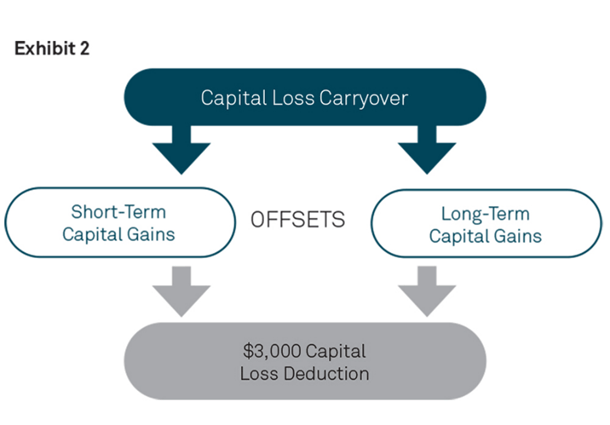
Because 2022 was such a bad year for the stock market, many investors who sold stocks back then had more capital losses than capital gains for that year. The good news is that they can use those excess losses to reduce their capital gains in 2023 and even some of their ordinary income (up to $3,000).

Capital loss carryover is a tax rule that lets you use investment losses from one year to reduce your taxable income in future years. Before going any further, keep in mind that this rule only applies to taxable accounts, not retirement accounts, such as IRAs.

Here’s how it works:

1. Calculating your net capital loss:

  • First, you need to calculate your net capital loss for the year. This is the difference between your capital gains (money you made on investments) and your capital losses (money you lost on investments).
  • You can only deduct up to a certain amount of net capital losses in a single year. This limit is currently $3,000.

2. Carryover of unused losses:

  • If your net capital loss is greater than the allowable deduction ($3,000), the unused portion automatically carries over to future tax years.
  • There is no time limit to how long you can carry over capital losses.
  • You can use the carryover to:

o Offset capital gains in future years.

o Deduct up to $3,000 against your ordinary income in future years.

3. Applying the carryover:

  • Each year, you calculate your net capital loss again, considering any new gains and losses.
  • You can use your current year’s net capital loss first to offset any capital gains you have.
  • Then, you can apply any remaining unused carryover from previous years to further reduce your taxable income.

4. Important points to remember:

  • Capital losses are categorized as short-term or long-term based on how long you held the investment before selling. Short-term losses can only offset short-term gains, while long-term losses can offset both short-term and long-term gains.
  • Wash sales are a strategy where you sell an investment at a loss and then repurchase it shortly after. This is generally not allowed and can prevent you from claiming the capital loss.
  • It’s important to keep accurate records of your capital gains and losses for tax purposes.

Here’s an example:

In 2022, you had $5,000 in capital losses and no capital gains. You deducted $3,000 of your losses to offset your ordinary income, and the remaining $2,000 carried over to 2023. In 2023, you had $1,000 in capital gains. You can first use your $2,000 carryover to completely offset these gains. You then have $1,000 remaining in your carryover that you can offset your ordinary income with, thus using up all of your capital loss carryover.

I hope this explanation helps. Remember, it’s always a good idea to consult with a tax professional for advice specific to your situation.

Please comment or send an email if you have any questions. Thanks!

Joe Baker, CFP®
Baker Asset Management, LLC
joebaker@bakerassemanagement.com

You Can Still Reduce Your 2023 Taxes

2023 is in the rearview mirror but there is still time to reduce your taxable income for last year:

Make a tax-deductible contribution to your IRA.

If you qualify, an IRA contribution can be a great way to reduce your 2023 taxes. You are allowed to contribute up to $6,500. If you are age 50 or older, you can add an extra $1,000 for a total of $7,500. You basically just had to have worked last year (have earned income) to qualify to make an IRA contribution.

Plus, if you are married, you can double up the amount with a spousal IRA.

If you are not covered by a retirement plan at work, you can deduct the full amount of your contribution, regardless of how much money you make.

If you do have a retirement plan at work, there are restrictions and limitations to qualify for the full deduction. Here’s a table that summarizes these rules. They are confusing so feel free to shoot me an email with any questions.

2023 Traditional IRA deduction limits

Filing StatusModified adjusted gross income (MAGI)Deduction Limit
Single individuals≤ $73,000Full deduction up to the amount of your contribution limit
> $73,000 but < $83,000Partial deduction
≥ $83,000No deduction
Married (filing joint returns)≤ $116,000Full deduction up to the amount of your contribution limit
> $116,000 but < $136,000Partial deduction
≥ $136,000No deduction
Married (filing separately)*< $10,000Partial deduction
≥ $10,000No deduction
  

If you’re self-employed, you can sock away a lot more by opening up a Simplified Employee Pension (SEP) plan before filing your taxes. For 2023, you can contribute up to $66,000, depending on your income.

Please comment or send an email if you have any questions. Thanks!

Joe Baker, CFP®

Baker Asset Management, LLC

joebaker@bakerassetmanagement.com