
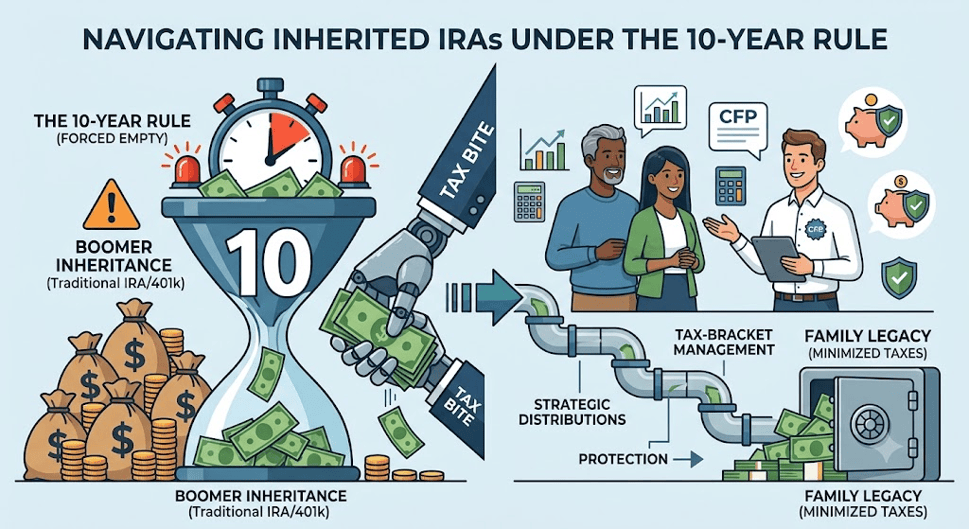
What You Need to Know If You Inherit an IRA

The Great Wealth Transfer is officially underway. Over the next two decades, Baby Boomers are projected to pass down tens of trillions of dollars to Gen X and Millennial heirs. A significant portion of this wealth is sitting inside tax-deferred retirement accounts—specifically Traditional IRAs and 401(k)s.

While receiving an inheritance can be life-changing, inheriting a retirement account comes with a maze of tax laws. Following the SECURE Act and finalized IRS regulations, the rules governing inherited IRAs have fundamentally changed. If you expect to leave or receive an inherited IRA, understanding these rules is critical to avoiding a massive tax bite.

The Death of the “Stretch IRA”

For decades, non-spouse beneficiaries (such as adult children or grandchildren) enjoyed a tax perk known as the Stretch IRA. Heirs could take small, required minimum distributions (RMDs) calculated over their own life expectancies. This allowed the remaining account balance to grow tax-deferred for 30, 40, or even 50 years.

Congress effectively eliminated the Stretch IRA for most non-spouse beneficiaries. Instead, most heirs are now subject to the 10-Year Rule, which requires the entire account balance to be depleted by December 31st of the 10th year following the original owner’s death.

How the 10-Year Rule Works (And the “RMD Catch”)

How you manage an inherited Traditional IRA over that 10-year window depends heavily on whether the original account owner had reached their Required Beginning Date for RMDs (currently age 73) before passing away:

Owner’s Status at PassingDistribution Requirement for Non-Spouse BeneficiaryTax Impact
Died BEFORE Age 73Flexible 10-Year Window: No mandatory annual withdrawals are required in years 1–9. The entire account must simply be emptied by the end of Year 10.Income tax is owed on withdrawals in the year they are taken.
Died ON or AFTER Age 73Mandatory Annual RMDs: You must take annual RMDs in years 1–9 based on your life expectancy and fully empty the account by Year 10.Income tax is owed on each annual distribution.
Inherited Roth IRA10-Year Draining Rule: Account must be emptied by Year 10, but no annual RMDs are required during years 1–9 regardless of the owner’s age.100% Tax-Free distributions (assuming the Roth account met the 5-year holding rule).

Note on Exceptions: Surviving spouses, minor children of the account owner, disabled or chronically ill individuals, and beneficiaries not more than 10 years younger than the deceased qualify as “Eligible Designated Beneficiaries” and may still use lifetime distribution rules under specific conditions.

The “Tax Bomb” Risk for Heirs

The biggest trap of the 10-Year Rule is the unexpected tax bump.

Gen Xers and Millennials inheriting IRAs are often in their peak earning years (ages 40 to 60). Adding $50,000 to $100,000+ per year in taxable IRA distributions on top of a high salary can push heirs into significantly higher federal and state tax brackets. Furthermore, waiting until Year 10 to withdraw a lump sum can result in a massive single-year tax liability.

Don’t Forget the State Tax Twist

While federal rules dictate when you must take distributions, state laws determine how much extra cut the government takes. State income taxes vary drastically across the country, making location a critical factor in your withdrawal strategy. For instance, heirs living in Texas pay 0% state income tax on inherited IRA distributions, leaving only federal tax to manage. In contrast, beneficiaries in California face steep top income tax rates (up to 13.3%), which can severely compound the tax hit on forced 10-year withdrawals. States like South Carolina (top rate around 6.2%) and New York fall in between—neither state charges a separate inheritance tax, but both tax traditional IRA distributions as ordinary state income (though both offer specific state tax exemptions for seniors that may apply under certain conditions). If you or your heirs reside in a high-tax state, tax-bracket management becomes doubly important.

Smart Strategies to Minimize the Tax Hit

  1. Stagger Withdrawals Intentionally: Rather than taking nothing for nine years and triggering a massive tax bill in Year 10, spread distributions evenly over the decade to keep yourself within lower tax brackets.
  2. Utilize Low-Income or Gap Years: If you plan to retire, take a sabbatical, or experience a lower-income year during the 10-year window, schedule larger inherited IRA withdrawals during those specific years.
  3. Proactive Planning for Account Owners (Lifetime Roth Conversions): If you are currently planning your estate, consider executing systematic Roth conversions during your lifetime. Paying the tax now at your current tax bracket allows your heirs to inherit tax-free growth and tax-free withdrawals.

The Bottom Line

Inheriting an IRA can provide a significant boost to your long-term financial security, but without a coordinated strategy, income taxes can erode a substantial portion of your family’s legacy.

Whether you are looking to update your current estate plan or have recently inherited an account, consulting with a financial advisor can help ensure you keep as much of that wealth as possible.

Please comment or send an email if you have any questions.

Joe Baker, CFP®

Baker Asset Management, LLC

joebaker@bakerassetmanagement.com
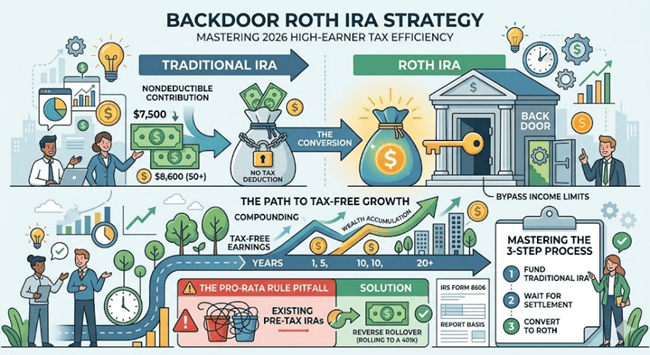
Mastering the Backdoor Roth: A 2026 High-Earner’s Strategy

Building long-term wealth requires more than just picking the right stocks; it requires picking the right tax structures. For high earners, the IRS often closes the front door to tax-free growth. Fortunately, the “backdoor” remains wide open.

Here is the 2026 blueprint for executing a Backdoor Roth conversion with precision.


🚪What is a Backdoor Roth?

A Backdoor Roth isn’t a specific type of account, it’s a strategy.

By law, if your income exceeds certain limits, you are barred from contributing directly to a Roth IRA. However, there are no income limits on contributing to a Traditional IRA or on converting those funds to a Roth. By combining these two steps, you effectively “bypass” the income cap, allowing your money to grow tax-free for decades.

📈Why It Matters in 2026

Tax-advantaged space is a finite resource. In 2026, the contribution limits and income thresholds have shifted, making this strategy more valuable than ever:

  • 2026 Contribution Limit: $7,500 (or $8,600 if you are age 50 or older).
  • The “Front Door” Income Caps: In 2026, the ability to contribute directly to a Roth begins to phase out if your Modified Adjusted Gross Income (MAGI) exceeds:
    • $153,000 (Single)
    • $242,000 (Married Filing Jointly)

⏳When is the “Best Age” to Start?

The short answer: The best age to start is the very first year your income exceeds the direct contribution limits.

Because Roth IRAs grow tax-free, time is your greatest ally. The earlier you start, the more “tax-free compounding” cycles your money undergoes.

  • Early Career (20s-30s): If you are a high-earning young professional, starting now can result in hundreds of thousands of dollars in tax savings by retirement.
  • The “Sweet Spot” (50+): At age 50, the IRS allows “catch-up” contributions (bringing your 2026 total to $8,600). If you haven’t started yet, this is the time to maximize your contributions while you are likely in your peak earning years.
  • The 5-Year Rule: Remember that every conversion starts its own 5-year clock before earnings can be withdrawn tax-free. Starting earlier ensures you clear these hurdles well before you actually need the cash.

🛠️How to Execute (The 3-Step Process)

  1. Fund a Traditional IRA: Open a Traditional IRA and make a nondeductible contribution. This means you don’t take a tax deduction for the contribution (since you’ve already paid tax on that income).
  2. The “Waiting Period”: While not strictly a legal requirement, I typically recommend waiting until the funds fully clear—usually a few business days—before moving to the next step.
  3. The Conversion: Instruct your custodian to move the funds from the Traditional IRA into your Roth IRA.

Expert Tip: Convert the funds as soon as they settle. If the money sits in the Traditional IRA and earns even a few dollars in interest, those earnings will be taxable upon conversion. We want the “basis” and the “conversion amount” to be as identical as possible.

⚠️The “Pro-Rata” Rule: The Biggest Pitfall

This is where most high earners get caught. The IRS views all of your Traditional, SEP, and SIMPLE IRAs as one giant bucket.

If you have $92,500 in an old Rollover IRA (pre-tax) and you add a $7,500 non-deductible contribution (after-tax), the IRS sees a $100,000 total balance. If you try to convert just that $7,500, they will claim only 7.5% of it is tax-free. You would owe income tax on the other 92.5%.

The Solution: Before executing a backdoor conversion, we must look for a “Reverse Rollover”, moving those pre-tax IRA balances into your current employer’s 401(k). 401(k) balances are excluded from this calculation.

📝Reporting to the IRS

Precision in paperwork is mandatory. You must file IRS Form 8606 with your tax return. This form tracks your “basis” (the after-tax money) so the IRS knows you’ve already paid taxes on that contribution and shouldn’t be taxed again during the conversion.


Summary Checklist

  • Verify your 2026 MAGI exceeds the direct Roth limits.
  • Confirm you have zero existing pre-tax IRA balances (check old SEP/SIMPLE/Rollover accounts).
  • Contribute up to $7,500 (or $8,600) to a non-deductible Traditional IRA.
  • Convert to Roth once funds settle.
  • Ensure your tax preparer files Form 8606.

At the end of the day, the Backdoor Roth is about more than just a single year’s contribution; it’s about the compounding power of tax-free growth over the course of your career. While the process is straightforward, the “Pro-Rata” rule and filing requirements leave zero room for error. If you’re ready to secure this tax-advantaged space for 2026 but aren’t sure how your existing IRA balances might impact the strategy, make sure you talk to a tax professional before you move forward.

Please comment or send an email if you have any questions.

Joe Baker, CFP®

Baker Asset Management, LLC

joebaker@bakerassetmanagement.com

You Can Still Reduce Your 2023 Taxes

2023 is in the rearview mirror but there is still time to reduce your taxable income for last year:

Make a tax-deductible contribution to your IRA.

If you qualify, an IRA contribution can be a great way to reduce your 2023 taxes. You are allowed to contribute up to $6,500. If you are age 50 or older, you can add an extra $1,000 for a total of $7,500. You basically just had to have worked last year (have earned income) to qualify to make an IRA contribution.

Plus, if you are married, you can double up the amount with a spousal IRA.

If you are not covered by a retirement plan at work, you can deduct the full amount of your contribution, regardless of how much money you make.

If you do have a retirement plan at work, there are restrictions and limitations to qualify for the full deduction. Here’s a table that summarizes these rules. They are confusing so feel free to shoot me an email with any questions.

2023 Traditional IRA deduction limits

Filing StatusModified adjusted gross income (MAGI)Deduction Limit
Single individuals≤ $73,000Full deduction up to the amount of your contribution limit
> $73,000 but < $83,000Partial deduction
≥ $83,000No deduction
Married (filing joint returns)≤ $116,000Full deduction up to the amount of your contribution limit
> $116,000 but < $136,000Partial deduction
≥ $136,000No deduction
Married (filing separately)*< $10,000Partial deduction
≥ $10,000No deduction
  

If you’re self-employed, you can sock away a lot more by opening up a Simplified Employee Pension (SEP) plan before filing your taxes. For 2023, you can contribute up to $66,000, depending on your income.

Please comment or send an email if you have any questions. Thanks!

Joe Baker, CFP®

Baker Asset Management, LLC

joebaker@bakerassetmanagement.com