
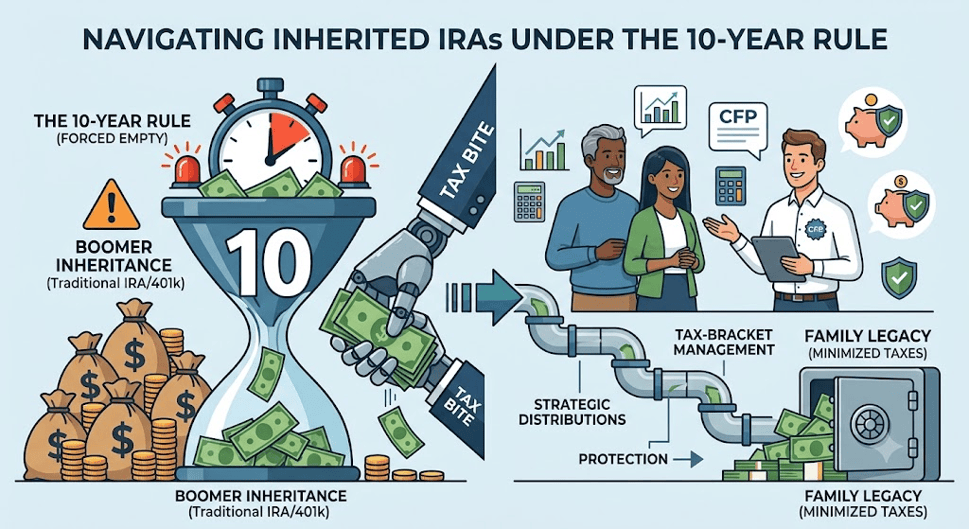
The Great Wealth Transfer is officially underway. Over the next two decades, Baby Boomers are projected to pass down tens of trillions of dollars to Gen X and Millennial heirs. A significant portion of this wealth is sitting inside tax-deferred retirement accounts—specifically Traditional IRAs and 401(k)s.
While receiving an inheritance can be life-changing, inheriting a retirement account comes with a maze of tax laws. Following the SECURE Act and finalized IRS regulations, the rules governing inherited IRAs have fundamentally changed. If you expect to leave or receive an inherited IRA, understanding these rules is critical to avoiding a massive tax bite.
The Death of the “Stretch IRA”
For decades, non-spouse beneficiaries (such as adult children or grandchildren) enjoyed a tax perk known as the Stretch IRA. Heirs could take small, required minimum distributions (RMDs) calculated over their own life expectancies. This allowed the remaining account balance to grow tax-deferred for 30, 40, or even 50 years.
Congress effectively eliminated the Stretch IRA for most non-spouse beneficiaries. Instead, most heirs are now subject to the 10-Year Rule, which requires the entire account balance to be depleted by December 31st of the 10th year following the original owner’s death.
How the 10-Year Rule Works (And the “RMD Catch”)
How you manage an inherited Traditional IRA over that 10-year window depends heavily on whether the original account owner had reached their Required Beginning Date for RMDs (currently age 73) before passing away:
| Owner’s Status at Passing | Distribution Requirement for Non-Spouse Beneficiary | Tax Impact |
| Died BEFORE Age 73 | Flexible 10-Year Window: No mandatory annual withdrawals are required in years 1–9. The entire account must simply be emptied by the end of Year 10. | Income tax is owed on withdrawals in the year they are taken. |
| Died ON or AFTER Age 73 | Mandatory Annual RMDs: You must take annual RMDs in years 1–9 based on your life expectancy and fully empty the account by Year 10. | Income tax is owed on each annual distribution. |
| Inherited Roth IRA | 10-Year Draining Rule: Account must be emptied by Year 10, but no annual RMDs are required during years 1–9 regardless of the owner’s age. | 100% Tax-Free distributions (assuming the Roth account met the 5-year holding rule). |
Note on Exceptions: Surviving spouses, minor children of the account owner, disabled or chronically ill individuals, and beneficiaries not more than 10 years younger than the deceased qualify as “Eligible Designated Beneficiaries” and may still use lifetime distribution rules under specific conditions.
The “Tax Bomb” Risk for Heirs
The biggest trap of the 10-Year Rule is the unexpected tax bump.
Gen Xers and Millennials inheriting IRAs are often in their peak earning years (ages 40 to 60). Adding $50,000 to $100,000+ per year in taxable IRA distributions on top of a high salary can push heirs into significantly higher federal and state tax brackets. Furthermore, waiting until Year 10 to withdraw a lump sum can result in a massive single-year tax liability.
Don’t Forget the State Tax Twist
While federal rules dictate when you must take distributions, state laws determine how much extra cut the government takes. State income taxes vary drastically across the country, making location a critical factor in your withdrawal strategy. For instance, heirs living in Texas pay 0% state income tax on inherited IRA distributions, leaving only federal tax to manage. In contrast, beneficiaries in California face steep top income tax rates (up to 13.3%), which can severely compound the tax hit on forced 10-year withdrawals. States like South Carolina (top rate around 6.2%) and New York fall in between—neither state charges a separate inheritance tax, but both tax traditional IRA distributions as ordinary state income (though both offer specific state tax exemptions for seniors that may apply under certain conditions). If you or your heirs reside in a high-tax state, tax-bracket management becomes doubly important.
Smart Strategies to Minimize the Tax Hit
- Stagger Withdrawals Intentionally: Rather than taking nothing for nine years and triggering a massive tax bill in Year 10, spread distributions evenly over the decade to keep yourself within lower tax brackets.
- Utilize Low-Income or Gap Years: If you plan to retire, take a sabbatical, or experience a lower-income year during the 10-year window, schedule larger inherited IRA withdrawals during those specific years.
- Proactive Planning for Account Owners (Lifetime Roth Conversions): If you are currently planning your estate, consider executing systematic Roth conversions during your lifetime. Paying the tax now at your current tax bracket allows your heirs to inherit tax-free growth and tax-free withdrawals.
The Bottom Line
Inheriting an IRA can provide a significant boost to your long-term financial security, but without a coordinated strategy, income taxes can erode a substantial portion of your family’s legacy.
Whether you are looking to update your current estate plan or have recently inherited an account, consulting with a financial advisor can help ensure you keep as much of that wealth as possible.
Please comment or send an email if you have any questions.
Joe Baker, CFP®
Baker Asset Management, LLC
joebaker@bakerassetmanagement.com

