The Best Way to Fund College….and Beyond

For years, one of the biggest hesitations I’ve heard from parents and grandparents about funding a 529 college savings plan was the fear of overfunding it. “What if they get a scholarship?” or “What if they don’t go to college? We’ll get hit with taxes and a 10% penalty if we pull the money out.”

Thanks to the SECURE 2.0 Act, that fear is largely gone.

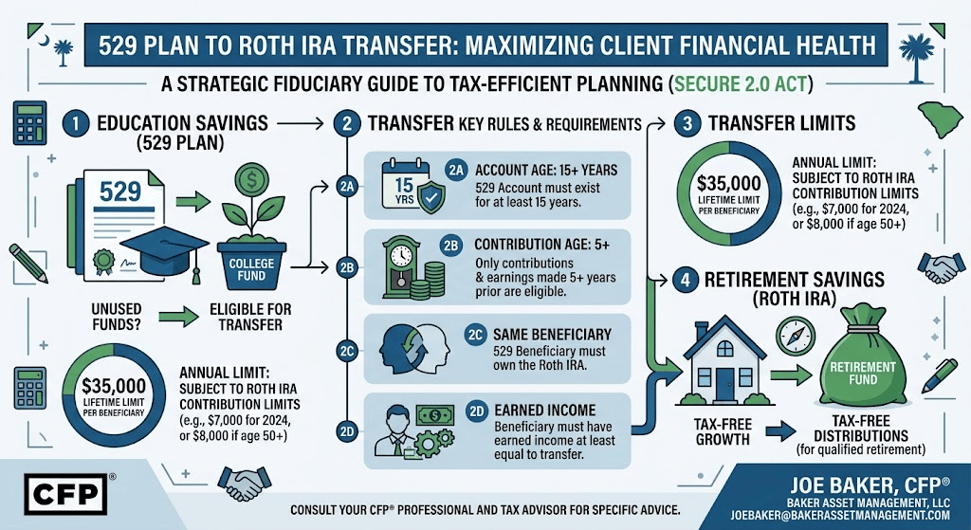
We now have a powerful new financial planning tool: the ability to roll over unused 529 plan funds directly into a Roth IRA for the beneficiary. This effectively turns an education savings account into a tax-free retirement springboard.

Here’s how it works and what you need to know.

The Mechanics of the 529-to-Roth Rollover

If your child or grandchild finishes their education and still has money left in their 529 plan, you can transfer those funds into a Roth IRA in their name. The money moves from a tax-free education account to a tax-free retirement account without incurring taxes or penalties.

This is massive. A young adult starting their career with a jump-started Roth IRA has decades of tax-free compounding ahead of them.

The Rules of the Game (And There Are Several)

As with anything tax-related, the IRS has strict rules you must follow to execute this strategy cleanly:

  1. The $35,000 Lifetime Limit: You can only transfer a maximum of $35,000 during the beneficiary’s lifetime. This isn’t an unlimited backdoor.
  2. Annual IRA Contribution Limits Apply: You cannot move the entire $35,000 at once. The transfers are subject to the annual IRA contribution limits. For 2026, that limit is $7,500. It will take nearly five years to transfer the full $35,000.
  3. Earned Income Requirement: The beneficiary must have earned income (W-2 wages or self-employment income) in the year of the transfer, and the transfer amount cannot exceed their earned income for that year.
  4. The 15-Year Rule: The 529 plan must have been open for at least 15 years.
  5. The 5-Year Rule: Contributions (and the earnings on those contributions) made to the 529 plan in the five years prior to the rollover cannot be transferred.
  6. Direct Transfer: The rollover must be moved directly from the 529 plan to the Roth IRA (a trustee-to-trustee transfer). Do not cash out the 529 and try to deposit it into the Roth yourself.

Why This is a Game Changer

This legislation effectively removes the risk of “over-saving” for college.

  • Bypassing High-Income Limits: Even if your young adult child earns too much to contribute directly to a Roth IRA, they can still receive these 529-to-Roth transfers.
  • Decades of Tax-Free Growth: If you fund a Roth IRA with $7,500 a year from ages 22 to 26 (using leftover 529 funds) and never add another dime, that $35,000 could grow to several hundred thousand dollars of tax-free money by the time they reach retirement age.

What You Should Do Now

If you have an existing 529 plan, track its age. If you’ve been putting off opening a 529 because of overfunding fears, start one now to get the 15-year clock ticking.

Before executing a transfer, you should run the numbers and ensure all IRS criteria are met to avoid unexpected tax hits or state-level recapture rules (some states may treat the rollover as a non-qualified withdrawal).

Please comment or send an email if you have any questions.

Joe Baker, CFP®

Baker Asset Management, LLC

joebaker@bakerassetmanagement.com
What You Need to Know If You Inherit an IRA

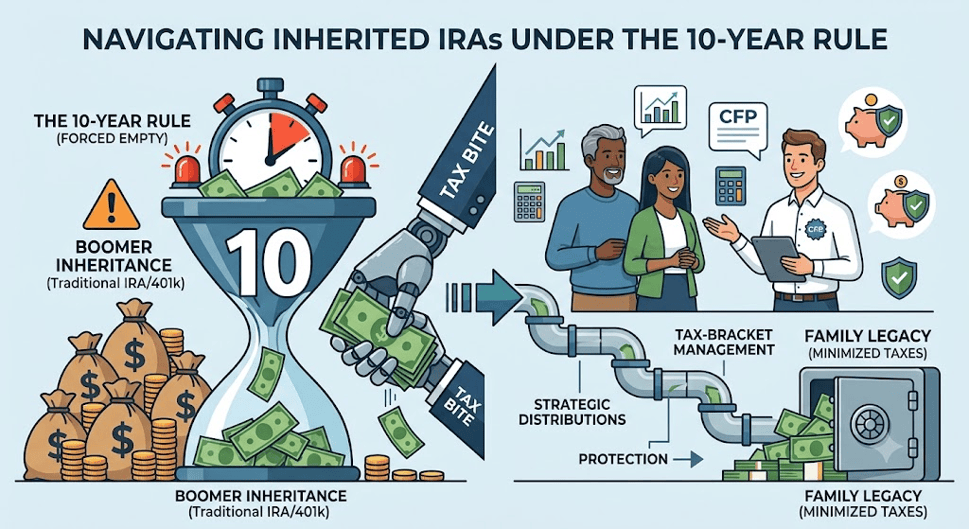
The Great Wealth Transfer is officially underway. Over the next two decades, Baby Boomers are projected to pass down tens of trillions of dollars to Gen X and Millennial heirs. A significant portion of this wealth is sitting inside tax-deferred retirement accounts—specifically Traditional IRAs and 401(k)s.

While receiving an inheritance can be life-changing, inheriting a retirement account comes with a maze of tax laws. Following the SECURE Act and finalized IRS regulations, the rules governing inherited IRAs have fundamentally changed. If you expect to leave or receive an inherited IRA, understanding these rules is critical to avoiding a massive tax bite.

The Death of the “Stretch IRA”

For decades, non-spouse beneficiaries (such as adult children or grandchildren) enjoyed a tax perk known as the Stretch IRA. Heirs could take small, required minimum distributions (RMDs) calculated over their own life expectancies. This allowed the remaining account balance to grow tax-deferred for 30, 40, or even 50 years.

Congress effectively eliminated the Stretch IRA for most non-spouse beneficiaries. Instead, most heirs are now subject to the 10-Year Rule, which requires the entire account balance to be depleted by December 31st of the 10th year following the original owner’s death.

How the 10-Year Rule Works (And the “RMD Catch”)

How you manage an inherited Traditional IRA over that 10-year window depends heavily on whether the original account owner had reached their Required Beginning Date for RMDs (currently age 73) before passing away:

Owner’s Status at PassingDistribution Requirement for Non-Spouse BeneficiaryTax Impact
Died BEFORE Age 73Flexible 10-Year Window: No mandatory annual withdrawals are required in years 1–9. The entire account must simply be emptied by the end of Year 10.Income tax is owed on withdrawals in the year they are taken.
Died ON or AFTER Age 73Mandatory Annual RMDs: You must take annual RMDs in years 1–9 based on your life expectancy and fully empty the account by Year 10.Income tax is owed on each annual distribution.
Inherited Roth IRA10-Year Draining Rule: Account must be emptied by Year 10, but no annual RMDs are required during years 1–9 regardless of the owner’s age.100% Tax-Free distributions (assuming the Roth account met the 5-year holding rule).

Note on Exceptions: Surviving spouses, minor children of the account owner, disabled or chronically ill individuals, and beneficiaries not more than 10 years younger than the deceased qualify as “Eligible Designated Beneficiaries” and may still use lifetime distribution rules under specific conditions.

The “Tax Bomb” Risk for Heirs

The biggest trap of the 10-Year Rule is the unexpected tax bump.

Gen Xers and Millennials inheriting IRAs are often in their peak earning years (ages 40 to 60). Adding $50,000 to $100,000+ per year in taxable IRA distributions on top of a high salary can push heirs into significantly higher federal and state tax brackets. Furthermore, waiting until Year 10 to withdraw a lump sum can result in a massive single-year tax liability.

Don’t Forget the State Tax Twist

While federal rules dictate when you must take distributions, state laws determine how much extra cut the government takes. State income taxes vary drastically across the country, making location a critical factor in your withdrawal strategy. For instance, heirs living in Texas pay 0% state income tax on inherited IRA distributions, leaving only federal tax to manage. In contrast, beneficiaries in California face steep top income tax rates (up to 13.3%), which can severely compound the tax hit on forced 10-year withdrawals. States like South Carolina (top rate around 6.2%) and New York fall in between—neither state charges a separate inheritance tax, but both tax traditional IRA distributions as ordinary state income (though both offer specific state tax exemptions for seniors that may apply under certain conditions). If you or your heirs reside in a high-tax state, tax-bracket management becomes doubly important.

Smart Strategies to Minimize the Tax Hit

  1. Stagger Withdrawals Intentionally: Rather than taking nothing for nine years and triggering a massive tax bill in Year 10, spread distributions evenly over the decade to keep yourself within lower tax brackets.
  2. Utilize Low-Income or Gap Years: If you plan to retire, take a sabbatical, or experience a lower-income year during the 10-year window, schedule larger inherited IRA withdrawals during those specific years.
  3. Proactive Planning for Account Owners (Lifetime Roth Conversions): If you are currently planning your estate, consider executing systematic Roth conversions during your lifetime. Paying the tax now at your current tax bracket allows your heirs to inherit tax-free growth and tax-free withdrawals.

The Bottom Line

Inheriting an IRA can provide a significant boost to your long-term financial security, but without a coordinated strategy, income taxes can erode a substantial portion of your family’s legacy.

Whether you are looking to update your current estate plan or have recently inherited an account, consulting with a financial advisor can help ensure you keep as much of that wealth as possible.

Please comment or send an email if you have any questions.

Joe Baker, CFP®

Baker Asset Management, LLC

joebaker@bakerassetmanagement.com
Updating Your Estate Plan: Why Naming a Trust as Your IRA Beneficiary Needs a Checkup

If you created a trust years ago to pass your IRA to children or grandchildren, the ground beneath your estate plan has fundamentally shifted.

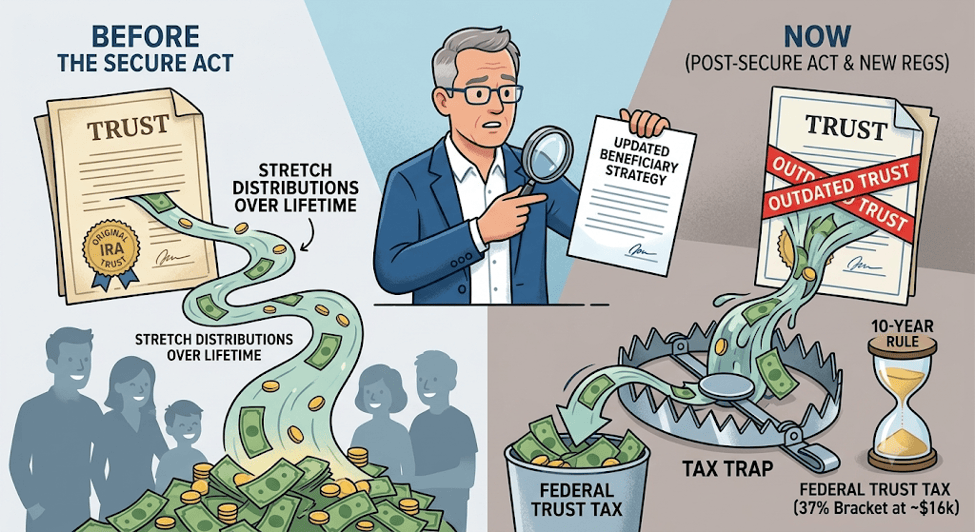
Under older tax law, naming a trust as your IRA beneficiary allowed your heirs to “stretch” distributions—and the tax burden—gradually over their lifetimes. Today, under the post-SECURE Act framework, those rules have been replaced with strict deadlines that could trigger unexpected tax bills if left unchecked.

The Problem: Compressed Trust Tax Brackets

Many older trusts were drafted as “accumulation trusts,” which allow the trustee to hold IRA distributions inside the trust for asset protection. While protection remains valuable, the tax cost has skyrocketed:

  • Individual Tax Brackets: An individual doesn’t reach the top 37% federal marginal tax bracket until their income exceeds $600,000 (or over $750,000 for married couples filing jointly).
  • Trust Tax Brackets: A trust hits the top 37% tax bracket at just over $16,000 of retained income.

If your inherited traditional IRA pushes hundreds of thousands of dollars into a trust over a short period, the IRS takes a significantly larger bite than if the funds were distributed directly or managed through an updated structure.

The 10-Year Rule Factor

Most non-spouse beneficiaries must now fully deplete an inherited IRA by December 31 of the 10th year following the owner’s death. Furthermore, if you pass away after reaching your Required Beginning Date (RBD), your beneficiaries are required to take annual distributions in years 1 through 9 before liquidating the balance in year 10.

Without proactive coordination, forcing large distributions into an outdated trust structure can needlessly drain family wealth.

Strategic Solutions to Consider

  1. Review Conduit vs. Accumulation Language: Ensure trust provisions match current legal definitions for “see-through” status while balancing creditor protection against tax drag.
  2. Lifetime Roth Conversions: Converting traditional IRA assets to a Roth IRA during your lifetime allows the account to pass tax-free to heirs. Inherited Roth IRAs are still subject to the 10-year rule, but distributions come out completely tax-free.
  3. Re-evaluate Direct Beneficiary Designations: For mature heirs who do not require legal protection, direct designations may be far more tax efficient.

If you haven’t reviewed your estate plan and beneficiary designations recently, now is the time to align them with current tax law and your overall financial goals.

Please comment or send an email if you have any questions.

Joe Baker, CFP®

Baker Asset Management, LLC

joebaker@bakerassetmanagement.com
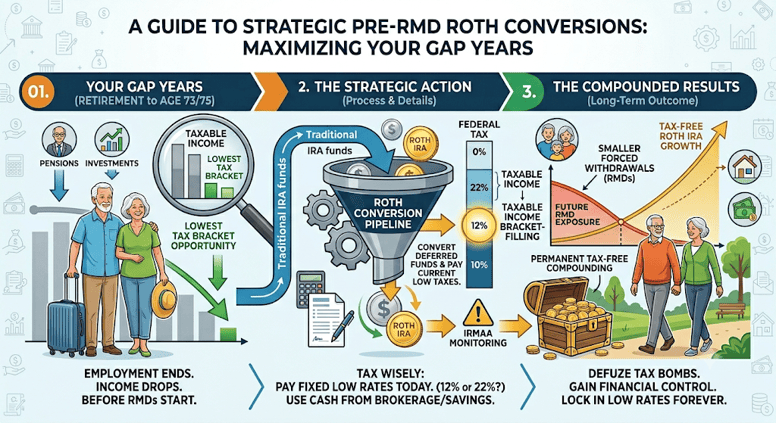
Maximizing Your Gap Years: How Pre-RMD Roth Conversions Protect Your Wealth

The Bottom Line: Waiting until age 73 or 75 to let the government dictate your retirement withdrawals is a costly tax mistake. By executing strategic Roth IRA conversions during your early retirement “gap years,” you can systematically minimize your Traditional IRA balance, shrink future Required Minimum Distributions (RMDs), and lock in historically low tax rates.

The Hidden Tax Trap of Retirement

Many retirees believe that once they stop working, their tax planning is finished. Unfortunately, a major tax trap awaits in your 70s: Required Minimum Distributions (RMDs). If you have spent decades building a substantial nest egg in a tax-deferred Traditional IRA or 401(k), the IRS will eventually force you to withdraw specific percentages annually, regardless of whether you need the cash. These forced distributions are taxed as ordinary income and can easily push you into a significantly higher marginal tax bracket, trigger higher Medicare premiums (IRMAA), and increase the taxation of your Social Security benefits.

The Window of Opportunity: Your “Gap Years”

The optimal time to defuse this tax bomb is during your “gap years”, the golden window after you retire but before your forced RMDs begin. During this period, your earned income drops off, frequently dropping you into the lowest tax brackets you will see for the rest of your life.

The core strategy is simple: Bracket Filling. You intentionally withdraw money from your Traditional IRA, convert it into a Roth IRA, and pay ordinary income tax on that amount today. The goal is to maximize the amount converted at the lowest current marginal rates (the 10% and 12% brackets, or up to the 22% bracket depending on your wealth targets), ensuring that the converted funds grow tax-free and can be withdrawn completely tax-free later in life.

2026 Federal Income Tax Brackets (Marginal Rates)

To implement this effectively, we must evaluate the current federal tax structure. Below are the key ordinary income brackets for the 2026 tax year:

  • 10% Bracket: Single: $0 to $12,400 | Married Filing Jointly: $0 to $24,800
  • 12% Bracket: Single: $12,401 to $50,400 | Married Filing Jointly: $24,801 to $100,800
  • 22% Bracket: Single: $50,401 to $105,700 | Married Filing Jointly: $100,801 to $211,400
  • 24% Bracket: Single: $105,701 to $201,775 | Married Filing Jointly: $211,401 to $403,550

Here’s a few examples to illustrate this strategy.

Scenario A: The Single Filer

Consider a retired single filer with a guaranteed taxable income of $35,000 from a pension and dividends. This lands them squarely within the 12% bracket ($12,401 to $50,400).

  • The Opportunity: The top of the 12% bracket is $50,400.
  • The Calculation: $50,400 − $35,000 = $15,400 of available “headroom.”
  • The Action: Convert exactly $15,400 from their Traditional IRA to a Roth IRA.
  • The Result: The entire $15,400 is taxed at a modest 12%. This fund is now insulated from future tax increases, and the Traditional IRA balance is reduced by $15,400, shrinking future RMD exposure.

Scenario B: Married Filing Jointly

Consider a retired couple filing jointly with a combined base taxable income of $70,000 from investments and social security. They are currently in the 12% bracket ($24,801 to $100,800).

  • The Opportunity: The top of the 12% bracket is $100,800.
  • The Calculation: $100,800 − $70,000 = $30,800 of available headroom.
  • The Action: Convert exactly $30,800 from their Traditional IRA to their Roth IRA.
  • The Result: They lock in a 12% federal tax rate on $30,800. If they waited until RMDs kicked in alongside Social Security, their forced distributions could easily push their taxable income past $100,800, forcing those same dollars to be taxed at 22% or higher.

Critical Guardrails

While the numbers are highly compelling, Roth conversions require precise execution. To ensure compliance and optimize the financial impact, keep these rules in mind:

  • Pay Taxes from Cash, Not the IRA: To maximize the mathematics of a conversion, the income tax generated by the conversion should be paid using cash from non-retirement checking or brokerage accounts. Using IRA assets to pay the tax reduces the compounding power of your tax-free bucket.
  • Watch the IRMAA Thresholds: Roth conversions increase your Adjusted Gross Income (AGI). If your AGI crosses specific thresholds, it can trigger Medicare Part B and Part D premium surcharges (IRMAA) two years later. Always analyze this boundary before converting assets.
  • The 5-Year Rule: Converted earnings and principal must remain in the Roth IRA for at least five years (or until you reach age 59½) to be withdrawn tax-free. Because this strategy targets pre-RMD retirees, the time horizon aligns perfectly, but meticulous record-keeping is vital.

Summary & Next Steps

Roth conversions are not a one-time event; they are a multi-year, proactive tactical strategy. By intentionally paying tax at a known, lower rate today, you seize control of your lifetime tax liability and build a flexible, tax-free financial legacy. Every individual situation requires custom financial projection modeling to guarantee that a conversion does not inadvertently push you into an unfavorable tax cliff.

Please comment or send an email if you have any questions.

Joe Baker, CFP®

Baker Asset Management, LLC

joebaker@bakerassetmanagement.com
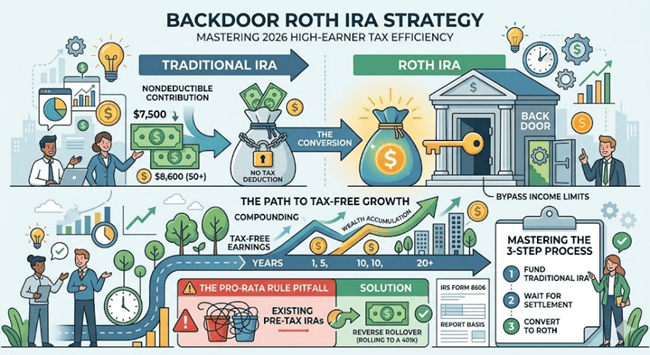
Mastering the Backdoor Roth: A 2026 High-Earner’s Strategy

Building long-term wealth requires more than just picking the right stocks; it requires picking the right tax structures. For high earners, the IRS often closes the front door to tax-free growth. Fortunately, the “backdoor” remains wide open.

Here is the 2026 blueprint for executing a Backdoor Roth conversion with precision.


🚪What is a Backdoor Roth?

A Backdoor Roth isn’t a specific type of account, it’s a strategy.

By law, if your income exceeds certain limits, you are barred from contributing directly to a Roth IRA. However, there are no income limits on contributing to a Traditional IRA or on converting those funds to a Roth. By combining these two steps, you effectively “bypass” the income cap, allowing your money to grow tax-free for decades.

📈Why It Matters in 2026

Tax-advantaged space is a finite resource. In 2026, the contribution limits and income thresholds have shifted, making this strategy more valuable than ever:

  • 2026 Contribution Limit: $7,500 (or $8,600 if you are age 50 or older).
  • The “Front Door” Income Caps: In 2026, the ability to contribute directly to a Roth begins to phase out if your Modified Adjusted Gross Income (MAGI) exceeds:
    • $153,000 (Single)
    • $242,000 (Married Filing Jointly)

⏳When is the “Best Age” to Start?

The short answer: The best age to start is the very first year your income exceeds the direct contribution limits.

Because Roth IRAs grow tax-free, time is your greatest ally. The earlier you start, the more “tax-free compounding” cycles your money undergoes.

  • Early Career (20s-30s): If you are a high-earning young professional, starting now can result in hundreds of thousands of dollars in tax savings by retirement.
  • The “Sweet Spot” (50+): At age 50, the IRS allows “catch-up” contributions (bringing your 2026 total to $8,600). If you haven’t started yet, this is the time to maximize your contributions while you are likely in your peak earning years.
  • The 5-Year Rule: Remember that every conversion starts its own 5-year clock before earnings can be withdrawn tax-free. Starting earlier ensures you clear these hurdles well before you actually need the cash.

🛠️How to Execute (The 3-Step Process)

  1. Fund a Traditional IRA: Open a Traditional IRA and make a nondeductible contribution. This means you don’t take a tax deduction for the contribution (since you’ve already paid tax on that income).
  2. The “Waiting Period”: While not strictly a legal requirement, I typically recommend waiting until the funds fully clear—usually a few business days—before moving to the next step.
  3. The Conversion: Instruct your custodian to move the funds from the Traditional IRA into your Roth IRA.

Expert Tip: Convert the funds as soon as they settle. If the money sits in the Traditional IRA and earns even a few dollars in interest, those earnings will be taxable upon conversion. We want the “basis” and the “conversion amount” to be as identical as possible.

⚠️The “Pro-Rata” Rule: The Biggest Pitfall

This is where most high earners get caught. The IRS views all of your Traditional, SEP, and SIMPLE IRAs as one giant bucket.

If you have $92,500 in an old Rollover IRA (pre-tax) and you add a $7,500 non-deductible contribution (after-tax), the IRS sees a $100,000 total balance. If you try to convert just that $7,500, they will claim only 7.5% of it is tax-free. You would owe income tax on the other 92.5%.

The Solution: Before executing a backdoor conversion, we must look for a “Reverse Rollover”, moving those pre-tax IRA balances into your current employer’s 401(k). 401(k) balances are excluded from this calculation.

📝Reporting to the IRS

Precision in paperwork is mandatory. You must file IRS Form 8606 with your tax return. This form tracks your “basis” (the after-tax money) so the IRS knows you’ve already paid taxes on that contribution and shouldn’t be taxed again during the conversion.


Summary Checklist

  • Verify your 2026 MAGI exceeds the direct Roth limits.
  • Confirm you have zero existing pre-tax IRA balances (check old SEP/SIMPLE/Rollover accounts).
  • Contribute up to $7,500 (or $8,600) to a non-deductible Traditional IRA.
  • Convert to Roth once funds settle.
  • Ensure your tax preparer files Form 8606.

At the end of the day, the Backdoor Roth is about more than just a single year’s contribution; it’s about the compounding power of tax-free growth over the course of your career. While the process is straightforward, the “Pro-Rata” rule and filing requirements leave zero room for error. If you’re ready to secure this tax-advantaged space for 2026 but aren’t sure how your existing IRA balances might impact the strategy, make sure you talk to a tax professional before you move forward.

Please comment or send an email if you have any questions.

Joe Baker, CFP®

Baker Asset Management, LLC

joebaker@bakerassetmanagement.com

Don’t Forget to Review your Beneficiaries

Talking about your beneficiaries means talking about death, specifically your death. Planning for your death may sound like the worst thing ever but it is really an incredibly thoughtful act on your part and will help to minimize stress for your family and loved ones when you ultimately check out.

Beneficiaries are typically assigned to retirement accounts (401k, IRAs, etc.), life insurance and annuity policies, as well as transfer-on-death (TOD) accounts. Naming beneficiaries on these accounts allow these assets to avoid the probate process after your death. If you don’t name any beneficiaries, these accounts will be passed on to your estate where they will go through probate based on your state laws. Probate is a legal proceeding that determines who will get your stuff. It is a lengthy, complex process that can be pretty expensive.

If you have a will, probate will use that to determine how your assets get divvied up. If you don’t have a will, also known as intestate, the state will do the best they can to determine who gets what. Suffice it to say, naming beneficiaries is the way to go. Getting this done before you pass away will make things simpler, quicker, and cheaper for your heirs during a very stressful time.

Naming beneficiaries can also be a very simple and inexpensive estate plan for most people, especially if you title your real estate property as a TOD asset.

You should name both primary and contingent beneficiaries. The primary beneficiary is first in line to receive your assets. If the primary beneficiary passes away before you, the contingent beneficiary will receive those assets, depending on your selection of per capita or per stirpes (see explanation below). You can have as many primary and contingent beneficiaries as you want.

Now, here is the most overlooked section of the beneficiary page: Choosing per stirpes or per capita.

Per stirpes (derived from the Latin word for roots) means that if a beneficiary dies before you die, the deceased beneficiary’s children inherit your money.

Per capita (Latin for each head) means that if a beneficiary dies before you die, their share of the inheritance goes back to the estate and gets divided among the other living beneficiaries.

Choosing which one of these for your beneficiaries is very important and should be considered carefully. In the most basic instance, you should elect per stirpes on your beneficiary designations to ensure that your heirs’ heirs receive their share.

I mentioned transfer-on-death (TOD) accounts earlier and just wanted to review what they are and when to use them. TOD is used for taxable accounts, and it allows you to assign beneficiaries just as you do with retirement accounts, annuities, and life insurance. This allows your taxable accounts to bypass the probate process, which is quicker, cheaper, and less stressful for your heirs.

Also, there are about 25 states that currently offer a TOD deed for real estate property. This is a huge time and money saver for your heirs because the property automatically passes down to your beneficiaries named on the deed.

Finally, remember to review your beneficiaries at least annually and certainly after any major life events, such as death, divorce, marriage, adoption, etc.

Please comment or send an email if you have any questions.

Joe Baker, CFP®

Baker Asset Management, LLC

joebaker@bakerassetmanagement.com

Check Out The New Retirement Plan Contribution Limits for 2025

The IRS recently posted the retirement plan contribution limits for 2025. Here is a table of the new limits as well as the limits from 32024 so you can see how much they have changed:

20252024
 401k, 403b, 457 plans
Employee Contributions:$23,500$23,000
Annual Contribution Limit (employer plus employee contributions)$70,000$69,000
Catch-Up Contributions$7,500$7,500
Age 60-63 Catch-Up Contributions$11,250—
SIMPLE IRA/401k plans
Employee Contribution Limit$16,500$16,000
Catch-Up Contributions$3,500$3,500
Age 60-63 Catch-Up Contributions$5,250—
IRA Contributions$7,000$7,000
Catch-Up IRA Contributions$1,000$1,000

The changes are typical and not surprising except for a new catch-up amount that is allowed for those of us who reach the age of 60, 61, 62, or 63. It is called enhanced catch-up or super catch-up. Whatever you call it, it means you can put more money into your retirement plan in 2025.

For example, if you turn 60 in 2025 and participate in a 401k plan, you can contribute $23,500 plus $11,250 for a total of $34,750.

Please comment or send an email if you have any questions.

Joe Baker, CFP®

Baker Asset Management, LLC

joebaker@bakerassemanagement.com

How to Get Paid by the IRS to Save for Retirement

Do you want to get paid by the IRS for contributing to your IRA or other retirement plans? Well, you can because they will pay you to save for retirement.

There is a little-known tax rule that has been around since 2002 called the Retirement Savings Contributions Credit (Saver’s Credit). This tax credit essentially pays you to put money into your IRA, Roth IRA, 401k, TSA, and most other retirement plans. Here’s a quick summary of how it works:

Eligibility

You are eligible for the credit if you meet certain criteria:

  • Income limits: Your adjusted gross income (AGI) must be below a certain threshold. The exact threshold varies depending on your filing status and whether you are a qualifying individual.
  • Contributions: You must make qualifying contributions to a traditional or Roth IRA, or to an eligible employer-sponsored retirement plan.
  • Age: You must be at least 18 years old and not a full-time student.

Credit Amount

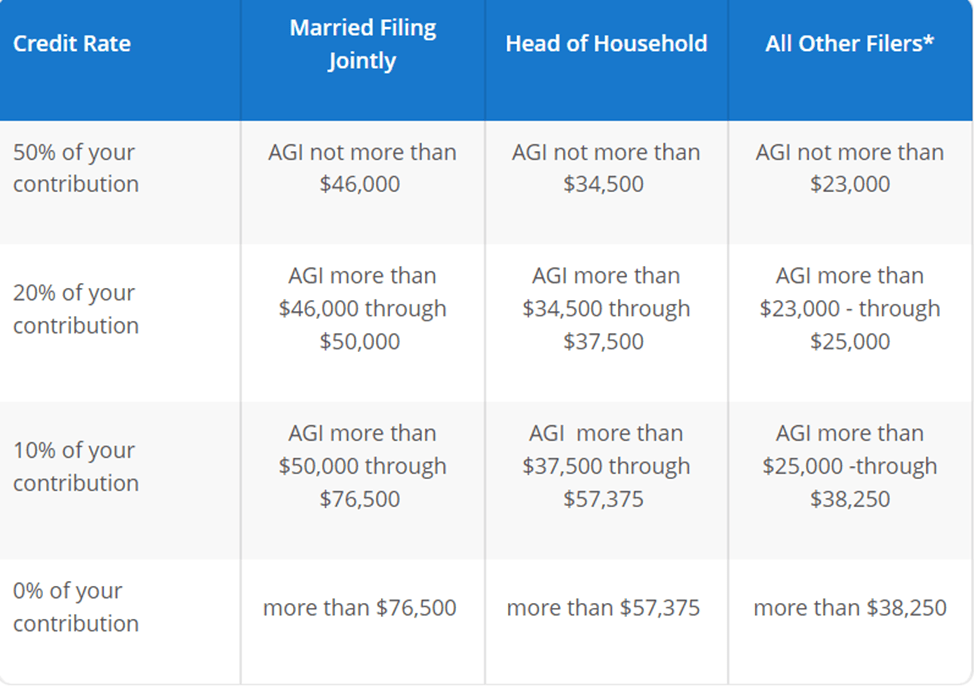
As with most tax credits, the amount is based on your adjusted gross income (AGI) in the year that you contribute. The maximum amount of the credit is 50% of the amount that you contribute to your retirement plan. The maximum contribution amount that can qualify for the credit is $2,000, making the maximum credit $1,000. Here is an example:

Jill, who works at a retail store, is married and earned $41,000 in 2024. Jill’s spouse was unemployed in 2024 and didn’t have any earnings. Jill contributed $2,000 to her IRA for 2024. After deducting her IRA contribution, the adjusted gross income shown on her joint return is $39,000. Jill may claim a 50% credit of $1,000 for her $2,000 IRA contribution on her 2024 tax return.

The following table shows how much of a credit that you are eligible for:

2024 Saver’s Credit Rates and Filing Status

For those that are eligible, it is like getting a match from the government on your contribution. Every little bit helps!

Please comment or send an email if you have any questions.

Joe Baker, CFP®

Baker Asset Management, LLC

joebaker@bakerassemanagement.com