For generations, the ultimate retirement milestone was the “mortgage-burning party”—that moment you paid off your final home loan statement and officially owned your piece of property free and clear.
Entering retirement completely debt-free sounds like a no-brainer. But as with most things in financial planning, the actual answer to “Should I pay off my mortgage before I retire?” isn’t always a simple yes or no.
While eliminating a monthly mortgage payment provides undeniable psychological comfort, writing a massive check to clear your home loan can sometimes work against your overall financial flexibility.
If you’re approaching retirement and weighing this decision, here are the core trade-offs to consider before making a move.
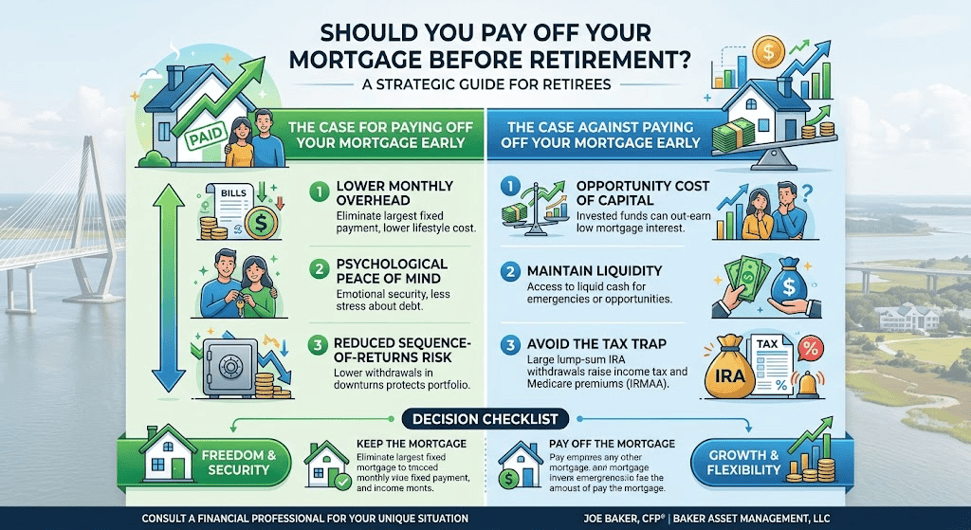
The Case FOR Paying Off Your Mortgage
1. Lower Monthly Overhead
Your mortgage is likely your single largest recurring monthly expense. Eliminating principal and interest payments drastically lowers the baseline income you need each month to maintain your lifestyle. Lower required income means smaller withdrawals from your portfolio.
2. Protection Against “Sequence-of-Returns” Risk
One of the biggest risks in early retirement is a major market downturn right after you stop working. If the market drops and you still have high fixed expenses (like a mortgage), you are forced to sell depreciated investments to pay your bills. By eliminating the mortgage, you lower your mandatory distributions, allowing your investment accounts more room to recover during lean market years.
3. Unbeatable Peace of Mind
The emotional benefit of owning your home outright cannot be overstated. For many retirees, knowing that their housing is secure—regardless of what happens to the stock market or the economy—is worth more than any theoretical mathematical gain.
The Case AGAINST Paying Off Your Mortgage
1. The Opportunity Cost of Capital
If you secured a low fixed mortgage rate in past years, the math may favor keeping the loan. If your mortgage rate is sitting at 3% or 4%, but your diversified investment portfolio or high-yield cash vehicles are earning a higher return, your money may work harder for you staying invested rather than locked up in home equity.
2. Illiquidity: You Can’t Eat Real Estate
Home equity is illiquid wealth. Money used to pay down a mortgage is tied up in bricks and mortar. If an unexpected medical emergency, home repair, or family need arises, accessing that home equity quickly isn’t easy—especially once you no longer have a earned income to qualify for a traditional home equity loan. Having liquid cash or accessible taxable investments provides a safety cushion that a paid-off house cannot.
3. The Tax Trap of Large Lump-Sum Withdrawals
If you don’t have enough liquid cash sitting in a bank account and need to withdraw funds from a Traditional IRA or 401(k) to pay off the mortgage balance, be extremely careful. That withdrawal counts as ordinary income. A single large distribution can instantly push you into a significantly higher tax bracket, trigger higher Medicare premium surcharges (IRMAA), and create a hefty tax bill that wipes out any savings on mortgage interest.
A Quick Checklist: Which Side Are You On?
It may make sense to KEEP your mortgage if:
You hold a very low fixed interest rate.
Paying it off would drain your liquid emergency reserves.
Clearing the balance requires pulling a large lump sum out of a taxable retirement account.
It may make sense to PAY OFF your mortgage if:
You have excess idle cash sitting in low-interest savings accounts that can cover the balance without tax consequences.
Carrying debt causes you significant stress or anxiety.
Eliminating the payment is essential for your retirement cash flow to balance out.
The Bottom Line
There is no one-size-fits-all answer. The choice between mathematical optimization and emotional peace of mind comes down to your personal risk tolerance, tax profile, and retirement cash flow goals.
Before making a large lump-sum payment on your mortgage, it’s always wise to run the numbers to see how it impacts your long-term retirement projections and tax liability.
Please comment or send an email if you have any questions.
For years, one of the biggest hesitations I’ve heard from parents and grandparents about funding a 529 college savings plan was the fear of overfunding it. “What if they get a scholarship?” or “What if they don’t go to college? We’ll get hit with taxes and a 10% penalty if we pull the money out.”
Thanks to the SECURE 2.0 Act, that fear is largely gone.
We now have a powerful new financial planning tool: the ability to roll over unused 529 plan funds directly into a Roth IRA for the beneficiary. This effectively turns an education savings account into a tax-free retirement springboard.
Here’s how it works and what you need to know.
The Mechanics of the 529-to-Roth Rollover
If your child or grandchild finishes their education and still has money left in their 529 plan, you can transfer those funds into a Roth IRA in their name. The money moves from a tax-free education account to a tax-free retirement account without incurring taxes or penalties.
This is massive. A young adult starting their career with a jump-started Roth IRA has decades of tax-free compounding ahead of them.
The Rules of the Game (And There Are Several)
As with anything tax-related, the IRS has strict rules you must follow to execute this strategy cleanly:
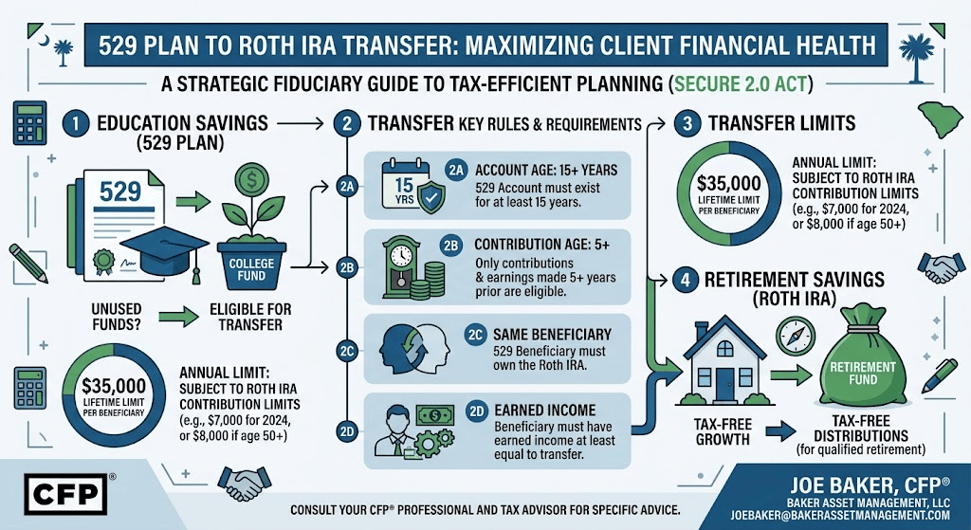
The $35,000 Lifetime Limit: You can only transfer a maximum of $35,000 during the beneficiary’s lifetime. This isn’t an unlimited backdoor.
Annual IRA Contribution Limits Apply: You cannot move the entire $35,000 at once. The transfers are subject to the annual IRA contribution limits. For 2026, that limit is $7,500. It will take nearly five years to transfer the full $35,000.
Earned Income Requirement: The beneficiary must have earned income (W-2 wages or self-employment income) in the year of the transfer, and the transfer amount cannot exceed their earned income for that year.
The 15-Year Rule: The 529 plan must have been open for at least 15 years.
The 5-Year Rule: Contributions (and the earnings on those contributions) made to the 529 plan in the five years prior to the rollover cannot be transferred.
Direct Transfer: The rollover must be moved directly from the 529 plan to the Roth IRA (a trustee-to-trustee transfer). Do not cash out the 529 and try to deposit it into the Roth yourself.
Why This is a Game Changer
This legislation effectively removes the risk of “over-saving” for college.
Bypassing High-Income Limits: Even if your young adult child earns too much to contribute directly to a Roth IRA, they can still receive these 529-to-Roth transfers.
Decades of Tax-Free Growth: If you fund a Roth IRA with $7,500 a year from ages 22 to 26 (using leftover 529 funds) and never add another dime, that $35,000 could grow to several hundred thousand dollars of tax-free money by the time they reach retirement age.
What You Should Do Now
If you have an existing 529 plan, track its age. If you’ve been putting off opening a 529 because of overfunding fears, start one now to get the 15-year clock ticking.
Before executing a transfer, you should run the numbers and ensure all IRS criteria are met to avoid unexpected tax hits or state-level recapture rules (some states may treat the rollover as a non-qualified withdrawal).
Please comment or send an email if you have any questions.
If you’ve been keeping an eye on the financial news lately, you’ve probably heard a massive amount of buzz about Trump Accounts (officially known as Section 530A accounts). Authorized under federal legislation, the platform officially went live for funding on July 4, 2026!
If you are looking to build long-term wealth for the next generation, this new vehicle is shaking things up. But like any new government financial program, it comes with a mountain of fine print. Is it a golden opportunity to jumpstart your kid’s financial future, or is it a tax headache waiting to happen?
Let’s break down exactly what Trump Accounts are, how they operate, where you can open one today, and whether they deserve a spot in your family’s financial toolkit.
What is a Trump Account?
Think of a Trump Account as a traditional IRA designed specifically for minors, but with a game-changing twist: your child does not need earned income for contributions to be made. The core goal of the program is to get kids invested in the stock market early to harness the massive power of long-term compounding.
From the day you open the account until December 31st of the year before your child turns 18, the account enters its “growth period.” During this time, the rules are highly specific:
100% Equities: By law, the funds must be invested in low-cost, broad-market U.S. equity index funds or ETFs.
Fee Caps: To protect families, fund expense ratios are legally capped at a razor-thin 0.10%.
No Glide Path: Unlike typical target-date college funds, a Trump Account won’t automatically shift into safer bonds as your child gets closer to adulthood. It rides the stock market wave all the way through childhood.
Contribution Limits & Free Government Money
One of the best perks of a Trump Account is that there are no income limits to open one. Anyone can participate. Here is how the funding breaks down:
Annual Contribution Cap: Total individual and employer contributions are capped at $5,000 per year per child (adjusted for inflation starting in 2028).
Free $1,000 Government Seed: If your child is a U.S. citizen born between January 1, 2025, and December 31, 2028, the U.S. Treasury will drop a one-time $1,000 deposit into their account to kick things off. Note: You must manually claim this via the registration process; it isn’t automatic!
Employer Matches: Employers can chip in up to $2,500 per year to an employee’s child’s account. This counts toward the $5,000 annual limit but is entirely excluded from the employee’s taxable wages.
Charitable Boosts: Eligible children (such as those 10 or younger in qualifying ZIP codes) may also receive private grants, like a $250 deposit from participating philanthropic organizations like the Michael & Susan Dell Foundation.
Quick Tip: Government seed money and qualifying charitable grants do not count against your $5,000 annual individual contribution limit.
What Are the Investment Options & How Do You Buy Them?
Because the law forces a strict “hands-off, low-fee” approach during childhood, you won’t be using these accounts to day-trade tech stocks or crypto.
As of the platform launch, there is currently only one investment option. All cash deposited into a Trump Account is automatically swept into:
SPYM (State Street SPDR Portfolio S&P 500 ETF): Selected by the Treasury because it features one of the absolute lowest-cost S&P 500 tracking fees on the market.
Over the coming months, the Treasury plans to phase in four other broad-market ETFs: Vanguard’s VTI, iShares’ IVV and ITOT, and SPDR’s SPTM. Regardless of which fund is active, the 0.10% fee cap remains legally locked in.
How to Purchase
The purchase process is completely automated. You don’t have to log in and manually click “buy.”
Linked Bank Transfers (ACH): Link your checking account through the app or portal for one-time or automated monthly recurring transfers.
Payroll Deductions: If your employer offers a Trump Account match, the funds flow straight from your paycheck into the account.
The “Gifting” Code: The platform allows you to generate a personalized contribution code. You can text or email this to grandparents, aunts, or uncles, letting them deposit cash directly for birthdays or holidays without you acting as the middleman.
The moment any funds hit the account, the platform instantly and automatically buys shares of the designated index fund at the next available market price.
Taxability & Distributions: The Sticky Part
Here is where you need to pay close attention, because Trump Accounts do not work like a tax-free Roth IRA.
Tax-Deferred Growth: Money grows tax-deferred, meaning you won’t pay annual taxes on capital gains or dividends while it sits in the account.
The Withdrawal Tax: When money is eventually taken out, all earnings and pre-tax contributions (like government seed money and employer matches) are taxed as ordinary income. * Tracking Your Basis: Family contributions are made with after-tax dollars. Because you already paid taxes on that money, it creates a “basis.” Your child won’t be taxed on the return of your original contributions, but they will be taxed on the growth.
What Happens at Age 18?: On January 1 of the calendar year your child turns 18, the account converts into a traditional IRA under their full control. They gain the freedom to change investments as they see fit.
The Penalty Rule: Because it transforms into a traditional IRA, taking money out before age 59½ subjects the taxable portion to ordinary income tax plus a 10% early withdrawal penalty. Fortunately, standard IRA exceptions apply—meaning they can pull money out penalty-free (though still taxed) for higher education, a first-time home down payment, or starting a business.
Where Can You Set One Up Right Now?
Because Trump Accounts are tightly tied to federal infrastructure, you cannot open one directly from scratch on a private brokerage site like Fidelity or Vanguard just yet. The U.S. Treasury acts as the default initial custodian.
To open an account right now, you have three primary paths:
The Official Portal: Head over to TrumpAccounts.gov to register your child and verify eligibility.
The Mobile App: Download the official Trump Accounts mobile app (built in partnership with Robinhood and BNY Mellon) on the Apple App Store or Google Play to handle registration and link your bank.
IRS Form 4547: This is the official “Trump Account Election” form. You can file it electronically through your secure IRS Online Account, e-file it alongside your federal tax return, or submit it digitally via the Trump Accounts portal.
The Private Brokerage Route: Major firms like Fidelity, Vanguard, and Charles Schwab are actively building systems to support these accounts. However, you must use the Treasury portal or Form 4547 to initiate the account and claim the $1,000 government seed money first. Once active, you can request a trustee-to-trustee rollover to your preferred private broker.
Trump Account vs. 529 Plan: Head-to-Head
If you’re wondering whether to prioritize a Trump Account or a traditional 529 plan, remember that they serve entirely different primary purposes:
No earned income required (unlike a custodial Roth IRA).
Locked-in ultra-low fees (0.10% cap).
Tax-free employer matching up to $2,500.
The Cons:
Heavy tax drag later (paying ordinary income tax on decades of stock market growth).
Zero investment flexibility until age 18.
Complete loss of parental control at age 18.
Highly complex record-keeping to track after-tax vs. pre-tax bases over 18 years.
The Verdict: Which should you choose?
If your number one goal is funding college or trade school, the 529 plan remains the undisputed champ due to its completely tax-free withdrawals and permanent parental control.
However, if you have a child born between 2025 and 2028, grabbing that free $1,000 government seed money is a complete no-brainer. Think of them as complementary financial tools: use the 529 to cover school and use the Trump Account to hand your child a massive head start on retirement wealth—especially since savvy financial advisors are already plotting out strategies to convert these into Roth IRAs once your child reaches adulthood!
Please comment or send an email if you have any questions.
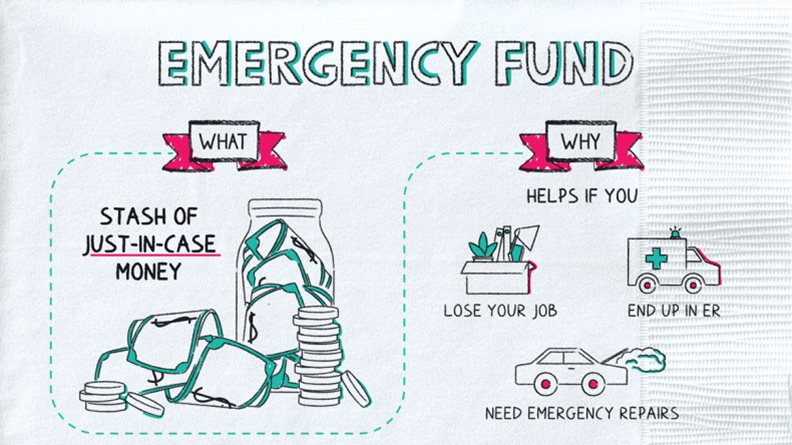
In the current interest rate environment, it is a good idea to shop around for the best savings rates when deciding where to park your emergency funds. As the graphic above suggests, an emergency fund is an account that contains cash that is liquid (easy and quick to access) so that it can be used if something unexpected happens and calls for some money quickly.
An emergency fund should be at the top of the list regarding the order that you should fund your financial accounts. Amazingly, most Americans say that they wouldn’t be able to pay off a $1,000 emergency expense if it ever came up. Almost as amazing is for those fortunate enough to have an adequate emergency fund, about 70% of them keep their emergency fund in their regular checking account, earning zero percent interest or close to it.
Yes, it does take a little effort to find a savings, checking, or money market account that pays a respectable interest rate, but it can be well worth it. There are money market account (MMA) rates near 5.5% right now, far better than the current average savings account yield of 0.08%. For example, $30,000 in an MMA yielding 5% will earn $1,500 in interest annually, versus $24 in the average savings account. That’s not bad for doing a little leg work.
A quick search on Google will give you a ton of options for both online and brick-and-mortar bank rates. Here are two that I like to use:
It’s important to consider other factors besides just the interest rate when choosing a money market account, such as minimum balance requirements, monthly fees, and ATM access.
Please comment or send an email if you have any questions. Thanks!