For years, one of the biggest hesitations I’ve heard from parents and grandparents about funding a 529 college savings plan was the fear of overfunding it. “What if they get a scholarship?” or “What if they don’t go to college? We’ll get hit with taxes and a 10% penalty if we pull the money out.”
Thanks to the SECURE 2.0 Act, that fear is largely gone.
We now have a powerful new financial planning tool: the ability to roll over unused 529 plan funds directly into a Roth IRA for the beneficiary. This effectively turns an education savings account into a tax-free retirement springboard.
Here’s how it works and what you need to know.
The Mechanics of the 529-to-Roth Rollover
If your child or grandchild finishes their education and still has money left in their 529 plan, you can transfer those funds into a Roth IRA in their name. The money moves from a tax-free education account to a tax-free retirement account without incurring taxes or penalties.
This is massive. A young adult starting their career with a jump-started Roth IRA has decades of tax-free compounding ahead of them.
The Rules of the Game (And There Are Several)
As with anything tax-related, the IRS has strict rules you must follow to execute this strategy cleanly:
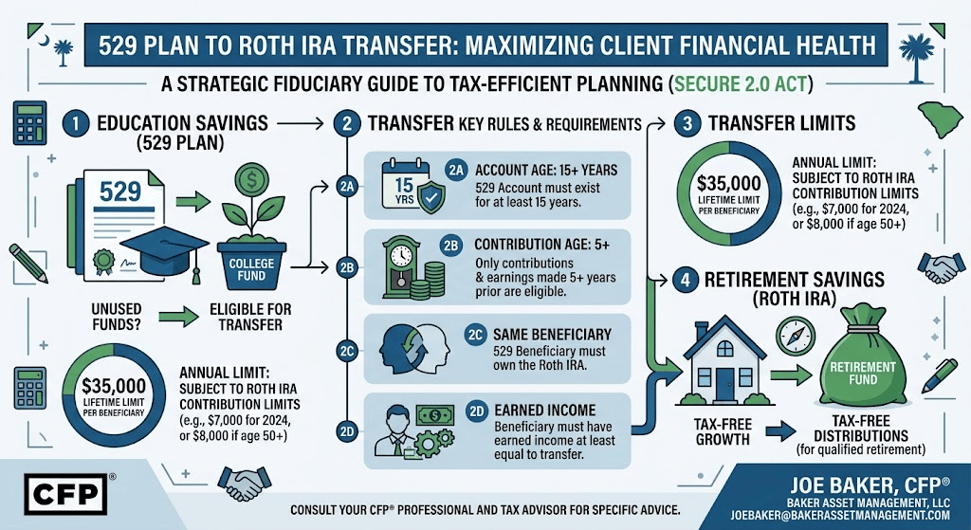
- The $35,000 Lifetime Limit: You can only transfer a maximum of $35,000 during the beneficiary’s lifetime. This isn’t an unlimited backdoor.
- Annual IRA Contribution Limits Apply: You cannot move the entire $35,000 at once. The transfers are subject to the annual IRA contribution limits. For 2026, that limit is $7,500. It will take nearly five years to transfer the full $35,000.
- Earned Income Requirement: The beneficiary must have earned income (W-2 wages or self-employment income) in the year of the transfer, and the transfer amount cannot exceed their earned income for that year.
- The 15-Year Rule: The 529 plan must have been open for at least 15 years.
- The 5-Year Rule: Contributions (and the earnings on those contributions) made to the 529 plan in the five years prior to the rollover cannot be transferred.
- Direct Transfer: The rollover must be moved directly from the 529 plan to the Roth IRA (a trustee-to-trustee transfer). Do not cash out the 529 and try to deposit it into the Roth yourself.
Why This is a Game Changer
This legislation effectively removes the risk of “over-saving” for college.
- Bypassing High-Income Limits: Even if your young adult child earns too much to contribute directly to a Roth IRA, they can still receive these 529-to-Roth transfers.
- Decades of Tax-Free Growth: If you fund a Roth IRA with $7,500 a year from ages 22 to 26 (using leftover 529 funds) and never add another dime, that $35,000 could grow to several hundred thousand dollars of tax-free money by the time they reach retirement age.
What You Should Do Now
If you have an existing 529 plan, track its age. If you’ve been putting off opening a 529 because of overfunding fears, start one now to get the 15-year clock ticking.
Before executing a transfer, you should run the numbers and ensure all IRS criteria are met to avoid unexpected tax hits or state-level recapture rules (some states may treat the rollover as a non-qualified withdrawal).
Please comment or send an email if you have any questions.
Joe Baker, CFP®
Baker Asset Management, LLC
joebaker@bakerassetmanagement.com