
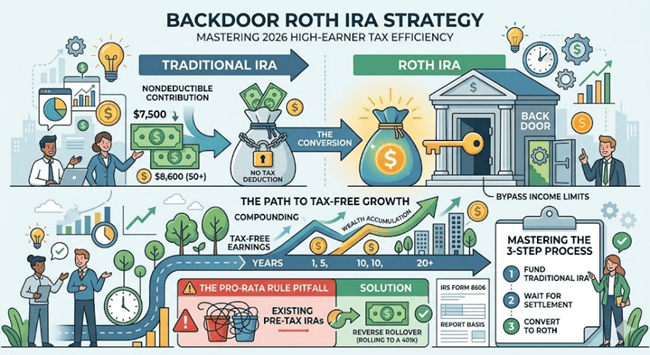
Building long-term wealth requires more than just picking the right stocks; it requires picking the right tax structures. For high earners, the IRS often closes the front door to tax-free growth. Fortunately, the “backdoor” remains wide open.
Here is the 2026 blueprint for executing a Backdoor Roth conversion with precision.
🚪What is a Backdoor Roth?
A Backdoor Roth isn’t a specific type of account, it’s a strategy.
By law, if your income exceeds certain limits, you are barred from contributing directly to a Roth IRA. However, there are no income limits on contributing to a Traditional IRA or on converting those funds to a Roth. By combining these two steps, you effectively “bypass” the income cap, allowing your money to grow tax-free for decades.
📈Why It Matters in 2026
Tax-advantaged space is a finite resource. In 2026, the contribution limits and income thresholds have shifted, making this strategy more valuable than ever:
- 2026 Contribution Limit: $7,500 (or $8,600 if you are age 50 or older).
- The “Front Door” Income Caps: In 2026, the ability to contribute directly to a Roth begins to phase out if your Modified Adjusted Gross Income (MAGI) exceeds:
- $153,000 (Single)
- $242,000 (Married Filing Jointly)
⏳When is the “Best Age” to Start?
The short answer: The best age to start is the very first year your income exceeds the direct contribution limits.
Because Roth IRAs grow tax-free, time is your greatest ally. The earlier you start, the more “tax-free compounding” cycles your money undergoes.
- Early Career (20s-30s): If you are a high-earning young professional, starting now can result in hundreds of thousands of dollars in tax savings by retirement.
- The “Sweet Spot” (50+): At age 50, the IRS allows “catch-up” contributions (bringing your 2026 total to $8,600). If you haven’t started yet, this is the time to maximize your contributions while you are likely in your peak earning years.
- The 5-Year Rule: Remember that every conversion starts its own 5-year clock before earnings can be withdrawn tax-free. Starting earlier ensures you clear these hurdles well before you actually need the cash.
🛠️How to Execute (The 3-Step Process)
- Fund a Traditional IRA: Open a Traditional IRA and make a nondeductible contribution. This means you don’t take a tax deduction for the contribution (since you’ve already paid tax on that income).
- The “Waiting Period”: While not strictly a legal requirement, I typically recommend waiting until the funds fully clear—usually a few business days—before moving to the next step.
- The Conversion: Instruct your custodian to move the funds from the Traditional IRA into your Roth IRA.
Expert Tip: Convert the funds as soon as they settle. If the money sits in the Traditional IRA and earns even a few dollars in interest, those earnings will be taxable upon conversion. We want the “basis” and the “conversion amount” to be as identical as possible.
⚠️The “Pro-Rata” Rule: The Biggest Pitfall
This is where most high earners get caught. The IRS views all of your Traditional, SEP, and SIMPLE IRAs as one giant bucket.
If you have $92,500 in an old Rollover IRA (pre-tax) and you add a $7,500 non-deductible contribution (after-tax), the IRS sees a $100,000 total balance. If you try to convert just that $7,500, they will claim only 7.5% of it is tax-free. You would owe income tax on the other 92.5%.
The Solution: Before executing a backdoor conversion, we must look for a “Reverse Rollover”, moving those pre-tax IRA balances into your current employer’s 401(k). 401(k) balances are excluded from this calculation.
📝Reporting to the IRS
Precision in paperwork is mandatory. You must file IRS Form 8606 with your tax return. This form tracks your “basis” (the after-tax money) so the IRS knows you’ve already paid taxes on that contribution and shouldn’t be taxed again during the conversion.
Summary Checklist
- Verify your 2026 MAGI exceeds the direct Roth limits.
- Confirm you have zero existing pre-tax IRA balances (check old SEP/SIMPLE/Rollover accounts).
- Contribute up to $7,500 (or $8,600) to a non-deductible Traditional IRA.
- Convert to Roth once funds settle.
- Ensure your tax preparer files Form 8606.
At the end of the day, the Backdoor Roth is about more than just a single year’s contribution; it’s about the compounding power of tax-free growth over the course of your career. While the process is straightforward, the “Pro-Rata” rule and filing requirements leave zero room for error. If you’re ready to secure this tax-advantaged space for 2026 but aren’t sure how your existing IRA balances might impact the strategy, make sure you talk to a tax professional before you move forward.
Please comment or send an email if you have any questions.
Joe Baker, CFP®
Baker Asset Management, LLC
joebaker@bakerassetmanagement.com

