
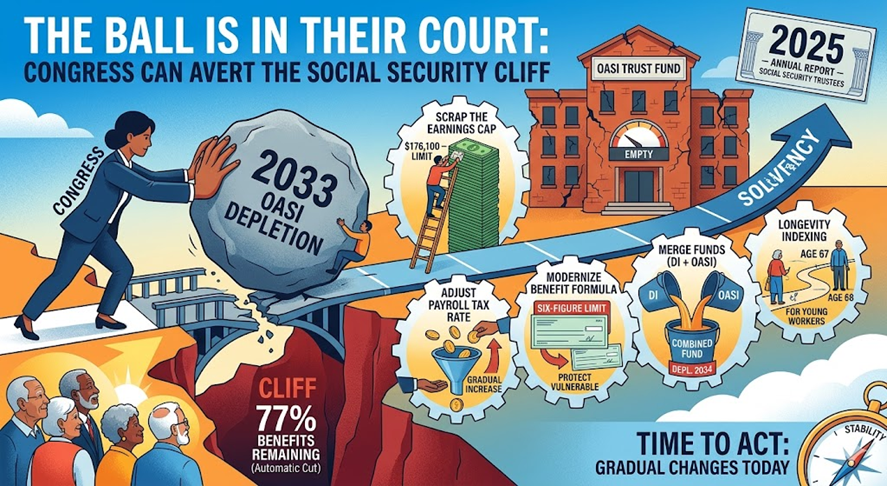
Social Security isn’t failing because of a lack of math; it’s stalling because of a lack of movement in Washington. While the program’s trust funds are undeniably shrinking, this is a crisis of legislative willpower rather than a lack of solutions. The 2025 Trustees Report makes it clear that the “safety net” is held up by a fraying rope, but Congress still holds the scissors—and the spool of thread. To save the program, lawmakers must stop treating Social Security as a political “third rail” and start treating it as a standard legislative repair project.
The Current Trajectory (2025 Trustees Report)
According to the Social Security Board of Trustees’ 2025 Annual Report, the timeline for action has narrowed. The report underscores that without intervention from the Capitol, the following milestones are inevitable:
- The 2033 Deadline: The Old-Age and Survivors Insurance (OASI) Trust Fund—the primary source for retiree benefits—is projected to be depleted in 2033.
- The Enforced Benefit Cut: Under current law, once reserves are gone, the Social Security Administration cannot pay full benefits. By 2033, incoming tax revenue would only cover 77% of scheduled payments, resulting in an immediate 23% cut for all beneficiaries unless Congress changes the law.
- Growing Deficit: The 75-year actuarial deficit has risen to 3.82% of taxable payroll, meaning the gap Congress needs to bridge is larger than it was just one year ago.
The Congressional “Fix-It” List
Congress has several specific levers they can pull to stabilize the system for the next 75 years without cutting benefits for those who rely on them most. Fixing the program will likely require a “grand bargain” involving these components:
- Scrapping the Earnings Cap: Currently, Social Security taxes are only collected on income up to $176,100 (for 2025). High earners stop paying into the system once they hit that mark. Congress could eliminate this cap or create a “donut hole” (e.g., taxing income above $250,000) to ensure the wealthiest Americans contribute at the same rate as the middle class. I feel this is the best way to fix the problem and can be implemented quickly.
- Gradual Payroll Tax Adjustments: The 12.4% payroll tax (split between you and your employer) hasn’t moved in decades. A tiny, phased-in increase—such as 0.1% per year—would be barely noticeable on a weekly paycheck but would pour billions back into the trust fund over time.
- Modernizing the Benefit Formula (The “Six-Figure Limit”): Lawmakers are currently debating a cap on maximum benefits for high-income couples (e.g., a $100,000 limit). By slowing benefit growth for the top 1–5% of earners, Congress can redirect funds to keep the program solvent for everyone else.
- Longevity Indexing: For younger generations, Congress could index the retirement age to life expectancy. This would mean the age moves by mere months over several decades, reflecting the reality that we are living longer than the workers of 1935.
The math behind Social Security is straightforward; the politics are what’s complicated. We don’t need a miracle to save Social Security; we need a Congress that is willing to trade short-term political points for long-term national stability. By acting now, lawmakers can implement small, gradual changes that protect current retirees and guarantee a future for the next generation. The 2033 “cliff” is seven years away—it’s time for Washington to pick up the tools and get to work.
Please comment or send an email if you have any questions.
Joe Baker, CFP®
Baker Asset Management, LLC
joebaker@bakerassetmanagement.com

