
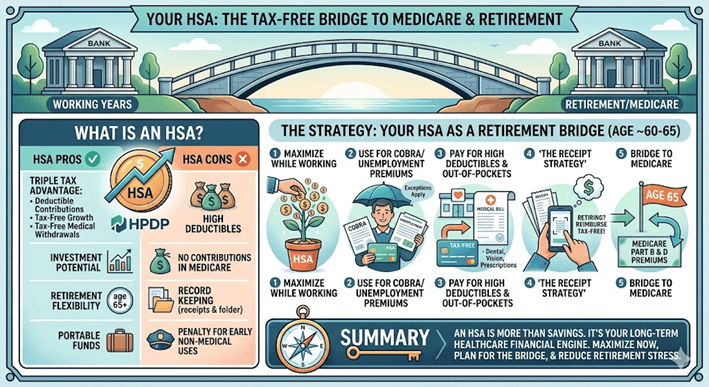
For many Americans, the road to retirement includes a significant “bridge” period: the years between leaving a career and becoming eligible for Medicare at age 65. Navigating this gap can be a financial tightrope, as private health insurance premiums and out-of-pocket medical costs often skyrocket just as a steady paycheck disappears. Fortunately, one of the most powerful tools for crossing this bridge is already in the wallets of millions. A Health Savings Account (HSA) isn’t just a way to pay for today’s bandages and prescriptions; when managed strategically, it acts as a tax-advantaged “health 401(k)” that can fund your healthcare needs during those critical pre-Medicare years.
What is an HSA and an HDHP?
To understand an HSA, you must first understand the insurance plan that allows you to have one.
- High-Deductible Health Plan (HDHP): For 2026, the IRS defines an HDHP as a plan with a minimum annual deductible of $1,700 for self-only coverage or $3,400 for family coverage. Additionally, the plan’s annual out-of-pocket expenses (including deductibles, copayments, and coinsurance, but not premiums) cannot exceed $8,500 for self-only coverage or $17,000 for family coverage.
- Health Savings Account (HSA): This is a unique, tax-advantaged savings account available only to those enrolled in an HDHP. Unlike a Flexible Spending Account (FSA), the money in an HSA is yours to keep forever; it doesn’t expire at the end of the year, and it stays with you even if you change jobs or retire.
2026 HSA Contribution Limits
Knowing the limits is crucial for maximizing your “bridge” funding before you leave the workforce.
- Self-Only Coverage: You can contribute up to $4,400 annually.
- Family Coverage: You can contribute up to $8,750 annually.
- Catch-Up Contribution (Age 55+): If you are 55 or older, you can contribute an additional $1,000 on top of the limits listed above, bringing your potential total contribution to $5,400 for an individual or $9,750 for a family in 2026.
Pros and Cons of an HSA
| Pros | Cons |
| Triple Tax Advantage: Contributions are tax-deductible, growth is tax-free, and withdrawals for medical expenses are tax-free. | High Deductibles: You’ll pay significantly more out-of-pocket before insurance coverage begins, which requires disciplined saving. |
| Investment Potential: Most providers allow you to invest your balance in stocks or mutual funds for long-term, compounded growth. | Strict Eligibility: You cannot contribute once you enroll in Medicare or if you have other non-qualified health coverage. |
| Retirement Flexibility: After age 65, you can withdraw funds for any reason without penalty (though non-medical withdrawals are taxed as income). | Record Keeping: You must save receipts to prove to the IRS that your withdrawals were for qualified medical expenses. |
The Strategy: Using Your HSA as a Retirement Bridge
The “bridge” period (typically ages 60–65) is where the HSA shines. Because you can no longer contribute to an HSA once you are on Medicare, your goal should be to maximize your balance while working and then deploy it strategically once you retire.
- Fund Your Premiums During COBRA or Unemployment: Generally, you cannot use an HSA to pay health insurance premiums. However, there are two major exceptions for retirees: COBRA and Unemployment. If you leave your job and use COBRA to keep your insurance, or if you are receiving state or federal unemployment benefits, you can use your HSA tax-free to pay those premiums.
- Cover Out-of-Pocket Costs: If you transition to an ACA Marketplace plan or a private plan before 65, you will likely face the high deductibles required by those plans. Your HSA can cover 100% of these “qualified medical expenses”—including dental, vision, and prescriptions—with tax-free dollars, preserving your other retirement accounts.
- The “Receipt Strategy” for Maximum Cash Flow: If you can afford to pay for medical expenses out-of-pocket while working, do it—and save the receipts. There is no time limit on when you must reimburse yourself. You can “bank” those receipts for years and then withdraw the cash from your HSA tax-free during retirement to use for travel or living expenses.
- Bridge to Medicare Premiums: Once you hit 65, the bridge is complete, but the utility continues. You can use remaining HSA funds to pay for Medicare Part B and Part D premiums, further reducing your monthly retirement costs.
An HSA is far more than a simple savings account; it is a versatile financial engine that provides a tax-free safety net when you are most vulnerable to rising healthcare costs. By viewing your HSA as a long-term investment rather than a short-term spending account, you can transform the “bridge” to Medicare from a source of stress into a well-funded, strategic transition.
Please comment or send an email if you have any questions.
Joe Baker, CFP®
Baker Asset Management, LLC
joebaker@bakerassetmanagement.com

