
With the November 3 midterm elections weeks away, the usual noise is building: attack ads, cable news panels, and a steady drip of “this changes everything” headlines. If you’re an investor, history says the smartest move may be to look past all of it.
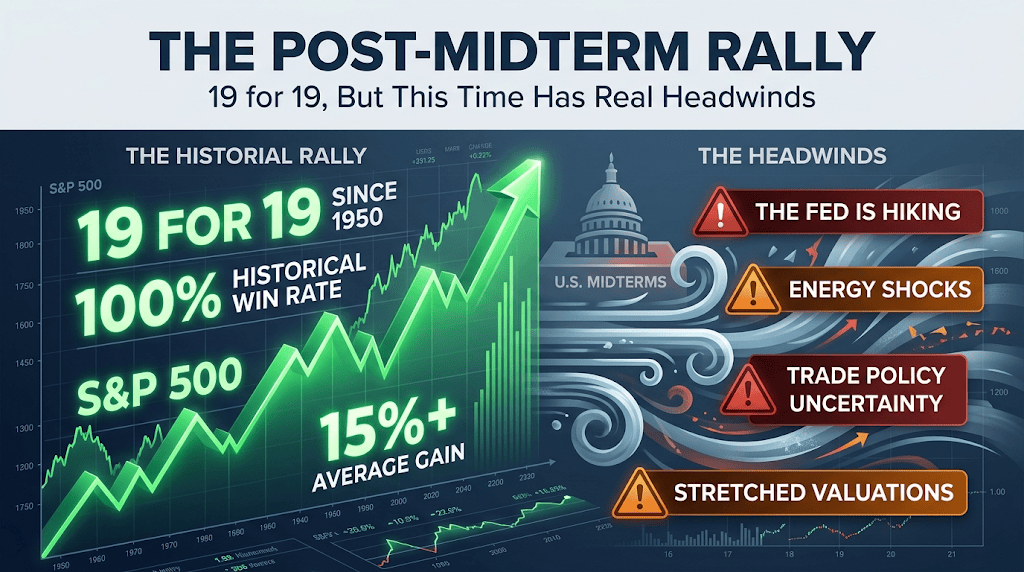
Since 1950, the S&P 500 has not posted a single negative return in the 12 months following a midterm election. That is 19 midterms and 19 positive years—a streak that has endured through recessions, oil shocks, foreign conflicts, and a global financial crisis.
But this cycle arrives with a unique set of obstacles: a rate-hiking Federal Reserve, an energy shock that has already materialized, unresolved trade policy, and near-record valuations. Does the streak survive?
The Streak, in Numbers
The consistency is remarkable. According to research compiled by LPL Research Market Analysis, the S&P 500 has been solidly higher 12 months after every midterm election since 1954. The average gain in the 12 months following a midterm is roughly 15% to 18% depending on the historical window and dataset used. The exact figure varies by methodology, but the direction has never flipped.
However, two caveats are worth keeping in mind:
- The 12-Month Window Isn’t Calendar 2027: The statistic measures performance across the 12 months following Election Day—roughly November 2026 through November 2027—rather than the standard calendar year.
- A Weak Starting Point Flatters the Return: Midterm election years themselves are historically sluggish. Data from LPL Research Market Analysis shows that midterm years average lower returns than any other point in the four-year presidential cycle. A bounce off a pre-election slump naturally flatters the subsequent 12-month figure.
Why It Tends to Happen
The primary explanation is simple: markets hate uncertainty, and midterms resolve a tremendous amount of it. Once the results are in, investors can refocus on corporate earnings, fundamental growth, and monetary policy.
What about government gridlock? While often cited as the primary catalyst, the historical evidence is mixed. Some market studies indicate that unified governments have occasionally delivered stronger excess returns than divided ones, and the post-midterm rally has occurred regardless of party alignment.
Keep in mind that 19 data points represent a relatively small sample size that overlaps directly with the broader four-year presidential cycle. A 100% win rate is a compelling base rate, but it is not a law of nature.
Headwind #1: The Fed Is Hiking, Not Easing
It is tempting to assume the historical pattern relied on low-interest-rate environments, but that narrative does not hold up to scrutiny. Only the 2010 midterm coincided with zero interest rates; both the 2018 and 2022 midterms occurred during Fed tightening cycles, and the streak held firm.
What makes today different is the current policy trajectory. As documented in the Federal Reserve Monetary Policy Statement, the central bank raised the benchmark federal funds rate by 25 basis points to a 3.75%–4.00% target range. Detailed analysis in the Raisin FOMC Minutes Breakdown underscores that policymakers remain watchful of sticky inflation.
Higher interest rates pressure valuation multiples—particularly for long-duration technology and AI growth stocks. Consequently, any post-election rally in 2027 will need to be earned through organic corporate earnings growth rather than central-bank liquidity.
Headwind #2: The Energy Shock Already Happened
Geopolitical risk in this cycle is not a hypothetical tail risk. As documented in the Wikipedia Strait of Hormuz Crisis Overview, military conflict disrupted energy transit through the Strait of Hormuz, temporarily bottlenecking global crude supplies and driving Brent crude toward $120 per barrel.
While shipping flows have partially recovered and crude prices have retreated from their peaks, energy markets remain volatile. For investors, the question is no longer “what if energy supplies are disrupted?” but rather how much economic damage corporate margins have already absorbed, and how sticky energy-driven inflation will remain.
Headwind #3: Trade Policy Isn’t Resolved
Election Day will not bring immediate clarity on foreign trade policy. Following the Supreme Court’s February ruling invalidating IEEPA-based tariffs, as detailed in the Levy Economics Institute Tariff Analysis, the administration shifted to broad Section 301 duties across dozens of economies.
As noted in the Coppersmith Section 301 Duty Breakdown, these replacement tariffs face active legal challenges, creating an environment where trade rules remain fluid. This persistent policy shift directly counters the traditional “post-election fading of uncertainty” that markets typically enjoy.
Headwind #4: Valuations Leave Little Margin for Error
While the 19-for-19 streak has survived recessions and wars, starting valuations pose a distinct risk. According to the YCharts S&P 500 Shiller CAPE Ratio Tracker, the Cyclically Adjusted Price-to-Earnings (CAPE) ratio sits near historical highs around 40.7.
Reporting from TheStreet Market Valuation Report highlights that CAPE levels above 40 have historically been associated with lower long-term forward returns. Rich valuation multiples leave the S&P 500 vulnerable to earnings disappointments, especially in a higher-rate regime.
So, Will History Repeat?
The historical baseline remains powerful: a perfect 19-for-19 record is difficult to bet against, and political clarity following Election Day typically frees up sidelined capital.
However, this cycle features a rate-hiking Fed, energy markets recovering from a supply shock, unresolved trade litigation, and stretched valuations. The odds favor a positive 12-month return, but the margin for error is notably thinner than historical averages suggest. High-quality companies with strong balance sheets, pricing power, and resilient cash flows remain best positioned to navigate the terrain ahead.
Please comment or send an email if you have any questions.
Joe Baker, CFP®
Baker Asset Management, LLC
joebaker@bakerassetmanagement.com


One thought on “The Post-Midterm Rally: 19 for 19, But This Time Has Real Headwinds”