Navigating Election Volatility: Keeping Politics Out of Your Investments

Dovetailing from my most recent blog post, The Post-Midterm Rally: 19 for 19, But This Time Has Real Headwinds, I want to explore the psychological side of the political cycle. In that post, we looked at the incredible historical streak of market rebounds after midterm elections, alongside the unique economic challenges we are facing today. But while history is on our side, getting through the election season itself is often easier said than done, especially with the 2026 midterm elections fast approaching. The news cycle is becoming increasingly loud, polarized, and—for many people—a bit stressful. Every day brings a new round of polls, debates, and dramatic predictions about what the future holds depending on which party gains control.

When the political temperature rises, it is entirely natural to feel a sense of urgency. However, as an investor, one of the most critical challenges you will face over the coming months is a simple one: keeping your political beliefs separate from your investment strategy.

To help you keep a steady hand through this election cycle, let’s explore why elections cause so much noise, what history actually tells us about markets and politics, and some practical strategies for staying on track.

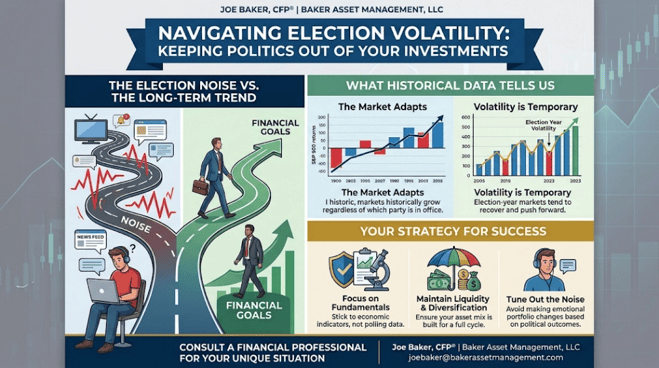
1. The Election Noise vs. The Long-Term Trend

It is easy to fall into the trap of thinking that a specific election outcome will either “save” or “ruining” the economy. The media often amplifies this narrative, framing every legislative shift as a make-or-break moment for your portfolio.

But there is a vast difference between the chaotic “noise” of an election season and the long-term trend of the stock market.

While elections can introduce short-term volatility as the market tries to predict future policies, the long-term trajectory of the S&P 500 is driven by far more powerful forces:

  • Corporate Earnings: The profitability and innovation of American businesses.
  • Economic Fundamentals: Interest rates, consumer spending, inflation, and employment data.
  • Global Progress: Advancements in technology and productivity.

A political party winning or losing an election doesn’t rewrite the fundamental rules of the global economy. Good businesses continue to find ways to generate profit, innovate, and provide value to their shareholders regardless of who holds the gavel in Washington.

2. What Historical Data Tells Us

When we look back at decades of market history, several clear patterns emerge that should reassure anxious investors:

The Market Adapts (Regardless of the Party in Power)

A common misconception is that the stock market only performs well when one specific party is in office. But history tells a very different story.

The S&P 500 has historically grown under all combinations of government—whether we have a Democratic president, a Republican president, a divided Congress, or single-party control. Since World War II, the market’s long-term upward trend has remained remarkably consistent, adapting to different administrations and regulatory environments.

Volatility Is Temporary

Midterm election years (like 2026) are historically known for higher-than-average market volatility, particularly in the months leading up to November. The uncertainty of who will hold power can cause the market to fluctuate.

However, once the results are in—regardless of which party wins—the uncertainty resolves itself. Historically, the market tends to experience a post-election “certainty bounce,” often rallying in the months following a midterm election as businesses and investors adjust to the known landscape.

3. Your Strategy for Success

How do you navigate this polarized environment without letting it affect your hard-earned savings? Here are three strategies to focus on:

Focus on Fundamentals

When evaluating your portfolio, rely on economic indicators, corporate earnings, and interest rates—not polling data. Let the math, not your political opinions, guide your asset allocation.

Maintain Liquidity and Diversification

If you know you will need cash in the near term, ensure you have an adequate liquidity buffer (such as high-yield savings or short-term CDs) so you are never forced to sell stocks during a temporary, election-induced dip. Make sure your portfolio is diversified across different asset classes to smooth out any bumps.

Tune Out the Noise

The single best thing you can do for your portfolio (and your peace of mind) during an election year is to limit your consumption of sensationalized news. Avoid making emotional, impulse changes to your investment plan based on political headlines or debate outcomes.

The Bottom Line

An election is a major event for our country, but it is just one of many events that the stock market encounters and adapts to over time. Your investment plan should be built to withstand a full market cycle—which includes several election cycles.

Please comment or send an email if you have any questions.

Joe Baker, CFP®

Baker Asset Management, LLC

joebaker@bakerassetmanagement.com
Economic Headwinds: The Unnecessary Strain on U.S. Businesses and Consumers

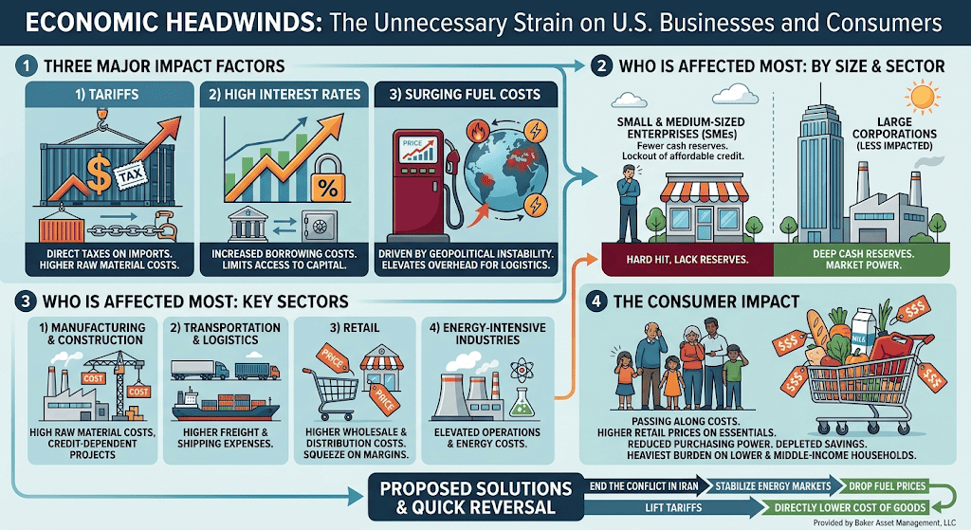
The U.S. economy has shown remarkable resilience, largely buoyed by a historic surge in productivity and investment driven by the artificial intelligence revolution. However, that underlying momentum is now in serious jeopardy due to three major self-inflicted pressures: high interest rates, trade tariffs, and surging inflation driven by skyrocketing fuel costs. These conditions create an unnecessary drag on economic expansion, but they could be reversed quickly by ending the conflict in Iran to stabilize global energy markets and removing trade tariffs.

Here is a breakdown of how these factors are impacting the market and who is bearing the brunt of the burden:

The Core Economic Pressures

  • Tariffs: Tariffs act as a direct tax on imported goods, raising the cost of raw materials and inventory. Businesses are forced to either absorb these losses or pass them on to consumers, driving inflation higher.
  • Surging Fuel Costs: Geopolitical conflict—specifically the war in Iran—has pushed fuel and energy prices up rapidly. This disproportionately increases overhead for any business reliant on physical operations, shipping, or manufacturing.
  • High Interest Rates: Elevated borrowing costs mean that securing capital for business expansion, equipment upgrades, or day-to-day cash flow management is now prohibitively expensive.

Who is Affected the Most?

  • By Business Size: Small and medium-sized enterprises (SMEs) bear the heaviest load. Unlike massive multinational corporations, SMEs lack the deep cash reserves and market power to absorb sustained cost increases, while high interest rates restrict their access to affordable working capital.

  • By Sector:
  • Manufacturing & Construction: Heavily reliant on raw materials subject to tariffs and credit-dependent for project financing.
  • Transportation & Logistics: Surging fuel costs act as an immediate hit to margins for any firm moving physical goods.
  • Retail: Retailers are squeezed on both ends—paying higher wholesale and transport costs while selling to consumers whose discretionary budgets are pinched by inflation.

  • By Consumer (Lower and Middle-Income Households): Ultimately, these corporate cost pressures spill over onto everyday households. As businesses pass along tariff taxes, elevated freight charges, and higher borrowing expenses, retail prices rise on essential goods like food, energy, and household staples. Lower and middle-income families—who spend a significantly larger portion of their take-home pay on basic necessities—bear the heaviest burden, facing reduced purchasing power and depleted savings as living costs climb.

The Solution

The clearest, most efficient path to economic relief requires straightforward policy changes. Ending the conflict in Iran would immediately ease energy market volatility and lower fuel prices at the pump, while lifting tariffs would directly reduce input costs for businesses and bring relief to consumer budgets across the board. By eliminating these primary drivers of inflation, the Federal Open Market Committee (FOMC) would have the leeway needed to lower interest rates without the risk of runaway prices, providing immediate relief to borrowing businesses and the broader economy.

Please comment or send an email if you have any questions.

Joe Baker, CFP®

Baker Asset Management, LLC

joebaker@bakerassetmanagement.com
The Ball is in Their Court: How Congress Can Avert the Social Security Cliff

Social Security isn’t failing because of a lack of math; it’s stalling because of a lack of movement in Washington. While the program’s trust funds are undeniably shrinking, this is a crisis of legislative willpower rather than a lack of solutions. The 2025 Trustees Report makes it clear that the “safety net” is held up by a fraying rope, but Congress still holds the scissors—and the spool of thread. To save the program, lawmakers must stop treating Social Security as a political “third rail” and start treating it as a standard legislative repair project.

The Current Trajectory (2025 Trustees Report)

According to the Social Security Board of Trustees’ 2025 Annual Report, the timeline for action has narrowed. The report underscores that without intervention from the Capitol, the following milestones are inevitable:

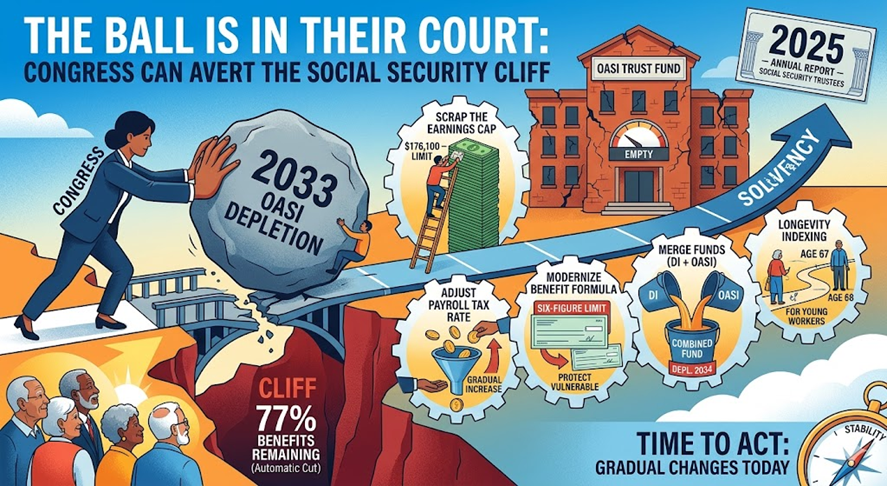
  • The 2033 Deadline: The Old-Age and Survivors Insurance (OASI) Trust Fund—the primary source for retiree benefits—is projected to be depleted in 2033.
  • The Enforced Benefit Cut: Under current law, once reserves are gone, the Social Security Administration cannot pay full benefits. By 2033, incoming tax revenue would only cover 77% of scheduled payments, resulting in an immediate 23% cut for all beneficiaries unless Congress changes the law.
  • Growing Deficit: The 75-year actuarial deficit has risen to 3.82% of taxable payroll, meaning the gap Congress needs to bridge is larger than it was just one year ago.

The Congressional “Fix-It” List

Congress has several specific levers they can pull to stabilize the system for the next 75 years without cutting benefits for those who rely on them most. Fixing the program will likely require a “grand bargain” involving these components:

  • Scrapping the Earnings Cap: Currently, Social Security taxes are only collected on income up to $176,100 (for 2025). High earners stop paying into the system once they hit that mark. Congress could eliminate this cap or create a “donut hole” (e.g., taxing income above $250,000) to ensure the wealthiest Americans contribute at the same rate as the middle class. I feel this is the best way to fix the problem and can be implemented quickly.
  • Gradual Payroll Tax Adjustments: The 12.4% payroll tax (split between you and your employer) hasn’t moved in decades. A tiny, phased-in increase—such as 0.1% per year—would be barely noticeable on a weekly paycheck but would pour billions back into the trust fund over time.
  • Modernizing the Benefit Formula (The “Six-Figure Limit”): Lawmakers are currently debating a cap on maximum benefits for high-income couples (e.g., a $100,000 limit). By slowing benefit growth for the top 1–5% of earners, Congress can redirect funds to keep the program solvent for everyone else.
  • Longevity Indexing: For younger generations, Congress could index the retirement age to life expectancy. This would mean the age moves by mere months over several decades, reflecting the reality that we are living longer than the workers of 1935.

The math behind Social Security is straightforward; the politics are what’s complicated. We don’t need a miracle to save Social Security; we need a Congress that is willing to trade short-term political points for long-term national stability. By acting now, lawmakers can implement small, gradual changes that protect current retirees and guarantee a future for the next generation. The 2033 “cliff” is seven years away—it’s time for Washington to pick up the tools and get to work.

Please comment or send an email if you have any questions.

Joe Baker, CFP®

Baker Asset Management, LLC

joebaker@bakerassetmanagement.com
Why Global Shocks Hit Your Local Pump: The Strait of Hormuz and Your Wallet

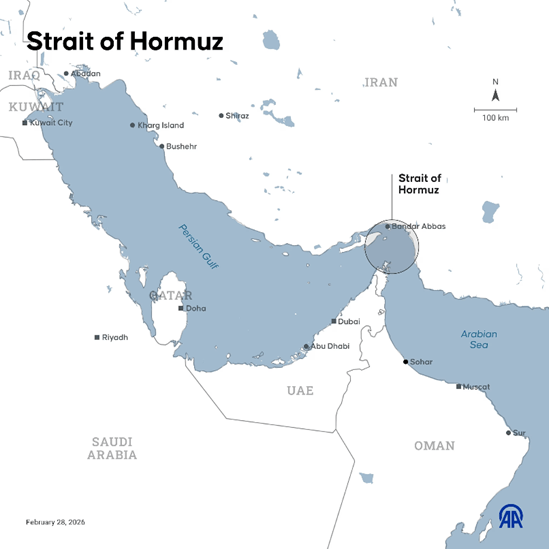
It’s a common question I hear from clients: “If the U.S. is producing record amounts of its own oil, why does a conflict thousands of miles away in the Middle East make it more expensive to fill up my SUV in suburbs?” It feels like a disconnect, but the answer lies in the fact that oil isn’t just a local resource—it’s a global currency. Even if not a single drop of oil from the Strait of Hormuz ever reaches a U.S. refinery, the closure of that vital waterway sends a shockwave through the global market that changes the price of every barrel on earth, including the ones produced right here in the U.S.

Why U.S. Oil Prices Are Rising

West Texas Intermediate (WTI) is the U.S. benchmark for oil. While it is produced domestically, its price is heavily influenced by global supply and demand.

  • Global Competition for Barrels: When 20% of the world’s oil supply is cut off at the Strait of Hormuz, countries that previously relied on Middle Eastern oil (like those in Asia and Europe) must find it elsewhere. They begin bidding on any available barrel, including those produced in the U.S., which drives up the price for everyone.
  • Market Interconnectivity: Traders look for the highest price globally. If global benchmarks like Brent crude spike, U.S. producers will sell to international buyers unless domestic prices rise to match.

Why U.S. Gas Prices Are Increasing

Retail gasoline prices respond to the replacement cost of fuel, not just the current supply.

  • Refining Realities: Although the U.S. produces more oil than it consumes, our refineries are often configured to process heavy crude imported from abroad rather than the “light sweet” crude produced in Texas. Disruptions in global shipping force refiners to pay more for suitable crude, a cost passed to the pump. Why our refineries aren’t configured to process U.S. oil is a whole other discussion.
  • Anticipating Future Costs: Gas station owners set prices based on what it will cost to buy their next shipment. If they see wholesale oil prices skyrocketing due to the Strait’s closure, they raise prices immediately to ensure they have enough cash to restock their tanks at the new, higher rate.
  • “Rockets and Feathers”: Economists note that gas prices typically rise quickly (like a rocket) when oil prices spike but fall slowly (like a feather) even after tensions ease, as retailers are cautious about lowering prices until they are sure their replacement costs have stabilized.

Ultimately, while we have achieved a high level of energy independence on paper, we are still tied to a global price tag. When 20% of the world’s oil supply is suddenly at risk, the “neighborhood” of global energy becomes a lot more expensive for everyone. Understanding this helps us look past the daily headlines and focus on the broader economic reality: in a connected world, a bottleneck in the Middle East is felt at every gas station in America.

Please comment or send an email if you have any questions.

Joe Baker, CFP®

Baker Asset Management, LLC

joebaker@bakerassetmanagement.com
Beyond the Barrel: Why the Strait of Hormuz is the Chokepoint for Global Industry

The Strait of Hormuz is often called the “world’s most important oil artery,” but its role in the global economy extends far beyond just crude oil. As of March 2026, the ongoing conflict involving the U.S., Israel, and Iran has effectively turned this narrow waterway into a “nightmare scenario” for global trade. Beyond the millions of barrels of crude, the Strait is the exit point for 20% of the world’s Liquefied Natural Gas (LNG), nearly a third of the global seaborne fertilizer trade, and a massive 8% of the world’s aluminum supply. From the essential chemicals like sulfur that power our mines and farms to the refined fuels that keep global shipping afloat, the blockade of Hormuz isn’t just an energy crisis, it is a total systemic disruption of the materials that build our cities, feed our populations, and power our technology.

Below are the main commodities that pass through the Strait and how the current war is impacting their supply and pricing.

1. Energy: The Lifeblood of the Global Economy

The Strait of Hormuz is the primary conduit for energy moving from the Persian Gulf to the rest of the world.

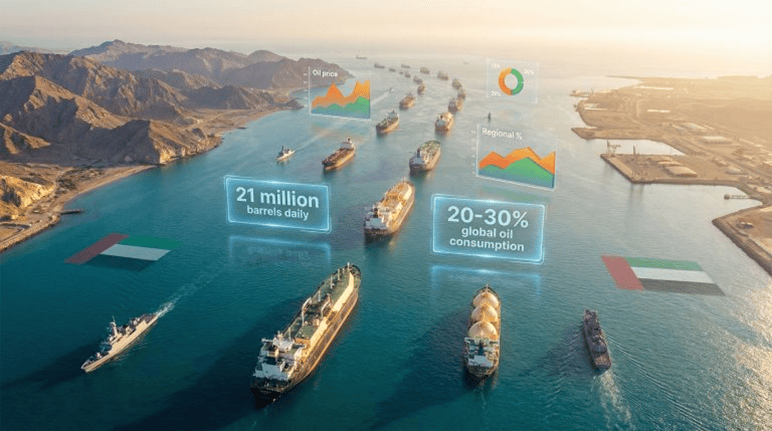
Crude Oil & Petroleum Liquids: Roughly 20–21 million barrels per day (bpd)—about 20% of global consumption—transit the Strait.

Impact: Since the escalation on February 28, 2026, oil prices have been highly volatile. Brent crude spiked from around $70 to a peak of nearly $120 per barrel before stabilizing near $90.

Supply: Most exports go to Asia (China, India, Japan, South Korea). With the Strait effectively under blockade, these nations are facing immediate supply shortages.

Liquefied Natural Gas (LNG): About 20% of the world’s seaborne LNG passes through the Strait, almost all of it from Qatar.

Impact: QatarEnergy recently declared force majeure and suspended production at its main facilities following regional attacks. This has caused European natural gas futures to jump by over 70% in early March.


2. Agriculture: The Fertilizer Crisis

While less discussed than oil, the Strait is a critical chokepoint for the materials that grow the world’s food.

Fertilizers (Urea, Ammonia, Phosphates): Between 25% and 33% of the global seaborne trade in fertilizer raw materials passes through the Strait.

Impact: Regional producers like Saudi Arabia and Iran are massive exporters of urea. The “soft closure” of the Strait has halted these shipments, causing benchmark Egyptian urea prices to rise by more than 25%.

Economic Ripple: Because half of global food production relies on synthetic fertilizers, this disruption is expected to push up the prices of household staples like bread, pasta, and animal feed globally.


3. Industrial Metals: The Aluminum Squeeze

The Gulf region has become a major hub for high-grade industrial metals, which are now trapped behind the blockade.

Aluminum: The Gulf produces about 8% of the world’s aluminum. Smelters in Bahrain, Qatar, and the UAE rely on the Strait for both exporting finished metal and importing raw materials like bauxite and alumina.

Impact: Qatari smelters (like Qatalum) have begun shutting down due to gas supply suspensions. This “dual squeeze”—blocking both raw material imports and finished metal exports—has sent aluminum prices soaring on the London Metal Exchange.


4. The Middle East: The World’s Sulfur Engine

The Persian Gulf region accounts for approximately 50% of the global seaborne sulfur trade. It is produced primarily as a byproduct of natural gas processing and oil refining at massive hubs like Ras Laffan (Qatar) and Ruwais (UAE).

Impact: Closing the Strait of Hormuz halts both the fuel and the feedstock for sulfuric acid—the most produced chemical on Earth. Without this acid, we lose the ability to extract copper and cobalt. No copper or cobalt means no EV batteries, no power transformers, and no data center hardware.


In summary, the crisis in the Strait of Hormuz is a stark reminder that our globalized economy is only as resilient as its most narrow corridor. We have long viewed this waterway through the lens of oil prices, but the events of March 2026 have proven that the stakes are far more complex. When the Strait closes, the world loses more than just fuel; it loses the LNG heating European homes, the aluminum framing our modern architecture, the fertilizers sustaining global agriculture, and even the airfreight capacity that moves our electronics and medicines. The ‘Hormuz Factor’ is not merely an energy shock—it is a systemic threat to the physical materials that build and feed our world. Let’s hope we can get a quick resolution to this ill-advised war.

Please comment or send an email if you have any questions.

Joe Baker, CFP®

Baker Asset Management, LLC

joebaker@bakerassetmanagement.com

Monthly Update – August 2025

Calendar Notes

  • None.

Stocks stayed in the green for the third month in a row, climbing a wall of worry built mainly from tariffs. The index reached a series of new all-time highs, driven by strong performances in Q2 by our home-grown big technology companies.

For the month of July, the S&P 500 rose a respectable 2.2%, even with a pretty big drop in the last days of the month. That beat the historical July average of 1.28% and now takes the index to a year-to-date return of 8.50%.

The usually quiet summer months for stocks are anything but this year. With most of the Q2 earnings posted already, the stock market is now going to be fixated on trade policy, the job market, inflation, and interest rates. Each of these four elements can provide a boost or a bust for stocks over the next month. If the new tariffs that were recently implemented stay in place, inflation is going to continue higher as it has over the past few months. Layoffs from both the public and private sectors are now showing up in the data as the effects of DOGE, trade, and immigration policies take hold. Companies are embracing AI to reduce payroll as well. The Federal Reserve is more likely to cut interest rates by their September meeting (no meeting in August) now with the recent poor jobs data most likely outweighing the rising inflation data.

The good news is, as I have said many times this year, the economy can get back on track if we get rid of the tariffs and instead negotiate trade deals with our allies that are beneficial to both parties. This would especially help our small businesses that can’t afford to pay these levies and still remain viable. It would also benefit those that are in the lower- and middle-income tiers that can’t afford the price increases that our companies will have to pass on to their customers due to the tariffs.

Historically, August has been a pretty boring month for stocks, with an average return of about 0.5%. I think this August could be a little more exciting, to say the least.

Take a look at the Outlook section below to see what events could move the markets over the short term.

Bond prices were flat to slightly lower during July as the economy began to show signs of slowing, increasing the potential for short-term interest rates to be lowered by the Federal Reserve. Although the Federal Reserve held rates unchanged after their July meeting, sentiment increased sharply for a cut by the time that they meet again in September due to the poor jobs report that came out just after the Fed concluded their meeting.

While there is a recovery in market sentiment after a temporary pause on new tariffs, concerns over the long-term impact of trade policies and geopolitical risks still persist. This kind of uncertainty can drive investors toward safer assets like bonds, particularly government bonds, increasing demand and pushing prices up. We will most likely see this price action continue if the most recent tariffs stay in place for any significant period of time.

The 10-year US Treasury note yield finished higher in July, settling at 4.36%, higher than the 4.23% yield that it was at the beginning of the month. The 30-year bond yield closed out the month at 4.89%, about 12 basis points higher than a month ago.

With all of the uncertainty in the bond market, it is prudent to invest in bonds that mature sooner rather than later. I like bonds with a 12-to-18-month maturity and plan on holding onto them until they do mature.

Savings rates didn’t move much in July. Money market rates and bank savings accounts are averaging only about 0.46% but the best rates can be found at credit unions and online banks with rates approaching 4.5%. It is worth it to do some research here. With rates staying above 4%, I think more money is going to be funneled into the safe havens of money markets and CDs as the stock market rebound is showing signs of fatigue. So, CDs and MMAs continue to be a great place toput your cash and your emergency fund, for now. Knowing this, it makes sense in most situations to put cash that you don’t immediately need into CDs with up to 2-year maturities. For emergency cash, stick to high yielding money market and savings accounts, of which the best are yielding about 4.4%. As always, keep the total under $250,000 per person at any one bank to ensure you are fully covered by the FDIC.

Mortgage rates mirrored other rate categories and had little movement this past month. The expectations were low for any changes in rates by the Federal Reserve, so this was expected. Higher housing inventory continued to put downward pressure on mortgage rates as well. Active listings rose for the 21st consecutive month, but overall inventory remains below pre-pandemic levels. It has become a buyers’ market in most parts of the country, but prices are still historically high and coupled with high mortgage rates, makes home purchases out of reach for many, especially first-time home buyers.

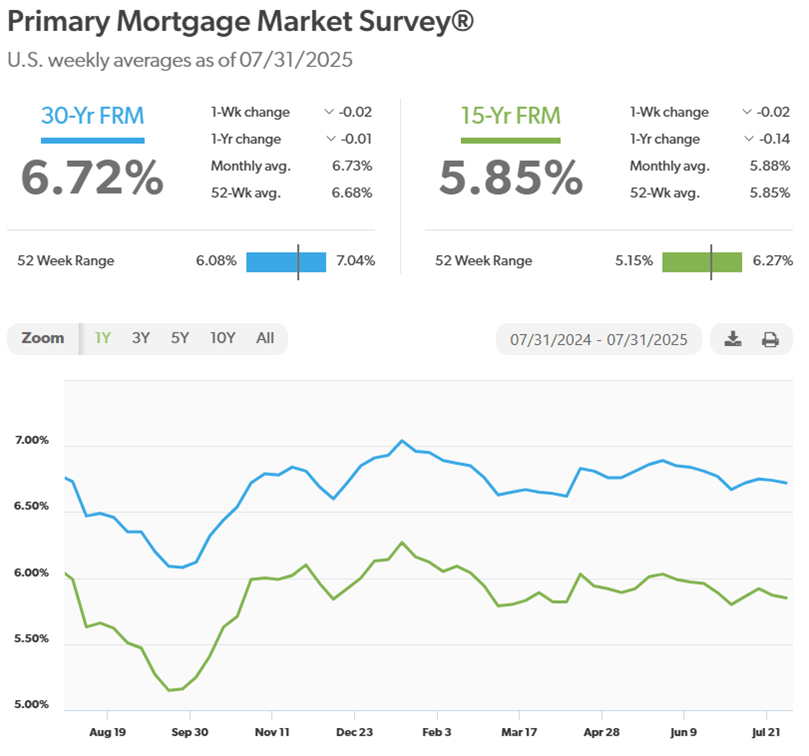
The 30-year fixed rate finished the month at 6.72%, still within the narrow range of 6.5% and 7% that it has been in since October of last year. The trade and immigration policies are causing higher raw materials and labor costs for homebuilders and are starting to show up in new home prices now, making it even harder to afford a new home.

Here is a look at the one-year chart of the 15- and 30-year mortgage rates from Freddie Mac.

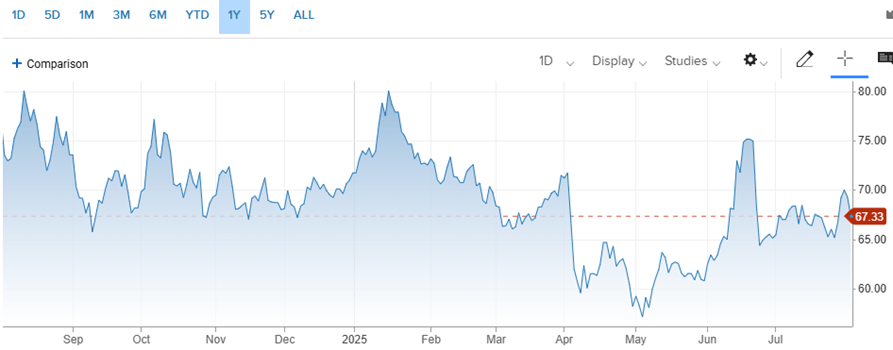
Oil prices were much calmer in July than they were in June of this year. That is, until the last week when oil prices surged due to renewed geopolitical risk causing a disruption in the global oil supply. Specifically, when the U.S. issued a deadline to Russia to end the war in Ukraine, threatening additional sanctions and tariffs on countries that continue to buy Russian oil. This, coupled with the seasonally strong summer demand could keep prices elevated at least through the end of August.

For the month, the price for a barrel of oil closed at $69.26, up from $65.11 at the beginning of July. For the year, it’s down about 3.40%. We certainly don’t want to see oil prices going higher now because that will raise the input costs for companies even higher as the tariffs take hold.

Here’s a look at the one-year chart for U.S. oil:

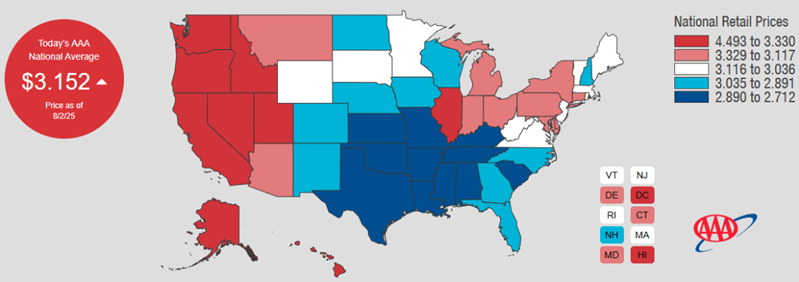
Gasoline prices dipped slightly in July. Regular unleaded gasoline is now averaging $3.15 per gallon, down four cents from last month. However, gas prices could be heading higher in the near future for reasons stated above in the oil prices section. Mississippi has the cheapest gas currently, checking in at $2.71 a gallon. California has the most expensive gasoline at $4.49 per gallon. FYI, a year ago, we were paying $3.48.

Check out the prices at the pump in your area: AAA Gas Prices.

Outlook

Events on the horizon that could move the markets in the near term:

  • Fed & Inflation: The Federal Reserve had started leaning towards cutting rates even before the bad jobs report came out this past Friday. Cracks have begun to appear in our resilient labor market as layoffs from DOGE and the private sector are reflected in the latest data. Also, inflation is picking up as U.S. companies begin to raise prices to offset the tariffs they are paying on imported goods and raw materials. Higher unemployment and higher prices, aka stagflation, is a tough scenario for the Fed to fight at the same time. Right now, it looks like they need to focus on the labor side of the equation, which would mean to cut rates. However, they have to tread carefully because lower rates combined with tariffs could lead to runaway inflation, which would be devastating to the economy. The ideal situation would be if we cut rates and removed the tariffs. That would help our economy recover and spur growth. I’m still hopeful.
  • Trump Administration Policies: The trade war is back on the front burner as tariffs are assessed on almost everything that our companies import for the products that they produce. As a reminder, the tariffs that we have been talking about this year are fees that U.S. companies pay our government. I like to think of these tariffs simply as an increase in the corporate tax for our companies. It basically increases the cost of doing business. So, in order for companies to keep the same profit margins pre-tariff, or in the case of many small businesses, to remain profitable at all, they have to either raise the prices that they charge their customers, lower expenses in other areas of their business, or a combination of both. Regardless of which avenue a company chooses, our economy will suffer, especially our small businesses and our lower income population that is already living paycheck to paycheck. As I said last month and will keep saying, the government needs to scuttle this absurd tariff strategy and go back to the drawing board to put together a plan that is realistic and can meet their objectives without damaging so many industries and so many lives. It’s not too late to save our small businesses, keep inflation in check, and get our economy back on track.

Joe Baker, CFP®

Baker Asset Management, LLC

joebaker@bakerassetmanagement.com

Here’s Why Interest Rates May Stay Higher for Longer

The economic stars were aligning beautifully at the beginning of the year for the Federal Reserve to start to gradually lower interest rates in 2025. Then, in February our economy, and much of the world’s economies, were upended with a shock and awe tariff policy by the Trump administration. This, coupled with changing global perceptions of U.S. governance and institutions has forced the Fed to rethink its interest rate strategy. Subsequently, the odds of any rate cuts this year have dropped significantly since the end of 2024.

Here are the main suspects that may keep interest rate higher for the foreseeable future:

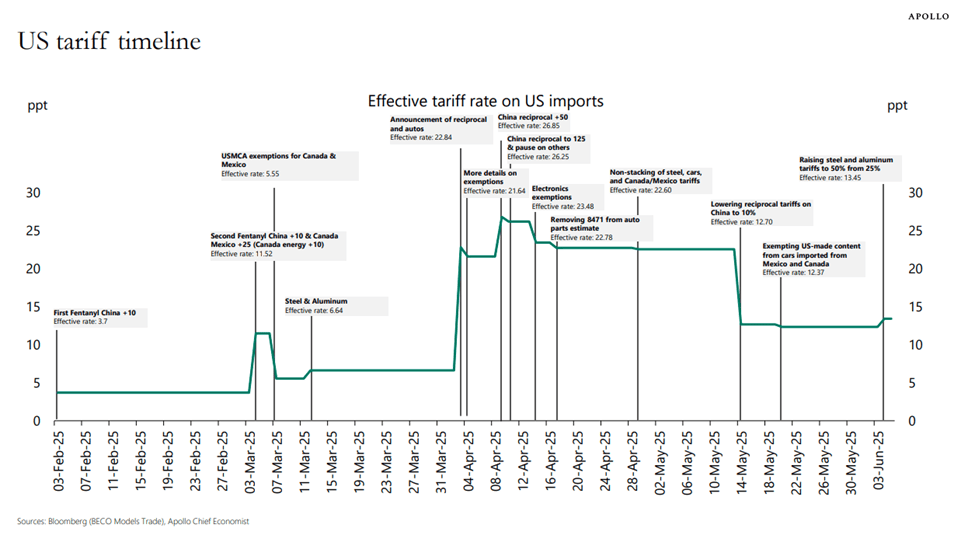
  • Tariffs: This chart summarizes the effective tariff rate that U.S. companies have had to pay since February:

The green line shows the effective tariff rate from February to June of this year. Prior to February, the U.S. was paying an effective tariff rate of about 2.4%. Currently, we are paying an effective rate of 13.45%. We were as high as 26.85% in April, so we have come off of the highs but still are at a level that is almost 6 times what we were paying at the start of the year. Now, it’s showing up in the prices that we are paying and also in the number of small businesses that have had to lay off workers, suspend operations, or shut down completely. This increase is just not sustainable and higher prices mean rates have to stay high to fend off runaway inflation.

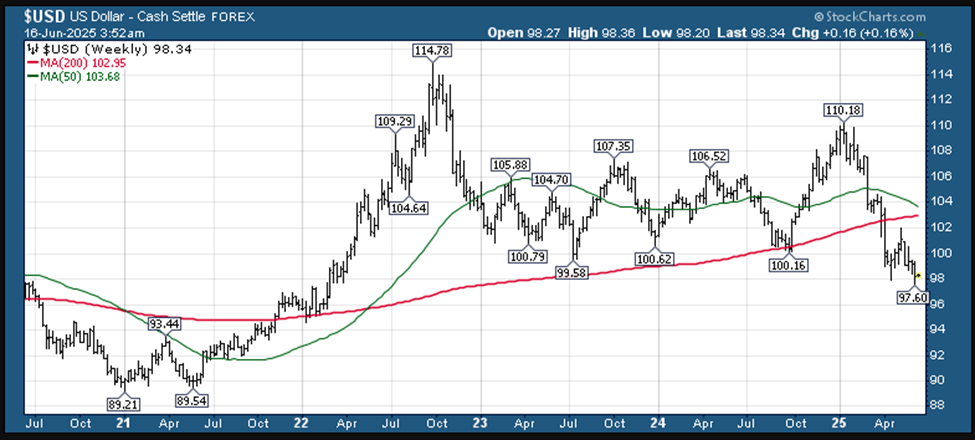
  • Weaker Dollar: Take a look at this chart of the US Dollar hitting a 3-year low recently.

The black is the dollar index value, the red is its 200-day moving average and the green is its 50-day moving average. There are several factors contributing to the downward pressure on the U.S. dollar, including:

  • Tariffs and Trade Policy
  • Global Concerns about U.S. Economic Growth and Recession Risks
  • Fiscal Deficit and Debt Concerns
  • Erosion of U.S. Except

In essence, a combination of protectionist trade policies, concerns about the U.S. economy’s resilience, fiscal anxieties, and a shift in global investor sentiment are all contributing to the weakening of the U.S. dollar in 2025. A weaker dollar is inflationary and another reason for the Fed to keep rate elevated.

As I have said before, these issues are self-inflicted, which means they can be resolved quickly if we act now. The longer these policies are in place, the harder it will be to recover from them. Then, the Federal Reserve will have to lower interest rates but for all the wrong reasons, aka a recession.

Please comment or send an email if you have any questions.

Joe Baker, CFP®

Baker Asset Management, LLC

joebaker@bakerassetmanagement.com
An Economic Storm is Coming for the US

In my last post, I talked about how our tariffs could adversely affect the 33+ million small businesses in the U.S. Today, I want to continue that discussion but go into a little more detail with some interesting illustrations that show the contribution that our small businesses have to our economy.

Tariffs have been used throughout history to protect domestic industries. When implemented tactically on certain materials or products within a broader, strategic economic plan, they have had some success. However, when you carpet-bomb everything simultaneously that is imported into our country with tariffs without letting our companies prepare and plan, it results in chaos, as we have seen already.

When our government implements very high tariffs suddenly, they impact many businesses, particularly small businesses, because the tariff must be paid by the business when the imported goods arrive in the US. Small businesses that have relied on a stable US system for decades need to adjust quickly and may not have the working capital to pay tariffs. Ships might remain offshore, orders could be canceled, and many small businesses may face bankruptcy.

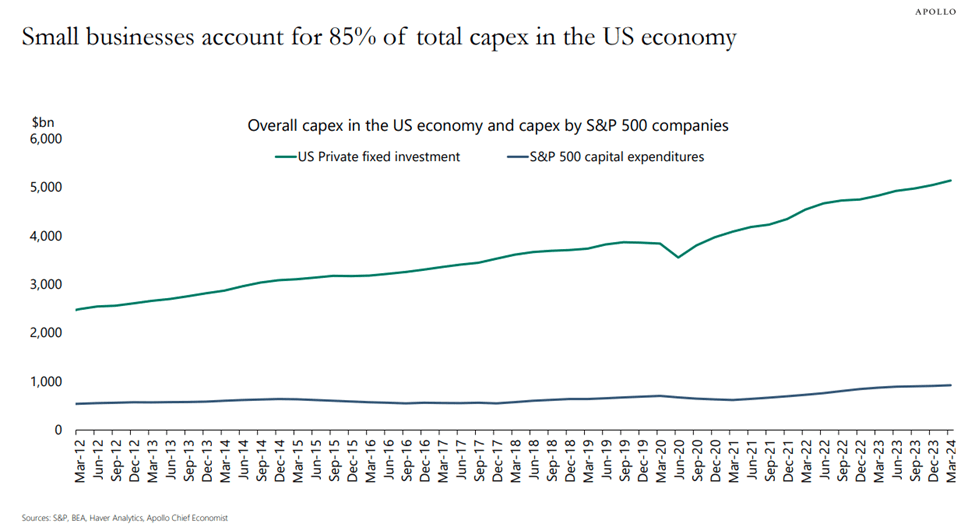
There have been some exceptions for large businesses, but they are the companies that need them the least. These massive corporations have the flexibility and the resources to handle unforeseen expenses. Not giving the same breaks to small businesses does not make any sense. Just look at these charts below to see why:

This shows that 85% of the capital expenditures, basically the money that businesses reinvest into themselves to expand and grow, in the US economy comes from small businesses. These guys should be getting the tariff exemptions.

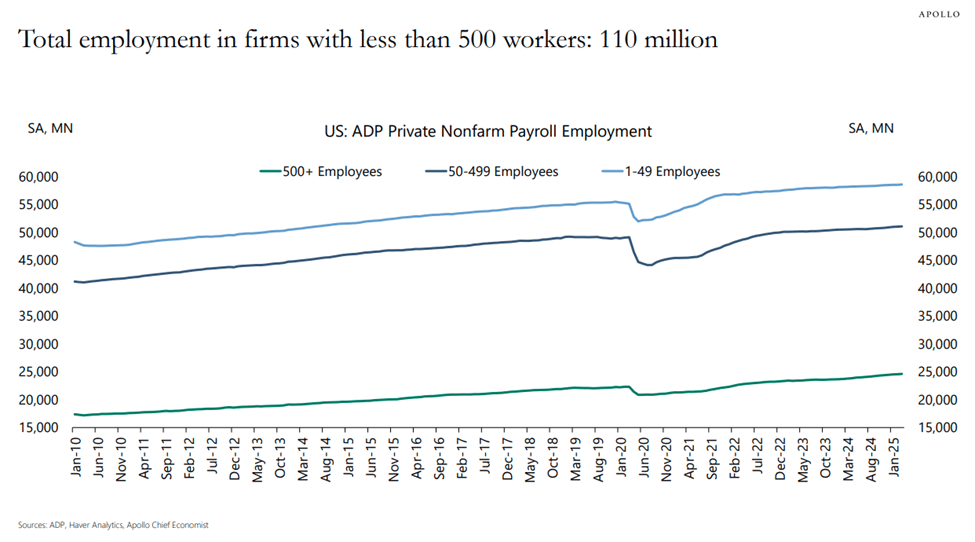
Here we see that small businesses (less than 500 employees) account for 110 million workers of the labor force, approximately 75% of the total number of workers employed in the country. Damage to this large of a swath of the economy would be devastating.

So now, the challenges for small companies have become a big problem for the US economy. Even if tariffs get knocked down substantially from their current high levels, many small businesses will not be able to absorb the costs and will have to pass the costs onto their customers, reduce their payroll, or worse, shut down.

Let’s hope we abandon the blanket tariff policy and instead develop a long-term plan along with our trading partners that will benefit all parties.

Please comment or send an email if you have any questions.

Joe Baker, CFP®

Baker Asset Management, LLC

joebaker@bakerassetmanagement.com
Why Small Businesses Will Be Hurt Most by Tariffs

I thought I’d take a look at how the current trade war could affect the small business community here in the U.S.

First , let’s look at some numbers. There are 33.27 million small businesses in the U.S. with fewer than 500 employees. These businesses employ 61.6 million people, which is 45.9% of the U.S. workforce, and account for 33% of the country’s imports.

For those that don’t know, the tariffs that we have implemented so far this year are levies, or fees, on imported goods to the U.S. that have to be paid by the company that imports them. These tariffs are hitting small businesses particularly hard, since they almost all rely on some quantity of imported materials. Unlike large corporations, small businesses often lack the financial cushion to absorb rising costs, forcing them to either raise prices or take a financial hit. Also, many small retailers and manufacturers are struggling with uncertainty, as tariffs have been fluctuating, making it difficult to plan ahead.

Here’s a detailed breakdown on how the imposition of tariffs can significantly impact small businesses:

Increased Costs of Goods:

  • Imported Materials and Goods: Many small businesses rely on imported raw materials, components, or finished goods. Tariffs, being taxes on these imports, directly increase their cost. For example, a local furniture maker importing wood or hardware will face higher expenses.
  • Reduced Profit Margins: Unless small businesses can pass these increased costs entirely to their customers, their profit margins will likely shrink. Small businesses often operate with tighter margins than larger corporations and have less capacity to absorb these additional expenses.
  • Cash Flow Strain: Higher upfront costs for imported goods can strain the cash flow of small businesses, potentially affecting their ability to manage day-to-day operations and invest in growth.

Price Increases for Customers:

  • Passing on Costs: To maintain profitability, small businesses may need to increase the prices of their products or services. This can make them less competitive compared to larger businesses that might absorb some of the tariff costs or domestic producers not subject to these import taxes.
  • Loss of Customers: Price-sensitive customers might opt for cheaper alternatives from competitors, leading to a decrease in sales volume and customer loyalty for the small business.

Supply Chain Disruptions:

  • Difficulty in Sourcing: Tariffs can disrupt established global supply chains, making it harder for small businesses to obtain the necessary goods or materials. This could lead to production delays, an inability to fulfill orders, and a loss of customer trust.
  • Finding Alternative Suppliers: While businesses might look for domestic suppliers or suppliers in countries not affected by tariffs, this shift can be time-consuming, costly, and may not always offer the same quality or price. For instance, a small electronics repair shop that relies on specific imported components might struggle to find suitable local alternatives quickly.

Reduced Competitiveness:

  • Against Larger Businesses: Larger companies often have more leverage to negotiate with suppliers, find alternative sourcing, or absorb tariff costs due to their scale. This can put small businesses at a significant competitive disadvantage.
  • In Export Markets: When the U.S. imposes tariffs, other countries often retaliate with their own tariffs on U.S. exports, which we have already seen. This can harm small businesses that export their products, making them more expensive for foreign buyers. For example, a local artisan food producer exporting to a country that imposes a retaliatory tariff will see their goods become pricier in that market.

Uncertainty and Investment:

  • Difficulty in Planning: Fluctuating tariff policies create uncertainty, making it difficult for small businesses to plan for the future, make investments, or forecast their financials accurately.
  • Hesitation in Growth: The unpredictable economic climate caused by tariffs can make small business owners hesitant to expand their operations, hire new employees, or invest in new equipment.

To summarize, tariffs pose significant challenges for small businesses, primarily through increased costs, potential price hikes, supply chain disruptions, and reduced competitiveness. Finally, as history has taught us, there are no winners in a trade war. Hopefully, we can get that message through to the Trump administration sooner rather than later.

Please comment or send an email if you have any questions. Thanks!

Joe Baker, CFP®

Baker Asset Management, LLC

joebaker@bakerassetmanagement.com