
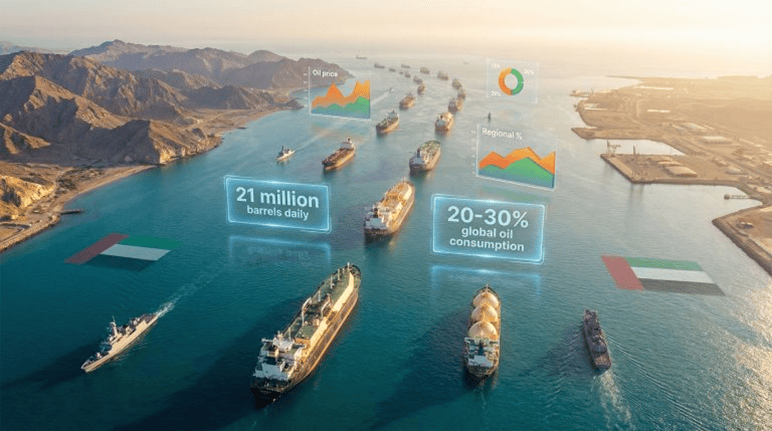
The Strait of Hormuz is often called the “world’s most important oil artery,” but its role in the global economy extends far beyond just crude oil. As of March 2026, the ongoing conflict involving the U.S., Israel, and Iran has effectively turned this narrow waterway into a “nightmare scenario” for global trade. Beyond the millions of barrels of crude, the Strait is the exit point for 20% of the world’s Liquefied Natural Gas (LNG), nearly a third of the global seaborne fertilizer trade, and a massive 8% of the world’s aluminum supply. From the essential chemicals like sulfur that power our mines and farms to the refined fuels that keep global shipping afloat, the blockade of Hormuz isn’t just an energy crisis, it is a total systemic disruption of the materials that build our cities, feed our populations, and power our technology.
Below are the main commodities that pass through the Strait and how the current war is impacting their supply and pricing.
1. Energy: The Lifeblood of the Global Economy
The Strait of Hormuz is the primary conduit for energy moving from the Persian Gulf to the rest of the world.
Crude Oil & Petroleum Liquids: Roughly 20–21 million barrels per day (bpd)—about 20% of global consumption—transit the Strait.
Impact: Since the escalation on February 28, 2026, oil prices have been highly volatile. Brent crude spiked from around $70 to a peak of nearly $120 per barrel before stabilizing near $90.
Supply: Most exports go to Asia (China, India, Japan, South Korea). With the Strait effectively under blockade, these nations are facing immediate supply shortages.
Liquefied Natural Gas (LNG): About 20% of the world’s seaborne LNG passes through the Strait, almost all of it from Qatar.
Impact: QatarEnergy recently declared force majeure and suspended production at its main facilities following regional attacks. This has caused European natural gas futures to jump by over 70% in early March.
2. Agriculture: The Fertilizer Crisis
While less discussed than oil, the Strait is a critical chokepoint for the materials that grow the world’s food.
Fertilizers (Urea, Ammonia, Phosphates): Between 25% and 33% of the global seaborne trade in fertilizer raw materials passes through the Strait.
Impact: Regional producers like Saudi Arabia and Iran are massive exporters of urea. The “soft closure” of the Strait has halted these shipments, causing benchmark Egyptian urea prices to rise by more than 25%.
Economic Ripple: Because half of global food production relies on synthetic fertilizers, this disruption is expected to push up the prices of household staples like bread, pasta, and animal feed globally.
3. Industrial Metals: The Aluminum Squeeze
The Gulf region has become a major hub for high-grade industrial metals, which are now trapped behind the blockade.
Aluminum: The Gulf produces about 8% of the world’s aluminum. Smelters in Bahrain, Qatar, and the UAE rely on the Strait for both exporting finished metal and importing raw materials like bauxite and alumina.
Impact: Qatari smelters (like Qatalum) have begun shutting down due to gas supply suspensions. This “dual squeeze”—blocking both raw material imports and finished metal exports—has sent aluminum prices soaring on the London Metal Exchange.
4. The Middle East: The World’s Sulfur Engine
The Persian Gulf region accounts for approximately 50% of the global seaborne sulfur trade. It is produced primarily as a byproduct of natural gas processing and oil refining at massive hubs like Ras Laffan (Qatar) and Ruwais (UAE).
Impact: Closing the Strait of Hormuz halts both the fuel and the feedstock for sulfuric acid—the most produced chemical on Earth. Without this acid, we lose the ability to extract copper and cobalt. No copper or cobalt means no EV batteries, no power transformers, and no data center hardware.
In summary, the crisis in the Strait of Hormuz is a stark reminder that our globalized economy is only as resilient as its most narrow corridor. We have long viewed this waterway through the lens of oil prices, but the events of March 2026 have proven that the stakes are far more complex. When the Strait closes, the world loses more than just fuel; it loses the LNG heating European homes, the aluminum framing our modern architecture, the fertilizers sustaining global agriculture, and even the airfreight capacity that moves our electronics and medicines. The ‘Hormuz Factor’ is not merely an energy shock—it is a systemic threat to the physical materials that build and feed our world. Let’s hope we can get a quick resolution to this ill-advised war.
Please comment or send an email if you have any questions.
Joe Baker, CFP®
Baker Asset Management, LLC
joebaker@bakerassetmanagement.com

