
Beyond the Beach: Why “Sell in May and Go Away” Is a Costly Myth
Every spring, Wall Street dusts off one of its oldest and most repeated clichés: “Sell in May and go away.” The theory goes that stock market returns are historically dismal between May and October, so you should cash out, enjoy your summer at the beach, and reinvest in November. It sounds cozy, low-stress, and delightfully simple.
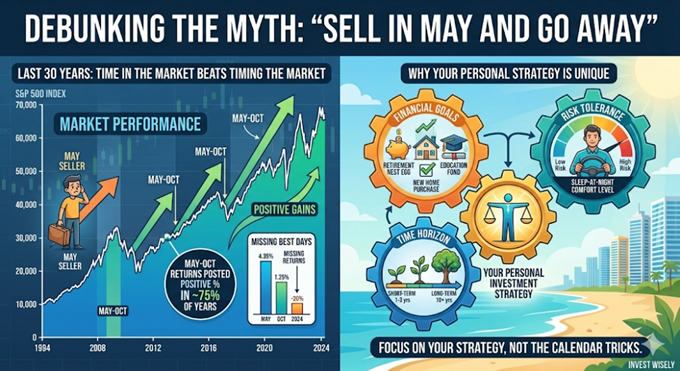
There’s just one glaring problem: Over the last 30 years, following this advice would have cost you a fortune.
Let’s unpack why this old adage has broken down, and why a cookie-cutter calendar trick is no substitute for a personalized investment strategy.
The Reality Check: The Last 30 Years
The idea of the “summer doldrums” used to hold some weight decades ago when trading volume slowed to a crawl during vacation season. But the modern financial world doesn’t take a summer vacation.
If you actually “went away” every May over the last three decades, you would have missed out on massive market gains.
1. Positive Returns Are the Norm, Not the Exception
While it’s true that the winter months (November to April) have historically shown stronger average gains, the May-to-October period has still been overwhelmingly positive. Over the last 30 years, the S&P 500 has posted positive returns during the summer/fall block roughly 70% to 80% of the time. By sitting on the sidelines, you aren’t avoiding a crash; you’re usually just missing a rally.
2. The Cost of Missing the “Best Days”
Market gains are often concentrated in a few explosive days. If you are sitting in cash, missing just a handful of the market’s best days can permanently stunt your portfolio’s compounding growth.
3. Frictional Costs Eat Your Wealth
Every time you sell and buy back in, you trigger a chain reaction of wealth-killers:
- Taxes: If you operate in a taxable account, selling every May triggers short-term capital gains taxes, which are taxed at a much higher rate than long-term gains.
- Transaction Costs: Even in an era of zero-commission trades, bid-ask spreads can quietly chip away at your principal.
The Bottom Line: Trying to time the market based on a calendar rhyme is a losing game. As the legendary investor Peter Lynch once said, “Far more money has been lost by investors preparing for corrections, or trying to anticipate corrections, than has been lost in corrections themselves.”
Why “One-Size-Fits-All” Strategies Fail You
The biggest flaw in “Sell in May” isn’t just the math—it’s that it treats every investor like a monolith. Wall Street clichés assume everyone has the exact same bank account, the same nerves, and the same expiration date.
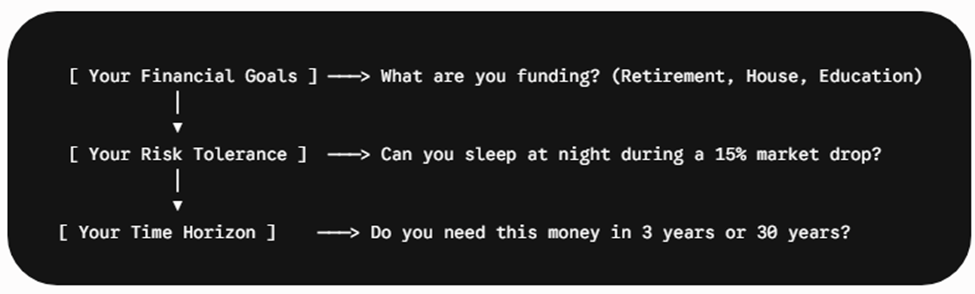
In reality, successful investing requires a strategy tailored uniquely to you across three critical pillars:
1. Your Unique Financial Goals
Are you investing to buy a house in three years, or are you building a nest egg for a retirement that is three decades away? A 25-year-old building long-term wealth shouldn’t care about a minor summer dip. A 63-year-old nearing retirement might need a smoother ride—but they achieve that through a balanced asset allocation (stocks, bonds, cash equivalents), not by completely exiting the stock market every May.
2. Your Personal Risk Tolerance
Risk tolerance isn’t just a math problem; it’s a psychological one. If selling in May makes you feel safe, but causes you to panic-buy back in at higher prices in November, the strategy has failed your psychology. A personalized portfolio is designed to keep you comfortably invested through all seasons, preventing the emotional decisions that derail wealth.
3. Your Time Horizon
Time is the ultimate equalizer in investing. If your time horizon is long, the seasonal squiggles of the stock market become irrelevant background noise. The historical data proves that time in the market beats timing the market every single time.
Focus on Your Blueprint, Not the Calendar
The next time you see a financial news headline warning you to “Sell in May,” turn off the TV and check in on your personal financial plan instead.
Market myths make for great headlines, but personalized strategies build generational wealth. Stick to your goals, respect your time horizon, and leave the calendar tricks behind. Your future self will thank you.
Please comment or send an email if you have any questions.
Joe Baker, CFP®
Baker Asset Management, LLC
joebaker@bakerassetmanagement.com

