
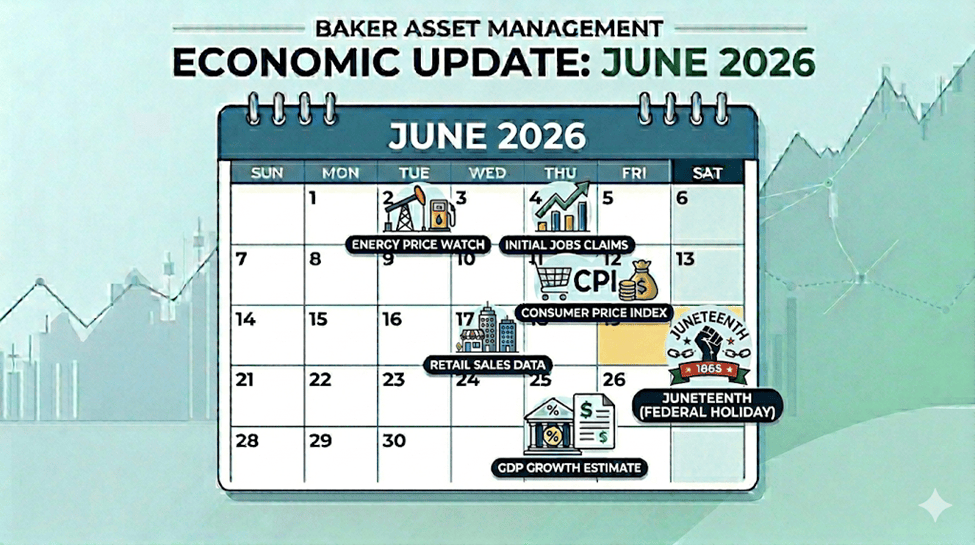
Calendar Notes
- June 19th, Friday – Juneteenth National Independence Day. Stock market is closed.
Stocks continued to defy gravity as more and more investors hopped on the AI express. Stocks also got a boost from the possibility of a peace deal with Iran or at least an extended cease fire. In the tech space, insane amounts of capital are being deployed by companies, both big and small, into AI adoption, benefiting chip makers and data center infrastructure providers, just to name a few sectors. This is providing a solid floor of support for stocks.
The old Wall Street adage “Sell in May and go away” did not hold true this year. For the month of May, the S&P 500 had one of its best Mays of this century, finishing with a gain of 5.15%, well above its historical average over the last thirty years of +1.35%. For the year, the index is now up nearly 11%. Very impressive, considering some of the headwinds that it is facing this year.
Speaking of headwinds, the on again, off again peace deal with Iran has been making waves in the markets but is starting to have less and less of an effect. Supply chains are doing what they can to reroute materials away from the Strait of Hormuz and companies and countries are sourcing goods and materials from other parts of the world. The bad news is that inflation continues to accelerate due to this chaos. This is making the likelihood of a rate cut this year very slim and a rate hike more probable. A rate hike could put the brakes on the amazing run that we are having in the stock market. Let’s hope we get a resolution to the strait closure soon.
Historically, the performance of the S&P 500 index in June has been modest, at best. Over the last thirty years, it has had a return of approximately +0.70%, on average. Once again, if we can get out of this war, we should have no problem beating that number.
Take a look at the Outlook section below to see what events could move the markets over the short term.
Bond prices continued to drop again in May, as higher inflation data pushed yields higher. However, there was some price divergence across different sectors. While safe-haven government bonds faced headwind pressures that drove prices down, corporate and high-yield (“junk”) bonds showed immense resilience, heavily protected by robust corporate earnings and tightening credit spreads.
The 10-year US Treasury note yield finished slightly higher in May, settling at 4.44%, above the 4.38% yield that it was at the beginning of the month. The 30-year bond yield closed out the month at 4.97%, the same as a month ago.
Checking the current high yield credit spread (HYCS) of 2.71%, it has compressed further from a month ago and continues its downward trend that started back in May 2025. In fact, this current drop to the 2.7% level has not been seen since 2007, about a year before the Great Financial Crisis. Here’s what this means for the markets: In the short term, this is a very good sign for the current momentum of the economy, but it serves as a warning sign for future bond returns and long-term stock valuations. When high-yield spreads compress to ultra-tight levels like 2.7%, it means the market is pricing in near-perfection: robust corporate health, low default expectations, and smooth economic growth. Caution is most certainly warranted at this time, particularly in the high yield bond space.
Bond investors will be waiting anxiously for the next FOMC meeting with a new Fed chairman, scheduled for June 17th. Expectations are changing daily so get ready for a very interesting meeting this month.
I continue to like bonds with maturities up to two years, but you should plan on holding them until they mature.
Savings rates headed higher this past month as talk of rate cuts by the Fed faded away due to inflation continuing to stay elevated. As you can see from the table below, there is still a huge disparity between the rates offered by traditional banks and those offered by online-only banks. You can earn roughly 10 times more yield by utilizing top-tier online platforms. It is so worth taking some time to research where you can find the best rates.
I am grateful that rates are remaining this high, considering there is so much demand: total assets in U.S. money market funds are sitting near all-time highs, hovering around $7.64 trillion, up 11% year-over-year. When will this trend reverse and see some of this cash rotate into the stock or bond markets? Probably not until rates for MMA, HYSA, and short-term CDs drop below 3.5%. This is another reason why the next FOMC meeting will be watched intently.
| Account Type | Average Rate (APY) | Highest Rate (APY) |
| Money Market Account | 0.45% | 4.22% |
| High-Yield Savings Account | 0.38% | 4.21% |
| 1-Year CD | 2.30% | 4.11% |
| 3-Year CD | 2.07% | 4.04% |
| 5-Year CD | 2.09% | 4.30% |
For now, CDs and MMAs are still a great place to put your cash and your emergency funds. Knowing this, it makes sense in most situations to put cash that you don’t immediately need into CDs with up to 2-year maturities. For emergency cash, stick to high yielding money market and savings accounts, of which the best are yielding about 4.2%. As always, keep the total under $250,000 per person at any one bank to ensure you are fully covered by the FDIC.
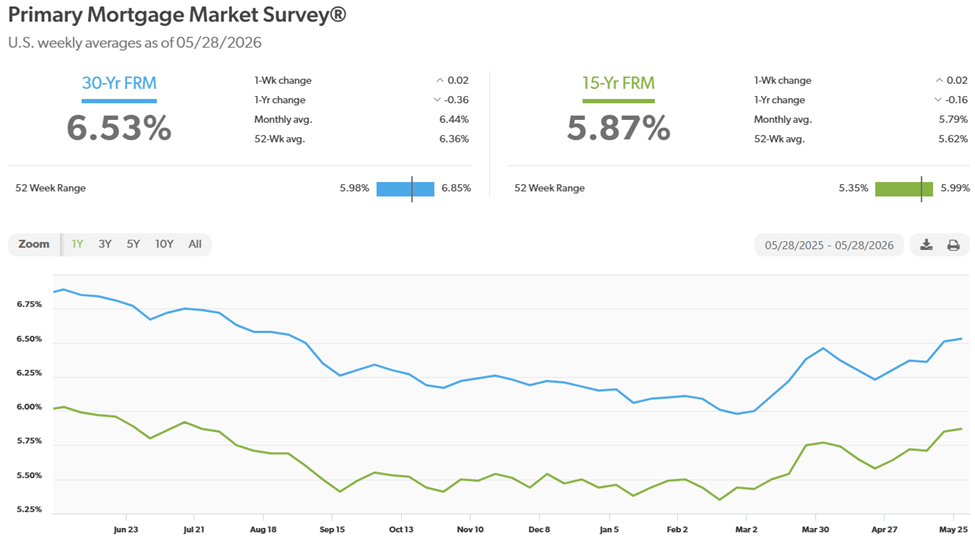
Mortgage rates continued their slow but steady rise since the start of the Iran war in the beginning of March. This has hurt the refi market as well as deterring first-time home buyers. The good news is that new home inventory is increasing enough to offset the lack of existing home inventory. This is giving buyers a little more leverage than they had a year ago.
The 30-year fixed rate finished the month at 6.53%, up 23 bps from last month. Looking ahead, rates will most likely remain below the 7% level and track the 10-year bond rate until inflation subsides, which could be a while with no resolution in the Middle East as of yet.
Here is a look at the one-year chart of the 15- and 30-year mortgage rates from Freddie Mac.
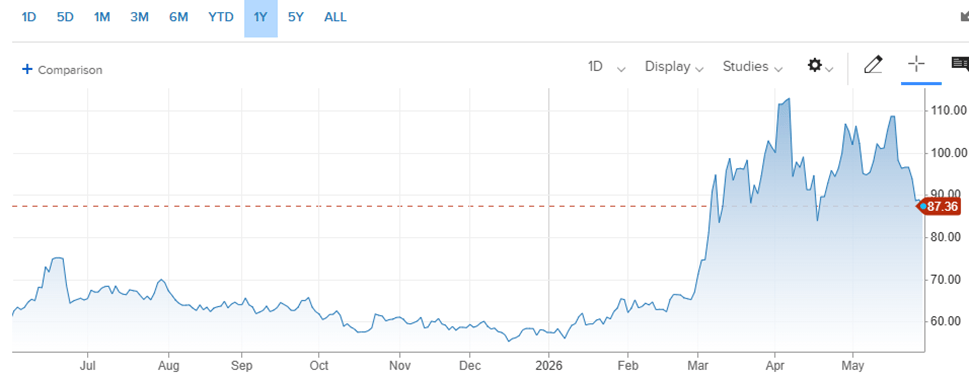
Oil prices had a wild ride once again in May, swinging up and down for the third month in a row as talks of a peace deal between Iran dn the U.S. rise and fall daily. Fortunately, there seems to be enough hope out there for a resolution and that has forced oil prices lower since the beginning of May.
For the month of May, the price for a barrel of West Texas Intermediate (WTI) oil started at $105.93 and ended at $87.36, down about $19 for the month. For the year, it is still up $30 a barrel, or just over 52%.
Oil reserves continue to get tapped by countries worldwide. More measures across the globe to curb demand, such as work-from-home, virtual learning, and cancelling flights are being implemented. However, if oil reserves continue to get depleted across the globe, it will push oil prices even higher than they already are, impacting corporate profits and accelerating inflation significantly.
For now, prices for oil across the world have come down quite a bit this past month, which is great news. As far as getting back to pre-war price levels, that could take quite a while due to the extensive infrastructure damage, the time it takes to restart oil fields that were shut in due to the war, and the lingering risk premium on oil prices for fear that the war will reignite.
Here’s a look at the one-year chart for U.S. oil:
Gasoline prices cruised higher once again this past month, hitting their highest national average since the post-pandemic surge in the summer of 2022. This increase over the last three months has been almost entirely due to the war with Iran, which caused the Strait of Hormuz to essentially close, cutting off about 20% of the world’s oil supply. The national average price hit $4.39 per gallon to end the month. It’s even more devastating in the parts of the world that are more dependent on this supply source. Indiana has the cheapest gas currently, checking in at $3.77 a gallon. California has the most expensive gasoline at $6.06 per gallon. FYI, a year ago, we were paying $3.17.
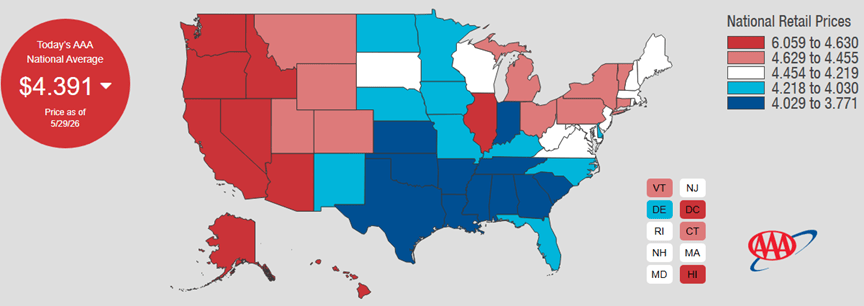
Check out the prices at the pump in your area: AAA Gas Prices.
Outlook
Events on the horizon that could move the markets in the near term:
- Fed, Rates, & Inflation: The Federal Open Market Committee (FOMC) meets in a few weeks and is widely anticipated since it is the first meeting with the new chairman, Kevin Warsh. That said, it is still likely that the Fed will keep interest rates unchanged. Inflation is still rising due to the closure of the Strait of Hormuz. Barring any breakthroughs in the geopolitical friction in the Middle East, expectations are for a “higher-for-longer” interest rate environment for the remainder of 2026. Plus, with employment numbers steady and consumer spending resilient, the focus will be on getting inflation under control, which means higher interest rates for now.
- Trump Administration Policies:
Trade – The refund process is in full swing for the roughly 330,000 U.S. companies that had to pay levies that were eventually deemed illegal. This corporate windfall will boost earnings for many companies in 2026. Some have offered to return all of this money to their customers, mostly shippers like FedEx and UPS, since they were the importers (getting the refund) who paid the tariffs for hundreds of thousands of small businesses and passed that cost onto them. This boost to earnings should be already priced into stocks.
Immigration – The administration’s new United States Citizenship and Immigration Services (USCIS) mandate, forcing foreign applicants to leave the U.S. to process green cards, will begin to hit our economy in a big way unless the courts deem this illegal. If they don’t, we could see tens of thousands of people forced to leave the U.S., creating a massive loss of employment. I expect the courts to rule this order illegal because the damage to our country would be unprecedented.
- Iran Conflict: We have entered our fourth month in this conflict and the damage to the global economy continues to worsen. This war has had a similar effect on our economy as the tariffs have had, both self-inflicted. That means, similar to the tariff chaos, the damage from this war can be somewhat reversed by simply getting out of there. The sooner we do that, the sooner that the Strait can reopen and the flow of oil and other materials can normalize. We have the powerful winds of the AI revolution at our backs and once we stop hurting ourselves and mend our international relationships, we could really see our economy accelerate.
Joe Baker, CFP®
Baker Asset Management, LLC
joebaker@bakerassetmanagement.com

