

Do you want to get paid by the IRS for contributing to your IRA or other retirement plans? Well, you can because they will pay you to save for retirement.
There is a little-known tax rule that has been around since 2002 called the Retirement Savings Contributions Credit (Saver’s Credit). This tax credit essentially pays you to put money into your IRA, Roth IRA, 401k, TSA, and most other retirement plans. Here’s a quick summary of how it works:
Eligibility
You are eligible for the credit if you meet certain criteria:
- Income limits: Your adjusted gross income (AGI) must be below a certain threshold. The exact threshold varies depending on your filing status and whether you are a qualifying individual.
- Contributions: You must make qualifying contributions to a traditional or Roth IRA, or to an eligible employer-sponsored retirement plan.
- Age: You must be at least 18 years old and not a full-time student.
Credit Amount
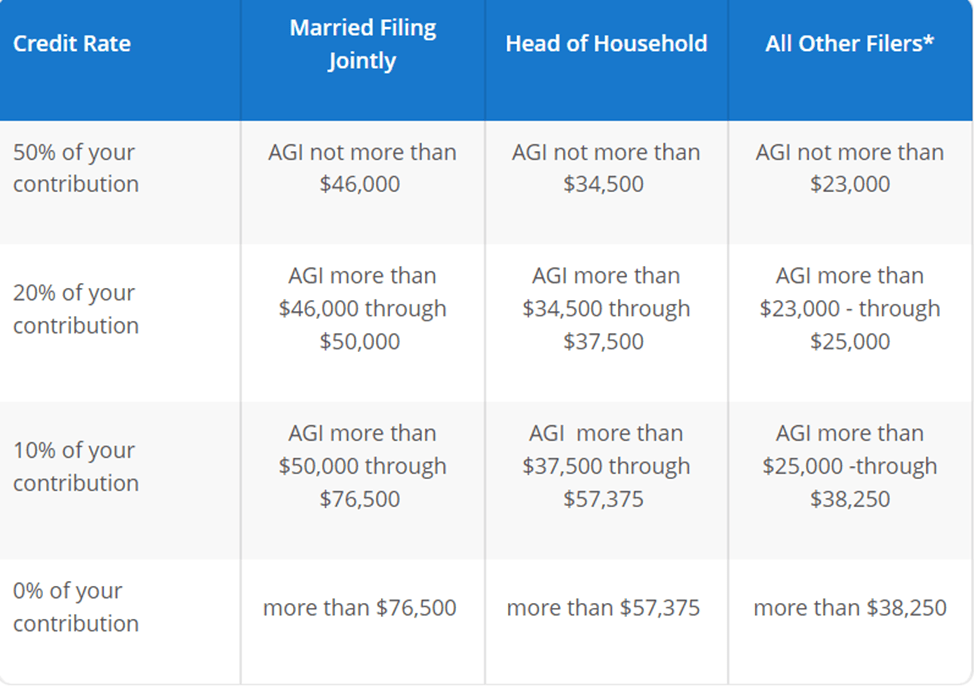
As with most tax credits, the amount is based on your adjusted gross income (AGI) in the year that you contribute. The maximum amount of the credit is 50% of the amount that you contribute to your retirement plan. The maximum contribution amount that can qualify for the credit is $2,000, making the maximum credit $1,000. Here is an example:
Jill, who works at a retail store, is married and earned $41,000 in 2024. Jill’s spouse was unemployed in 2024 and didn’t have any earnings. Jill contributed $2,000 to her IRA for 2024. After deducting her IRA contribution, the adjusted gross income shown on her joint return is $39,000. Jill may claim a 50% credit of $1,000 for her $2,000 IRA contribution on her 2024 tax return.
The following table shows how much of a credit that you are eligible for:
2024 Saver’s Credit Rates and Filing Status
For those that are eligible, it is like getting a match from the government on your contribution. Every little bit helps!
Please comment or send an email if you have any questions.
Joe Baker, CFP®
Baker Asset Management, LLC
joebaker@bakerassemanagement.com

