

Calendar Notes
- September 2nd – Labor Day. Stock and bond markets are closed.
- September 22nd – First day of Autumn
Stocks made it a positive month in August, but it was quite the wild ride. Right at the beginning of the month, we had some weak economic data come in sparking fears that the U.S. was heading into a recession. It seemed like that coupled with Buffet selling almost all of his Apple shares and the federal courts finding Google guilty of violating antitrust laws all on the same day was enough for panic selling to ensue. As surprising as that all was, it was even more surprising how quickly stocks bounced back once everyone took a deep breath.
For the month, the S&P 500 was higher for the fourth month in a row, this time by 2.28%. For 2024, it is up 18.4%.
The Federal Reserve did not meet in August but had plenty of speaking time during their retreat at Jackson Hole, Wyoming. They basically said that it was time to start cutting interest rates. Everyone knew it was coming but the fact that they said it certainly helped calm the markets a little bit.
Besides rate cuts, we have another potential mover of stocks in September: The Past. Historically speaking, September is almost always the worst month for stocks. For the last twenty years, the S&P 500 has had a negative return of 0.60%. We will have to see if interest rate cuts or history will be more influential over the next 30 days.
Take a look at the Outlook section below to see what events could move the markets over the short term.
Bond prices made it four months in a row of positive gains, their longest run in three years. Government, corporate, and high yield bonds all moved higher as inflation continues to drop and the Federal Reserve gets ready to cut short-term interest rates this month.
The 10-year US Treasury note yield fell once again in August, finishing the month at 3.91%, lower than the 4.07% that it was at the beginning of the month. The 30-year bond yield closed out the month at 4.20%, lower than the 4.35% that it was a month ago.
Bond investors can rest a little easier now because it looks fairly certain what direction rates are going for at least the next year. Therefore, bond buyers holding to maturity could extend their maturity range out to two to three years and feel confident. If rates drop faster than expected, you can sell those bonds before they mature with some nice capital gains.
Savings rates have peaked, I believe, and are starting to roll over as a cut in interest rates by the Federal Reserve is imminent. There is still a ton of money parked in cash (CDs, MMA, Savings) and why not? You can still get over 5% return on your money, risk free. However, I don’t think these rates are going to be around much longer, especially if the Federal Reserve starts chopping rates. Having said that, CDs and MMAs continue to be a great place topark your cash and your emergency fund, for now.
Now, take a look at the top rates for CDs and money market accounts (MMA):
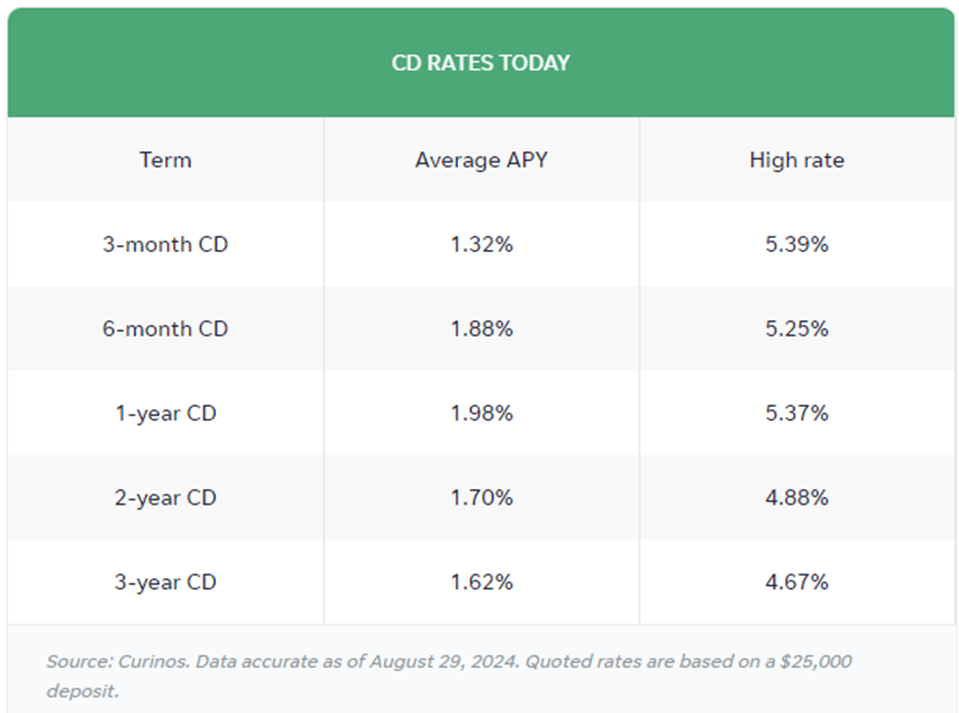
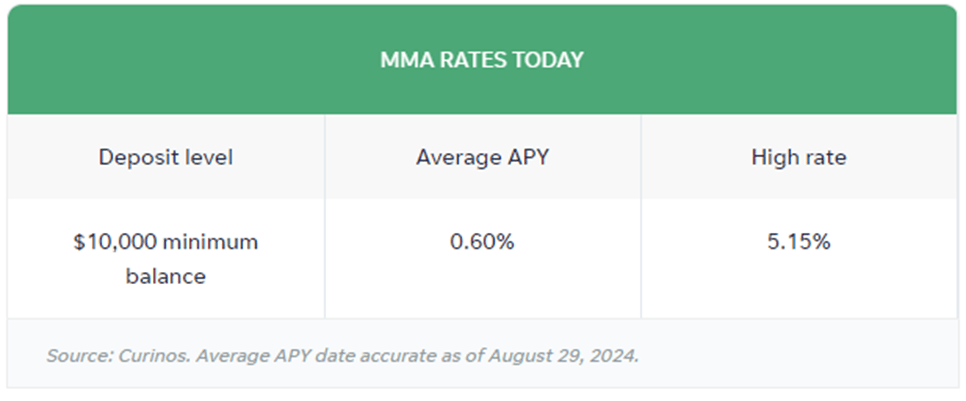
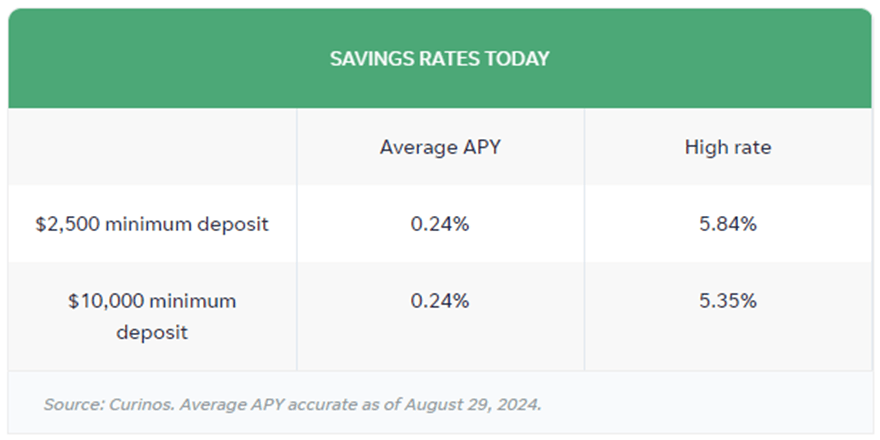
The best 1-year CD interest rate is currently at 5.37%, same as last month. The best 5-year CD rate right now is around 4.50%, a 25-basis point drop from last month. All the other rates pretty much stayed the same.
Savings rates are going to be coming down over the next year or so as long as inflation remains tame. If this holds true, it would be okay to put cash that you don’t need immediately in CDs with up to 2-year maturities. For emergency cash, stick to high yielding money market and savings accounts, which are still yielding well over 5%. As always, keep the total under $250,000 per person at any one bank to ensure you are fully covered by the FDIC.
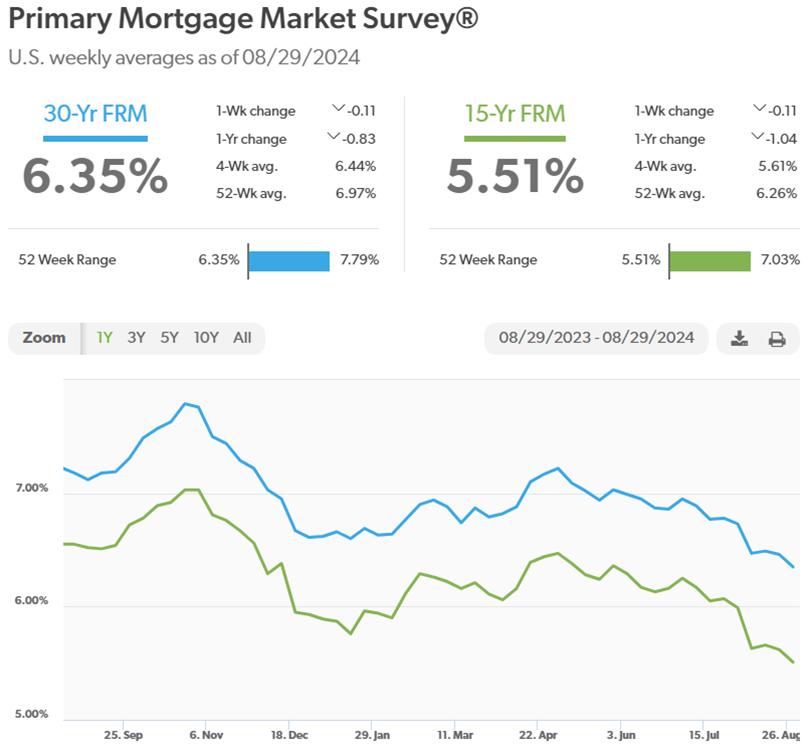
Mortgage rates dropped once again in August, hitting 15-month lows and falling further from the dreaded 7% mark for the 30-year rate. This is welcome news for the housing industry. Hopefully, 7% mortgages are in the rearview mirror for a long time. Currently, the 30-year rate sits at 6.35%, lower than a month ago, at 6.78%.
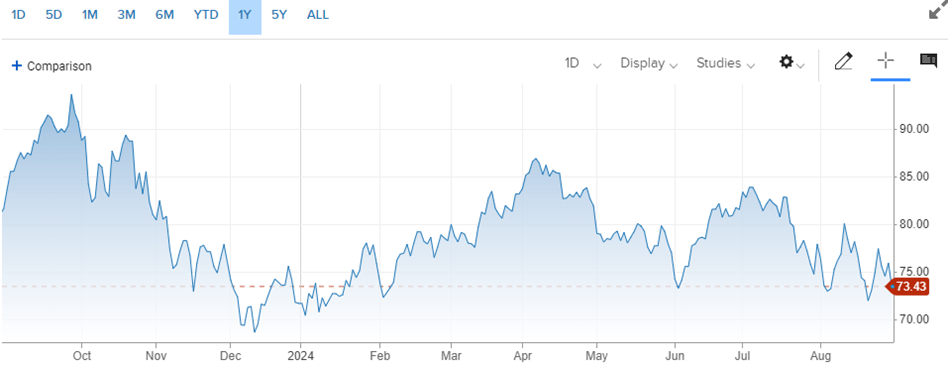
Oil prices fell again in August, even as tensions ramp up in the Middle East. Producers are pumping out the black gold, but demand hasn’t picked up as expected so we are seeing some excess supply.
For the month, the price for a barrel of oil settled at $73.43, down from $77.91 at the beginning of August. For the year, it is only up about 2.4%. Oil, diesel, and gasoline prices are input costs for almost every product or service consumers use. So, watching the price trends of fossil fuels is a great leading indicator as to where consumer prices should be heading, which should be lower now.
Here’s a look at the one-year chart for U.S. oil:
Gasoline prices dropped nicely in August, following oil’s lead. Regular unleaded gasoline is now averaging $3.35 per gallon, down from $3.49 last month. Mississippi has the cheapest gas currently, checking in at $2.88 a gallon. Hawaii has the most expensive gasoline at $4.66 per gallon. FYI, a year ago, we were paying $3.83.
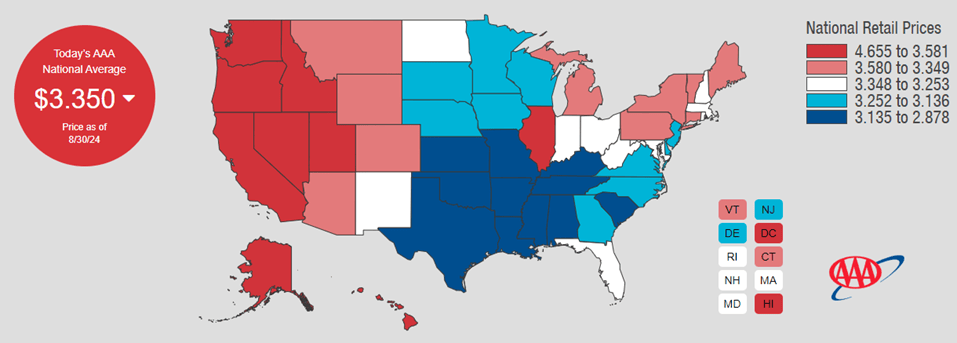
Check out the prices at the pump in your area: AAA Gas Prices.
Outlook
Events on the horizon that could move the markets in the near term:
- Fed & Inflation: Well, it’s pretty much a lock that the Federal Reserve Open Market Committee (FOMC) will cut short-term interest rates at least 25 basis points at their next meeting this month. Inflation is on a steady glide path to the Fed’s 2% target. For consumers, that just means prices have stopped going up so fast but are still high. We will need deflation to get prices down to where they were before the pandemic, but that’s probably not going to happen. So, wages will have to continue to rise, which they have been for most professions, albeit at a slower pace more recently. It will remain tough for people on fixed incomes, such as retirees.
Back to the rate cut, I don’t expect it to move the markets very much since it is probably baked into the cake already. However, if this is the start of several cuts in the months ahead, this should provide the next catalyst for stocks and bonds to move higher.
- Potential Asset Shift: Interest rates have rolled over and should continue downward as the Fed starts hacking away at them over the next year or so. We are already starting to see money flow from bonds and money markets to stocks. I suspect that it will flow to the highflyers in technology but also to dividend- paying stocks, such as utilities, REITs, etc., so investors can continue to generate investment income similar to what they were getting in the fixed income markets. There’s still about $6 trillion sitting in money market funds which could provide a nice boost to stocks if rates continue to drop.
Joe Baker, CFP®
Baker Asset Management, LLC
joebaker@bakerassetmanagement.com

