What You Need to Know If You Inherit an IRA

The Great Wealth Transfer is officially underway. Over the next two decades, Baby Boomers are projected to pass down tens of trillions of dollars to Gen X and Millennial heirs. A significant portion of this wealth is sitting inside tax-deferred retirement accounts—specifically Traditional IRAs and 401(k)s.

While receiving an inheritance can be life-changing, inheriting a retirement account comes with a maze of tax laws. Following the SECURE Act and finalized IRS regulations, the rules governing inherited IRAs have fundamentally changed. If you expect to leave or receive an inherited IRA, understanding these rules is critical to avoiding a massive tax bite.

The Death of the “Stretch IRA”

For decades, non-spouse beneficiaries (such as adult children or grandchildren) enjoyed a tax perk known as the Stretch IRA. Heirs could take small, required minimum distributions (RMDs) calculated over their own life expectancies. This allowed the remaining account balance to grow tax-deferred for 30, 40, or even 50 years.

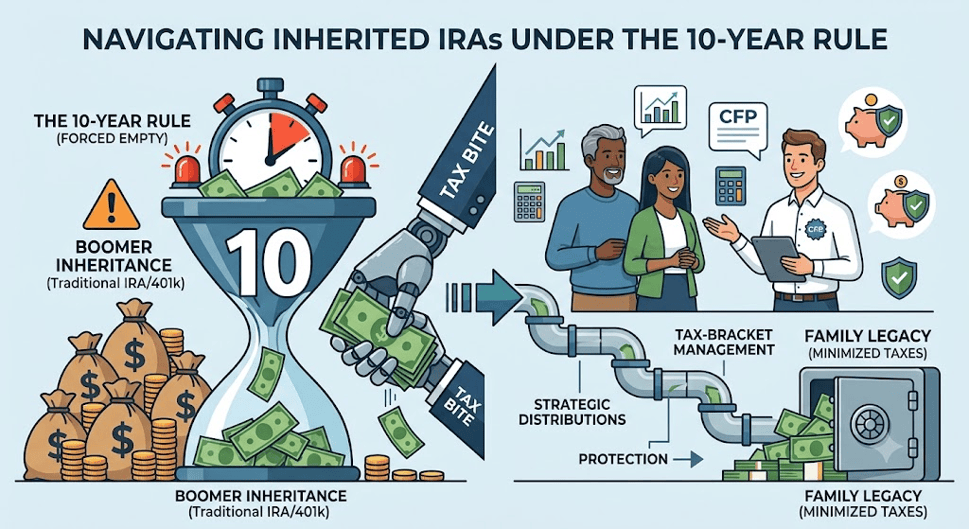
Congress effectively eliminated the Stretch IRA for most non-spouse beneficiaries. Instead, most heirs are now subject to the 10-Year Rule, which requires the entire account balance to be depleted by December 31st of the 10th year following the original owner’s death.

How the 10-Year Rule Works (And the “RMD Catch”)

How you manage an inherited Traditional IRA over that 10-year window depends heavily on whether the original account owner had reached their Required Beginning Date for RMDs (currently age 73) before passing away:

Owner’s Status at PassingDistribution Requirement for Non-Spouse BeneficiaryTax Impact
Died BEFORE Age 73Flexible 10-Year Window: No mandatory annual withdrawals are required in years 1–9. The entire account must simply be emptied by the end of Year 10.Income tax is owed on withdrawals in the year they are taken.
Died ON or AFTER Age 73Mandatory Annual RMDs: You must take annual RMDs in years 1–9 based on your life expectancy and fully empty the account by Year 10.Income tax is owed on each annual distribution.
Inherited Roth IRA10-Year Draining Rule: Account must be emptied by Year 10, but no annual RMDs are required during years 1–9 regardless of the owner’s age.100% Tax-Free distributions (assuming the Roth account met the 5-year holding rule).

Note on Exceptions: Surviving spouses, minor children of the account owner, disabled or chronically ill individuals, and beneficiaries not more than 10 years younger than the deceased qualify as “Eligible Designated Beneficiaries” and may still use lifetime distribution rules under specific conditions.

The “Tax Bomb” Risk for Heirs

The biggest trap of the 10-Year Rule is the unexpected tax bump.

Gen Xers and Millennials inheriting IRAs are often in their peak earning years (ages 40 to 60). Adding $50,000 to $100,000+ per year in taxable IRA distributions on top of a high salary can push heirs into significantly higher federal and state tax brackets. Furthermore, waiting until Year 10 to withdraw a lump sum can result in a massive single-year tax liability.

Don’t Forget the State Tax Twist

While federal rules dictate when you must take distributions, state laws determine how much extra cut the government takes. State income taxes vary drastically across the country, making location a critical factor in your withdrawal strategy. For instance, heirs living in Texas pay 0% state income tax on inherited IRA distributions, leaving only federal tax to manage. In contrast, beneficiaries in California face steep top income tax rates (up to 13.3%), which can severely compound the tax hit on forced 10-year withdrawals. States like South Carolina (top rate around 6.2%) and New York fall in between—neither state charges a separate inheritance tax, but both tax traditional IRA distributions as ordinary state income (though both offer specific state tax exemptions for seniors that may apply under certain conditions). If you or your heirs reside in a high-tax state, tax-bracket management becomes doubly important.

Smart Strategies to Minimize the Tax Hit

  1. Stagger Withdrawals Intentionally: Rather than taking nothing for nine years and triggering a massive tax bill in Year 10, spread distributions evenly over the decade to keep yourself within lower tax brackets.
  2. Utilize Low-Income or Gap Years: If you plan to retire, take a sabbatical, or experience a lower-income year during the 10-year window, schedule larger inherited IRA withdrawals during those specific years.
  3. Proactive Planning for Account Owners (Lifetime Roth Conversions): If you are currently planning your estate, consider executing systematic Roth conversions during your lifetime. Paying the tax now at your current tax bracket allows your heirs to inherit tax-free growth and tax-free withdrawals.

The Bottom Line

Inheriting an IRA can provide a significant boost to your long-term financial security, but without a coordinated strategy, income taxes can erode a substantial portion of your family’s legacy.

Whether you are looking to update your current estate plan or have recently inherited an account, consulting with a financial advisor can help ensure you keep as much of that wealth as possible.

Please comment or send an email if you have any questions.

Joe Baker, CFP®

Baker Asset Management, LLC

joebaker@bakerassetmanagement.com

Updating Your Estate Plan: Why Naming a Trust as Your IRA Beneficiary Needs a Checkup

If you created a trust years ago to pass your IRA to children or grandchildren, the ground beneath your estate plan has fundamentally shifted.

Under older tax law, naming a trust as your IRA beneficiary allowed your heirs to “stretch” distributions—and the tax burden—gradually over their lifetimes. Today, under the post-SECURE Act framework, those rules have been replaced with strict deadlines that could trigger unexpected tax bills if left unchecked.

The Problem: Compressed Trust Tax Brackets

Many older trusts were drafted as “accumulation trusts,” which allow the trustee to hold IRA distributions inside the trust for asset protection. While protection remains valuable, the tax cost has skyrocketed:

  • Individual Tax Brackets: An individual doesn’t reach the top 37% federal marginal tax bracket until their income exceeds $600,000 (or over $750,000 for married couples filing jointly).
  • Trust Tax Brackets: A trust hits the top 37% tax bracket at just over $16,000 of retained income.

If your inherited traditional IRA pushes hundreds of thousands of dollars into a trust over a short period, the IRS takes a significantly larger bite than if the funds were distributed directly or managed through an updated structure.

The 10-Year Rule Factor

Most non-spouse beneficiaries must now fully deplete an inherited IRA by December 31 of the 10th year following the owner’s death. Furthermore, if you pass away after reaching your Required Beginning Date (RBD), your beneficiaries are required to take annual distributions in years 1 through 9 before liquidating the balance in year 10.

Without proactive coordination, forcing large distributions into an outdated trust structure can needlessly drain family wealth.

Strategic Solutions to Consider

  1. Review Conduit vs. Accumulation Language: Ensure trust provisions match current legal definitions for “see-through” status while balancing creditor protection against tax drag.
  2. Lifetime Roth Conversions: Converting traditional IRA assets to a Roth IRA during your lifetime allows the account to pass tax-free to heirs. Inherited Roth IRAs are still subject to the 10-year rule, but distributions come out completely tax-free.
  3. Re-evaluate Direct Beneficiary Designations: For mature heirs who do not require legal protection, direct designations may be far more tax efficient.

If you haven’t reviewed your estate plan and beneficiary designations recently, now is the time to align them with current tax law and your overall financial goals.

Please comment or send an email if you have any questions.

Joe Baker, CFP®

Baker Asset Management, LLC

joebaker@bakerassetmanagement.com

Don’t Forget to Review your Beneficiaries

Talking about your beneficiaries means talking about death, specifically your death. Planning for your death may sound like the worst thing ever but it is really an incredibly thoughtful act on your part and will help to minimize stress for your family and loved ones when you ultimately check out.

Beneficiaries are typically assigned to retirement accounts (401k, IRAs, etc.), life insurance and annuity policies, as well as transfer-on-death (TOD) accounts. Naming beneficiaries on these accounts allow these assets to avoid the probate process after your death. If you don’t name any beneficiaries, these accounts will be passed on to your estate where they will go through probate based on your state laws. Probate is a legal proceeding that determines who will get your stuff. It is a lengthy, complex process that can be pretty expensive.

If you have a will, probate will use that to determine how your assets get divvied up. If you don’t have a will, also known as intestate, the state will do the best they can to determine who gets what. Suffice it to say, naming beneficiaries is the way to go. Getting this done before you pass away will make things simpler, quicker, and cheaper for your heirs during a very stressful time.

Naming beneficiaries can also be a very simple and inexpensive estate plan for most people, especially if you title your real estate property as a TOD asset.

You should name both primary and contingent beneficiaries. The primary beneficiary is first in line to receive your assets. If the primary beneficiary passes away before you, the contingent beneficiary will receive those assets, depending on your selection of per capita or per stirpes (see explanation below). You can have as many primary and contingent beneficiaries as you want.

Now, here is the most overlooked section of the beneficiary page: Choosing per stirpes or per capita.

Per stirpes (derived from the Latin word for roots) means that if a beneficiary dies before you die, the deceased beneficiary’s children inherit your money.

Per capita (Latin for each head) means that if a beneficiary dies before you die, their share of the inheritance goes back to the estate and gets divided among the other living beneficiaries.

Choosing which one of these for your beneficiaries is very important and should be considered carefully. In the most basic instance, you should elect per stirpes on your beneficiary designations to ensure that your heirs’ heirs receive their share.

I mentioned transfer-on-death (TOD) accounts earlier and just wanted to review what they are and when to use them. TOD is used for taxable accounts, and it allows you to assign beneficiaries just as you do with retirement accounts, annuities, and life insurance. This allows your taxable accounts to bypass the probate process, which is quicker, cheaper, and less stressful for your heirs.

Also, there are about 25 states that currently offer a TOD deed for real estate property. This is a huge time and money saver for your heirs because the property automatically passes down to your beneficiaries named on the deed.

Finally, remember to review your beneficiaries at least annually and certainly after any major life events, such as death, divorce, marriage, adoption, etc.

Please comment or send an email if you have any questions.

Joe Baker, CFP®

Baker Asset Management, LLC

joebaker@bakerassetmanagement.com

The Pros and Cons of Living Trusts

This is always a great time of the year to review your financial picture.

One of the items that you might be considering, or have considered before, is whether or not to establish a revocable living trust to hold your assets.

A revocable living trust is a legal document created by you (the grantor) while you are alive and of sound mind and body. Just like a will, a living trust spells out exactly what your desires are with regard to your assets, your dependents, and your heirs. But a won’t go into effect until after you die, whereas a living trust is already in effect.

There is little difference to owning your assets in your name or in your living trust’s name while you are alive and well. The benefits occur after you die or if you become incapable of handling your own affairs.

Here is a list of some of the benefits of having a living trust:

  • Avoids probate – This is probably the biggest reason people have a living trust. The trust bypasses the costly and time-consuming process of probate, which is conducted by the state courts of your residence when you die and has the authority to decide how to divvy up your assets.
  • Provides privacy – a living trust is not made public, so upon your death, your estate will be distributed in private. A will, on the other hand, is public record and so all transactions will be public as well.
  • Maintains control – If you become incapacitated in a way that you can no longer manage your assets, your handpicked successor trustee can manage your affairs without court intervention, and since the trust is revocable, if you dispute your incapacity, you can retain control yourself.

There are disadvantages as well:

  • Cost – A living trust can cost anywhere between $500 – $4,000, depending on the complexity. This is the price that you pay for the money saved by avoiding probate, which can typically run around 4% of your total estate value.
  • Bookkeeping – In order for your living trust to be of use, you have to transfer your assets into it. That means opening new accounts with the trust as owner for your bank and investment accounts. Also, transferring deeds and title for property into the trust name, which can be time consuming.

In summary, if you have a large family and/or a large number of assets, you may want to consider establishing a revocable living trust. It could save you and your family not just a lot of money, but also a ton of undue stress and strain on you and your family during difficult times.

If you have questions or want to know if you should establish a living trust, just shoot me an email.

Joe Baker, CFP®

Baker Asset Management, LLC

joebaker@bakerassetmanagement.com

Letter of Final Instruction – Don’t Leave This World Without It

The Letter of Final Instruction (LOFI) should be a major part of everyone’s estate plan.  Unfortunately, I rarely see one when reviewing a client’s financial documents.

The LOFI isn’t a legal document like a will or trust.  It is simply a document that provides your family with guidance upon your death on little things that wouldn’t necessarily go into a legal document.  It is a godsend for family members, especially after a sudden, unexpected death.  I have seen many a family become completely stressed out and overwhelmed when dealing with the aftermath of a death of a loved one.

The LOFI provides important information to heirs, such as location of safe deposit box keys, insurance policy info, financial account numbers, online passwords, etc.  It also allows you to direct where you want your personal belongings to go to, such as your 100-year-old china set or your vintage ‘65 Mustang.  These items typically aren’t specified in a will or trust.  However, you can reference a LOFI in a will or living trust.  That way, if you need to make changes, you can simply change the LOFI without having to amend the will or trust, since that takes the assistance of an attorney.

The LOFI should be distributed to all immediate family members and updated annually, if needed.  I keep mine as a pdf file on my computer as well as a hard copy that I leave on my desk when I travel.

If you want to get started on writing up your LOFI, here is a link to a very comprehensive checklist of what you should include: https://www.cals.uidaho.edu/edcomm/pdf/CIS/CIS0958.pdf.

You can also just do an internet search for letters of final instructions, and you’ll find a bunch of resources to use.

Get going on this, even if you don’t have a will.  Something is better than nothing.  Having a LOFI for your family will give you peace of mind and will help your heirs deal with settling your estate without all the stress and confusion.

Joe Baker, CFP®

Baker Asset Management, LLC

joebaker@bakerassetmanagement.com

FDIC and Trusts: What You Need To Know

A new rule regarding FDIC insurance for trust accounts became effective on April 1, 2024, that could impact anyone with a trust account held at an FDIC-member bank. The new rule simplifies insurance coverage for trust accounts by:

  • Reducing the number of insurance rules for trust accounts
  • Eliminating complexities from the revocable and irrevocable trust rules
  • Utilizing the same familiar, straightforward insurance calculation for both revocable and irrevocable trusts

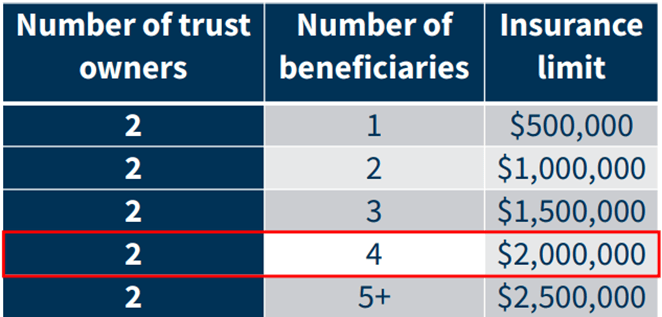
The new rule provides insurance of a trust account(s) of $250,000 per beneficiary, for up to five beneficiaries, for a total of $1,250,000.

This is per each trust owner for each bank. However, many trusts have multiple owners. So, for example, if you own a trust with your spouse (two owners) and the trust has four beneficiaries, FDIC insures up to $2,000,000 (2 owners x 4 beneficiaries x $250,000).

It’s important to note that $1,250,000 remains the maximum insurance, per bank, for a single owner, regardless of how many trusts and/or beneficiaries that they have at that particular bank. That means if a person has, say, a revocable living trust and an irrevocable charitable trust, those trusts are combined to determine how much the owner is insured for those combined assets.

Although this new rule was enacted to simplify the FDIC insurance rules regarding trust accounts, it still has its complexities. I would definitely recommend working with your financial advisers to maximize coverage for your financial assets.

Please comment or send an email if you have any questions. Thanks!

Joe Baker, CFP®

Baker Asset Management, LLC

joebaker@bakerassemanagement.com