
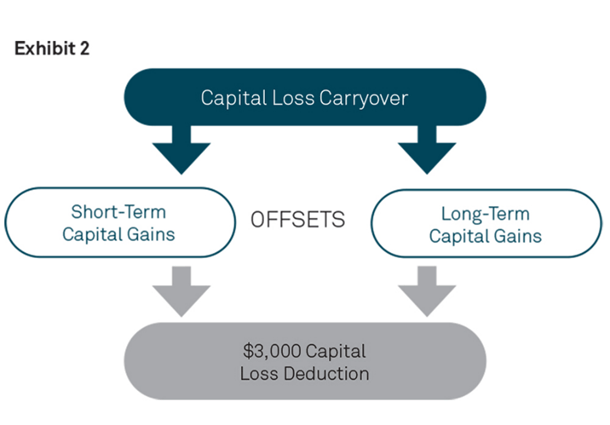
Because 2022 was such a bad year for the stock market, many investors who sold stocks back then had more capital losses than capital gains for that year. The good news is that they can use those excess losses to reduce their capital gains in 2023 and even some of their ordinary income (up to $3,000).
Capital loss carryover is a tax rule that lets you use investment losses from one year to reduce your taxable income in future years. Before going any further, keep in mind that this rule only applies to taxable accounts, not retirement accounts, such as IRAs.
Here’s how it works:
1. Calculating your net capital loss:
- First, you need to calculate your net capital loss for the year. This is the difference between your capital gains (money you made on investments) and your capital losses (money you lost on investments).
- You can only deduct up to a certain amount of net capital losses in a single year. This limit is currently $3,000.
2. Carryover of unused losses:
- If your net capital loss is greater than the allowable deduction ($3,000), the unused portion automatically carries over to future tax years.
- There is no time limit to how long you can carry over capital losses.
- You can use the carryover to:
o Offset capital gains in future years.
o Deduct up to $3,000 against your ordinary income in future years.
3. Applying the carryover:
- Each year, you calculate your net capital loss again, considering any new gains and losses.
- You can use your current year’s net capital loss first to offset any capital gains you have.
- Then, you can apply any remaining unused carryover from previous years to further reduce your taxable income.
4. Important points to remember:
- Capital losses are categorized as short-term or long-term based on how long you held the investment before selling. Short-term losses can only offset short-term gains, while long-term losses can offset both short-term and long-term gains.
- Wash sales are a strategy where you sell an investment at a loss and then repurchase it shortly after. This is generally not allowed and can prevent you from claiming the capital loss.
- It’s important to keep accurate records of your capital gains and losses for tax purposes.
Here’s an example:
In 2022, you had $5,000 in capital losses and no capital gains. You deducted $3,000 of your losses to offset your ordinary income, and the remaining $2,000 carried over to 2023. In 2023, you had $1,000 in capital gains. You can first use your $2,000 carryover to completely offset these gains. You then have $1,000 remaining in your carryover that you can offset your ordinary income with, thus using up all of your capital loss carryover.
I hope this explanation helps. Remember, it’s always a good idea to consult with a tax professional for advice specific to your situation.
Please comment or send an email if you have any questions. Thanks!
Joe Baker, CFP®
Baker Asset Management, LLC
joebaker@bakerassemanagement.com

