

Calendar Notes
- March 10th: Daylight saving time begins at 2 a.m.
- March 17th: St. Patrick’s Day
- March 19th: First day of spring (vernal equinox)
- March 29th: Good Friday – The stock market is closed.
- March 31st: Easter Sunday
Stocks continued to push higher in February, led once again by most of the big tech companies, some major pharmaceuticals, and also firms associated with crypto currencies. Both the S&P 500 and the NASDAQ 100 indices closed the month at all-time highs.
For February, the index was up about 5.2%. So far this year, it is up 6.8%. This should bode well for the stock market for at least the rest of the year because when the S&P 500 is higher in both January and February, which it was this year, the next 12 months have been higher 27 out of 28 times since 1950, with an average return of 14.8%. Hopefully, the stock market can follow this historical trend.
The economy continues to power ahead, with very low unemployment and most inflation indicators continuing to drop. This is helping to pull stocks up, but the stickiness of most food prices and home prices are giving investors angst as to what the Federal Reserve will do with regards to interest rates. On top of all of that, we have elections coming up in November which always put some extra volatility in the markets.
Take a look at the Outlook section below to see what events could move the markets over the short term.
Bond prices moved lower across the board in February. Inflation data that came in this past month added uncertainty to the Fed’s rate cut timeline, pushing prices lower and rates higher.
I haven’t shown the yield curve in a while so wanted to add this to the monthly update this time to show you how out of whack it still is:
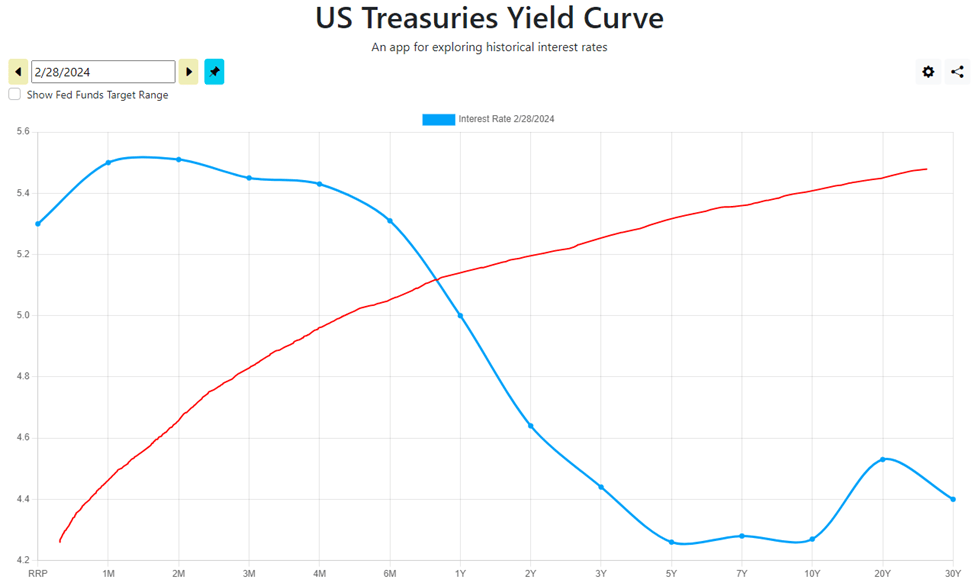
The blue line is the current yield curve for U.S. Treasury bonds, with the term of the bonds on the x axis (horizontal) and their corresponding interest rates on the y axis (vertical). The red line is my freehand drawing of what a normal yield curve is supposed to look like. Obviously, we have a ways to go to get back to a normal yield curve.
The 10-year US Treasury note yield breached the 4% level once again, finishing the month of February near 4.25%, higher than the 3.94% that it was at the beginning of the month. The 30-year bond yield closed out the month at 4.37%, about 20 basis points higher from a month ago.
With so much uncertainty surrounding the direction of interest rates, bond buyers should continue to focus on bonds with short-term maturities. I would keep maturities under 18 months and just plan on holding these bonds to maturity. That way, you won’t have to worry about selling at a discount if interest rates continue to head higher.
Savings rates moved slightly higher in February as hopes for rate cuts in March dissipated. Fyi, savings rates typically follow, but lag, the direction of bond yields. These current savings rates are still relatively high, especially with respect to inflation. So, CDs and MMAs continue to be a great place to park your cash and your emergency fund. These rates continue to be a legitimate alternative to stocks and bonds and will keep pressure on those markets until we see this trend reverse, which looks like it will be happening later in the year than expected.
Now, take a look at the top rates for CDs and money market accounts (MMA):
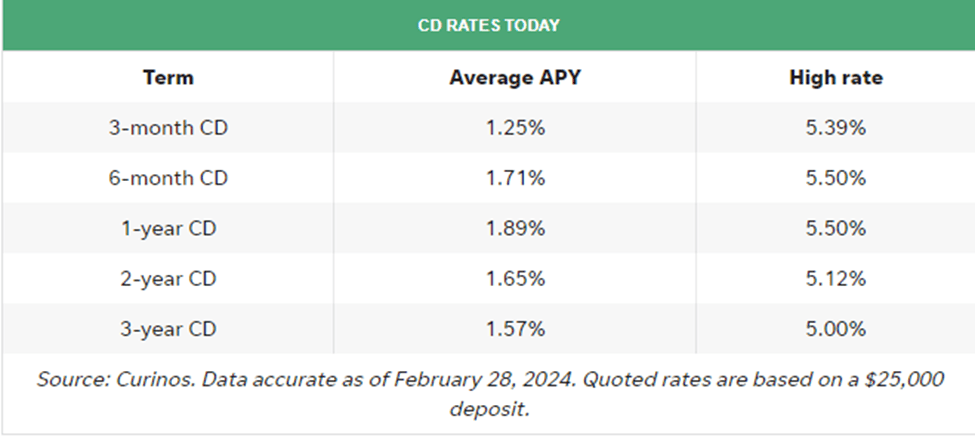
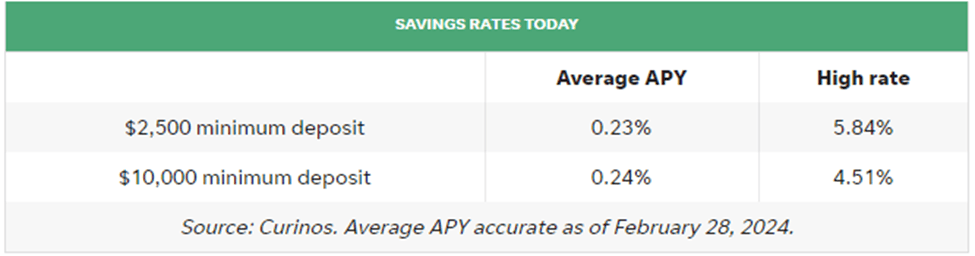
The best 1-year CD interest rate is currently at 5.50%. The best 5-year CD rate right now is around 4.61%. These rates are still inverted and may stay that way for a while based on the consensus of the Federal Reserve holding steady on interest rates.
Eventually, they will normalize but not until the inflation comes down enough for the Fed to feel comfortable lowering interest rates. As such, I would still put my savings or emergency spending money into short-term CDs, 1 year or less, and reevaluate when they mature. If you’d rather have more liquidity, look into an MMA (still yielding well over 5% currently). Keep the total under $250,000 per person at any one bank to ensure you are fully covered by the FDIC. CDs and MMAs have become nice alternatives for risk-averse investors and have drawn money away from stocks because of their relatively high rates that carry virtually no risk.
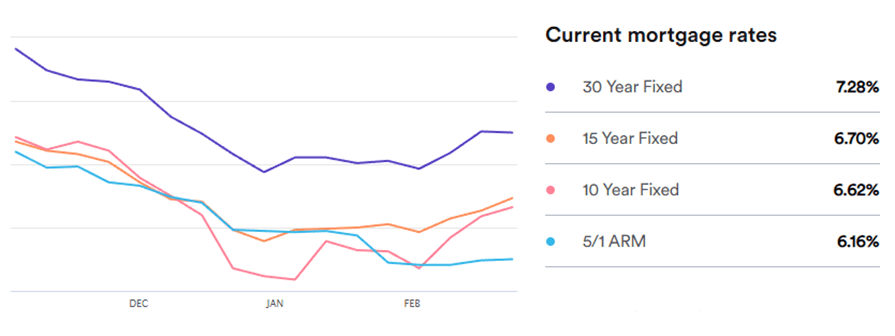
Mortgage rates continued to head higher during February as hopes faded for an interest rate cut anytime soon by the Federal Reserve. Currently, the 30-year rate sits at 7.28%, slightly higher than a month ago, at 7.03%. These relatively high rates along with very little existing home inventory for sale have dropped mortgage applications to their lowest since 1995.
Although rates went up again for the second month in a row, I don’t think this is a long-term trend. That said, demand for mortgage loans will most likely pick up as we head into the spring even if the Fed stays the course and takes no action on interest rates.
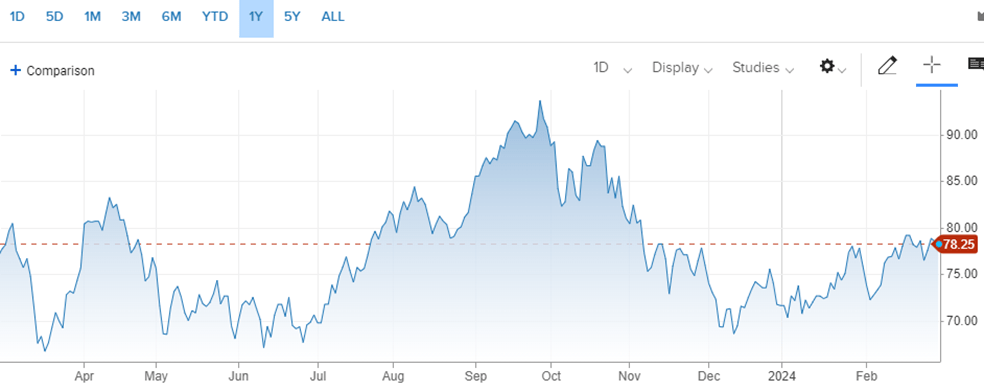
Oil prices moved higher for the second consecutive month in February. Some of the causes for this rise in prices are OPEC+ extending its production cuts that it started last year as well as the potential for disruptions in oil shipping in the middle east due to Houthi militants. The U.S., Brazil, and Canada are continuing to produce at a near-record pace to help offset the OPEC+ cuts.
For the month, the price for a barrel of oil settled around $78.25, up from $75.76 at the beginning of February. OPEC+ is signaling that they would like to keep the production cuts in place through the end of this year, which is not going to help move prices lower. Plus, if China’s economy starts to fully recover, we could see higher oil prices before we see lower prices.
Here’s a look at the one-year chart for U.S. oil:
Gasoline prices tracked oil prices higher in February. The record warm winter temperatures helped fuel (pun intended) some of this increase.
Regular unleaded gasoline is now averaging $3.32 per gallon, up from $3.14 last month. Mississippi has the cheapest gas currently, checking in at $2.87 a gallon. California is back on top with the most expensive gasoline at $4.74 per gallon. FYI, a year ago, we were paying $3.36.
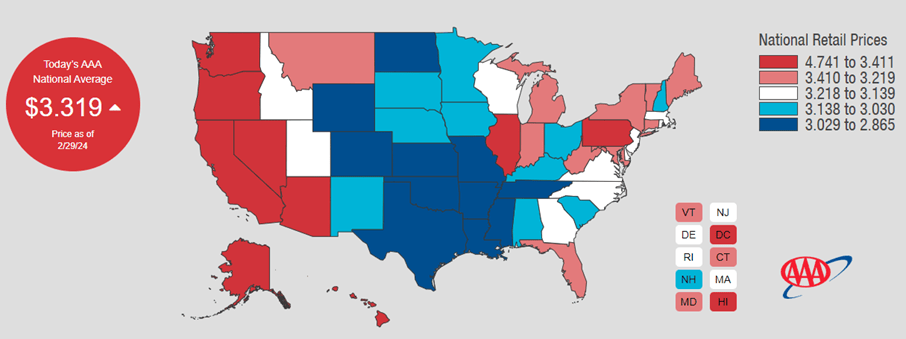
Check out the prices at the pump in your area: AAA Gas Prices.
Outlook
Events on the horizon that could move the markets in the near term:
- Fed & Inflation: The Fed did not meet in February, but they said plenty during their members’ many scheduled guest speaker events. As a result, many of their talking points coupled with the latest economic data are keeping the inflation embers glowing. Word on the street now is that The Fed won’t cut rates until mid-summer. Surprisingly, it may not matter to the economy or the stock market. They are both humming along in spite of persistently high interest rates. Just the expectation that the Fed will be cutting rates at some point in the near future is giving the markets strong support so far this year. We’ll certainly no more on this front when they meet again in late March.
Regarding inflation, here’s a big picture look at raw material prices over the last few years. The chart below shows the Bloomberg Commodity Index, which is a measure of raw materials used throughout our economy, such as fossil fuels, grains, and metals.
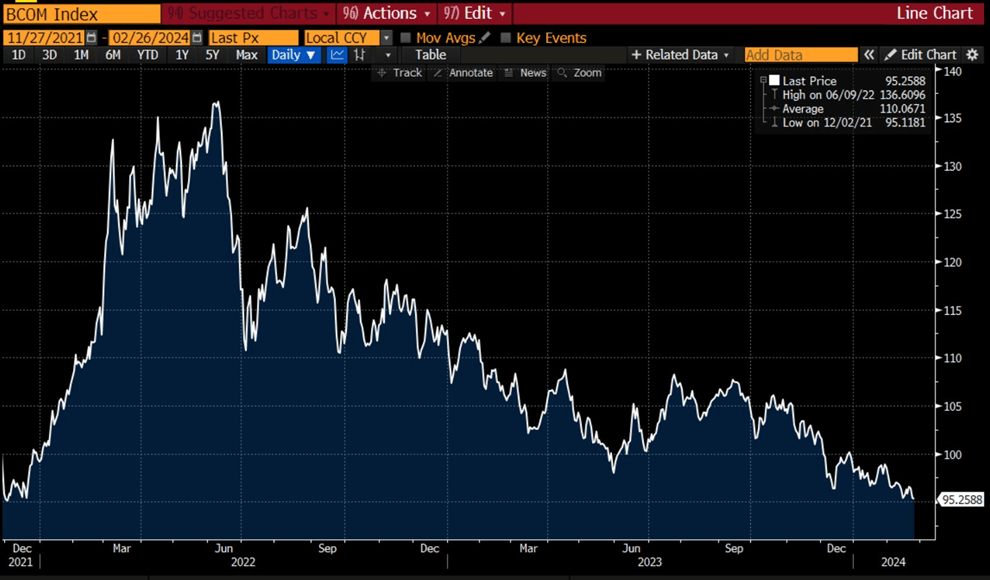
As you can see, it has been steadily decreasing over the past year. However, many of the consumer products that we use, particularly groceries, have not decreased in price at the same rate. I think the retail companies that sell these products are starting to feel the consumer blowback on their sustained high prices in the form of reduced demand. Hopefully, this will trigger some price reductions to match some of this drop in raw materials that we have seen. This should help move overall inflation lower towards the Fed’s two percent target so they can start cutting rates. This would be a positive for stock and bond holders in the near term.
- Savings Rates Peak: This is still in play as savings rates seemed to have stalled and could be heading lower. If the Fed starts to cut rates sometime this summer, we should see money flowing out of money markets and CDs and back into stocks. This could fund another leg up for stocks over the next 12-18 months.
Joe Baker, CFP®
Baker Asset Management, LLC
joebaker@bakerassetmanagement.com

