
When Can I Get Rid of My Old Tax Documents?

It’s always a good time to go through your stuff and purge what you don’t need anymore. I know I have a few boxes of financial paperwork that need a good going-through to see if anything can be sent to the shredder. Regarding tax documents, there is always the question of how long do we have to keep this information. The good news is that the Internal Revenue Service has some guidelines that can help you sort what to keep and what to get rid of.

Here are some of the retention guidelines that the IRS recommends:

General Rule:

Keep records for 3 years from the date you filed your original return or 2 years from the date you paid the tax, whichever is later, if you file a claim for credit or refund.

Exceptions and Longer Retention:

  • Keep records for 7 years if you file a claim for a loss from worthless securities or bad debt deduction.
  • Keep records for 6 years if you do not report income that you should report, and it is more than 25% of the gross income shown on your return.
  • Keep records indefinitely if you do not file a return or if you file a fraudulent return.
  • Employment Tax Records: Keep employment tax records for at least 4 years after the date that the tax becomes due or is paid, whichever is later.

Property Records:

  • Keep records related to property until the period of limitations expires for the year in which you dispose of the property.
  • These records are essential for calculating depreciation, amortization, depletion, and gain or loss on sale.

Important Considerations:

  • Even after IRS requirements are met, consider if other entities (e.g., state where you file taxes, lenders, insurance companies) require longer retention.
  • When records are no longer needed, dispose of them securely, such as by shredding.

Please comment or send an email if you have any questions. Thanks!

Joe Baker, CFP®

Baker Asset Management, LLC

joebaker@bakerassetmanagement.com

A Little Known IRS Program That Can Make Tax Season Less Taxing

There is a program offered by the IRS that allows you to file your federal taxes through an associated tax preparer for free! The IRS Free File program is a public-private partnership between the IRS and a group of tax software companies called the Free File Alliance. It allows eligible taxpayers to prepare and file their federal income tax returns online for free. Here’s how it works:

1. Eligibility:

  • Income: The main requirement is your Adjusted Gross Income (AGI). For the 2024 tax year (filing in 2025), the AGI limit is $84,000. This applies to all filing statuses (single, married filing jointly, etc.).
  • Other factors: Some participating companies may have additional eligibility requirements, such as age or state residency.

2. Accessing Free File:

3. Preparing and Filing:

  • Create an account: Once you’ve chosen a provider, you’ll be redirected to their website to create an account.
  • Follow the instructions: The software will guide you through the process of entering your tax information.
  • File electronically: When you’re finished, the software will transmit your return electronically to the IRS.

Key Features of IRS Free File:

  • Free federal return: Participating companies cannot charge you to prepare and e-file your federal tax return if you qualify.
  • Guided experience: The software uses a question-and-answer format to help you complete your return accurately.
  • Error checks: Built-in checks help catch mistakes and ensure your return is complete.
  • Direct deposit: You can choose to receive your refund via direct deposit for faster processing.

Important Notes:

  • State taxes: While federal filing is free, some providers may charge for state tax preparation.14 Check with your chosen provider for details.
  • Support: The level of customer support offered may vary between providers.
  • Accuracy: Always review your return carefully before filing, even with the help of software.

This is a great service that is most certainly underutilized by eligible tax filers and can potentially save you some hard-earned cash.

Please comment or send an email if you have any questions.

Joe Baker, CFP®

Baker Asset Management, LLC

joebaker@bakerassetmanagement.com
Don’t Forget About Your Capital Loss Carryover When Filing Your Taxes This Year

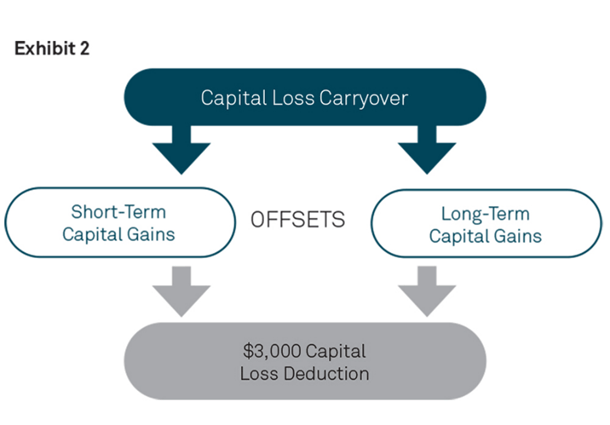
Because 2022 was such a bad year for the stock market, many investors who sold stocks back then had more capital losses than capital gains for that year. The good news is that they can use those excess losses to reduce their capital gains in 2023 and even some of their ordinary income (up to $3,000).

Capital loss carryover is a tax rule that lets you use investment losses from one year to reduce your taxable income in future years. Before going any further, keep in mind that this rule only applies to taxable accounts, not retirement accounts, such as IRAs.

Here’s how it works:

1. Calculating your net capital loss:

  • First, you need to calculate your net capital loss for the year. This is the difference between your capital gains (money you made on investments) and your capital losses (money you lost on investments).
  • You can only deduct up to a certain amount of net capital losses in a single year. This limit is currently $3,000.

2. Carryover of unused losses:

  • If your net capital loss is greater than the allowable deduction ($3,000), the unused portion automatically carries over to future tax years.
  • There is no time limit to how long you can carry over capital losses.
  • You can use the carryover to:

o Offset capital gains in future years.

o Deduct up to $3,000 against your ordinary income in future years.

3. Applying the carryover:

  • Each year, you calculate your net capital loss again, considering any new gains and losses.
  • You can use your current year’s net capital loss first to offset any capital gains you have.
  • Then, you can apply any remaining unused carryover from previous years to further reduce your taxable income.

4. Important points to remember:

  • Capital losses are categorized as short-term or long-term based on how long you held the investment before selling. Short-term losses can only offset short-term gains, while long-term losses can offset both short-term and long-term gains.
  • Wash sales are a strategy where you sell an investment at a loss and then repurchase it shortly after. This is generally not allowed and can prevent you from claiming the capital loss.
  • It’s important to keep accurate records of your capital gains and losses for tax purposes.

Here’s an example:

In 2022, you had $5,000 in capital losses and no capital gains. You deducted $3,000 of your losses to offset your ordinary income, and the remaining $2,000 carried over to 2023. In 2023, you had $1,000 in capital gains. You can first use your $2,000 carryover to completely offset these gains. You then have $1,000 remaining in your carryover that you can offset your ordinary income with, thus using up all of your capital loss carryover.

I hope this explanation helps. Remember, it’s always a good idea to consult with a tax professional for advice specific to your situation.

Please comment or send an email if you have any questions. Thanks!

Joe Baker, CFP®
Baker Asset Management, LLC
joebaker@bakerassemanagement.com