Investing in the $630 Billion Race to Power AI

We often think of Artificial Intelligence as something ethereal—code floating in the “cloud.” But the reality of 2026 is grounded in steel, concrete, and energy supply. With Big Tech “hyperscalers” like Microsoft, Amazon, Meta, and Google projected to spend between $600 and $650 billion this year alone on infrastructure, we are witnessing an industrial buildout that economists argue now rivals the railroad expansion of the 1850s. While the first phase of the AI revolution was defined by who could design the smartest chip, the next phase will be defined by who can physically power it. The opportunity for investors is no longer just about the model; it is about the massive machine required to run it.

What is an AI Data Center?

Unlike traditional data centers that store files and run websites, AI data centers are designed for massively parallel computing. This creates unprecedented heat and power density. (Geek alert) While a standard server rack consumes 5–10 kW, a modern rack equipped with NVIDIA Blackwell or H100 GPUs demands 40 kW to over 100 kW. This physical constraint is forcing a complete redesign of the data centers needed in the AI world.

The Builders & Locations

The build-out is led by the “Hyperscalers”—Microsoft, Amazon (AWS), Google, and Meta—who are racing to secure land and power. Because these facilities consume gigawatts of electricity (enough to power small cities), they are moving away from congested hubs like Northern Virginia to regions with available power and land.

  • The Power Belt (Ohio, Indiana, Midwest): Emerging as a prime location due to grid capacity and land availability.
  • Texas: Attracting massive investment due to its independent energy grid and renewable abundance.
  • Nuclear Sites: Data centers are increasingly being built “behind the meter” at nuclear plants (e.g., Pennsylvania) to guarantee 24/7 zero-carbon power.

Investment Opportunities: The “Picks & Shovels”

Investors are looking beyond the chipmakers to the companies building the physical infrastructure. This includes thermal management (cooling), power distribution, and real estate.

TickerCompanyPrimary RoleInvestment Thesis
VRTVertiv HoldingsLiquid CoolingMarket leader in thermal management; essential for cooling NVIDIA’s hot chips.
ETNEaton CorpPower MgmtCritical electrical infrastructure (transformers, switchgear) for grid upgrades.
CEGConstellation EnergyNuclear PowerOwner of largest US nuclear fleet; prime partner for baseload AI power deals.
DLRDigital RealtyData Center REITGlobal landlord for data centers with strong hyperscaler relationships.
MODModine MfgThermal SystemsPivot from automotive cooling to high-growth data center thermal solutions.
ANETArista NetworksAI NetworkingProvides the ultra-fast ethernet switches needed to connect GPU clusters.

Investment Note: This list is for informational purposes only and does not constitute financial advice. Stocks in this sector, particularly pure plays like Vertiv, have seen significant volatility.


As the AI race accelerates, the primary bottleneck has shifted from silicon availability to energy reliability. With modern GPU racks consuming over 100 kW of power—ten times the standard of a decade ago—the digital economy is colliding with the physical limits of the power grid. For the astute investor, this signals a clear pivot: the most durable long-term value may not be found in the volatile software wars, but in the “picks and shovels” of the infrastructure supply chain—the liquid cooling systems, the copper interconnects, and the baseload nuclear power that keep the lights on. The code is written, but the concrete is just beginning to pour.

Please comment or send an email if you have any questions.

Joe Baker, CFP®

Baker Asset Management, LLC

joebaker@bakerassetmanagement.com
How to Lower Your Income and Keep Your 2026 Health Insurance Affordable

Starting this year, the landscape of the Affordable Care Act (ACA) has shifted dramatically. With the expiration of temporary enhancements, millions of Americans are now facing a return to the strict “subsidy cliff,” where earning just a dollar over the income limit means losing all premium assistance. So, let’s take a look at the new 2026 rules, including the specific income thresholds that trigger a full repayment “clawback,” and identify some of the ways that you can lower your Modified Adjusted Gross Income (MAGI), maintain essential subsidies, and avoid a massive tax bill.

For 2026, Affordable Care Act (ACA) premium tax credits have reverted to pre-2021 rules following the expiration of temporary enhancements. Subsidies are now generally limited to individuals and families with household incomes between 100% and 400% of the Federal Poverty Level (FPL).

2026 Income Limits for Subsidies

Based on 2025 Federal Poverty Guidelines used for 2026 coverage, the income ranges for eligibility in most states are:

Household SizeLower Limit (100% FPL)Upper Limit (400% FPL)
Single Person$15,650$62,600
Family of Four$32,150$128,600

If the income that you provided on the healthcare.gov (ACA) site falls within the range above, you will receive a healthcare premium subsidy. The amount will vary based on where your income falls within these ranges.

For 2026, the maximum percentage of income you must pay for a benchmark plan is as follows:

  • 100% to 133% FPL: Premiums are limited to approximately 2.1% to 3.14% of your annual income.
  • 300% to 400% FPL: Premiums are capped at approximately 9.96% of your income.
  • Above 400% FPL: The “subsidy cliff” has returned; households earning even $1 over this limit are generally responsible for 100% of their premiums, with no federal tax credits available.

The subsidy covers the difference between the actual cost of the plan and your required income-based contribution. For example, a family of four earning $45,000 (roughly 140% FPL) might pay about $1,607 annually for their premium in 2026, whereas under previous enhanced rules, they might have paid $0.

In 2026, avoiding an ACA subsidy “clawback” (repaying excess tax credits) is critical because the repayment caps that previously protected low-income households have been eliminated. You are now responsible for repaying the full amount of any excess subsidy received.

The following strategies can help you manage your income and eligibility to prevent a large tax bill:

1. Reduce Your Modified Adjusted Gross Income (MAGI)

Since subsidies are based on your MAGI, lowering this figure can increase your credit or keep you under the “subsidy cliff” ($62,600 for individuals; $128,600 for a family of four).

  • Maximize Contributions to Pre-Tax Retirement Accounts: Contributions to a Traditional IRA, 401(k), or 403(b) directly reduce your MAGI.
  • Maximize HSA Contributions: Starting in 2026, all Bronze and catastrophic plans are automatically eligible for a Health Savings Account (HSA). Contributing to your HSA reduces your MAGI dollar-for-dollar.
  • Harvest Investment Losses: If you have stocks or bonds that have lost value, selling them can offset capital gains and reduce your income by up to an additional $3,000.

2. Strategic Income Management

  • Update the Marketplace Immediately: Report any raises, new jobs, or household changes (like a child moving out) to HealthCare.gov as soon as possible. The Marketplace will adjust your monthly credit in real-time to match your new income, preventing a lump-sum debt at tax time.
  • Use Roth Accounts for Extra Cash: If you need more money during the year, withdraw from a Roth IRA or Roth 401(k). Because these are funded with after-tax dollars, qualified withdrawals do not count as income and will not trigger a clawback.
  • Underestimate with Caution: If you are unsure of your income, you can choose to take only a portion of your subsidy upfront (e.g., take 75% of the credit monthly and claim the remaining 25% as a refund when you file).

3. Timing and “Bunching”

  • Time Large Income Events: If possible, postpone large capital gains, property sales, or Roth conversions until a year when you are not using ACA coverage or have reached Medicare age.
  • Make Last-Minute Adjustments: You have until April 15, 2027, to make 2026 contributions to an IRA or HSA. This allows you to calculate your exact 2026 income during tax season and make a final contribution to lower your MAGI and reduce what you owe back to the IRS.

Careful income planning is crucial under the 2026 ACA rules. By maximizing pre-tax contributions, managing income events, and keeping your income information updated with the Marketplace, you can preserve your health insurance subsidies and avoid unexpected tax bills.

Please comment or send an email if you have any questions.

Joe Baker, CFP®

Baker Asset Management, LLC

joebaker@bakerassetmanagement.com

Big Changes Coming To Social Security Benefits

Recently, the Social Security Fairness Act was signed into law. Its primary purpose is to provide more equitable Social Security benefits for public sector workers and their families.

The way that the new law will achieve this objective is by removing rules that reduce social security benefit payments to workers who receive pensions from employers that did not withhold Social Security taxes. This typically applies to public sector workers (like teachers, firefighters, and state employees) whose pensions were not funded by Social Security.

Here are the two rules that will be removed by the Social Security Fairness Law:

  • Windfall Elimination Provision (WEP) – Reduces Social Security benefits for individuals who receive pensions from employers that did not withhold Social Security taxes (like state and local governments).
  • Government Pension Offset (GPO) – Reduces or eliminates Social Security benefits for spouses of public sector retirees.

This is a major change and a huge increase in social security benefits for public sector workers. For many, it will be life changing, in a good way.

Of course, the downside is the higher funding costs which could accelerate the depletion of the social security fund. 2035 is the expected year that there won’t be enough money to pay 100% of the benefits. But I have a feeling that Congress will get that fixed right before the fund runs out of money.

Please comment or send an email if you have any questions.

Joe Baker, CFP®

Baker Asset Management, LLC

joebaker@bakerassetmanagement.com

What History Tells Us About Stock Performance in the 4th Quarter

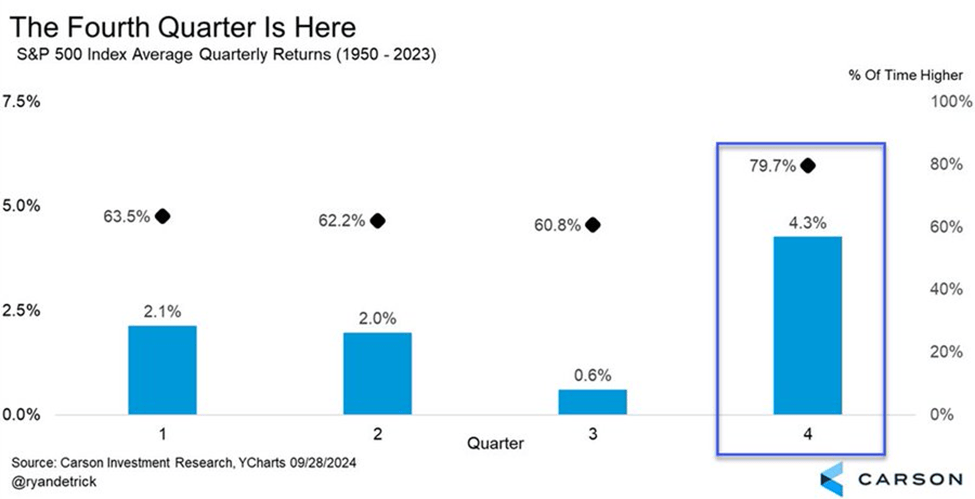
History tells us that the fourth quarter of the year is typically a very good time to be invested in stocks. Take a look at this chart:

As you can see, the S&P 500 index has an average return of 4.3% in the fourth quarter over the past seventy-three years. This is more than twice as good a return as any other quarter of the year.

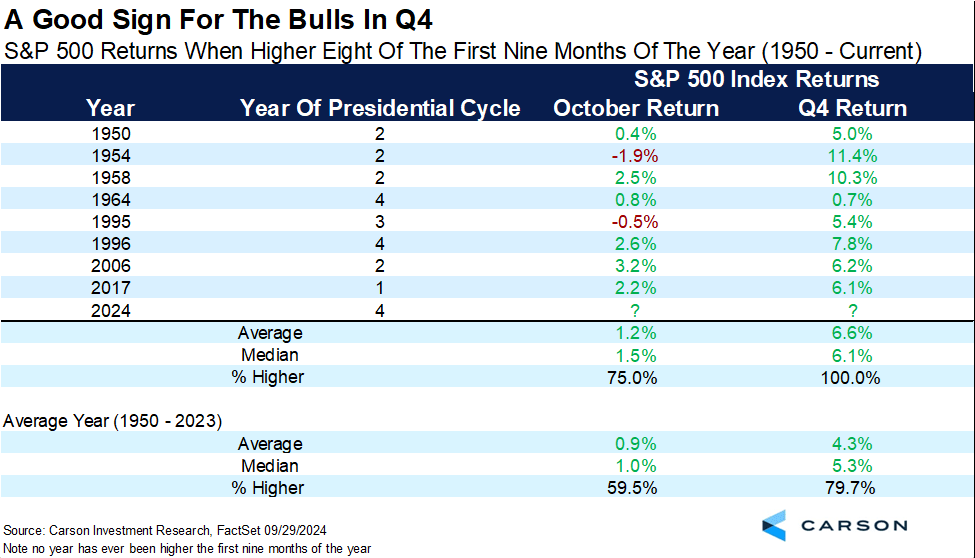
Historical data gets even better for stock market bulls when it comes to this year. When the S&P 500 index is higher the first eight of the nine months of a year, like it has been in 2024, then the fourth quarter is positive every single time (8 for 8), with an average gain of 6.6%. FYI, the index has never been up each of the first nine months of a year. This year, April has been the only down month.

I have to hedge this blog by stating that the upcoming election could have a greater influence on the markets than any other election in recent history. Even so, if history repeats itself, or at least rhymes, we should expect a pretty good quarter for the stock market to finish out 2024.

Please comment or send an email if you have any questions.

Joe Baker, CFP®

Baker Asset Management, LLC

joebaker@bakerassemanagement.com

Two Most Important Factors To Consider When Choosing SS Benefits Age

Social security retirement benefits provide a major source of income for most retirees in the U.S. In fact, about 40% of retirees rely solely on social security income. So, it is important to know when to start taking it to maximize your benefit. The decision is basically a bet with the government on how long you are going to live. Therefore, like any bet, you should gather as much information as possible to move the odds in your favor.

Here’s what I consider are the two most important factors that you should consider before deciding when to start taking social security:

  • Financial Needs: This should be looked at first because if you need the money, you can stop the analysis and just take the money at age 62. If you’re not sure, then the next step is to consider your retirement income sources. If you have a 401k, IRA, pension, savings, or plan to keep working, you might be able to delay benefits. However, if you plan on relying heavily on Social Security, starting benefits earlier could be necessary. If you can swing it, it definitely pays to wait, because your benefit increases by about 8% for every year you wait. That’s a huge difference in payments, especially extrapolating it out over twenty years or more.
  • Life Expectancy: So, if you decided that you don’t need the money at age 62, then you need to analyze what your expected lifespan will be. If you have a family history of longevity, delaying benefits might be wise to maximize the total amount you receive over your lifetime. Conversely, if you have health concerns or a shorter life expectancy, taking benefits earlier ensures you get more money while you can.

I have run the numbers for a bunch of people with all different scenarios and I have found that the breakeven point for most people is between ten and twelve years. This is the number of years that it would take for the total of your payments starting at age 70 to equal the total payments received if started at age 62. That means if you think that you’ll live to 85 (15 years past age 70), which is the age that you receive the maximum benefit, then you should delay taking benefits until age 70 in order to get the most money over your lifetime.

You also want to consider if you want that extra income while you are younger, to use for things, such as traveling, that you might not be able to do when older.

If you’re still not sure what to do after looking at the two factors above, here are some additional things to consider as well:

  • Work Status: If you continue working past your full retirement age (age 67 for anyone born after 1960), your benefits might be reduced until you reach FRA. However, your benefit amount will be recalculated later to include those working years.
  • Marital Status: Married couples have additional considerations. The benefit you receive might depend on your spouse’s earnings history and claiming decisions.
  • Tax implications: Social Security benefits can be taxed depending on your total income. Here’s the details: http://www.ssa.gov/planners/taxes.html
  • Healthcare coverage: If you retire before 65, you might lose employer-provided health insurance and need to consider alternatives.

Everyone’s situation is unique, so it is worth it to take the time and figure out the best strategy to maximize your social security retirement benefit. By weighing the factors listed above and using the resources available on the Social Security Administration’s website, www.ssa.gov, you can make an informed decision about when to claim your Social Security benefits.

Please comment or send an email if you have any questions. Thanks!

Joe Baker, CFP®

Baker Asset Management, LLC

joebaker@bakerassemanagement.com

You Can Still Reduce Your 2023 Taxes

2023 is in the rearview mirror but there is still time to reduce your taxable income for last year:

Make a tax-deductible contribution to your IRA.

If you qualify, an IRA contribution can be a great way to reduce your 2023 taxes. You are allowed to contribute up to $6,500. If you are age 50 or older, you can add an extra $1,000 for a total of $7,500. You basically just had to have worked last year (have earned income) to qualify to make an IRA contribution.

Plus, if you are married, you can double up the amount with a spousal IRA.

If you are not covered by a retirement plan at work, you can deduct the full amount of your contribution, regardless of how much money you make.

If you do have a retirement plan at work, there are restrictions and limitations to qualify for the full deduction. Here’s a table that summarizes these rules. They are confusing so feel free to shoot me an email with any questions.

2023 Traditional IRA deduction limits

Filing StatusModified adjusted gross income (MAGI)Deduction Limit
Single individuals≤ $73,000Full deduction up to the amount of your contribution limit
> $73,000 but < $83,000Partial deduction
≥ $83,000No deduction
Married (filing joint returns)≤ $116,000Full deduction up to the amount of your contribution limit
> $116,000 but < $136,000Partial deduction
≥ $136,000No deduction
Married (filing separately)*< $10,000Partial deduction
≥ $10,000No deduction
  

If you’re self-employed, you can sock away a lot more by opening up a Simplified Employee Pension (SEP) plan before filing your taxes. For 2023, you can contribute up to $66,000, depending on your income.

Please comment or send an email if you have any questions. Thanks!

Joe Baker, CFP®

Baker Asset Management, LLC

joebaker@bakerassetmanagement.com