US Balance Sheets Looking Strong Heading Into 2025

Financially speaking, U.S. households are looking strong heading into 2025. In fact, they have never looked better. Just check out the following chart to see how we are doing compared to the last 50 years:
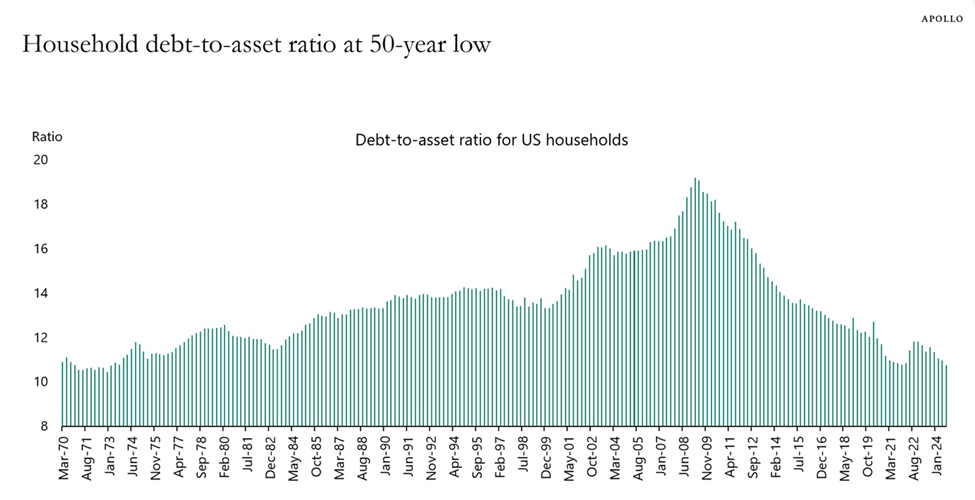
Source: Federal Reserve, Haver Analytics, Apollo Chief Economist

As you can see, we have come quite a long way from the Great Financial Crisis era in 2008/2009 and are at levels that we haven’t seen since the early 1970’s. There are a few key reasons for such a strong showing:

  • Home prices have increased at a much faster rate over the past fifteen years than in the past. This has improved the asset side of the balance sheet.
  • More homes are now owned outright (no mortgage) or have mortgages at a 3% rate or lower than ever before. This has helped reduce household debt quite a bit.
  • Stellar stock market returns over the past two years have bolstered people’s retirement and investment accounts, thereby increasing their assets and subsequently, their net worth.

Can it keep going?

It’s possible. We still have a shortage of housing which will keep upward pressure on home prices. But mortgage rates are still relatively high which could increase the debt side of the balance sheet of new homeowners.

Regarding stocks, history is on our side. For instance, the S&P 500 has a history of delivering strong gains following two consecutive years of 20%+ gains, which we just had. Since 1950, there have been eight instances where the S&P 500 index has risen by 20% or more for two consecutive years. In six of those cases, the U.S. stock market achieved positive returns in the third year, with an average return of 12%.

Obviously, it’s always tough to predict what’s going to happen over the course of the next year but it’s good to know that we are in a great position now, regardless of what the future holds.

Please comment or send an email if you have any questions.

Joe Baker, CFP®

Baker Asset Management, LLC

joebaker@bakerassetmanagement.com

Big Changes Coming To Social Security Benefits

Recently, the Social Security Fairness Act was signed into law. Its primary purpose is to provide more equitable Social Security benefits for public sector workers and their families.

The way that the new law will achieve this objective is by removing rules that reduce social security benefit payments to workers who receive pensions from employers that did not withhold Social Security taxes. This typically applies to public sector workers (like teachers, firefighters, and state employees) whose pensions were not funded by Social Security.

Here are the two rules that will be removed by the Social Security Fairness Law:

  • Windfall Elimination Provision (WEP) – Reduces Social Security benefits for individuals who receive pensions from employers that did not withhold Social Security taxes (like state and local governments).
  • Government Pension Offset (GPO) – Reduces or eliminates Social Security benefits for spouses of public sector retirees.

This is a major change and a huge increase in social security benefits for public sector workers. For many, it will be life changing, in a good way.

Of course, the downside is the higher funding costs which could accelerate the depletion of the social security fund. 2035 is the expected year that there won’t be enough money to pay 100% of the benefits. But I have a feeling that Congress will get that fixed right before the fund runs out of money.

Please comment or send an email if you have any questions.

Joe Baker, CFP®

Baker Asset Management, LLC

joebaker@bakerassetmanagement.com

What Is A Wash Sale When Selling Stocks?

This is the time of year that many investors sell some loser investments to offset their income or other capital gains, sometimes referred to as tax-loss harvesting. There is an obscure tax rule, known as the wash sale rule, that could affect how the IRS views these trades. So, here is a brief summary of how the wash sale rule works.

The wash sale rule was designed to discourage people from selling securities at a loss simply to claim a tax benefit.

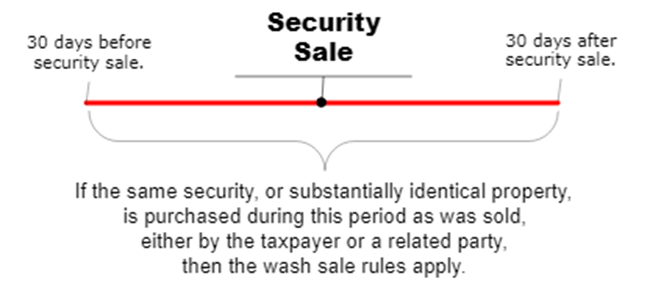
A wash sale occurs when an investment is sold at a loss and, within a period of 30 days before or 30 days after the sale, the identical or “substantially identical” investment is purchased again.

Under such circumstances, that loss will be “disallowed” and may not be considered in calculating a taxpayer’s losses for income tax purposes.

An example is the easiest way to explain this rule:

Suppose Joe has a taxable brokerage account that holds 50 shares of XYZ stock with a cost basis of $500 because he bought the stock when it cost $10 per share. The stock is worth only $5 per share on July 31, and he sells all 50 shares for a total sales proceeds of $250. Joe now has a realized capital loss of $250.

If Joe purchases new shares in XYZ within 30 calendar days before the sale or up to 30 calendar days after the sale, his capital loss can’t be used to offset income or capital gains for that tax year but is deferred until he sells the new, replacement shares.

As you can see in the example, you temporarily lose the tax benefit of the realized loss, but you get it back when you eventually sell the newly purchased shares because you add the original capital loss to the new purchase price to establish your actual cost basis for the newly purchased shares. The only time that you lose the loss permanently is when you sell an investment in a taxable account, and you buy it back in an IRA.

If it sounds confusing, don’t worry. It is. That’s our tax code.

Please comment or send an email if you have any questions. Thanks!

Joe Baker, CFP®

Baker Asset Management, LLC

joebaker@bakerassetmanagement.com

Check Out The New Retirement Plan Contribution Limits for 2025

The IRS recently posted the retirement plan contribution limits for 2025. Here is a table of the new limits as well as the limits from 32024 so you can see how much they have changed:

20252024
 401k, 403b, 457 plans
Employee Contributions:$23,500$23,000
Annual Contribution Limit (employer plus employee contributions)$70,000$69,000
Catch-Up Contributions$7,500$7,500
Age 60-63 Catch-Up Contributions$11,250—
SIMPLE IRA/401k plans
Employee Contribution Limit$16,500$16,000
Catch-Up Contributions$3,500$3,500
Age 60-63 Catch-Up Contributions$5,250—
IRA Contributions$7,000$7,000
Catch-Up IRA Contributions$1,000$1,000

The changes are typical and not surprising except for a new catch-up amount that is allowed for those of us who reach the age of 60, 61, 62, or 63. It is called enhanced catch-up or super catch-up. Whatever you call it, it means you can put more money into your retirement plan in 2025.

For example, if you turn 60 in 2025 and participate in a 401k plan, you can contribute $23,500 plus $11,250 for a total of $34,750.

Please comment or send an email if you have any questions.

Joe Baker, CFP®

Baker Asset Management, LLC
joebaker@bakerassemanagement.com

How Long Will This Bull Market Last?

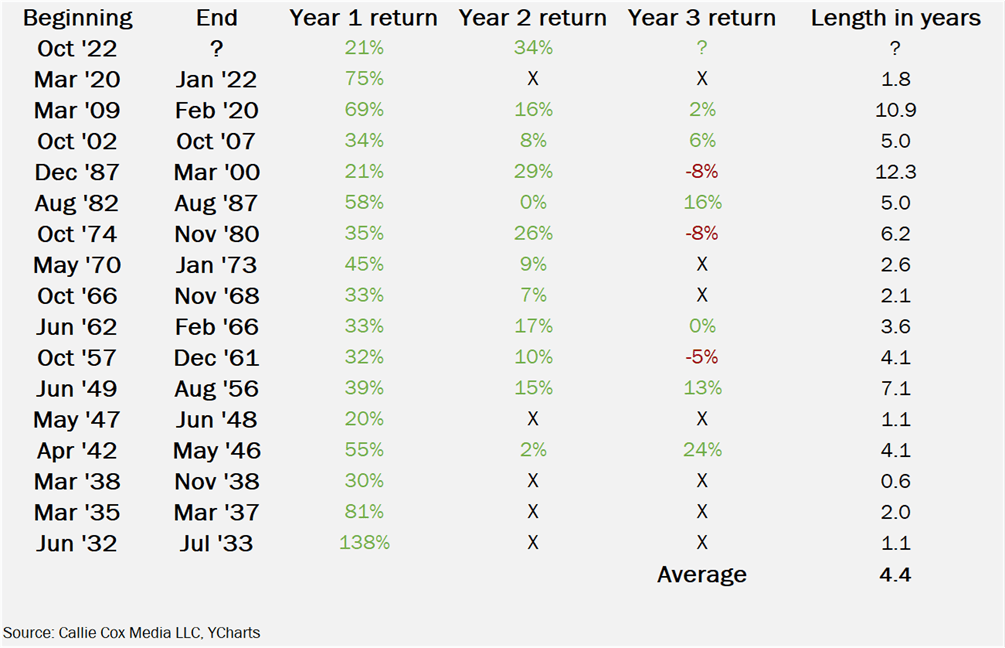
We recently hit the two-year anniversary of the current bull market in stocks. As a refresher, a bull market happens when stock prices have gone up 20% or more from the previous low for a sustained period of time. The current bull market started on October 12, 2022, and is being sustained by an expanding economy, low unemployment, and, most recently, falling interest rates.

Two years seems like a pretty long time for stocks to go up consistently, so how long can we expect this bull market to last? There’s no fool-proof way to determine the length of a bull market with any accuracy but we can look at historical data to see how long they have lasted in the past.

The table below shows all the bull markets of the S&P 500 index since the early 1930’s.

As you can see, bull markets have averaged almost 4.5 years in length so there’s a good chance that this bull market still has a ways to go. Of course, there are always unknown events that could throw a wrench into this bull, and don’t forget about an election that’s only a few weeks away that could stir up some volatility.

Please comment or send an email if you have any questions.

Joe Baker, CFP®

Baker Asset Management, LLC

joebaker@bakerassemanagement.com

How Social Security Interacts with Medicare

I was doing some research for a client on this topic a few days ago and thought it would be beneficial to post some basics of how the Social Security and Medicare programs interact with each other.

Social Security and Medicare are separate programs serving our country’s senior citizens as well as the disabled. But they do intersect in a big way: Social Security handles enrollment for Medicare Part A (hospital insurance) and Part B (medical insurance).

For most people, Medicare eligibility starts at age 65. If you are already receiving social security benefits at that time, you will be automatically enrolled in parts A and B. If you need a refresher on Medicare, here’s a nice overview of its different parts: https://www.ssa.gov/medicare/plan/medicare-parts.

If you have not yet filed for Social Security benefits, you will need to apply for Medicare yourself. You can do so any time during the initial enrollment period, which lasts seven months. This period starts three months before the month you turn 65 and ends three months after your birthday month. So, if your birthday is July 15th, the sign-up window runs from April 1 through Oct. 31. If you do not enroll during that period, you could end up paying penalty fees if you do so later.

Now let’s look at how you pay for Medicare. Most people don’t pay a monthly premium for Part A because they or a spouse paid Medicare taxes for at least 10 years while working.

For Part B, there is a monthly premium that you pay, currently $174.70 per person in 2024. This is automatically deducted out of your Social Security benefit payments, if you are receiving them. If you haven’t started receiving your Social Security benefit payments yet, you can pay by mail or via online bill payment.

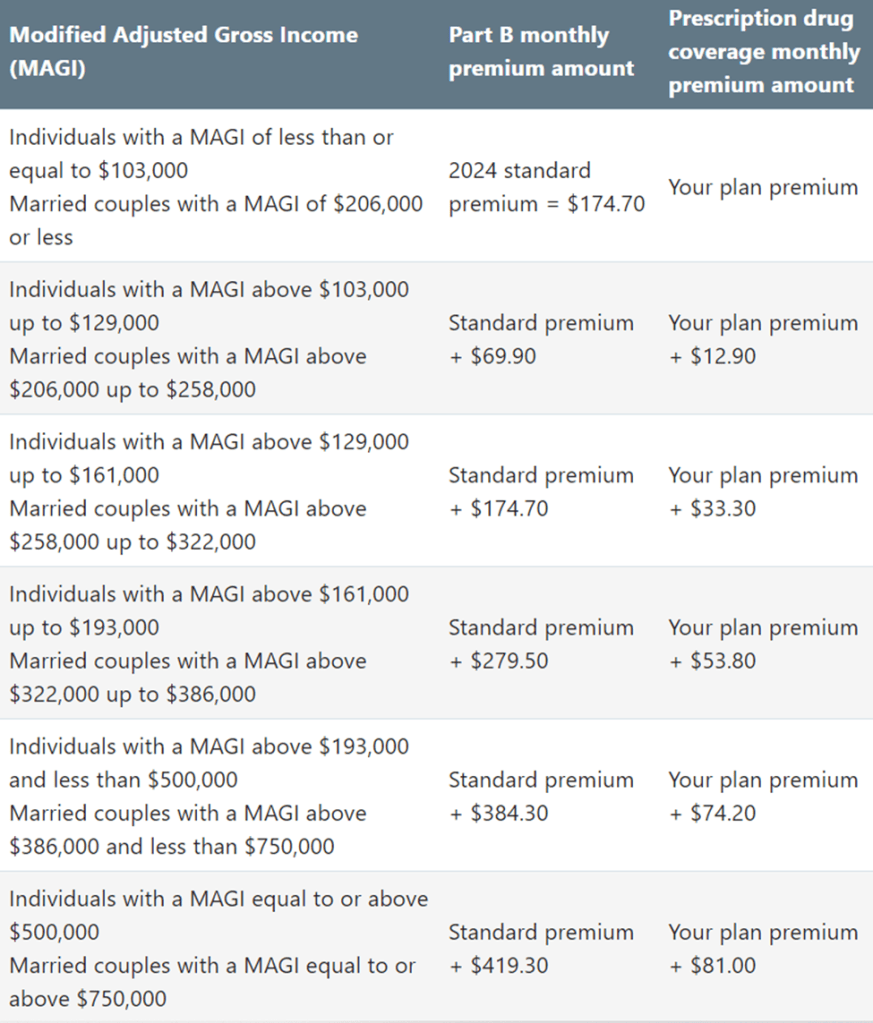
If your annual income exceeds a certain amount, you will have to pay a higher premium for Part B and Medicare prescription drug coverage premiums (also known as Medicare Part D).

Here’s the 2024 table for monthly Medicare premiums:

So, if you are a married couple with a MAGI below $206,000, you’ll only be paying $174.70 each per month in 2024.

Both the Social Security and Medicare programs are so complex. Be sure to do your research or contact program experts to answer your questions.

If you want more details on all things Medicare and Social Security, the best source is here: https://www.ssa.gov/.

Please comment or send an email if you have any questions.

Joe Baker, CFP®

Baker Asset Management, LLC

joebaker@bakerassemanagement.com

How to Get Paid by the IRS to Save for Retirement

Do you want to get paid by the IRS for contributing to your IRA or other retirement plans? Well, you can because they will pay you to save for retirement.

There is a little-known tax rule that has been around since 2002 called the Retirement Savings Contributions Credit (Saver’s Credit). This tax credit essentially pays you to put money into your IRA, Roth IRA, 401k, TSA, and most other retirement plans. Here’s a quick summary of how it works:

Eligibility

You are eligible for the credit if you meet certain criteria:

  • Income limits: Your adjusted gross income (AGI) must be below a certain threshold. The exact threshold varies depending on your filing status and whether you are a qualifying individual.
  • Contributions: You must make qualifying contributions to a traditional or Roth IRA, or to an eligible employer-sponsored retirement plan.
  • Age: You must be at least 18 years old and not a full-time student.

Credit Amount

As with most tax credits, the amount is based on your adjusted gross income (AGI) in the year that you contribute. The maximum amount of the credit is 50% of the amount that you contribute to your retirement plan. The maximum contribution amount that can qualify for the credit is $2,000, making the maximum credit $1,000. Here is an example:

Jill, who works at a retail store, is married and earned $41,000 in 2024. Jill’s spouse was unemployed in 2024 and didn’t have any earnings. Jill contributed $2,000 to her IRA for 2024. After deducting her IRA contribution, the adjusted gross income shown on her joint return is $39,000. Jill may claim a 50% credit of $1,000 for her $2,000 IRA contribution on her 2024 tax return.

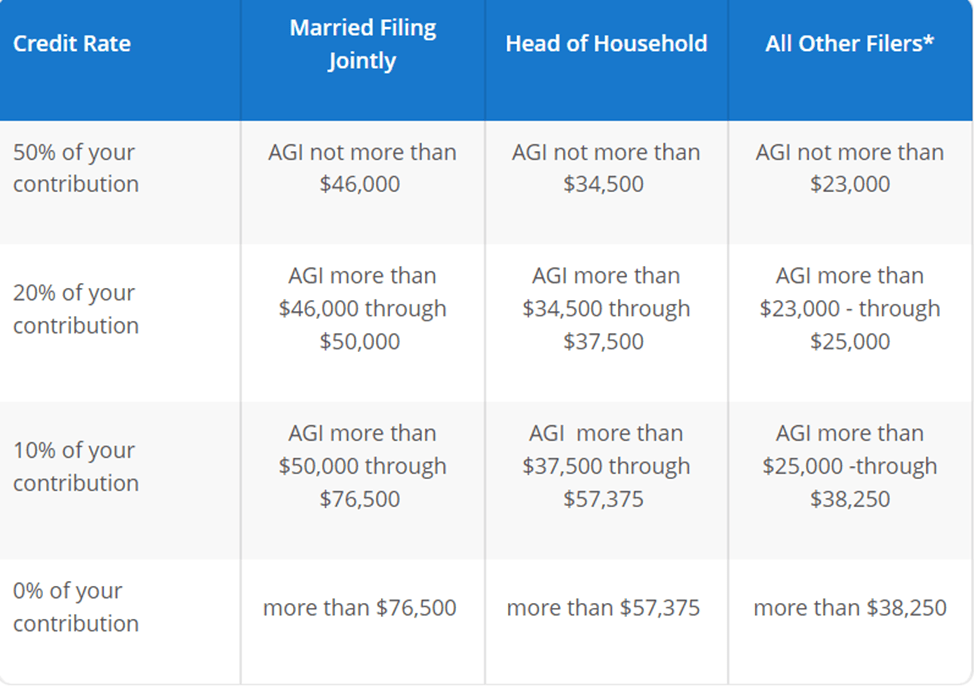
The following table shows how much of a credit that you are eligible for:

2024 Saver’s Credit Rates and Filing Status

For those that are eligible, it is like getting a match from the government on your contribution. Every little bit helps!

Please comment or send an email if you have any questions.

Joe Baker, CFP®

Baker Asset Management, LLC
joebaker@bakerassemanagement.com

Two Most Important Factors To Consider When Choosing SS Benefits Age

Social security retirement benefits provide a major source of income for most retirees in the U.S. In fact, about 40% of retirees rely solely on social security income. So, it is important to know when to start taking it to maximize your benefit. The decision is basically a bet with the government on how long you are going to live. Therefore, like any bet, you should gather as much information as possible to move the odds in your favor.

Here’s what I consider are the two most important factors that you should consider before deciding when to start taking social security:

  • Financial Needs: This should be looked at first because if you need the money, you can stop the analysis and just take the money at age 62. If you’re not sure, then the next step is to consider your retirement income sources. If you have a 401k, IRA, pension, savings, or plan to keep working, you might be able to delay benefits. However, if you plan on relying heavily on Social Security, starting benefits earlier could be necessary. If you can swing it, it definitely pays to wait, because your benefit increases by about 8% for every year you wait. That’s a huge difference in payments, especially extrapolating it out over twenty years or more.
  • Life Expectancy: So, if you decided that you don’t need the money at age 62, then you need to analyze what your expected lifespan will be. If you have a family history of longevity, delaying benefits might be wise to maximize the total amount you receive over your lifetime. Conversely, if you have health concerns or a shorter life expectancy, taking benefits earlier ensures you get more money while you can.

I have run the numbers for a bunch of people with all different scenarios and I have found that the breakeven point for most people is between ten and twelve years. This is the number of years that it would take for the total of your payments starting at age 70 to equal the total payments received if started at age 62. That means if you think that you’ll live to 85 (15 years past age 70), which is the age that you receive the maximum benefit, then you should delay taking benefits until age 70 in order to get the most money over your lifetime.

You also want to consider if you want that extra income while you are younger, to use for things, such as traveling, that you might not be able to do when older.

If you’re still not sure what to do after looking at the two factors above, here are some additional things to consider as well:

  • Work Status: If you continue working past your full retirement age (age 67 for anyone born after 1960), your benefits might be reduced until you reach FRA. However, your benefit amount will be recalculated later to include those working years.
  • Marital Status: Married couples have additional considerations. The benefit you receive might depend on your spouse’s earnings history and claiming decisions.
  • Tax implications: Social Security benefits can be taxed depending on your total income. Here’s the details: http://www.ssa.gov/planners/taxes.html
  • Healthcare coverage: If you retire before 65, you might lose employer-provided health insurance and need to consider alternatives.

Everyone’s situation is unique, so it is worth it to take the time and figure out the best strategy to maximize your social security retirement benefit. By weighing the factors listed above and using the resources available on the Social Security Administration’s website, www.ssa.gov, you can make an informed decision about when to claim your Social Security benefits.

Please comment or send an email if you have any questions. Thanks!

Joe Baker, CFP®

Baker Asset Management, LLC

joebaker@bakerassemanagement.com

You Can Still Reduce Your 2023 Taxes

2023 is in the rearview mirror but there is still time to reduce your taxable income for last year:

Make a tax-deductible contribution to your IRA.

If you qualify, an IRA contribution can be a great way to reduce your 2023 taxes. You are allowed to contribute up to $6,500. If you are age 50 or older, you can add an extra $1,000 for a total of $7,500. You basically just had to have worked last year (have earned income) to qualify to make an IRA contribution.

Plus, if you are married, you can double up the amount with a spousal IRA.

If you are not covered by a retirement plan at work, you can deduct the full amount of your contribution, regardless of how much money you make.

If you do have a retirement plan at work, there are restrictions and limitations to qualify for the full deduction. Here’s a table that summarizes these rules. They are confusing so feel free to shoot me an email with any questions.

2023 Traditional IRA deduction limits

Filing StatusModified adjusted gross income (MAGI)Deduction Limit
Single individuals≤ $73,000Full deduction up to the amount of your contribution limit
> $73,000 but < $83,000Partial deduction
≥ $83,000No deduction
Married (filing joint returns)≤ $116,000Full deduction up to the amount of your contribution limit
> $116,000 but < $136,000Partial deduction
≥ $136,000No deduction
Married (filing separately)*< $10,000Partial deduction
≥ $10,000No deduction
  

If you’re self-employed, you can sock away a lot more by opening up a Simplified Employee Pension (SEP) plan before filing your taxes. For 2023, you can contribute up to $66,000, depending on your income.

Please comment or send an email if you have any questions. Thanks!

Joe Baker, CFP®

Baker Asset Management, LLC
joebaker@bakerassetmanagement.com