
Beyond the Beach: Why “Sell in May and Go Away” Is a Costly Myth

Beyond the Beach: Why “Sell in May and Go Away” Is a Costly Myth

Every spring, Wall Street dusts off one of its oldest and most repeated clichés: “Sell in May and go away.” The theory goes that stock market returns are historically dismal between May and October, so you should cash out, enjoy your summer at the beach, and reinvest in November. It sounds cozy, low-stress, and delightfully simple.

There’s just one glaring problem: Over the last 30 years, following this advice would have cost you a fortune.

Let’s unpack why this old adage has broken down, and why a cookie-cutter calendar trick is no substitute for a personalized investment strategy.

The Reality Check: The Last 30 Years

The idea of the “summer doldrums” used to hold some weight decades ago when trading volume slowed to a crawl during vacation season. But the modern financial world doesn’t take a summer vacation.

If you actually “went away” every May over the last three decades, you would have missed out on massive market gains.

1. Positive Returns Are the Norm, Not the Exception

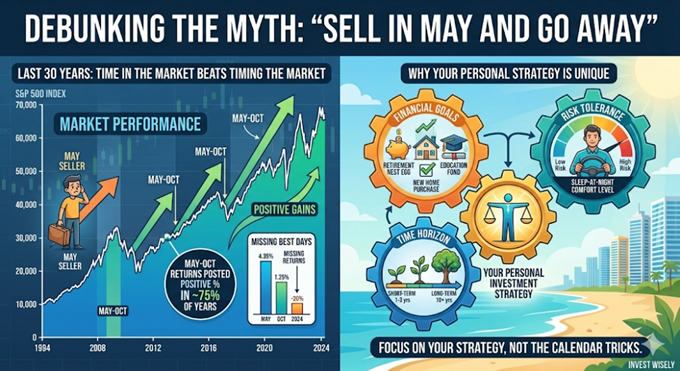
While it’s true that the winter months (November to April) have historically shown stronger average gains, the May-to-October period has still been overwhelmingly positive. Over the last 30 years, the S&P 500 has posted positive returns during the summer/fall block roughly 70% to 80% of the time. By sitting on the sidelines, you aren’t avoiding a crash; you’re usually just missing a rally.

2. The Cost of Missing the “Best Days”

Market gains are often concentrated in a few explosive days. If you are sitting in cash, missing just a handful of the market’s best days can permanently stunt your portfolio’s compounding growth.

3. Frictional Costs Eat Your Wealth

Every time you sell and buy back in, you trigger a chain reaction of wealth-killers:

  • Taxes: If you operate in a taxable account, selling every May triggers short-term capital gains taxes, which are taxed at a much higher rate than long-term gains.
  • Transaction Costs: Even in an era of zero-commission trades, bid-ask spreads can quietly chip away at your principal.

The Bottom Line: Trying to time the market based on a calendar rhyme is a losing game. As the legendary investor Peter Lynch once said, “Far more money has been lost by investors preparing for corrections, or trying to anticipate corrections, than has been lost in corrections themselves.”

Why “One-Size-Fits-All” Strategies Fail You

The biggest flaw in “Sell in May” isn’t just the math—it’s that it treats every investor like a monolith. Wall Street clichés assume everyone has the exact same bank account, the same nerves, and the same expiration date.

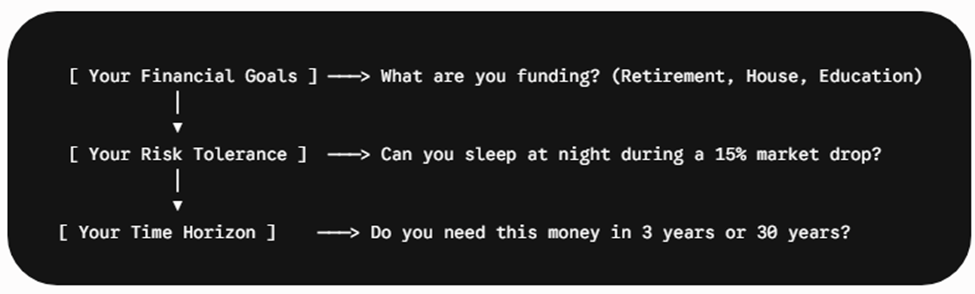
In reality, successful investing requires a strategy tailored uniquely to you across three critical pillars:
1. Your Unique Financial Goals

Are you investing to buy a house in three years, or are you building a nest egg for a retirement that is three decades away? A 25-year-old building long-term wealth shouldn’t care about a minor summer dip. A 63-year-old nearing retirement might need a smoother ride—but they achieve that through a balanced asset allocation (stocks, bonds, cash equivalents), not by completely exiting the stock market every May.

2. Your Personal Risk Tolerance

Risk tolerance isn’t just a math problem; it’s a psychological one. If selling in May makes you feel safe, but causes you to panic-buy back in at higher prices in November, the strategy has failed your psychology. A personalized portfolio is designed to keep you comfortably invested through all seasons, preventing the emotional decisions that derail wealth.

3. Your Time Horizon

Time is the ultimate equalizer in investing. If your time horizon is long, the seasonal squiggles of the stock market become irrelevant background noise. The historical data proves that time in the market beats timing the market every single time.

Focus on Your Blueprint, Not the Calendar

The next time you see a financial news headline warning you to “Sell in May,” turn off the TV and check in on your personal financial plan instead.

Market myths make for great headlines, but personalized strategies build generational wealth. Stick to your goals, respect your time horizon, and leave the calendar tricks behind. Your future self will thank you.

Please comment or send an email if you have any questions.

Joe Baker, CFP®

Baker Asset Management, LLC

joebaker@bakerassetmanagement.com
Mastering the Backdoor Roth: A 2026 High-Earner’s Strategy

Building long-term wealth requires more than just picking the right stocks; it requires picking the right tax structures. For high earners, the IRS often closes the front door to tax-free growth. Fortunately, the “backdoor” remains wide open.

Here is the 2026 blueprint for executing a Backdoor Roth conversion with precision.


🚪What is a Backdoor Roth?

A Backdoor Roth isn’t a specific type of account, it’s a strategy.

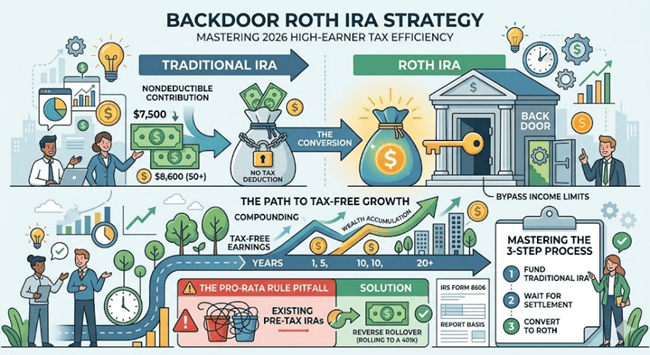
By law, if your income exceeds certain limits, you are barred from contributing directly to a Roth IRA. However, there are no income limits on contributing to a Traditional IRA or on converting those funds to a Roth. By combining these two steps, you effectively “bypass” the income cap, allowing your money to grow tax-free for decades.

📈Why It Matters in 2026

Tax-advantaged space is a finite resource. In 2026, the contribution limits and income thresholds have shifted, making this strategy more valuable than ever:

  • 2026 Contribution Limit: $7,500 (or $8,600 if you are age 50 or older).
  • The “Front Door” Income Caps: In 2026, the ability to contribute directly to a Roth begins to phase out if your Modified Adjusted Gross Income (MAGI) exceeds:
    • $153,000 (Single)
    • $242,000 (Married Filing Jointly)

⏳When is the “Best Age” to Start?

The short answer: The best age to start is the very first year your income exceeds the direct contribution limits.

Because Roth IRAs grow tax-free, time is your greatest ally. The earlier you start, the more “tax-free compounding” cycles your money undergoes.

  • Early Career (20s-30s): If you are a high-earning young professional, starting now can result in hundreds of thousands of dollars in tax savings by retirement.
  • The “Sweet Spot” (50+): At age 50, the IRS allows “catch-up” contributions (bringing your 2026 total to $8,600). If you haven’t started yet, this is the time to maximize your contributions while you are likely in your peak earning years.
  • The 5-Year Rule: Remember that every conversion starts its own 5-year clock before earnings can be withdrawn tax-free. Starting earlier ensures you clear these hurdles well before you actually need the cash.

🛠️How to Execute (The 3-Step Process)

  1. Fund a Traditional IRA: Open a Traditional IRA and make a nondeductible contribution. This means you don’t take a tax deduction for the contribution (since you’ve already paid tax on that income).
  2. The “Waiting Period”: While not strictly a legal requirement, I typically recommend waiting until the funds fully clear—usually a few business days—before moving to the next step.
  3. The Conversion: Instruct your custodian to move the funds from the Traditional IRA into your Roth IRA.

Expert Tip: Convert the funds as soon as they settle. If the money sits in the Traditional IRA and earns even a few dollars in interest, those earnings will be taxable upon conversion. We want the “basis” and the “conversion amount” to be as identical as possible.

⚠️The “Pro-Rata” Rule: The Biggest Pitfall

This is where most high earners get caught. The IRS views all of your Traditional, SEP, and SIMPLE IRAs as one giant bucket.

If you have $92,500 in an old Rollover IRA (pre-tax) and you add a $7,500 non-deductible contribution (after-tax), the IRS sees a $100,000 total balance. If you try to convert just that $7,500, they will claim only 7.5% of it is tax-free. You would owe income tax on the other 92.5%.

The Solution: Before executing a backdoor conversion, we must look for a “Reverse Rollover”, moving those pre-tax IRA balances into your current employer’s 401(k). 401(k) balances are excluded from this calculation.

📝Reporting to the IRS

Precision in paperwork is mandatory. You must file IRS Form 8606 with your tax return. This form tracks your “basis” (the after-tax money) so the IRS knows you’ve already paid taxes on that contribution and shouldn’t be taxed again during the conversion.


Summary Checklist

  • Verify your 2026 MAGI exceeds the direct Roth limits.
  • Confirm you have zero existing pre-tax IRA balances (check old SEP/SIMPLE/Rollover accounts).
  • Contribute up to $7,500 (or $8,600) to a non-deductible Traditional IRA.
  • Convert to Roth once funds settle.
  • Ensure your tax preparer files Form 8606.

At the end of the day, the Backdoor Roth is about more than just a single year’s contribution; it’s about the compounding power of tax-free growth over the course of your career. While the process is straightforward, the “Pro-Rata” rule and filing requirements leave zero room for error. If you’re ready to secure this tax-advantaged space for 2026 but aren’t sure how your existing IRA balances might impact the strategy, make sure you talk to a tax professional before you move forward.

Please comment or send an email if you have any questions.

Joe Baker, CFP®

Baker Asset Management, LLC

joebaker@bakerassetmanagement.com
The Ball is in Their Court: How Congress Can Avert the Social Security Cliff

Social Security isn’t failing because of a lack of math; it’s stalling because of a lack of movement in Washington. While the program’s trust funds are undeniably shrinking, this is a crisis of legislative willpower rather than a lack of solutions. The 2025 Trustees Report makes it clear that the “safety net” is held up by a fraying rope, but Congress still holds the scissors—and the spool of thread. To save the program, lawmakers must stop treating Social Security as a political “third rail” and start treating it as a standard legislative repair project.

The Current Trajectory (2025 Trustees Report)

According to the Social Security Board of Trustees’ 2025 Annual Report, the timeline for action has narrowed. The report underscores that without intervention from the Capitol, the following milestones are inevitable:

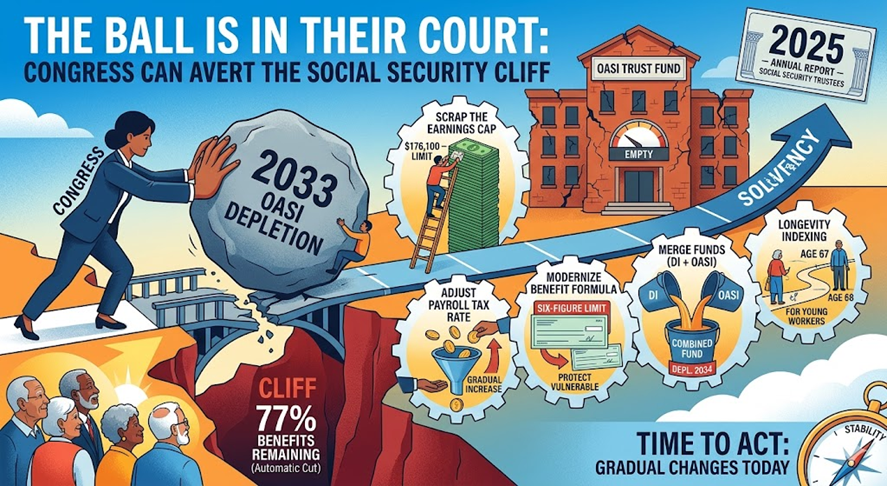
  • The 2033 Deadline: The Old-Age and Survivors Insurance (OASI) Trust Fund—the primary source for retiree benefits—is projected to be depleted in 2033.
  • The Enforced Benefit Cut: Under current law, once reserves are gone, the Social Security Administration cannot pay full benefits. By 2033, incoming tax revenue would only cover 77% of scheduled payments, resulting in an immediate 23% cut for all beneficiaries unless Congress changes the law.
  • Growing Deficit: The 75-year actuarial deficit has risen to 3.82% of taxable payroll, meaning the gap Congress needs to bridge is larger than it was just one year ago.

The Congressional “Fix-It” List

Congress has several specific levers they can pull to stabilize the system for the next 75 years without cutting benefits for those who rely on them most. Fixing the program will likely require a “grand bargain” involving these components:

  • Scrapping the Earnings Cap: Currently, Social Security taxes are only collected on income up to $176,100 (for 2025). High earners stop paying into the system once they hit that mark. Congress could eliminate this cap or create a “donut hole” (e.g., taxing income above $250,000) to ensure the wealthiest Americans contribute at the same rate as the middle class. I feel this is the best way to fix the problem and can be implemented quickly.
  • Gradual Payroll Tax Adjustments: The 12.4% payroll tax (split between you and your employer) hasn’t moved in decades. A tiny, phased-in increase—such as 0.1% per year—would be barely noticeable on a weekly paycheck but would pour billions back into the trust fund over time.
  • Modernizing the Benefit Formula (The “Six-Figure Limit”): Lawmakers are currently debating a cap on maximum benefits for high-income couples (e.g., a $100,000 limit). By slowing benefit growth for the top 1–5% of earners, Congress can redirect funds to keep the program solvent for everyone else.
  • Longevity Indexing: For younger generations, Congress could index the retirement age to life expectancy. This would mean the age moves by mere months over several decades, reflecting the reality that we are living longer than the workers of 1935.

The math behind Social Security is straightforward; the politics are what’s complicated. We don’t need a miracle to save Social Security; we need a Congress that is willing to trade short-term political points for long-term national stability. By acting now, lawmakers can implement small, gradual changes that protect current retirees and guarantee a future for the next generation. The 2033 “cliff” is seven years away—it’s time for Washington to pick up the tools and get to work.

Please comment or send an email if you have any questions.

Joe Baker, CFP®

Baker Asset Management, LLC

joebaker@bakerassetmanagement.com

A High Earner’s Guide to the 2026 $150k Threshold and Super Catch-Ups

For years, high-earning professionals aged 50 and older have relied on pre-tax catch-up contributions to shave thousands off their annual tax bills while fortifying their retirement nests. However, a major change recently occurred, as the SECURE 2.0 Act officially mandated that “high earners”—defined as those with prior-year (2025) wages exceeding $150,000—must transition their catch-up contributions exclusively to a Roth (after-tax) basis. While this removes the immediate tax deduction you may be accustomed to, it also unlocks a powerful opportunity for entirely tax-free growth and withdrawals in your later years. Understanding these new rules is no longer optional; it is a critical step in preserving your retirement strategy’s efficiency.

How Compensation Affects Your Company Match

When it comes to employer matching, the most important thing to know is that your company matches dollars, not tax types. Here is how your compensation and contribution choices interact with that match:

  • Match Calculation is Based on Gross Pay: Your employer typically matches a percentage of your eligible compensation (e.g., 50% of the first 6% you contribute). This calculation uses your gross, pre-tax pay, even if your own contributions are made on a Roth (after-tax) basis.
  • The $360,000 Salary Cap: For 2026, the IRS has set the compensation limit at $360,000. This means any income you earn above this amount cannot be used by your employer to calculate matching contributions.
  • Roth vs. Traditional Match Placement: Traditionally, employer matches are deposited into a pre-tax account, regardless of whether your contribution was Roth or traditional. However, under newer rules, some employers may now allow you to receive the match directly into your Roth account. If you choose this “Roth match” option, those matching dollars will be treated as taxable income in the year they are received.
  • Catch-Up Contributions and Matching: Most companies only match your “regular” contributions (up to the standard $24,500 limit for 2026) and do not provide additional matching on catch-up amounts. It is vital to check your specific plan document to see if your catch-up dollars trigger any extra employer funds.

Also in 2026, the “super catch-up” provision offers a significant boost for older savers.

  • Higher Limit: Participants aged 60, 61, 62, or 63 (by the end of the calendar year) can contribute up to $11,250 in catch-up contributions for 2026.
  • Total Potential Savings: When combined with the standard elective deferral limit of $24,500, these individuals can save a total of $35,750.
  • Comparison to Standard Catch-up: This is an increase over the standard $8,000 catch-up limit available to other participants aged 50 and older.
  • Age Cliff: Once a participant turns 64, their eligible catch-up amount reverts to the standard limit (e.g., $8,000 for 2026).
  • Roth Requirement for High Earners: Just like the standard catch-up, if your prior-year FICA wages exceeded $150,000, these super catch-up contributions must be made on a Roth basis.
  • Plan Optionality: It is important to note that employers are not required to offer the super catch-up; it is an optional plan feature.

Here is a table that compares different 2026 contribution limits based on age and income levels.

2026 401(k) Contribution Limits Comparison

Age GroupStandard LimitCatch-up AmountTotal LimitRoth Requirement (if 2025 Wages >$150k)
Under 50$24,500$0$24,500N/A
50 – 59$24,500$8,000$32,500Yes (Catch-up portion only)
60 – 63 (Super Catch-up)$24,500$11,250$35,750Yes (Catch-up portion only)
64 and Older$24,500$8,000$32,500Yes (Catch-up portion only)
  • Standard Limit: The base elective deferral for all participants increases to $24,500 in 2026.
  • Catch-up Eligibility: Participants aged 50 or older can contribute an additional $8,000.
  • Super Catch-up Enhancement: Under the SECURE 2.0 Act, those aged 60–63 receive a higher catch-up limit of $11,250.
  • Combined Annual Limit: The total limit for all contributions (employee plus employer match/profit sharing) is capped at $72,000 (plus any applicable catch-up).
  • High Earner Definition: The $150,000 threshold is based on FICA wages (Box 3 of your W-2) from the same employer in the preceding year.

2026 Total Possible Savings by Age

If you maximize both the combined (employee plus employer contributions) annual limit and your age-based catch-up, your total account additions can reach:

  • Age 50–59: $80,000 ($72,000 limit + $8,000 catch-up).
  • Age 60–63: $83,250 ($72,000 limit + $11,250 super catch-up).
  • Age 64+: $80,000 ($72,000 limit + $8,000 catch-up).

The 2026 mandatory Roth catch-up rule represents a significant pivot in how high earners must approach their peak saving years. While losing the upfront tax break on those extra contributions might sting today, the trade-off is a growing pool of assets that the IRS can never touch again. Whether you are hitting the $150k wage threshold or entering the “Super Catch-Up” age bracket, the key to 2026 is early coordination with your payroll department and financial advisor to ensure your contributions are coded correctly and your retirement trajectory remains on track.

Please comment or send an email if you have any questions.

Joe Baker, CFP®

Baker Asset Management, LLC

joebaker@bakerassetmanagement.com

The Social Security Break-Even: Is Waiting Until Age 70 Worth the Risk?

Deciding when to claim Social Security involves balancing immediate financial needs against long-term benefit growth. While you can start as early as age 62, your monthly payment increases for every month you delay until age 70, making the difference in the benefit amount significant in most cases. It’s a high-stakes decision because the choice you make now is largely permanent and affects how much you’ll receive every month for the rest of your life. To help cut through the confusion, here’s a simple step-by-step logic flow to help you decide which age makes the most sense for your health, your work life, and your family.

Social Security Claiming Flowchart

  1. Do you have an immediate, urgent need for cash to meet basic living expenses?
    • YES: Claim at age 62. Note that your benefits will be permanently reduced by up to 30% compared to your full retirement age.
    • NO: Go to Step 2.
  2. Are you still working and earning above the annual limit ($24,480 in 2026)?
    • YES: Consider waiting until your Full Retirement Age (FRA). If you claim before FRA while working, Social Security may temporarily withhold $1 for every $2 you earn above the annual limit.
    • NO: Go to Step 3.
  3. What is your health status and expected longevity?
    • POOR HEALTH / LOW LONGEVITY (Expected life < 77 years): Claim early. Taking smaller payments for more years often results in a higher total lifetime value if you do not expect to live past your late 70s.
    • GOOD HEALTH / FAMILY LONGEVITY (Expected life > 81 years): Wait until Age 70. Delaying past your FRA earns you 8% more in Delayed Retirement Credits for every year you wait, maximizing your monthly check for life.
    • AVERAGE: Go to Step 4.
  4. Are you married and the higher-earning spouse?
    • YES: Wait until age 70. This maximizes the survivor benefit for your spouse if you pass away first.
    • NO: Claim at FRA (Age 66-67). This provides 100% of your earned benefit without reductions or further delays.

Don’t forget that The Social Security site has a plethora of good information and tools to help you make the best decision for your situation.

At the end of the day, the goal is to maximize your peace of mind. If you need the money now or have health concerns, taking benefits early is a perfectly valid safety net. However, if you are healthy and can afford to wait, ‘buying’ a bigger paycheck by delaying can be the best insurance policy against outliving your savings. Use these guidelines as a starting point but always check your latest earnings statement on the SSA website to see the exact dollar amounts you’re working with.

Please comment or send an email if you have any questions.

Joe Baker, CFP®

Baker Asset Management, LLC

joebaker@bakerassetmanagement.com

Maximizing Your ROI: The Ultimate Guide to Capital Gains Deductions in 2026

When it comes to selling assets, what you keep is far more important than the sale price. Navigating the 2026 tax landscape requires more than just picking the right stocks or timing the real estate market; it requires a strategic understanding of how to lower your tax bill by accounting for every eligible expense. From the hidden costs of closing a deal to the power of tax-loss harvesting, knowing which deductions can offset your capital gains is the key to protecting your portfolio’s growth and ensuring you aren’t overpaying Uncle Sam.

To determine taxable capital gains for the 2026 tax year, the IRS allows you to deduct specific expenses that reduce either the final sale proceeds or the original cost basis of the asset.

Direct Reductions to Capital Gains

Taxable gain is calculated by subtracting your adjusted basis and selling expenses from the total sale price.

Selling Expenses: You can deduct costs directly related to the transfer or sale of the asset, such as:

  • Brokerage commissions and transaction fees for stocks and securities.
  • Legal fees, advertising, and appraisal costs.
  • Closing costs for real estate, including title search fees, notary fees, escrow fees, and recording fees.
  • Marketing and staging costs to prepare a property for sale.
  • Transfer taxes or stamp taxes charged by local or state governments.

Adjusted Cost Basis (Acquisition Costs): You can increase your basis (thereby decreasing your gain) by including:

  • The original purchase price of the asset.
  • Incidental acquisition costs like sales taxes, excise taxes, and shipping/handling.
  • Installation and setup charges required to make the asset usable.
  • Capital improvements for real estate that add value or prolong the property’s life (e.g., a new roof, kitchen remodel, or HVAC system). Note: Routine repairs like painting or fixing leaks are not deductible.

Offsetting Gains with Losses

One of the most effective ways to reduce capital gains tax is by deducting capital losses.

  • Tax-Loss Harvesting: You can use realized capital losses from selling underperforming investments to offset capital gains in the same year.
  • Net Loss Deduction: If your total capital losses exceed your total capital gains, you can deduct up to $3,000 of the remaining loss against ordinary income ($1,500 if married filing separately).
  • Loss Carryover: Any excess net capital loss above $3,000 can be carried forward indefinitely to future tax years.

Investment Interest Expense

If you borrowed money to purchase taxable investments (such as using a margin loan to buy stock), the interest paid may be deductible as an itemized deduction.

  • The deduction is generally limited to your net investment income for the year.
  • Any unused interest expense can be carried forward to the following tax year.
  • This deduction is not allowed in any tax-deferred accounts, such as an IRA.

Non-Deductible Expenses for 2026

Under current laws (including the One Big Beautiful Bill Act effective for 2026), several formerly common expenses are not deductible for individual taxpayers:

  • Miscellaneous Investment Fees: Investment advisory fees, IRA custodial fees, and accounting costs for individual investors are permanently disallowed.
  • Personal Property Losses: You cannot deduct losses from the sale of personal-use property, such as your personal car or a primary residence.
  • Securities Transaction Tax (STT): Certain taxes like STT or annual maintenance charges (AMC) for brokerage accounts cannot be claimed.

Maximizing tax efficiency in your investment portfolio requires careful attention to detail. By effectively tracking and managing adjustments to your cost basis and strategically utilizing tax loss harvesting, investors can potentially reduce their tax liability. Staying informed about current IRS regulations regarding investment expenses is crucial to ensure all deductions are properly claimed, ultimately allowing you to retain more of your investment returns.

Please comment or send an email if you have any questions.

Joe Baker, CFP®

Baker Asset Management, LLC

joebaker@bakerassetmanagement.com

2026 Paycheck Checkup

If you find yourself with a few minutes of free time during these cold winter days, you should take a look at your pay stub to make sure your deductions and withholdings are up to date and squared away.

I think the following pay stub items should be checked at least annually:

  • Federal and state status and exemptions – You set these when you complete form W-4 for your employer. These determine how much tax your employer withholds from your pay. You probably should adjust these if your tax returns show a large refund or if you owe a large amount. You can make these changes online with your employer or turn in a revised W-4 to HR.
  • Deductions – Check that the correct amount is being taken out for your retirement plans and group insurance plans. I have seen too many times where an employee changes their 401k contribution, but it never gets changed in the system. Again, these can typically be changed online on your benefits’ website.
  • Employer Contributions – Make sure your employer is contributing where they are supposed to. Employer matching for retirement plans and insurance premiums are two of the most common employer contributions that you should verify are correct.

The IRS even has a page on their site that you can use to help you figure out what your withholdings (marital status and exemptions on your W-4) should be based on your current pay stub and previous year’s tax filings. Here’s the link: https://www.irs.gov/paycheck-checkup

The IRS say that the following circumstances warrant a check of your withholdings:

  • Are a two-income family
  • Have two or more jobs at the same time
  • Work a seasonal job or only work part of the year
  • Claim credits like the child tax credit
  • Have dependents age 17 or older
  • Itemized deductions on your returns
  • Have high income or a complex tax return
  • Had a large tax refund or tax bill this past year

Now is a good time to review these items because if there are mistakes, there is enough time left in the year to rectify the situation. Also, if you wait until the end of the year, it will be much harder to find the time during the holiday season.

Please comment or send an email if you have any questions.

Joe Baker, CFP®

Baker Asset Management, LLC

joebaker@bakerassetmanagement.com
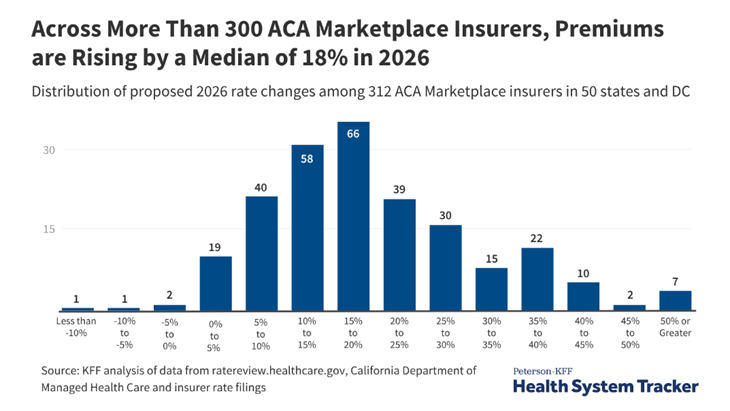
How to Lower Your Income and Keep Your 2026 Health Insurance Affordable

Starting this year, the landscape of the Affordable Care Act (ACA) has shifted dramatically. With the expiration of temporary enhancements, millions of Americans are now facing a return to the strict “subsidy cliff,” where earning just a dollar over the income limit means losing all premium assistance. So, let’s take a look at the new 2026 rules, including the specific income thresholds that trigger a full repayment “clawback,” and identify some of the ways that you can lower your Modified Adjusted Gross Income (MAGI), maintain essential subsidies, and avoid a massive tax bill.

For 2026, Affordable Care Act (ACA) premium tax credits have reverted to pre-2021 rules following the expiration of temporary enhancements. Subsidies are now generally limited to individuals and families with household incomes between 100% and 400% of the Federal Poverty Level (FPL).

2026 Income Limits for Subsidies

Based on 2025 Federal Poverty Guidelines used for 2026 coverage, the income ranges for eligibility in most states are:

Household SizeLower Limit (100% FPL)Upper Limit (400% FPL)
Single Person$15,650$62,600
Family of Four$32,150$128,600

If the income that you provided on the healthcare.gov (ACA) site falls within the range above, you will receive a healthcare premium subsidy. The amount will vary based on where your income falls within these ranges.

For 2026, the maximum percentage of income you must pay for a benchmark plan is as follows:

  • 100% to 133% FPL: Premiums are limited to approximately 2.1% to 3.14% of your annual income.
  • 300% to 400% FPL: Premiums are capped at approximately 9.96% of your income.
  • Above 400% FPL: The “subsidy cliff” has returned; households earning even $1 over this limit are generally responsible for 100% of their premiums, with no federal tax credits available.

The subsidy covers the difference between the actual cost of the plan and your required income-based contribution. For example, a family of four earning $45,000 (roughly 140% FPL) might pay about $1,607 annually for their premium in 2026, whereas under previous enhanced rules, they might have paid $0.

In 2026, avoiding an ACA subsidy “clawback” (repaying excess tax credits) is critical because the repayment caps that previously protected low-income households have been eliminated. You are now responsible for repaying the full amount of any excess subsidy received.

The following strategies can help you manage your income and eligibility to prevent a large tax bill:

1. Reduce Your Modified Adjusted Gross Income (MAGI)

Since subsidies are based on your MAGI, lowering this figure can increase your credit or keep you under the “subsidy cliff” ($62,600 for individuals; $128,600 for a family of four).

  • Maximize Contributions to Pre-Tax Retirement Accounts: Contributions to a Traditional IRA, 401(k), or 403(b) directly reduce your MAGI.
  • Maximize HSA Contributions: Starting in 2026, all Bronze and catastrophic plans are automatically eligible for a Health Savings Account (HSA). Contributing to your HSA reduces your MAGI dollar-for-dollar.
  • Harvest Investment Losses: If you have stocks or bonds that have lost value, selling them can offset capital gains and reduce your income by up to an additional $3,000.

2. Strategic Income Management

  • Update the Marketplace Immediately: Report any raises, new jobs, or household changes (like a child moving out) to HealthCare.gov as soon as possible. The Marketplace will adjust your monthly credit in real-time to match your new income, preventing a lump-sum debt at tax time.
  • Use Roth Accounts for Extra Cash: If you need more money during the year, withdraw from a Roth IRA or Roth 401(k). Because these are funded with after-tax dollars, qualified withdrawals do not count as income and will not trigger a clawback.
  • Underestimate with Caution: If you are unsure of your income, you can choose to take only a portion of your subsidy upfront (e.g., take 75% of the credit monthly and claim the remaining 25% as a refund when you file).

3. Timing and “Bunching”

  • Time Large Income Events: If possible, postpone large capital gains, property sales, or Roth conversions until a year when you are not using ACA coverage or have reached Medicare age.
  • Make Last-Minute Adjustments: You have until April 15, 2027, to make 2026 contributions to an IRA or HSA. This allows you to calculate your exact 2026 income during tax season and make a final contribution to lower your MAGI and reduce what you owe back to the IRS.

Careful income planning is crucial under the 2026 ACA rules. By maximizing pre-tax contributions, managing income events, and keeping your income information updated with the Marketplace, you can preserve your health insurance subsidies and avoid unexpected tax bills.

Please comment or send an email if you have any questions.

Joe Baker, CFP®

Baker Asset Management, LLC

joebaker@bakerassetmanagement.com

Maximize Your Tax Savings with the Senior Bonus Deduction

Starting in 2025, a new temporary federal tax break known as the “Senior Bonus Deduction “is available to taxpayers aged 65 and older. Enacted under the One Big Beautiful Bill Act (OBBBA), this provision is designed to provide additional tax relief through the 2028 tax year.

Key Features of the 2025 Senior Deduction

  • Deduction Amount: Eligible individuals can deduct up to $6,000 from their taxable income.
  • Married Couples: If both spouses are 65 or older and file a joint return, they can claim a combined deduction of $12,000.
  • “Stackable” Benefit: This deduction is in addition to the regular standard deduction and the existing “additional standard deduction” for seniors.
  • Accessibility: You can claim this deduction regardless of whether you take the standard deduction or itemize your deductions.

Eligibility and Income Limits

The full deduction is only available to those under specific income thresholds based on their Modified Adjusted Gross Income (MAGI):

Filing StatusFull Deduction Income LimitPhase-Out Range
Single / Head of HouseholdUp to $75,000$75,001 – $175,000
Married Filing JointlyUp to $150,000$150,001 – $250,000
  • Phase-Out Rule: For every $1 your MAGI exceeds the limit, the deduction is reduced by 6 cents until it reaches zero.
  • Age Requirement: You must be 65 or older by December 31, 2025.
  • Exclusion: The deduction is not available to those who use the “Married Filing Separately” status.

Impact on Social Security

While often discussed as a “No Tax on Social Security” measure, the law does not technically eliminate federal taxes on Social Security benefits. Instead, the $6,000 deduction serves to lower your overall taxable income, which for many seniors with modest incomes effectively offsets the portion of their Social Security that would have been taxed.

Maximum Combined Deductions for 2025

For a senior taking the standard deduction, the total amount of income sheltered from federal tax in 2025 could reach:

  • Single (65+): $23,750 ($15,750 base + $2,000 age-based + $6,000 new bonus).
  • Married (Both 65+): $46,700 ($31,500 base + $3,200 age-based + $12,000 new bonus).

Please comment or send an email if you have any questions.

Joe Baker, CFP®

Baker Asset Management, LLC

joebaker@bakerassetmanagement.com

How to Pay NO TAXES on your Long-Term Capital Gains

How to Avoid Capital Gains Tax in Mutual Funds

With positive returns in the stock market over the last three years, investors are most likely sitting on some unrealized capital gains in their taxable brokerage accounts. Read on if you are thinking about locking in some of those gains and how to minimize federal taxes on them.

First, let’s get some definitions out of the way.

A capital gain is the profit realized from the sale of a capital asset, such as stocks or bonds, for a price greater than what you paid for it, aka its cost basis.

For example, if a stock was purchased for $100 plus a $5 fee and was later sold for $150 with a $5 fee, the cost basis would be $105, and the net proceeds would be $145, resulting in a realized capital gain of $40.

For this gain to be considered long-term, you would need to have held the asset for more than one year. For example, if an asset is purchased on March 20, 2024, a sale on March 20, 2025, would be a short-term transaction, while a sale one day later on March 21, 2025, would be a long-term transaction.

Now, here’s the important part. These gains are subject to special, significantly lower tax rates of 0%, 15%, or 20%. These are typically lower than your ordinary income tax rate, which could be as high as 37%.

The following table details the specific income limits for 2025 to qualify for the various long-term capital gains (LTCG) tax rates.

Tax Filing Status0% Rate Taxable Income15% Rate Taxable Income20% Rate Taxable Income
SingleUp to $48,350$48,351 to $533,400Over $533,400
Married Filing JointlyUp to $96,700$96,701 to $600,050Over $600,050
Head of HouseholdUp to $64,750$64,751 to $566,700Over $566,700
Married Filing SeparatelyUp to $48,350$48,351 to $300,000Over $300,000

So, to be able to avoid LTCG tax in 2025, you will need to have taxable income of less than $48,300 for single filers and less than $96,700 if you’re married. It’s important to note that we are looking at taxable income, which is typically found at the bottom of your 1040 form (Line 15 on the 2024 Form 1040). Taxable income is calculated as adjusted gross income (AGI) minus standard or itemized deductions. This means an individual can strategically reduce their taxable income to fit within the 0% bracket.

For example, a single filer with a gross income of $65,000 using the standard deduction of $15,750 for 2025 and a 401k contribution of $10,900 could get their taxable income to $38,350, $10,000 below the $48,350 threshold. Therefore, a realized LTCG of $10,000 can be added to the taxable income, which would be taxed at 0% since the total taxable income is below the $48,350 threshold.

The decision to sell some winners and realize LTCGs in 2025 is not an isolated one; it must be coordinated with all other income, deduction, and contribution decisions for the year. Obviously, this strategy works best for those that already have a low taxable income, such as retirees.

Before taking any action, it is recommended to consult with a qualified tax professional, financial advisor, or attorney who can provide personalized guidance.

Please comment or send an email if you have any questions.

Joe Baker, CFP®

Baker Asset Management, LLC

joebaker@bakerassetmanagement.com