With positive returns in the stock market over the last three years, investors are most likely sitting on some unrealized capital gains in their taxable brokerage accounts. Read on if you are thinking about locking in some of those gains and how to minimize federal taxes on them.
First, let’s get some definitions out of the way.
A capital gain is the profit realized from the sale of a capital asset, such as stocks or bonds, for a price greater than what you paid for it, aka its cost basis.
For example, if a stock was purchased for $100 plus a $5 fee and was later sold for $150 with a $5 fee, the cost basis would be $105, and the net proceeds would be $145, resulting in a realized capital gain of $40.
For this gain to be considered long-term, you would need to have held the asset for more than one year. For example, if an asset is purchased on March 20, 2024, a sale on March 20, 2025, would be a short-term transaction, while a sale one day later on March 21, 2025, would be a long-term transaction.
Now, here’s the important part. These gains are subject to special, significantly lower tax rates of 0%, 15%, or 20%. These are typically lower than your ordinary income tax rate, which could be as high as 37%.
The following table details the specific income limits for 2025 to qualify for the various long-term capital gains (LTCG) tax rates.
Tax Filing Status
0% Rate Taxable Income
15% Rate Taxable Income
20% Rate Taxable Income
Single
Up to $48,350
$48,351 to $533,400
Over $533,400
Married Filing Jointly
Up to $96,700
$96,701 to $600,050
Over $600,050
Head of Household
Up to $64,750
$64,751 to $566,700
Over $566,700
Married Filing Separately
Up to $48,350
$48,351 to $300,000
Over $300,000
So, to be able to avoid LTCG tax in 2025, you will need to have taxable income of less than $48,300 for single filers and less than $96,700 if you’re married. It’s important to note that we are looking at taxable income, which is typically found at the bottom of your 1040 form (Line 15 on the 2024 Form 1040). Taxable income is calculated as adjusted gross income (AGI) minus standard or itemized deductions. This means an individual can strategically reduce their taxable income to fit within the 0% bracket.
For example, a single filer with a gross income of $65,000 using the standard deduction of $15,750 for 2025 and a 401k contribution of $10,900 could get their taxable income to $38,350, $10,000 below the $48,350 threshold. Therefore, a realized LTCG of $10,000 can be added to the taxable income, which would be taxed at 0% since the total taxable income is below the $48,350 threshold.
The decision to sell some winners and realize LTCGs in 2025 is not an isolated one; it must be coordinated with all other income, deduction, and contribution decisions for the year. Obviously, this strategy works best for those that already have a low taxable income, such as retirees.
Before taking any action, it is recommended to consult with a qualified tax professional, financial advisor, or attorney who can provide personalized guidance.
Please comment or send an email if you have any questions.
September 1st, Monday – Labor Day. Markets are closed.
Stocks continued their resilient climb higher in August, making it four months in a row of positive gains. Most stock indices reached all-time highs even as recent economic data shows signs of a possible slowdown. Much of the gains came from big tech once again as they appear to be the most resilient to the current economic headwinds.
For the month of August, the S&P 500 rose a solid 2%, well above its average of 0.5% for the last full month of summer. For the year, the index is now up 10.8%.
With Q2 earnings in the rearview mirror, the stock market is once again focused on interest rates and trade policy. Regarding rates, it feels like a 25-basis point cut by the Federal Reserve at their upcoming September meeting is already baked into the stock market cake. However, the jobs numbers coming out at the end of this week could bring some extra volatility to the stock market.
More tariffs went into effect in August with some imported products getting hit with levies approaching 50%! These rates are unsustainable for even our biggest companies to operate profitably. Fortunately, a recent appeals court ruling has upheld that many of these tariffs are illegal. This will certainly be appealed by the Trump administration to the Supreme Court so we may not know the legality of many of these tariffs until later this fall. For now, they will stay in place.
Historically, September has been the worst performing month for the S&P 500. In fact, it is the only month of the year with a negative return, averaging -1.2% since 1928. With stocks at record levels, the highest tariffs of the year being implemented, employment data coming out this week, and the Fed meeting coming up, it’s anybody’s guess which way the market will move. Hold on for the ride!
Take a look at the Outlook section below to see what events could move the markets over the short term.
Bond prices rallied in August mainly due to the weak labor market data that increased the potential for short-term interest rates to be lowered by the Federal Reserve at their September meeting. The bond market is now more worried about job losses than inflation based on the strong move downward in bond prices.
With more tariffs kicking in this past month, businesses will need to adjust their operations to stay profitable. That could include raising prices and reducing payrolls, probably a little of both. If the Fed is going to fight job losses instead of inflation, rates will go lower, and bond prices will continue to trend up. However, if the tariffs go away, we could see an abrupt reversal in the current price movement.
The 10-year US Treasury note yield finished lower in August, settling at 4.23%, lower than the 4.36% yield that it was at the beginning of the month. The 30-year bond yield closed out the month at 4.93%, just 4 basis points higher than a month ago.
There is still plenty of uncertainty in the bond market, so it is prudent to invest in bonds that mature sooner rather than later. I like bonds with a 9-to-18-month maturity and plan on holding onto them until they mature.
Savings rates are drifting slightly lower, most likely in anticipation of a short-term interest rate cut in September by the Federal Reserve. Money market rates and savings accounts are averaging only about 0.5% but the best rates can be found at credit unions and online banks. It is worth some of your time looking for the place with the best rates to park your cash.
Account Type
Average Rate
Highest Rate
Money Market Account
0.46%
4.80%
High-Yield Savings Account
0.60%
5.00%
CD Term
Average Rate
Highest Rate
1-Year
2.04%
4.50%
3-Year
1.69%
4.28%
5-Year
1.71%
4.28%
With money market deposits at record highs and the potential for savings rates to head lower, we could start to see cash flowing from savings and CDs to corporate bonds with higher yields as well as dividend-paying stocks. This is a trend to look for over the next several months.
For now, CDs and MMAs are still a great place to put your cash and your emergency funds. Knowing this, it makes sense in most situations to put cash that you don’t immediately need into CDs with up to 2-year maturities. For emergency cash, stick to high yielding money market and savings accounts, of which the best are yielding about 4.8%. As always, keep the total under $250,000 per person at any one bank to ensure you are fully covered by the FDIC.
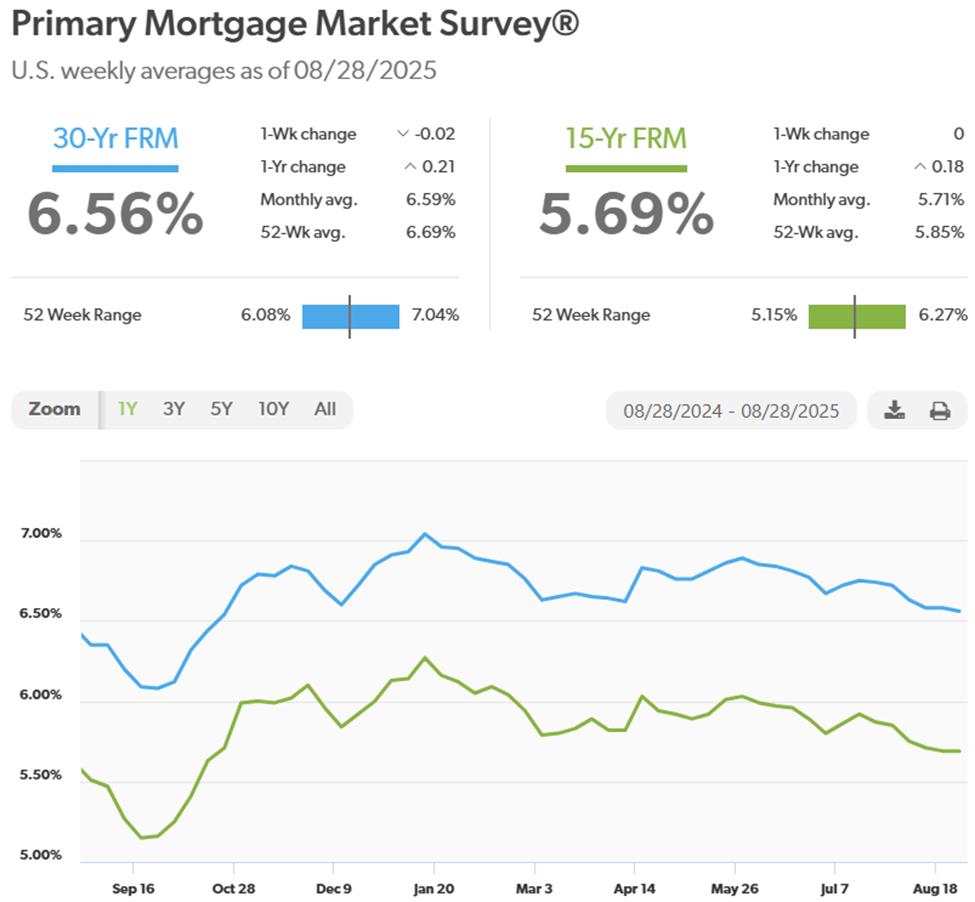
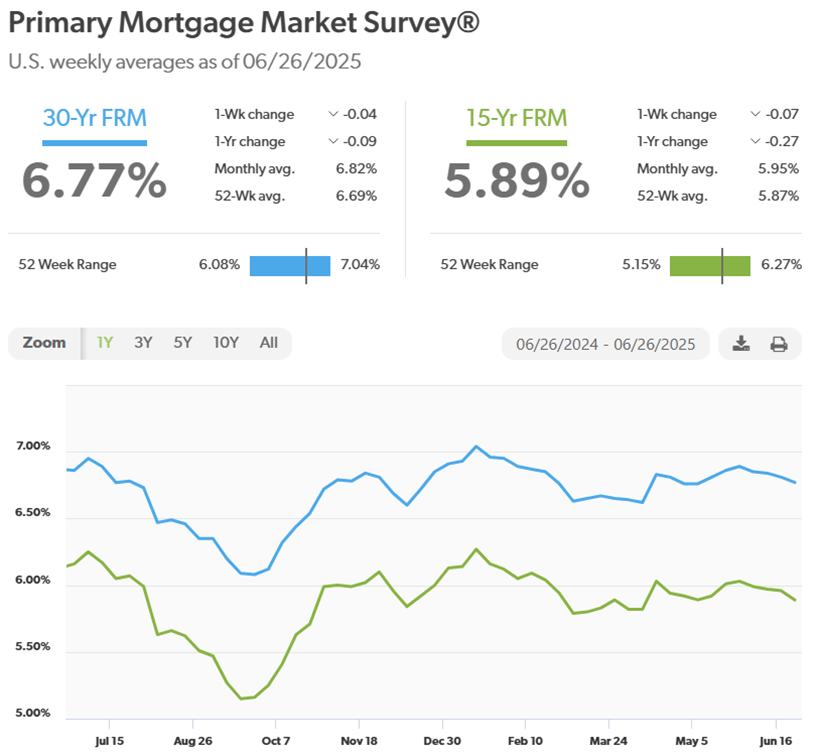
Mortgage rates finally had some movement worth noting and headed lower this past August, reaching a 10-month low. The decline is largely attributed to weaker-than-expected economic data, particularly in the labor market, which has increased the chances of an interest rate cut by the Federal Reserve.
The 30-year fixed rate finished the month at 6.56%, about 20 bps lower than last month but still within the narrow range of 6.5% and 7% that it has been in since October of last year. September should be a pivotal month for mortgage rates as the housing industry looks to the next Fed meeting for clarity.
Here is a look at the one-year chart of the 15- and 30-year mortgage rates from Freddie Mac.
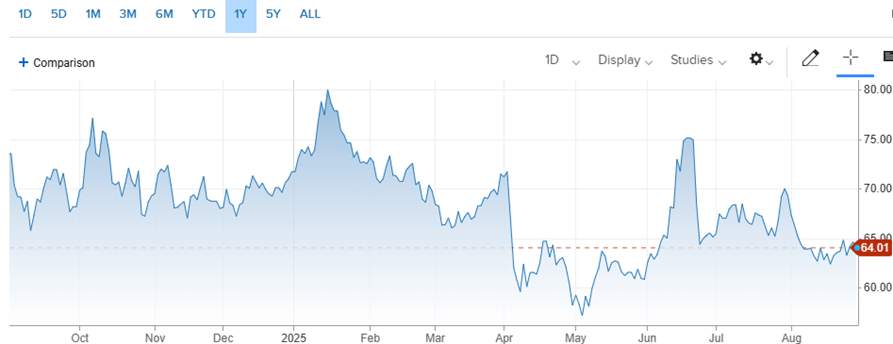
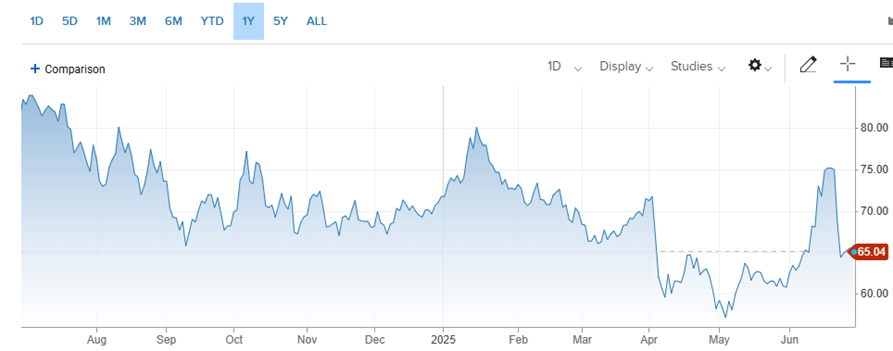
Oil prices took a significant dip at the beginning of the month and remained there for the rest of August. The drop was most likely due to the dollar weakening as a result of rising expectations for an interest rate cut by the Fed at their next meeting. Also, no major threats to production from hurricanes most likely contributed to the price drop.
For the month, the price for a barrel of oil closed at $64.01, down over $5 from the beginning of August. For the year, it’s down about 10.80%. Looking ahead, there are more catalysts that could move prices lower than higher, such as increased production across the globe, but that can change quickly. For now, prices going lower is good thing, in my opinion.
Here’s a look at the one-year chart for U.S. oil:
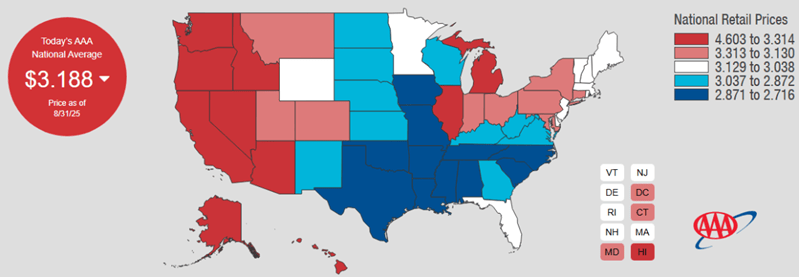
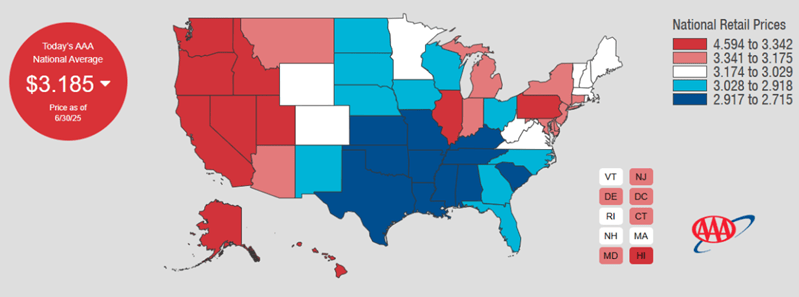
Gasoline prices were relatively flat in August, despite the drop in oil prices earlier in the month. Regular unleaded gasoline is now averaging $3.18 per gallon, up 3 cents from last month. We should see prices moving lower, especially with the summer driving season coming to an end. Mississippi holds onto the crown for the cheapest gas, checking in at $2.72 a gallon. California has the most expensive gasoline at $4.60 per gallon. FYI, a year ago, we were paying $3.34.
Check out the prices at the pump in your area: AAA Gas Prices.
Outlook
Events on the horizon that could move the markets in the near term:
Fed & Inflation: Although there was no FOMC meeting this past August, there was still plenty of activity involving the Federal Reserve. More economic data released recently seems to have caused the Fed to lean towards a 25-basis point rate cut in September. They are concentrating on fixing rising unemployment more than rising inflation. I think this makes sense because if less people are working, demand will go down for consumer goods, and that will put downward pressure on prices, thus slowing inflation. So, even if prices are going up now due to tariffs, they’ll eventually drop if less people are able to afford those goods. I also think there is a big variable affecting the labor market faster than expected: AI. Artificial Intelligence is being adopted by companies much faster than anticipated. Hiring has slowed because of it or halted altogether at many companies and lower interest rates are not going to change that. This is a seismic shift in the labor markets across the world that will last for decades. But focusing on the near term, the quickest and simplest way to keep our economy chugging along would be to cut rates just a little and, more importantly, remove the tariffs.
Trump Administration Policies: More tariffs went into effect in August, bringing the effective average tariff rate for consumers to approximately 18.6%, much higher than the 2.5% rate at the beginning of the year and the highest it has been since 1933. One of the biggest changes was the elimination of the “de minimis” exemption, which allowed imports valued at $800 or less to enter the United States duty-free. For reference, in 2024, the U.S. received 1.36 billion packages that qualified for the exemption. No doubt, there will be some sticker shock for consumers when they start their holiday shopping this year because imported items will be subject to duties that can range from 10% to 50% or more, depending on the product and its country of origin. Small businesses, particularly direct-to-consumer companies, will have to make some major changes to be able to survive this substantial increase in costs. I think it would make more sense to gradually lower the dollar value over a certain time period to a base amount, say $150, to allow businesses to prepare for the change. All of these new tariffs along with the potential of many of them to be deemed illegal by the courts will be pushing and pulling stocks for the next few months at least.
The Fed, specifically, the Federal Open Market Committee (FOMC), is not having their monthly meeting this August but many of the members are gathering this week in Jackson Hole, Wyoming with a bunch of financial big shots for their annual summer conference. The investment world will be tuning in to get any hints on what they plan to do with interest rates when they meet in September. So, I thought it would be a good time to review what happens when the Federal Reserve changes interest rates.
When the FOMC changes interest rates, they aren’t changing every rate out there. They are only changing the Federal Funds Rate (FFR). This is the rate that banks charge each other for overnight loans. Modifying this rate is one of the Fed’s tools that they use to maintain a healthy economy. They lower it if they feel the economy is slowing and raise it if the economy is heating up too quickly.
For example, if unemployment is trending up, the Fed would be more inclined to lower rates. If consumer prices (inflation) are going up at a higher rate than expected, they would consider raising rates to slow the increase.
Although you probably have never heard of the Fed Funds Rate, it does influence many of the interest rates that you are familiar with and interact with every day. The FFR is the base that the cost of money in the banking system is built upon. In fact, the prime rate, which almost all bank loans are based off of, is derived from the FFR and is typically 3% higher than the FFR.
Now, let’s take a look at the table below that shows what is expected with various rates and other economic factors when the FOMC changes the Fed Funds rate:
When FOMC raises the FFR, plan on:
When FOMC lowers the FFR, plan on:
Mortgage rates
Higher
Lower
Car loan rates
Higher
Lower
CD rates
Higher
Lower
Money market rates
Higher
Lower
Credit card rates
Higher
Lower
Business profits
Lower
Higher
Stock market
Lower
Higher
Consumer spending
Lower
Higher
Home sales
Lower
Higher
These expected changes don’t happen overnight. It takes time for the Fed’s actions to trickle down to other rates and markets. For instance, if the Fed raises the FFR, the stock market might not go down until rates are high enough in other investments, such as bonds or CDs, to justify the shift from stocks to those other investment options.
This should give you a better understanding of what is happening when you hear that the Fed is changing interest rates.
Please comment or send an email if you have any questions.
Talking about your beneficiaries means talking about death, specifically your death. Planning for your death may sound like the worst thing ever but it is really an incredibly thoughtful act on your part and will help to minimize stress for your family and loved ones when you ultimately check out.
Beneficiaries are typically assigned to retirement accounts (401k, IRAs, etc.), life insurance and annuity policies, as well as transfer-on-death (TOD) accounts. Naming beneficiaries on these accounts allow these assets to avoid the probate process after your death. If you don’t name any beneficiaries, these accounts will be passed on to your estate where they will go through probate based on your state laws. Probate is a legal proceeding that determines who will get your stuff. It is a lengthy, complex process that can be pretty expensive.
If you have a will, probate will use that to determine how your assets get divvied up. If you don’t have a will, also known as intestate, the state will do the best they can to determine who gets what. Suffice it to say, naming beneficiaries is the way to go. Getting this done before you pass away will make things simpler, quicker, and cheaper for your heirs during a very stressful time.
Naming beneficiaries can also be a very simple and inexpensive estate plan for most people, especially if you title your real estate property as a TOD asset.
You should name both primary and contingent beneficiaries. The primary beneficiary is first in line to receive your assets. If the primary beneficiary passes away before you, the contingent beneficiary will receive those assets, depending on your selection of per capita or per stirpes (see explanation below). You can have as many primary and contingent beneficiaries as you want.
Now, here is the most overlooked section of the beneficiary page: Choosing per stirpes or per capita.
Per capita (Latin for each head) means that if a beneficiary dies before you die, their share of the inheritance goes back to the estate and gets divided among the other living beneficiaries.
Choosing which one of these for your beneficiaries is very important and should be considered carefully. In the most basic instance, you should elect per stirpes on your beneficiary designations to ensure that your heirs’ heirs receive their share.
I mentioned transfer-on-death (TOD) accounts earlier and just wanted to review what they are and when to use them. TOD is used for taxable accounts, and it allows you to assign beneficiaries just as you do with retirement accounts, annuities, and life insurance. This allows your taxable accounts to bypass the probate process, which is quicker, cheaper, and less stressful for your heirs.
Also, there are about 25 states that currently offer a TOD deed for real estate property. This is a huge time and money saver for your heirs because the property automatically passes down to your beneficiaries named on the deed.
Finally, remember to review your beneficiaries at least annually and certainly after any major life events, such as death, divorce, marriage, adoption, etc.
Please comment or send an email if you have any questions.
Stocks stayed in the green for the third month in a row, climbing a wall of worry built mainly from tariffs. The index reached a series of new all-time highs, driven by strong performances in Q2 by our home-grown big technology companies.
For the month of July, the S&P 500 rose a respectable 2.2%, even with a pretty big drop in the last days of the month. That beat the historical July average of 1.28% and now takes the index to a year-to-date return of 8.50%.
The usually quiet summer months for stocks are anything but this year. With most of the Q2 earnings posted already, the stock market is now going to be fixated on trade policy, the job market, inflation, and interest rates. Each of these four elements can provide a boost or a bust for stocks over the next month. If the new tariffs that were recently implemented stay in place, inflation is going to continue higher as it has over the past few months. Layoffs from both the public and private sectors are now showing up in the data as the effects of DOGE, trade, and immigration policies take hold. Companies are embracing AI to reduce payroll as well. The Federal Reserve is more likely to cut interest rates by their September meeting (no meeting in August) now with the recent poor jobs data most likely outweighing the rising inflation data.
The good news is, as I have said many times this year, the economy can get back on track if we get rid of the tariffs and instead negotiate trade deals with our allies that are beneficial to both parties. This would especially help our small businesses that can’t afford to pay these levies and still remain viable. It would also benefit those that are in the lower- and middle-income tiers that can’t afford the price increases that our companies will have to pass on to their customers due to the tariffs.
Historically, August has been a pretty boring month for stocks, with an average return of about 0.5%. I think this August could be a little more exciting, to say the least.
Take a look at the Outlook section below to see what events could move the markets over the short term.
Bond prices were flat to slightly lower during July as the economy began to show signs of slowing, increasing the potential for short-term interest rates to be lowered by the Federal Reserve. Although the Federal Reserve held rates unchanged after their July meeting, sentiment increased sharply for a cut by the time that they meet again in September due to the poor jobs report that came out just after the Fed concluded their meeting.
While there is a recovery in market sentiment after a temporary pause on new tariffs, concerns over the long-term impact of trade policies and geopolitical risks still persist. This kind of uncertainty can drive investors toward safer assets like bonds, particularly government bonds, increasing demand and pushing prices up. We will most likely see this price action continue if the most recent tariffs stay in place for any significant period of time.
The 10-year US Treasury note yield finished higher in July, settling at 4.36%, higher than the 4.23% yield that it was at the beginning of the month. The 30-year bond yield closed out the month at 4.89%, about 12 basis points higher than a month ago.
With all of the uncertainty in the bond market, it is prudent to invest in bonds that mature sooner rather than later. I like bonds with a 12-to-18-month maturity and plan on holding onto them until they do mature.
Savings rates didn’t move much in July. Money market rates and bank savings accounts are averaging only about 0.46% but the best rates can be found at credit unions and online banks with rates approaching 4.5%. It is worth it to do some research here. With rates staying above 4%, I think more money is going to be funneled into the safe havens of money markets and CDs as the stock market rebound is showing signs of fatigue. So, CDs and MMAs continue to be a great place toput your cash and your emergency fund, for now. Knowing this, it makes sense in most situations to put cash that you don’t immediately need into CDs with up to 2-year maturities. For emergency cash, stick to high yielding money market and savings accounts, of which the best are yielding about 4.4%. As always, keep the total under $250,000 per person at any one bank to ensure you are fully covered by the FDIC.
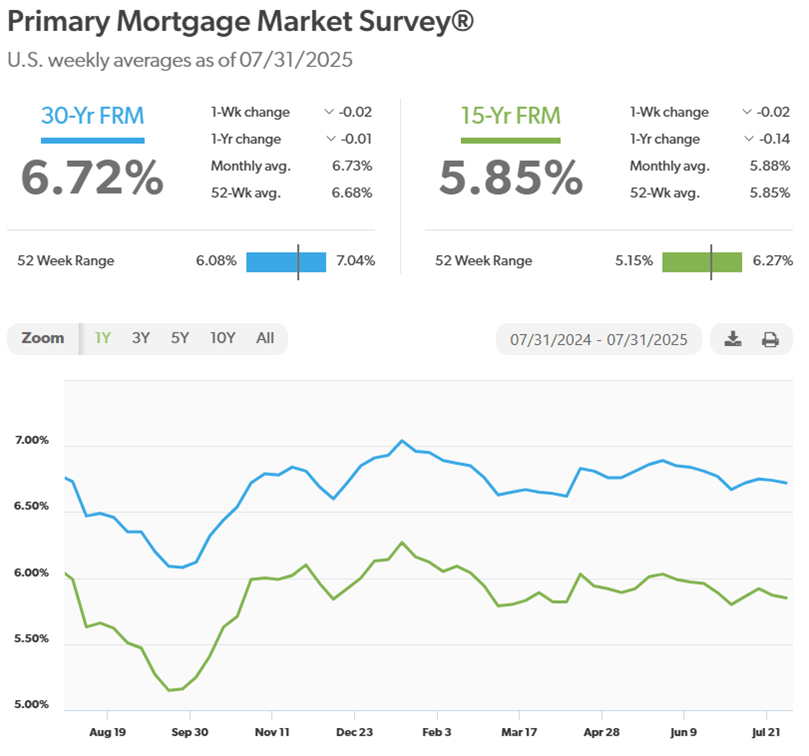
Mortgage rates mirrored other rate categories and had little movement this past month. The expectations were low for any changes in rates by the Federal Reserve, so this was expected. Higher housing inventory continued to put downward pressure on mortgage rates as well. Active listings rose for the 21st consecutive month, but overall inventory remains below pre-pandemic levels. It has become a buyers’ market in most parts of the country, but prices are still historically high and coupled with high mortgage rates, makes home purchases out of reach for many, especially first-time home buyers.
The 30-year fixed rate finished the month at 6.72%, still within the narrow range of 6.5% and 7% that it has been in since October of last year. The trade and immigration policies are causing higher raw materials and labor costs for homebuilders and are starting to show up in new home prices now, making it even harder to afford a new home.
Here is a look at the one-year chart of the 15- and 30-year mortgage rates from Freddie Mac.
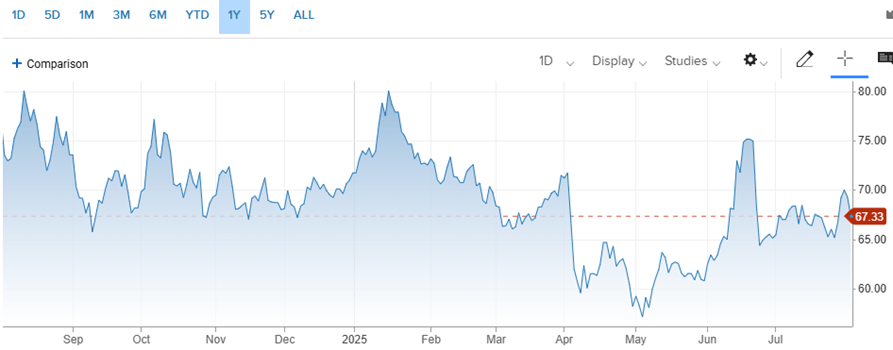
Oil prices were much calmer in July than they were in June of this year. That is, until the last week when oil prices surged due to renewed geopolitical risk causing a disruption in the global oil supply. Specifically, when the U.S. issued a deadline to Russia to end the war in Ukraine, threatening additional sanctions and tariffs on countries that continue to buy Russian oil. This, coupled with the seasonally strong summer demand could keep prices elevated at least through the end of August.
For the month, the price for a barrel of oil closed at $69.26, up from $65.11 at the beginning of July. For the year, it’s down about 3.40%. We certainly don’t want to see oil prices going higher now because that will raise the input costs for companies even higher as the tariffs take hold.
Here’s a look at the one-year chart for U.S. oil:
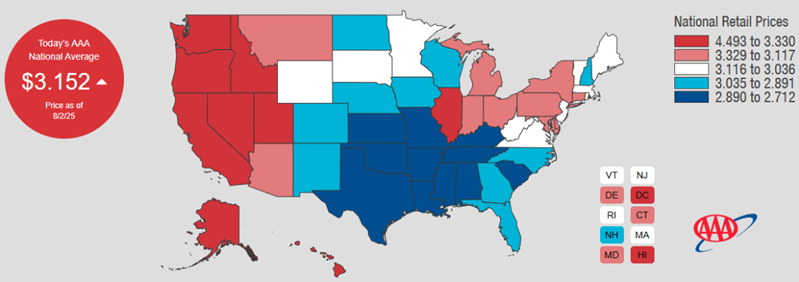
Gasoline prices dipped slightly in July. Regular unleaded gasoline is now averaging $3.15 per gallon, down four cents from last month. However, gas prices could be heading higher in the near future for reasons stated above in the oil prices section. Mississippi has the cheapest gas currently, checking in at $2.71 a gallon. California has the most expensive gasoline at $4.49 per gallon. FYI, a year ago, we were paying $3.48.
Check out the prices at the pump in your area: AAA Gas Prices.
Outlook
Events on the horizon that could move the markets in the near term:
Fed & Inflation: The Federal Reserve had started leaning towards cutting rates even before the bad jobs report came out this past Friday. Cracks have begun to appear in our resilient labor market as layoffs from DOGE and the private sector are reflected in the latest data. Also, inflation is picking up as U.S. companies begin to raise prices to offset the tariffs they are paying on imported goods and raw materials. Higher unemployment and higher prices, aka stagflation, is a tough scenario for the Fed to fight at the same time. Right now, it looks like they need to focus on the labor side of the equation, which would mean to cut rates. However, they have to tread carefully because lower rates combined with tariffs could lead to runaway inflation, which would be devastating to the economy. The ideal situation would be if we cut rates and removed the tariffs. That would help our economy recover and spur growth. I’m still hopeful.
Trump Administration Policies: The trade war is back on the front burner as tariffs are assessed on almost everything that our companies import for the products that they produce. As a reminder, the tariffs that we have been talking about this year are fees that U.S. companies pay our government. I like to think of these tariffs simply as an increase in the corporate tax for our companies. It basically increases the cost of doing business. So, in order for companies to keep the same profit margins pre-tariff, or in the case of many small businesses, to remain profitable at all, they have to either raise the prices that they charge their customers, lower expenses in other areas of their business, or a combination of both. Regardless of which avenue a company chooses, our economy will suffer, especially our small businesses and our lower income population that is already living paycheck to paycheck. As I said last month and will keep saying, the government needs to scuttle this absurd tariff strategy and go back to the drawing board to put together a plan that is realistic and can meet their objectives without damaging so many industries and so many lives. It’s not too late to save our small businesses, keep inflation in check, and get our economy back on track.
A big change is coming when you file your 2025 federal income taxes next year and here’s what you need to know.
Before we go over what has changed, let’s review what the State and Local Tax (SALT) includes. SALT refers to the federal tax deduction that allows taxpayers who itemize their deductions to subtract certain taxes they’ve paid to their state and local governments from their federal taxable income.
The taxes typically included in the SALT deduction are:
State and local income taxes
State and local property taxes
State and local general sales taxes (taxpayers generally choose to deduct either income taxes or sales taxes, but not both)
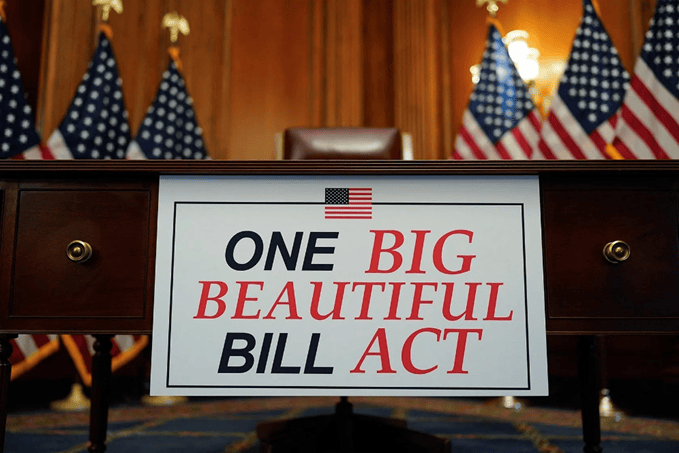
The SALT deduction cap has undergone significant changes with the recently signed “One Big Beautiful Bill” Act, offering a temporary increase for taxpayers. Here’s a breakdown of the new provisions:
Background:
Prior to 2025, there was a $10,000 cap ($5,000 for married individuals filing separately) on the SALT deduction.
Changes under the New Law (Effective 2025):
Increased Cap: For tax years 2025 through 2029, the SALT deduction cap is increased from $10,000 to $40,000.
Annual Adjustment: The $40,000 cap will increase by 1% each year from 2026 through 2029 to account for inflation.
Income-Based Phase-Down: The increased cap is subject to a phase-down for higher-income taxpayers:
For individuals and families with modified adjusted gross income (MAGI) over $500,000 (for joint filers in 2025, and this threshold also increases annually by 1%), the $40,000 cap is gradually reduced.
The deduction is phased down at a rate of $0.30 for every dollar over the income threshold.
Even with the phase-down, the deduction will not fall below the original $10,000 cap. This means taxpayers with MAGIs above approximately $600,000 in 2025 will effectively be limited to a $10,000 SALT deduction.
Sunset Provision: The higher SALT cap is temporary. Beginning in 2030, the deduction limit will revert to the original $10,000.
Who Benefits the Most:
Residents of High-Tax States: The increased cap provides significant relief to homeowners and taxpayers in states with high property and income taxes, such as California, New York, and New Jersey, who were significantly impacted by the previous $10,000 limit.
Itemizers: This change primarily benefits taxpayers who itemize their deductions, as the standard deduction has also been increased (e.g., to $31,500 for married filing jointly in 2025). Some households that previously took the standard deduction may now find it advantageous to itemize.
Targeted Relief: While the cap is higher, the income phase-down ensures that the full benefit of the increased cap is directed towards middle and upper-middle-income earners, with the highest earners seeing their deduction reduced back to the $10,000 level.
To summarize, the new SALT cap provides targeted relief to a broader segment of the population than the old cap, particularly those in areas with higher tax burdens, while still maintaining some limitations for the ultra-wealthy due to the income phase-down.
It’s important for taxpayers, especially those in high-tax states, to understand these changes and how they might affect their individual tax situations.
Please comment or send an email if you have any questions.
There’s a big benefit that started in 2025 for certain retirement plan savers to super charge their contributions.
What is it?
The super catch-up contribution is an enhanced catch-up contribution limit specifically for individuals in a narrow age range. It allows eligible participants to save more in their workplace retirement plans than the standard “age 50 and over” catch-up contribution.
Who is eligible?
Age: Participants must be aged 60, 61, 62, or 63 by the end of the calendar year to qualify for the super catch-up. Once an individual turns 64, they revert to the standard age 50+ catch-up contribution limit.
Plan Type: It applies to 401(k), 403(b), and governmental 457(b) plans, as well as SIMPLE IRAs, provided the plan already offers catch-up contributions. Not all plans are required to offer catch-up contributions, so participants should check with their plan administrator.
Contribution Limits (for 2025):
For 401(k), 403(b), and governmental 457(b) plans: The super catch-up contribution limit for ages 60-63 is $11,250. This is in place of the standard $7,500 catch-up contribution for those age 50 and over. This means an eligible participant could contribute a total of $34,750 ($23,500 regular limit + $11,250 super catch-up) in 2025.
For SIMPLE IRAs: The super catch-up limit for ages 60-63 is $5,250 (in 2025).
Also, starting in 2026, the super catch-up limits will be indexed for inflation, meaning they could increase in future years.
In summary, you can contribute an extra $3,750 to your company-sponsored retirement plan this year if you are age 60-63. Every little bit helps!
Please comment or send an email if you have any questions.
Just last week, the One Big Beautiful Bill Act (OBBBA) was signed into law by President Trump. It encompasses a wide array of provisions impacting areas such as tax regulations, energy, immigration, healthcare, and defense. Today, I wanted to focus on how this new law will affect the taxation of our social security benefits.
First off, the taxation of Social Security benefits did not change with this law. However, some of the provisions of the law were put in there to specifically help offset those taxes. The OBBBA will introduce a temporary tax deduction aimed at reducing the tax burden for taxpayers over the age of 65 that have income that falls below certain thresholds.
Here’s a summary of the key changes:
New Tax Deduction for Seniors: The bill enacts a temporary $6,000 tax deduction for individuals aged 65 or older. For married couples, this deduction can be up to $12,000 if both are 65 or older. This deduction applies whether you itemize your deductions or take the standard deduction.
Income Thresholds for Deduction: This deduction is available to individuals with incomes up to $75,000 and married couples with incomes up to $150,000. Above these thresholds, the deduction phases out, disappearing entirely for individual incomes over $175,000 and couple incomes over $250,000.
Temporary Provision: It’s important to note that this new tax deduction is temporary and is set to expire after 2028 unless extended by future legislation.
Effective Date: The tax break will take effect for the 2025 tax year, meaning eligible individuals will see changes when filing their taxes in early 2026.
To summarize, the bill provides tax relief to many seniors through a targeted deduction rather than a complete repeal of Social Security benefit taxation.
Please comment or send an email if you have any questions.
Thursday, July 3rd, – Stock market closes early at 1 pm.
Friday, July 4th, – Independence Day, stock market is closed
Stocks were resilient in June as they shrugged off tariffs, layoffs, and even wars to finish in the green for the second month in a row. The big tech and financial stocks are leading the way once again.
In June, the S&P 500 rose nearly 5%, topping off a fantastic comeback from the tariff lows in April. That performance put the index at an all-time high and solidly in the green for the year, now up about 5.50%.
We are only halfway through 2025, and it has already been quite eventful for the stock market. Looking ahead to the second half of the year, stocks could get a nice tailwind if tariffs go away or at least get whittled down to something that our companies and us, the consumers, can afford to pay. Still will be a tough road ahead for small businesses that don’t have the financial resources to weather the tariff storm. Regardless, advances in AI will continue to improve corporate productivity and profitability, which I believe will be a multi-year boost to stocks of companies that provide the technology as well as those companies that embrace it.
Historically, July has been a positive month for stocks. Since 1950, the S&P 500 has had an average return of about 1.28% in July, making it one of the strongest months of the year. We could see this trend continue this year if some trade deals get done, which are expected this month.
Take a look at the Outlook section below to see what events could move the markets over the short term.
Bond prices moved higher, and yields fell in a very tumultuous June for investors. There are many forces acting on the bond market right now that are pushing and pulling prices and yields in both directions. There is geopolitical and trade uncertainty providing a sturdy floor for government and high-quality corporate bond prices. Then we have the potential for trade deals getting done, which would remove the uncertainty of tariffs and put downward pressure on bond prices. Of course, any change in strategy by the Fed would be a major mover for bond prices. Once again, though, the Federal Open Market Committee (FOMC) kept the federal funds rate unchanged when they met this past June, citing the potential for a stagflation environment (higher prices, higher unemployment) due to the current trade and immigration policies.
The 10-year US Treasury note yield finished lower in June, settling at 4.23%, lower than 4.40% yield that it was at the beginning of the month. The 30-year bond yield closed out the month at 4.77%, about 15 basis points lower than a month ago.
With all of the uncertainty in the bond market, it is prudent to invest in bonds that mature sooner rather than later. I like bonds with a 12-to-18-month maturity and plan on holding onto them until they do mature.
Savings rates crept up just a bit in June with the online banks offering much higher yields than the national average. Money market rates and bank savings accounts are averaging only about 0.63% but the best online rates can be found in the 4.40% neighborhood, such a huge difference. It is worth it to do some research here. With rates staying above 4%, I think more money is going to be funneled into the safe havens of money markets and CDs as the stock market rebound is showing some signs of fatigue. So, CDs and MMAs continue to be a great place to put your cash and your emergency fund, for now. Knowing this, it makes sense in most situations to put cash that you don’t immediately need into CDs with up to 2-year maturities. For emergency cash, stick to high yielding money market and savings accounts, of which the best are yielding about 4.4%. As always, keep the total under $250,000 per person at any one bank to ensure you are fully covered by the FDIC.
Mortgage rates reversed course and headed lower in June, probably due to following the 10-year treasury note as well as lower demand from new home buyers. Home prices are just too high for most people at their current income. That’s why we are seeing only 24% of all homes sold are being purchased by first-time home buyers. That’s down from 50% in 2010.
The 30-year fixed rate continues to float in a narrow range between 6.5% and 7% since October of last year. Currently, the 30-year rate sits at 6.68%, about 20 basis points lower than a month ago, at 6.89%. The trade and immigration policies are starting to show up in new home prices now, but the lower demand could help reduce prices of existing homes for sale.
Here is a look at the one-year chart of the 15- and 30-year mortgage rates from Freddie Mac.
Oil prices had a wild ride in June, rocketing higher with the Israel/US vs. Iran scuffle threatening oil shipments in the Middle East, and then dropping precipitously when they decided to give it a rest. By the end of the month, oil prices settled higher.
For the month, the price for a barrel of oil closed at $65.04, up from $60.79 at the beginning of June. For the year, it’s still down about 9.30%. Geopolitical tensions and a weakening dollar are keeping oil prices elevated even as supplies are plentiful. We don’t want to see oil prices going higher now because that will raise the input costs for companies even higher as the tariffs take hold. Fortunately, OPEC is still increasing output to try and take market share from their competition, so that is continuing to put downward pressure on prices. If there are no other shocks to the system , we should see prices drift back down to the $60 level, but that’s a big if nowadays.
Here’s a look at the one-year chart for U.S. oil:
Gasoline prices headed higher in June. Regular unleaded gasoline is now averaging $3.19 per gallon, up four cents from last month. Gas prices at least had a reason for being higher this past month, with the fighting in the middle east being the main reason. Mississippi has the cheapest gas currently, checking in at $2.72 a gallon. California has the most expensive gasoline at $4.59 per gallon. FYI, a year ago, we were paying $3.49.
Check out the prices at the pump in your area: AAA Gas Prices.
Outlook
Events on the horizon that could move the markets in the near term:
Fed & Inflation: The Federal Reserve is in full standby mode on changing interest rate policy. Their June meeting came and went with no surprises. However, some fed members recently have commented that they could see an interest rate cut coming as soon as the July meeting, but it all depends on how much prices will rise due to tariffs once companies’ existing inventories have been used up. Prices have already been rising in certain sectors of the economy and the new set of tariffs that may be implemented this July could really hit prices right at the start of the holiday shopping season. Plus, the dollar has had its biggest drop in the first six months of a year in forty years. This can contribute to inflation as well. The Fed is in a bind, but I think it is a prudent move to wait for the hard data to come in over the summer before making any changes to short-term interest rates. Any cut in rates would be a nice boost for stocks and bonds, as long as the move wasn’t made to avoid a recession.
Trump Administration Policies: It sure felt like the trade war got put on the back burner this past month as the potential for us getting into a real war heated up. Luckily, it looks like we can avoid another scuffle in the middle east. Regarding immigration policy, the government backed off arresting workers in many sectors of the economy because of the damage it was doing to those industries, particularly the farming, restaurant, hotel, and construction industries. The government really needs to go back to the drawing board and put together a strategy that is realistic and can meet their objectives without damaging so many industries and so many lives. Also, repairing friendships with our allies would go a long way in helping many parts of our country that rely on international visitors for survival. Still, with all this, tariffs are the biggest concern for the markets and July could be a pivotal month for the entire economy as tariff deadlines come up. They could be delayed once again but the uncertainty, especially for small businesses, might be too much to allow them to remain in business. Typically, July is a very quiet month for stocks, but this one could become very interesting in a hurry.
The economic stars were aligning beautifully at the beginning of the year for the Federal Reserve to start to gradually lower interest rates in 2025. Then, in February our economy, and much of the world’s economies, were upended with a shock and awe tariff policy by the Trump administration. This, coupled with changing global perceptions of U.S. governance and institutions has forced the Fed to rethink its interest rate strategy. Subsequently, the odds of any rate cuts this year have dropped significantly since the end of 2024.
Here are the main suspects that may keep interest rate higher for the foreseeable future:
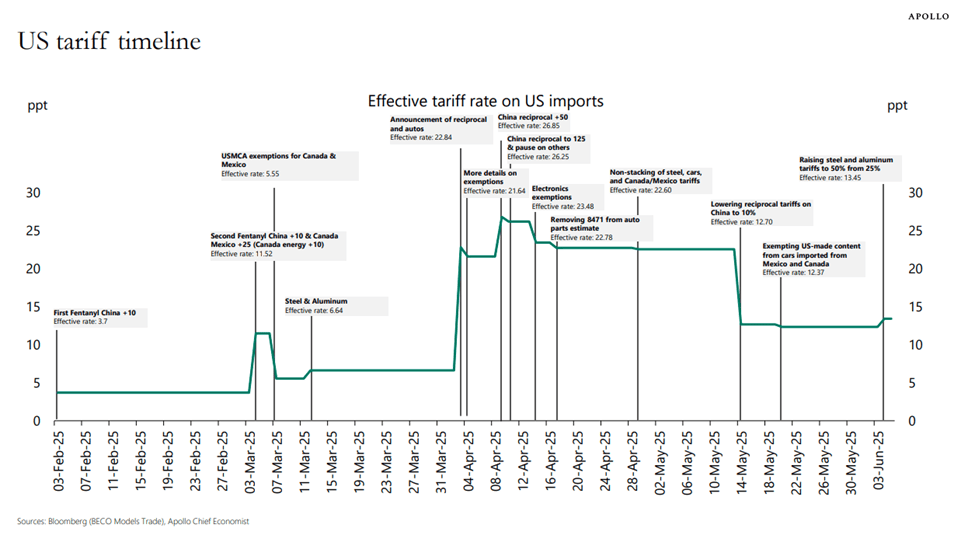
Tariffs: This chart summarizes the effective tariff rate that U.S. companies have had to pay since February:
The green line shows the effective tariff rate from February to June of this year. Prior to February, the U.S. was paying an effective tariff rate of about 2.4%. Currently, we are paying an effective rate of 13.45%. We were as high as 26.85% in April, so we have come off of the highs but still are at a level that is almost 6 times what we were paying at the start of the year. Now, it’s showing up in the prices that we are paying and also in the number of small businesses that have had to lay off workers, suspend operations, or shut down completely. This increase is just not sustainable and higher prices mean rates have to stay high to fend off runaway inflation.
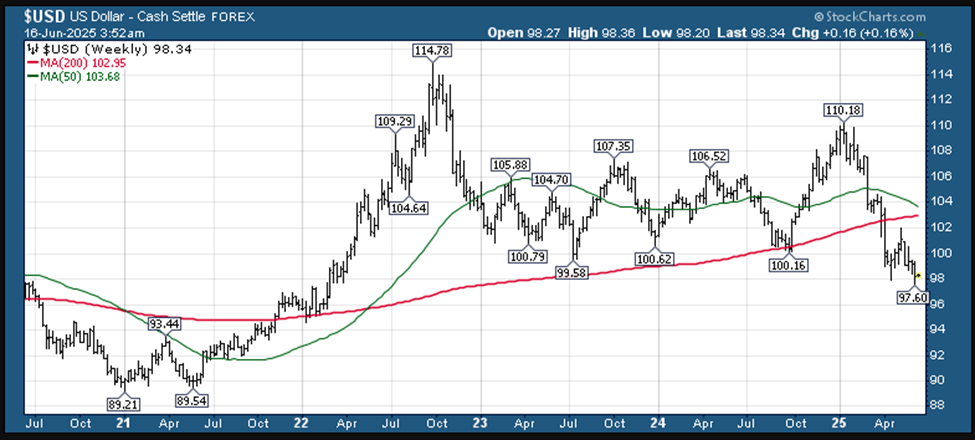
Weaker Dollar: Take a look at this chart of the US Dollar hitting a 3-year low recently.
The black is the dollar index value, the red is its 200-day moving average and the green is its 50-day moving average. There are several factors contributing to the downward pressure on the U.S. dollar, including:
Tariffs and Trade Policy
Global Concerns about U.S. Economic Growth and Recession Risks
Fiscal Deficit and Debt Concerns
Erosion of U.S. Except
In essence, a combination of protectionist trade policies, concerns about the U.S. economy’s resilience, fiscal anxieties, and a shift in global investor sentiment are all contributing to the weakening of the U.S. dollar in 2025. A weaker dollar is inflationary and another reason for the Fed to keep rate elevated.
As I have said before, these issues are self-inflicted, which means they can be resolved quickly if we act now. The longer these policies are in place, the harder it will be to recover from them. Then, the Federal Reserve will have to lower interest rates but for all the wrong reasons, aka a recession.
Please comment or send an email if you have any questions.