

Calendar Notes
- September 1st, Monday – Labor Day. Markets are closed.
Stocks continued their resilient climb higher in August, making it four months in a row of positive gains. Most stock indices reached all-time highs even as recent economic data shows signs of a possible slowdown. Much of the gains came from big tech once again as they appear to be the most resilient to the current economic headwinds.
For the month of August, the S&P 500 rose a solid 2%, well above its average of 0.5% for the last full month of summer. For the year, the index is now up 10.8%.
With Q2 earnings in the rearview mirror, the stock market is once again focused on interest rates and trade policy. Regarding rates, it feels like a 25-basis point cut by the Federal Reserve at their upcoming September meeting is already baked into the stock market cake. However, the jobs numbers coming out at the end of this week could bring some extra volatility to the stock market.
More tariffs went into effect in August with some imported products getting hit with levies approaching 50%! These rates are unsustainable for even our biggest companies to operate profitably. Fortunately, a recent appeals court ruling has upheld that many of these tariffs are illegal. This will certainly be appealed by the Trump administration to the Supreme Court so we may not know the legality of many of these tariffs until later this fall. For now, they will stay in place.
Historically, September has been the worst performing month for the S&P 500. In fact, it is the only month of the year with a negative return, averaging -1.2% since 1928. With stocks at record levels, the highest tariffs of the year being implemented, employment data coming out this week, and the Fed meeting coming up, it’s anybody’s guess which way the market will move. Hold on for the ride!
Take a look at the Outlook section below to see what events could move the markets over the short term.
Bond prices rallied in August mainly due to the weak labor market data that increased the potential for short-term interest rates to be lowered by the Federal Reserve at their September meeting. The bond market is now more worried about job losses than inflation based on the strong move downward in bond prices.
With more tariffs kicking in this past month, businesses will need to adjust their operations to stay profitable. That could include raising prices and reducing payrolls, probably a little of both. If the Fed is going to fight job losses instead of inflation, rates will go lower, and bond prices will continue to trend up. However, if the tariffs go away, we could see an abrupt reversal in the current price movement.
The 10-year US Treasury note yield finished lower in August, settling at 4.23%, lower than the 4.36% yield that it was at the beginning of the month. The 30-year bond yield closed out the month at 4.93%, just 4 basis points higher than a month ago.
There is still plenty of uncertainty in the bond market, so it is prudent to invest in bonds that mature sooner rather than later. I like bonds with a 9-to-18-month maturity and plan on holding onto them until they mature.
Savings rates are drifting slightly lower, most likely in anticipation of a short-term interest rate cut in September by the Federal Reserve. Money market rates and savings accounts are averaging only about 0.5% but the best rates can be found at credit unions and online banks. It is worth some of your time looking for the place with the best rates to park your cash.
| Account Type | Average Rate | Highest Rate |
| Money Market Account | 0.46% | 4.80% |
| High-Yield Savings Account | 0.60% | 5.00% |
| CD Term | Average Rate | Highest Rate |
| 1-Year | 2.04% | 4.50% |
| 3-Year | 1.69% | 4.28% |
| 5-Year | 1.71% | 4.28% |
With money market deposits at record highs and the potential for savings rates to head lower, we could start to see cash flowing from savings and CDs to corporate bonds with higher yields as well as dividend-paying stocks. This is a trend to look for over the next several months.
For now, CDs and MMAs are still a great place to put your cash and your emergency funds. Knowing this, it makes sense in most situations to put cash that you don’t immediately need into CDs with up to 2-year maturities. For emergency cash, stick to high yielding money market and savings accounts, of which the best are yielding about 4.8%. As always, keep the total under $250,000 per person at any one bank to ensure you are fully covered by the FDIC.
Mortgage rates finally had some movement worth noting and headed lower this past August, reaching a 10-month low. The decline is largely attributed to weaker-than-expected economic data, particularly in the labor market, which has increased the chances of an interest rate cut by the Federal Reserve.
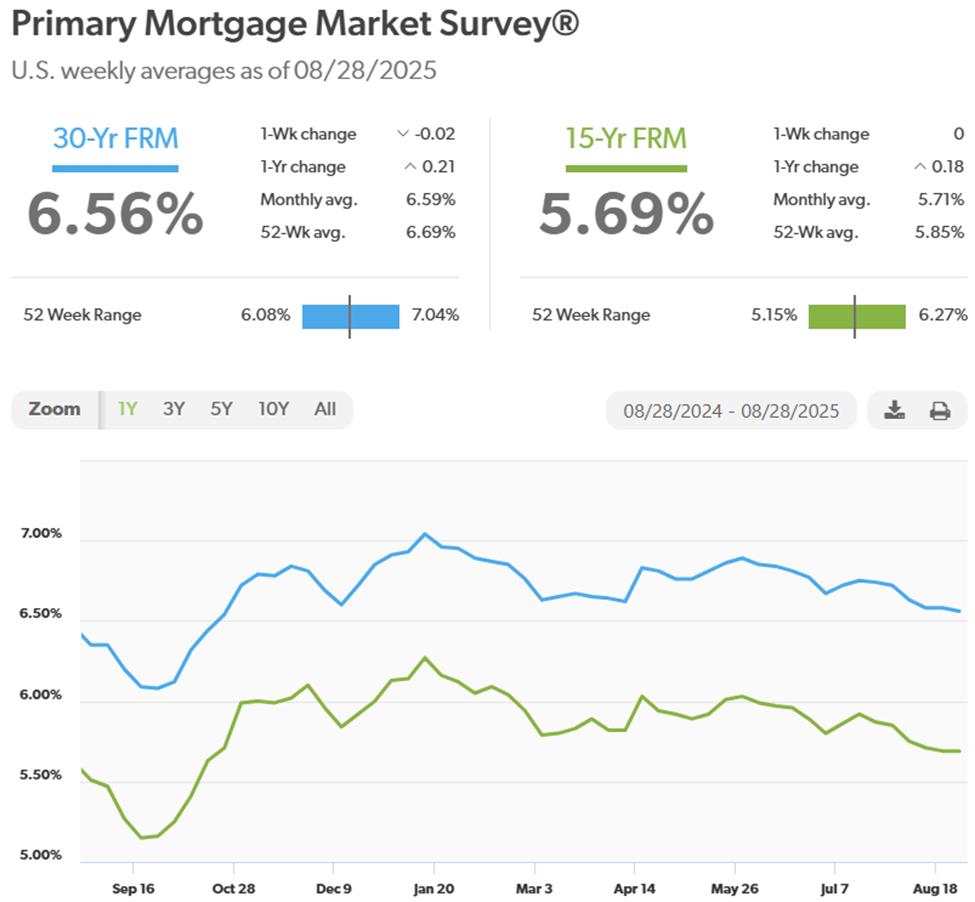
The 30-year fixed rate finished the month at 6.56%, about 20 bps lower than last month but still within the narrow range of 6.5% and 7% that it has been in since October of last year. September should be a pivotal month for mortgage rates as the housing industry looks to the next Fed meeting for clarity.
Here is a look at the one-year chart of the 15- and 30-year mortgage rates from Freddie Mac.
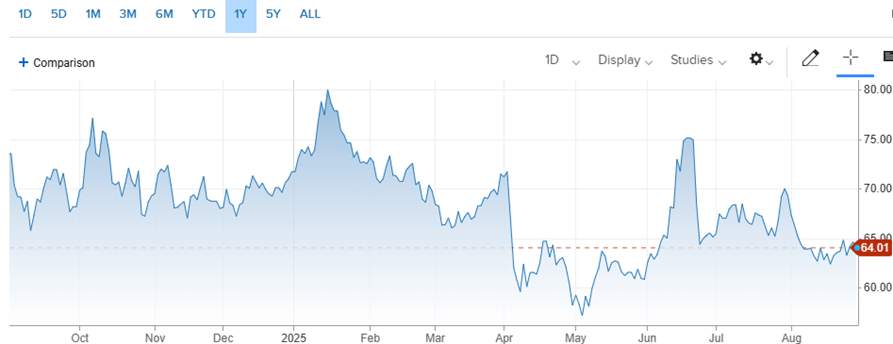
Oil prices took a significant dip at the beginning of the month and remained there for the rest of August. The drop was most likely due to the dollar weakening as a result of rising expectations for an interest rate cut by the Fed at their next meeting. Also, no major threats to production from hurricanes most likely contributed to the price drop.
For the month, the price for a barrel of oil closed at $64.01, down over $5 from the beginning of August. For the year, it’s down about 10.80%. Looking ahead, there are more catalysts that could move prices lower than higher, such as increased production across the globe, but that can change quickly. For now, prices going lower is good thing, in my opinion.
Here’s a look at the one-year chart for U.S. oil:
Gasoline prices were relatively flat in August, despite the drop in oil prices earlier in the month. Regular unleaded gasoline is now averaging $3.18 per gallon, up 3 cents from last month. We should see prices moving lower, especially with the summer driving season coming to an end. Mississippi holds onto the crown for the cheapest gas, checking in at $2.72 a gallon. California has the most expensive gasoline at $4.60 per gallon. FYI, a year ago, we were paying $3.34.
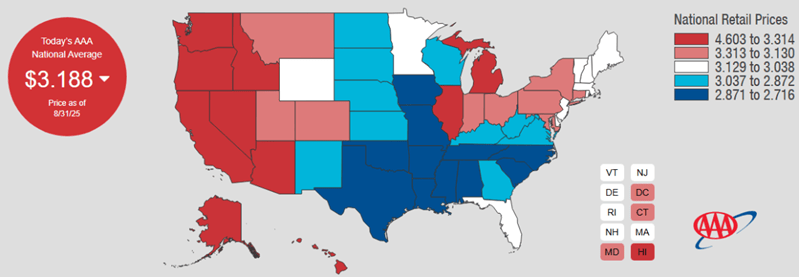
Check out the prices at the pump in your area: AAA Gas Prices.
Outlook
Events on the horizon that could move the markets in the near term:
- Fed & Inflation: Although there was no FOMC meeting this past August, there was still plenty of activity involving the Federal Reserve. More economic data released recently seems to have caused the Fed to lean towards a 25-basis point rate cut in September. They are concentrating on fixing rising unemployment more than rising inflation. I think this makes sense because if less people are working, demand will go down for consumer goods, and that will put downward pressure on prices, thus slowing inflation. So, even if prices are going up now due to tariffs, they’ll eventually drop if less people are able to afford those goods. I also think there is a big variable affecting the labor market faster than expected: AI. Artificial Intelligence is being adopted by companies much faster than anticipated. Hiring has slowed because of it or halted altogether at many companies and lower interest rates are not going to change that. This is a seismic shift in the labor markets across the world that will last for decades. But focusing on the near term, the quickest and simplest way to keep our economy chugging along would be to cut rates just a little and, more importantly, remove the tariffs.
- Trump Administration Policies: More tariffs went into effect in August, bringing the effective average tariff rate for consumers to approximately 18.6%, much higher than the 2.5% rate at the beginning of the year and the highest it has been since 1933. One of the biggest changes was the elimination of the “de minimis” exemption, which allowed imports valued at $800 or less to enter the United States duty-free. For reference, in 2024, the U.S. received 1.36 billion packages that qualified for the exemption. No doubt, there will be some sticker shock for consumers when they start their holiday shopping this year because imported items will be subject to duties that can range from 10% to 50% or more, depending on the product and its country of origin. Small businesses, particularly direct-to-consumer companies, will have to make some major changes to be able to survive this substantial increase in costs. I think it would make more sense to gradually lower the dollar value over a certain time period to a base amount, say $150, to allow businesses to prepare for the change. All of these new tariffs along with the potential of many of them to be deemed illegal by the courts will be pushing and pulling stocks for the next few months at least.
Joe Baker, CFP®
Baker Asset Management, LLC
joebaker@bakerassetmanagement.com

