

Calendar Notes
- Thursday, July 3rd, – Stock market closes early at 1 pm.
- Friday, July 4th, – Independence Day, stock market is closed
Stocks were resilient in June as they shrugged off tariffs, layoffs, and even wars to finish in the green for the second month in a row. The big tech and financial stocks are leading the way once again.
In June, the S&P 500 rose nearly 5%, topping off a fantastic comeback from the tariff lows in April. That performance put the index at an all-time high and solidly in the green for the year, now up about 5.50%.
We are only halfway through 2025, and it has already been quite eventful for the stock market. Looking ahead to the second half of the year, stocks could get a nice tailwind if tariffs go away or at least get whittled down to something that our companies and us, the consumers, can afford to pay. Still will be a tough road ahead for small businesses that don’t have the financial resources to weather the tariff storm. Regardless, advances in AI will continue to improve corporate productivity and profitability, which I believe will be a multi-year boost to stocks of companies that provide the technology as well as those companies that embrace it.
Historically, July has been a positive month for stocks. Since 1950, the S&P 500 has had an average return of about 1.28% in July, making it one of the strongest months of the year. We could see this trend continue this year if some trade deals get done, which are expected this month.
Take a look at the Outlook section below to see what events could move the markets over the short term.
Bond prices moved higher, and yields fell in a very tumultuous June for investors. There are many forces acting on the bond market right now that are pushing and pulling prices and yields in both directions. There is geopolitical and trade uncertainty providing a sturdy floor for government and high-quality corporate bond prices. Then we have the potential for trade deals getting done, which would remove the uncertainty of tariffs and put downward pressure on bond prices. Of course, any change in strategy by the Fed would be a major mover for bond prices. Once again, though, the Federal Open Market Committee (FOMC) kept the federal funds rate unchanged when they met this past June, citing the potential for a stagflation environment (higher prices, higher unemployment) due to the current trade and immigration policies.
The 10-year US Treasury note yield finished lower in June, settling at 4.23%, lower than 4.40% yield that it was at the beginning of the month. The 30-year bond yield closed out the month at 4.77%, about 15 basis points lower than a month ago.
With all of the uncertainty in the bond market, it is prudent to invest in bonds that mature sooner rather than later. I like bonds with a 12-to-18-month maturity and plan on holding onto them until they do mature.
Savings rates crept up just a bit in June with the online banks offering much higher yields than the national average. Money market rates and bank savings accounts are averaging only about 0.63% but the best online rates can be found in the 4.40% neighborhood, such a huge difference. It is worth it to do some research here. With rates staying above 4%, I think more money is going to be funneled into the safe havens of money markets and CDs as the stock market rebound is showing some signs of fatigue. So, CDs and MMAs continue to be a great place to put your cash and your emergency fund, for now. Knowing this, it makes sense in most situations to put cash that you don’t immediately need into CDs with up to 2-year maturities. For emergency cash, stick to high yielding money market and savings accounts, of which the best are yielding about 4.4%. As always, keep the total under $250,000 per person at any one bank to ensure you are fully covered by the FDIC.
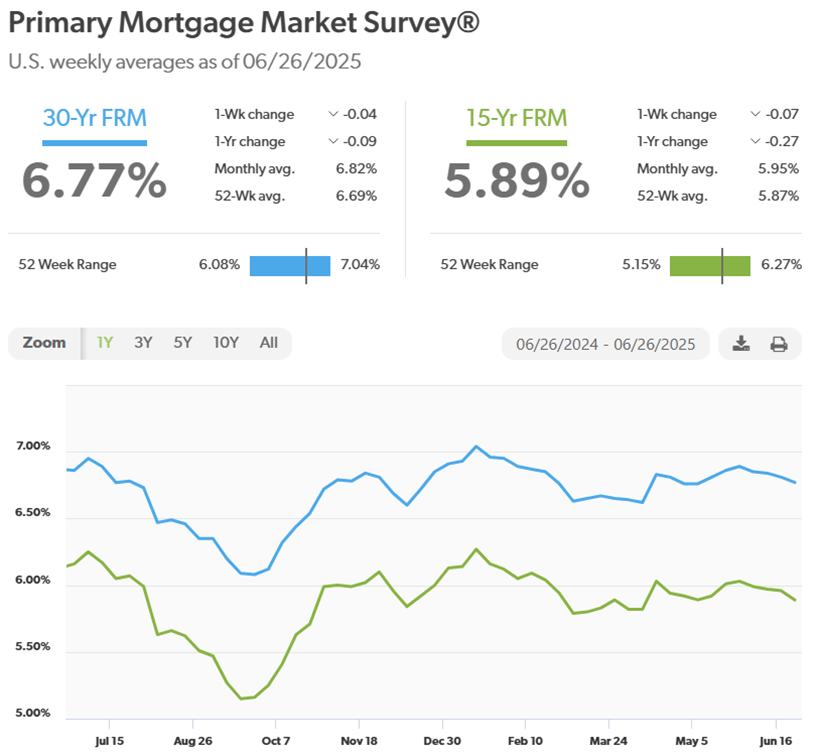
Mortgage rates reversed course and headed lower in June, probably due to following the 10-year treasury note as well as lower demand from new home buyers. Home prices are just too high for most people at their current income. That’s why we are seeing only 24% of all homes sold are being purchased by first-time home buyers. That’s down from 50% in 2010.
The 30-year fixed rate continues to float in a narrow range between 6.5% and 7% since October of last year. Currently, the 30-year rate sits at 6.68%, about 20 basis points lower than a month ago, at 6.89%. The trade and immigration policies are starting to show up in new home prices now, but the lower demand could help reduce prices of existing homes for sale.
Here is a look at the one-year chart of the 15- and 30-year mortgage rates from Freddie Mac.
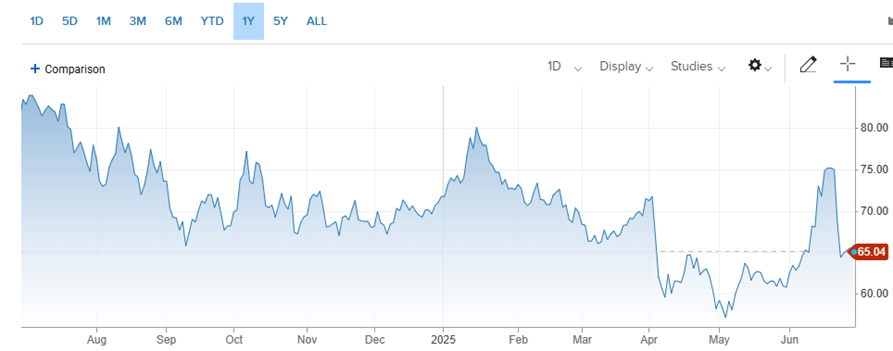
Oil prices had a wild ride in June, rocketing higher with the Israel/US vs. Iran scuffle threatening oil shipments in the Middle East, and then dropping precipitously when they decided to give it a rest. By the end of the month, oil prices settled higher.
For the month, the price for a barrel of oil closed at $65.04, up from $60.79 at the beginning of June. For the year, it’s still down about 9.30%. Geopolitical tensions and a weakening dollar are keeping oil prices elevated even as supplies are plentiful. We don’t want to see oil prices going higher now because that will raise the input costs for companies even higher as the tariffs take hold. Fortunately, OPEC is still increasing output to try and take market share from their competition, so that is continuing to put downward pressure on prices. If there are no other shocks to the system , we should see prices drift back down to the $60 level, but that’s a big if nowadays.
Here’s a look at the one-year chart for U.S. oil:
Gasoline prices headed higher in June. Regular unleaded gasoline is now averaging $3.19 per gallon, up four cents from last month. Gas prices at least had a reason for being higher this past month, with the fighting in the middle east being the main reason. Mississippi has the cheapest gas currently, checking in at $2.72 a gallon. California has the most expensive gasoline at $4.59 per gallon. FYI, a year ago, we were paying $3.49.
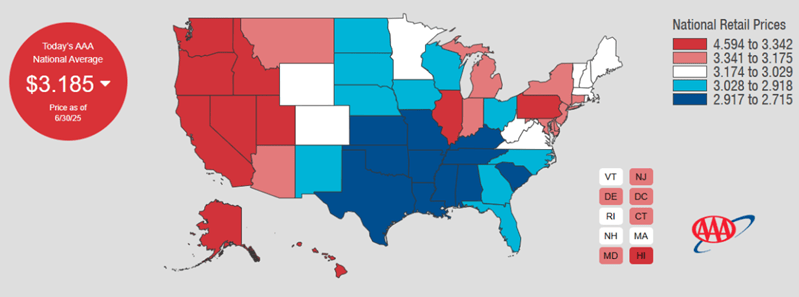
Check out the prices at the pump in your area: AAA Gas Prices.
Outlook
Events on the horizon that could move the markets in the near term:
- Fed & Inflation: The Federal Reserve is in full standby mode on changing interest rate policy. Their June meeting came and went with no surprises. However, some fed members recently have commented that they could see an interest rate cut coming as soon as the July meeting, but it all depends on how much prices will rise due to tariffs once companies’ existing inventories have been used up. Prices have already been rising in certain sectors of the economy and the new set of tariffs that may be implemented this July could really hit prices right at the start of the holiday shopping season. Plus, the dollar has had its biggest drop in the first six months of a year in forty years. This can contribute to inflation as well. The Fed is in a bind, but I think it is a prudent move to wait for the hard data to come in over the summer before making any changes to short-term interest rates. Any cut in rates would be a nice boost for stocks and bonds, as long as the move wasn’t made to avoid a recession.
- Trump Administration Policies: It sure felt like the trade war got put on the back burner this past month as the potential for us getting into a real war heated up. Luckily, it looks like we can avoid another scuffle in the middle east. Regarding immigration policy, the government backed off arresting workers in many sectors of the economy because of the damage it was doing to those industries, particularly the farming, restaurant, hotel, and construction industries. The government really needs to go back to the drawing board and put together a strategy that is realistic and can meet their objectives without damaging so many industries and so many lives. Also, repairing friendships with our allies would go a long way in helping many parts of our country that rely on international visitors for survival. Still, with all this, tariffs are the biggest concern for the markets and July could be a pivotal month for the entire economy as tariff deadlines come up. They could be delayed once again but the uncertainty, especially for small businesses, might be too much to allow them to remain in business. Typically, July is a very quiet month for stocks, but this one could become very interesting in a hurry.
Joe Baker, CFP®
Baker Asset Management, LLC
joebaker@bakerassetmanagement.com

