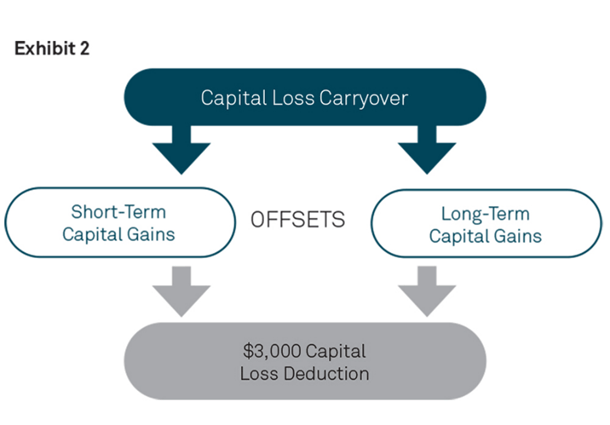
Because 2022 was such a bad year for the stock market, many investors who sold stocks back then had more capital losses than capital gains for that year. The good news is that they can use those excess losses to reduce their capital gains in 2023 and even some of their ordinary income (up to $3,000).
Capital loss carryover is a tax rule that lets you use investment losses from one year to reduce your taxable income in future years. Before going any further, keep in mind that this rule only applies to taxable accounts, not retirement accounts, such as IRAs.
Here’s how it works:
1. Calculating your net capital loss:
First, you need to calculate your net capital loss for the year. This is the difference between your capital gains (money you made on investments) and your capital losses (money you lost on investments).
You can only deduct up to a certain amount of net capital losses in a single year. This limit is currently $3,000.
2. Carryover of unused losses:
If your net capital loss is greater than the allowable deduction ($3,000), the unused portion automatically carries over to future tax years.
There is no time limit to how long you can carry over capital losses.
You can use the carryover to:
o Offset capital gains in future years.
o Deduct up to $3,000 against your ordinary income in future years.
3. Applying the carryover:
Each year, you calculate your net capital loss again, considering any new gains and losses.
You can use your current year’s net capital loss first to offset any capital gains you have.
Then, you can apply any remaining unused carryover from previous years to further reduce your taxable income.
4. Important points to remember:
Capital losses are categorized as short-term or long-term based on how long you held the investment before selling. Short-term losses can only offset short-term gains, while long-term losses can offset both short-term and long-term gains.
Wash sales are a strategy where you sell an investment at a loss and then repurchase it shortly after. This is generally not allowed and can prevent you from claiming the capital loss.
It’s important to keep accurate records of your capital gains and losses for tax purposes.
Here’s an example:
In 2022, you had $5,000 in capital losses and no capital gains. You deducted $3,000 of your losses to offset your ordinary income, and the remaining $2,000 carried over to 2023. In 2023, you had $1,000 in capital gains. You can first use your $2,000 carryover to completely offset these gains. You then have $1,000 remaining in your carryover that you can offset your ordinary income with, thus using up all of your capital loss carryover.
I hope this explanation helps. Remember, it’s always a good idea to consult with a tax professional for advice specific to your situation.
Please comment or send an email if you have any questions. Thanks!
Joe Baker, CFP® Baker Asset Management, LLC joebaker@bakerassemanagement.com
Unfortunately, as technology continues to advance, so do the methods used by criminals via email or text messages to steal our personal information, financial assets, and our peace of mind.
Scammers are constantly adapting their tactics, making it crucial to stay informed about the latest email scams. Here are some of the most prevalent ones to watch out for in 2024:
1. Tax Scams:
“Third Round of Economic Impact Payments” Scam: This email claims you’re due a refund of $976 related to the stimulus package, but it uses a fake IRS logo and a phishing link to steal your information.
“New Client” Scams Targeting Tax Professionals: Scammers impersonate potential clients seeking tax help, aiming to gain access to sensitive data or inject malware through malicious links.
Impersonation of Tax Authorities: Emails claiming you owe taxes or have inconsistencies in your return often use urgency and threats to pressure you into clicking on phishing links.
2. Fake Delivery Notifications:
Parcel Delivery Scams: Emails claiming missed deliveries or requiring additional fees often contain tracking numbers that lead to phishing websites or malware downloads.
3. Government Impersonation Scams:
Fake Government Account Takeover: Scammers impersonate government agencies like the IRS or Social Security Administration, urging you to update your information through phishing links.
4. Investment Scams:
Deepfakes and AI-Generated Content: Scammers use deepfakes of celebrities or AI-generated content to promote fraudulent investment opportunities.
5. Two-Factor Authentication (2FA) Scams:
Fake 2FA Requests: Scammers send emails pretending to be financial institutions or online services, requesting you to verify your 2FA code through a phishing link.
General Tips to Avoid Email Scams:
Be wary of unsolicited emails, even if they appear legitimate.
Never click on links or open attachments from unknown senders.
Verify the sender’s identity by contacting the organization directly through a trusted website or phone number.
Don’t be pressured into taking immediate action.
Report suspicious emails to the appropriate authorities.
Keep your software and antivirus up to date.
By staying informed and exercising caution, you can protect yourself from these and other email scams.
Please comment or send an email if you have any questions. Thanks!
February 19th: Presidents’ Day – The stock market is closed.
February 29th: Leap Day
Stocks started off the year on the right foot, continuing their climb higher from the big rally at the end of 2023. Much of the gains of the S&P 500 index can be attributed to the sharp rise in the large technology companies, such as, Microsoft, Nvidia, Alphabet, Meta, and Amazon.
For January, the index was up about 1.6%. Historically, this is an encouraging sign for stocks because since the early 1940’s, if the market is up in January, it has continued to rise in the remaining 11 months of the year more than 85% of the time with an average gain of about 11.5 %.
There are some headwinds out there, such as getting more heavily involved in the mid-east turmoil, but if we don’t put more boots on the ground than we already have out there, it shouldn’t be an issue. The biggest catalyst for stocks is still interest rates. If they continue to drop and/or the Federal Reserve starts cutting them, there should be a lot of money flowing out of bonds and CDs and moving into stocks, which could give a nice boost for the markets.
Take a look at the Outlook section below to see what events could move the markets over the short term.
Bond prices were kind of a mixed bag this January. Longer term treasury bonds reversed course and headed lower but short-term treasuries and corporate bonds all headed higher in price. This price action helped the yield curve on its path back to normal, but it still has a ways to go. After yesterday’s meeting, there is more clarity on where interest rates are heading in the near future.
The 10-year US Treasury note yield rose slightly to 3.94%, just above where it closed at the beginning of the month. The 30-year bond yield closed out the month at 4.19%, slightly higher as well from a month ago. After the big yield moves at the end of last year, January was a month for bond investors to catch their breath. We still have an inverted yield curve (for instance, the six-month T-bill is yielding 5.50%), which historically has preceded a recession, but there is more and more data that point to a soft landing for the economy, which would be great for everybody and a huge pat on the back for the Federal Reserve.
Bond buyers should continue to focus on bonds with short-term maturities. I would keep maturities under 18 months and just plan on holding these bonds to maturity. That way, you won’t have to worry about selling at a discount if interest rates head higher. If rates continue to drop, you can sell the bonds at a profit since their price will rise as their yield drops.
Savings rates moved very little in January despite December’s drop in short-term bond yields. Savings rates typically follow, but lag, the direction of bond yields. Regardless, they are still relatively high, especially with respect to inflation. So, CDs and MMAs continue to be a great place to park your cash and your emergency fund. These rates continue to be a legitimate alternative to stocks and bonds and will keep pressure on those markets until we see this trend reverse, which may be starting to happen.
Now, take a look at the top rates for CDs and money market accounts (MMA):
CD RATES TODAY
Term
Average APY
High rate
3-month CD
1.23%
5.39%
6-month CD
1.69%
5.84%
1-year CD
1.88%
5.87%
2-year CD
1.66%
5.35%
3-year CD
1.58%
5.00%
Source: Curinos. Data accurate as of January 30, 2024. Quoted rates are based on a $25,000 deposit.
MMA RATES TODAY
Deposit level
Average APY
High rate
$10,000 minimum balance
0.57%
5.13%
Source: Curinos. Average APY date accurate as of January 30, 2024.
The best 1-year CD interest rate is currently at 5.87%. The best 5-year CD rate right now is around 5.50%. These rates are still inverted, but are close to even now, which means that they are continuing to normalize. We are getting closer to the point where buying longer-term maturity bonds and CDs will make sense but for now, I would still put my savings or emergency spending money into short-term CDs, 1 year or less, and reevaluate when they mature. If you’d rather have more liquidity, look into an MMA (still yielding over 5% currently). Keep the total under $250,000 per person at any one bank to ensure you are fully covered by the FDIC. As I mentioned above, CDs and MMAs have become nice alternatives for risk-averse investors and have drawn money away from stocks because of their relatively high rates that carry virtually no risk.
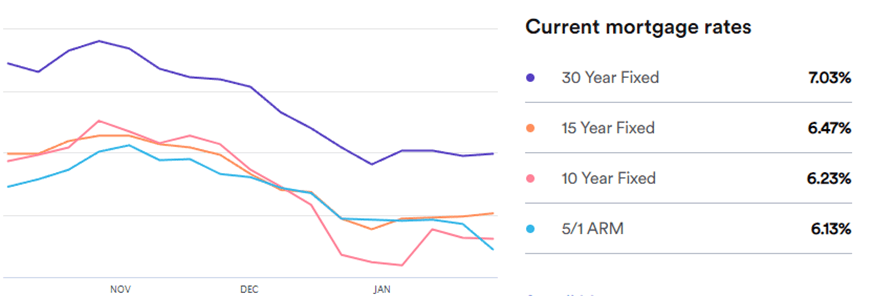
Mortgage rates creeped higher in January, reversing a three month down trend. This was mainly due to higher demand but also the uncertainty of the Fed’s actions over the next several months. Currently, the 30-year rate sits at 7.03%, slightly higher than a month ago, at 6.93%.
Although rates ticked higher in January, the trend since October has been down and that should continue based on the results of the Federal Reserve meeting yesterday. It probably won’t help with existing home sales but should help new home buyers heading into the spring peak buying season.
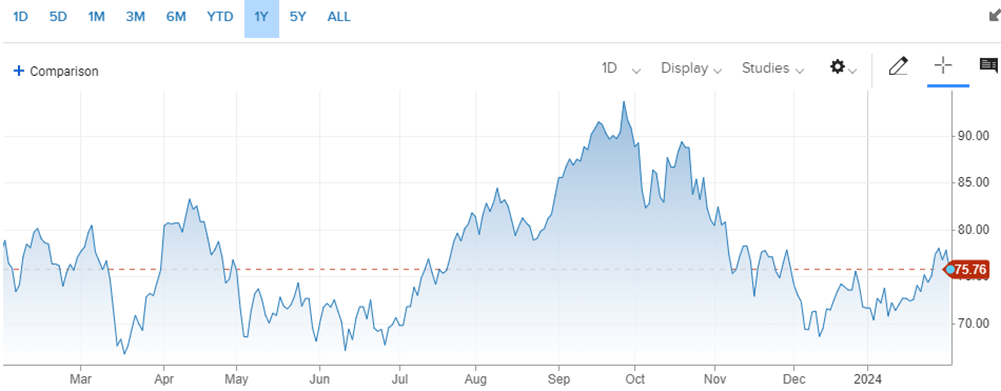
Oilprices stopped their descent in January and headed higher. There still seems to be ample supply out there but the potential of war escalating in the Middle East as well as Saudi Arabia halting plans to increase oil supply has tilted the scales towards higher prices for now.
For the month, the price for a barrel of oil settled around $75.76, up from $71.65 at the beginning of January. The mid-east turmoil is probably going to keep oil prices from falling further, especially if the Saudis keep tightening their spigots.
Here’s a look at the one-year chart for U.S. oil:
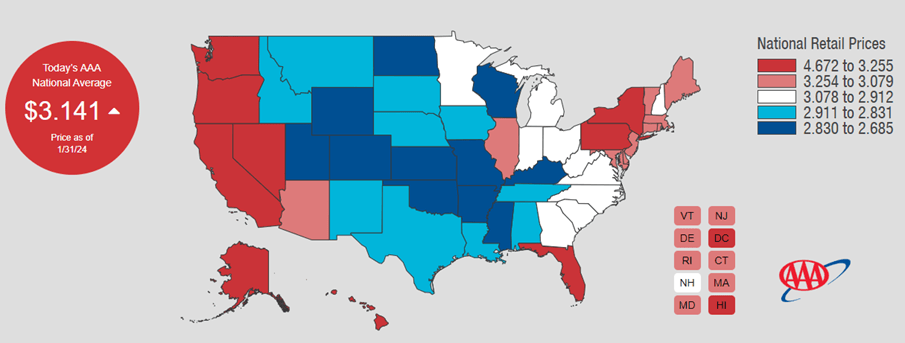
Gasoline prices stayed pretty flat in January, even with oil prices rising. I’m not sure how long that will last once we thaw out. Regular unleaded gasoline is now averaging $3.14 per gallon, up from $3.12 last month. Wyoming has the cheapest gas currently, checking in at $2.69 a gallon. Hawaii has the most expensive gasoline at $4.67 per gallon. FYI, a year ago, we were paying $3.51.
Check out the prices at the pump in your area: AAA Gas Prices.
Outlook
Events on the horizon that could move the markets in the near term:
Fed & Inflation: The Fed concluded their first meeting of 2024 yesterday and decided to keep interest rates where they are for now, which was exactly what everyone expected. The data coming in keeps pointing to lower inflation so if that continues, I expect that they’ll cut rates starting in March.
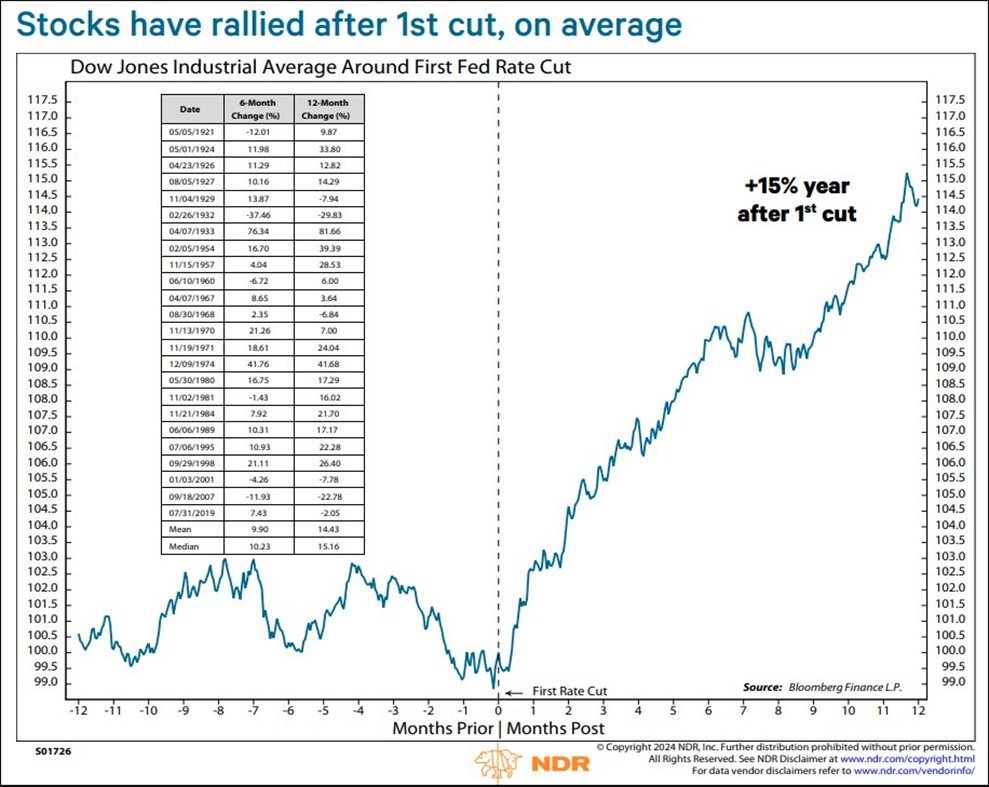
I thought the following illustration would be helpful in seeing how Fed rate cuts affect the stock market. The chart below shows how the Dow Jones Industrial Average (DJIA) has performed the year before and the year after the Federal Reserve cut rates. Note that when the DJIA has a positive return during the past six months prior to the Fed cutting rates for the first time, the following twelve months have always been positive for stocks with the exception of two times: 1968 and 2019. So, when we see the Federal Reserve cut rates (hopefully at their next meeting in March), we should feel confident that stocks will perform well in the twelve months.
Savings Rates Peak: This is still in play as savings rates seemed to have stalled and could be heading lower. If the Fed cuts rates in March, we should see money flowing out of money markets and CDs and back into stocks. This could fund another leg up for stocks over the next 12-18 months.
2023 is in the rearview mirror but there is still time to reduce your taxable income for last year:
Make a tax-deductible contribution to your IRA.
If you qualify, an IRA contribution can be a great way to reduce your 2023 taxes. You are allowed to contribute up to $6,500. If you are age 50 or older, you can add an extra $1,000 for a total of $7,500. You basically just had to have worked last year (have earned income) to qualify to make an IRA contribution.
Plus, if you are married, you can double up the amount with a spousal IRA.
If you are not covered by a retirement plan at work, you can deduct the full amount of your contribution, regardless of how much money you make.
If you do have a retirement plan at work, there are restrictions and limitations to qualify for the full deduction. Here’s a table that summarizes these rules. They are confusing so feel free to shoot me an email with any questions.
2023 Traditional IRA deduction limits
Filing Status
Modified adjusted gross income (MAGI)
Deduction Limit
Single individuals
≤ $73,000
Full deduction up to the amount of your contribution limit
> $73,000 but < $83,000
Partial deduction
≥ $83,000
No deduction
Married (filing joint returns)
≤ $116,000
Full deduction up to the amount of your contribution limit
> $116,000 but < $136,000
Partial deduction
≥ $136,000
No deduction
Married (filing separately)*
< $10,000
Partial deduction
≥ $10,000
No deduction
If you’re self-employed, you can sock away a lot more by opening up a Simplified Employee Pension (SEP) plan before filing your taxes. For 2023, you can contribute up to $66,000, depending on your income.
Please comment or send an email if you have any questions. Thanks!
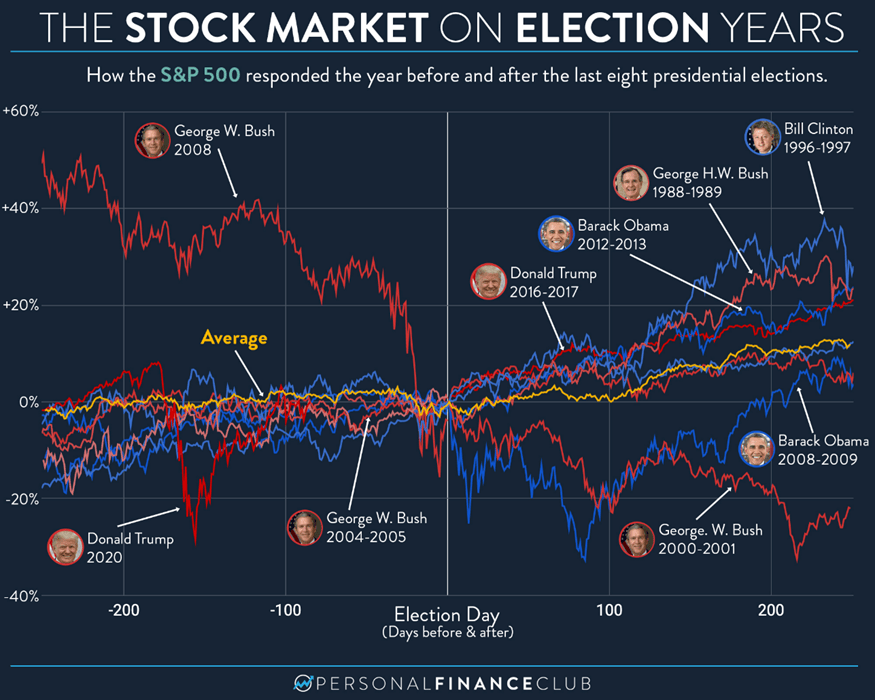
Besides interest rates and The Federal Reserve, stock market volatility is going to be heavily influenced by the presidential election this November. And it’s not going to wait until Fall. Headlines are going to be filled with polls, debates, and trials from now until election day (and beyond, I’m sure). I have always felt that elections are just short-term catalysts, both positive and negative, for stocks and Presidents don’t really have an affect on stock prices. It will still hold true this year. However, I suspect there will be much more volatility due to politics than normal, especially with addition of the Trump trials to the landscape.
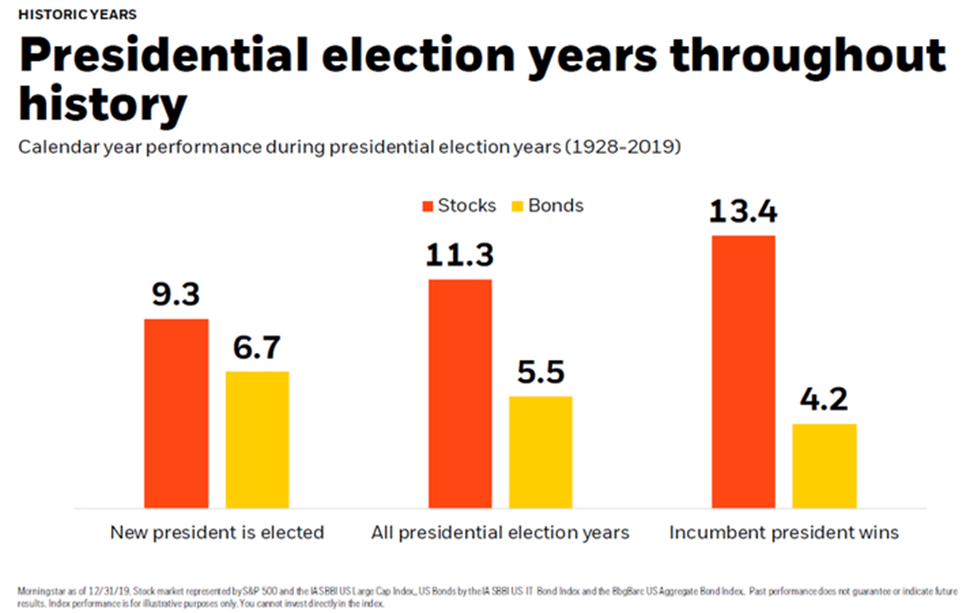
So, let’s take a look at how markets have performed historically in a presidential election year:
Historically, the S&P 500 has averaged a 7% gain during U.S. presidential election years since 1952. This is lower than the average annual gain of around 10% but still positive.
Re-election years: Markets tend to perform better in re-election years (such as this year), with the S&P 500 averaging a 12.2% gain since 1952. This could be due to an incumbent president’s focus on maintaining stability and avoiding major policy changes.
Party control: The party in control of Congress doesn’t seem to have a significant impact on market performance. However, major policy changes proposed by either party can cause uncertainty and volatility.
Economic conditions: The overall health of the economy has a much stronger influence on the stock market than the election itself. Strong economic growth and low inflation are typically associated with positive market returns.
Historically, stocks perform the best when an incumbent president wins and the opposite party controls at least one section of Congress, either the House of Representatives or the Senate. But this shouldn’t influence your investment strategy for the long term. Holding high-quality, well-run companies will serve you well regardless of the political climate.
Please comment or send an email if you have any questions.
Martin Luther King, Jr. Day: Monday, January 15th. The stock market is closed.
Stocks finished the year with a strong December as data continued to come in showing inflation dropping while the job market remains relatively strong. Recession fears are slowly fading away for now as the Federal Reserve continues to try and orchestrate a soft landing for the economy.
The S&P 500 rose for nine straight weeks to end the year, its best win streak since 2004. For December, the index was up about 4.2%, capping off a surprisingly good year. For 2023, the S&P 500 had a gain of 26.3%.
I think there was some FOMO with investment managers that missed out on this rally earlier in the year that helped the markets finish the year strong. Having said that, stocks sure seem like they are over bought right now. So, I wouldn’t be surprised that there could be some profit taking to start the new year off but if interest rates continue to drop, there should be a lot of money flowing out of bonds and CDs and moving into stocks, which could be the catalyst for the next leg up for stocks.
Take a look at the Outlook section below to see what events could move the markets over the short term.
Bond prices continued to rise in December as investors ramped up their buying with inflation data and the Fed both pointing to lower interest rates in the coming year.
The 10-year US Treasury note yield dropped almost 50 basis points to close out December at 3.87%. The 30-year bond yield fell about 50 bps as well, closing the month at 4.02%. These are huge moves in the bond world and suggest rates have made a definitive shift in direction in the short term. We still have an inverted yield curve, which historically has preceded a recession, but there are some signs that point to a soft landing for the economy, which would be great for everybody and a huge pat on the back for the Federal Reserve.
Bond buyers should continue to focus on bonds with short-term maturities. I would keep maturities under 18 months and just plan on holding these bonds to maturity. That way, you won’t have to worry about selling at a discount if interest rates head higher. If rates continue to drop, you can sell the bonds at a profit since their price will rise as their yield drops.
Savings rates went up again in December but look like they are about to rollover and start dropping, which makes sense since interest rates for treasury bills, notes, and bonds are all moving lower already. Still, current rates for CDs and MMAs are a great place to park your cash and your emergency fund. These rates continue to be a legitimate alternative to stocks and bonds and will keep pressure on those markets until we see this trend reverse, which may be happening sooner than later.
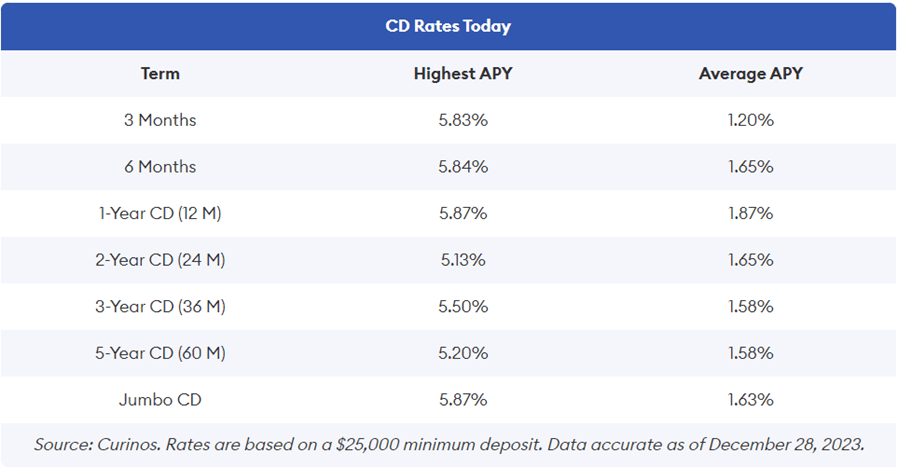
Now, take a look at the top rates for CDs and money market accounts (MMA):
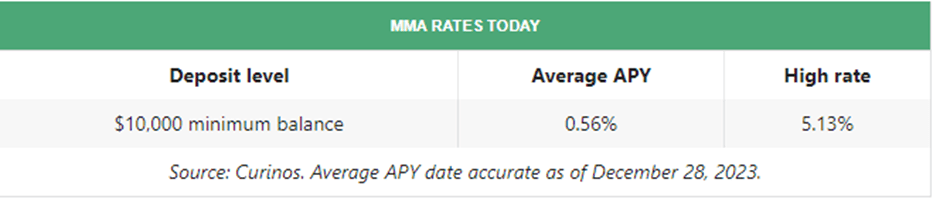
The best 1-year CD interest rate is currently at 5.87%. The best 5-year CD rate right now is right around 5.20%. These rates are still inverted, but are close to even now, which means that they are continuing to normalize. We are getting closer to the point where buying longer-term maturity bonds and CDs will make sense but for now, I would still put my savings or emergency spending money into short-term CDs, 1 year or less, and reevaluate when they mature. If you’d rather have more liquidity, look into an MMA (still yielding over 5% currently). Keep the total under $250,000 per person at any one bank to ensure you are fully covered by the FDIC. As I mentioned above, CDs and MMAs have become nice alternatives for risk-averse investors and have drawn money away from stocks because of their relatively high rates that carry virtually no risk.
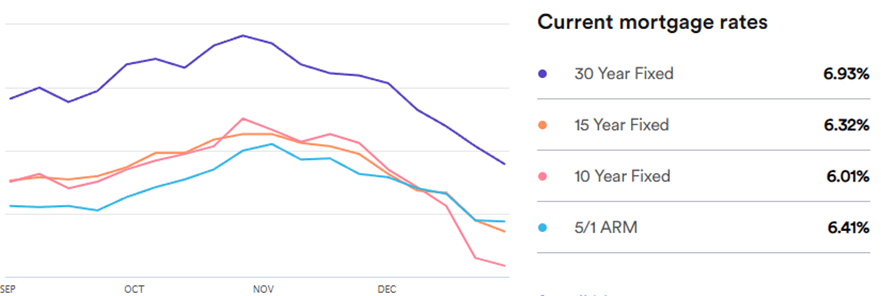
Mortgage rates took a tumble in December as the Fed showed no signs of raising rates again and more hints that they will be cutting rates in 2024. Currently, the 30-year rate sits at 6.93%, much lower than what it was a month ago, at 7.73%. This trend looks like it could continue based on the current yield path of the 10-year treasury bond, which has the biggest influence on mortgage rates.
Mortgage rates have come down quite a bit and we should see that get more buyers into the market as we head into the spring, especially for new home sales. It is still going to be a tough market for existing home sales because potential sellers are going to have a hard time letting go of their 2.5% – 3.5% mortgage, but if they do want to sell, there will probably be multiple bids coming in for them.
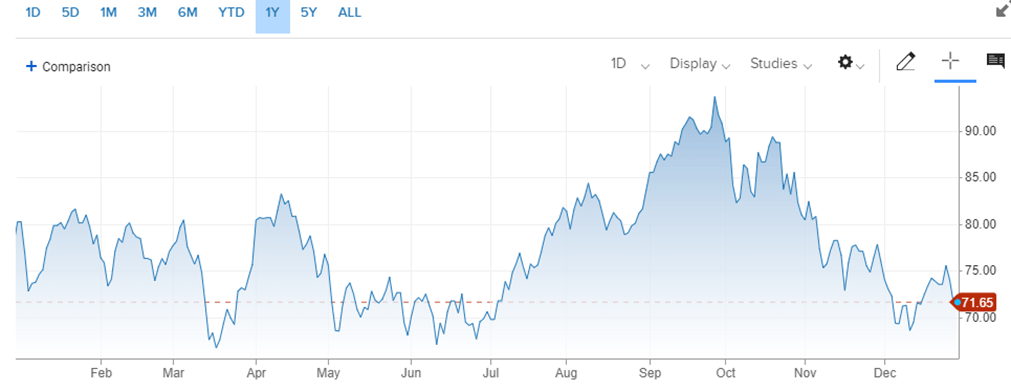
Oilprices declined for the third month in a row in December. Supply has been keeping up with demand, which is surprising given how much we are consuming just here in the states. For the month, the price for a barrel of oil settled around $71.65, down from $75.62 at the beginning of December. Oil prices are going in the right direction and will help profitability for almost all companies if this trend continues.
Here’s a look at the one-year chart for U.S. oil:
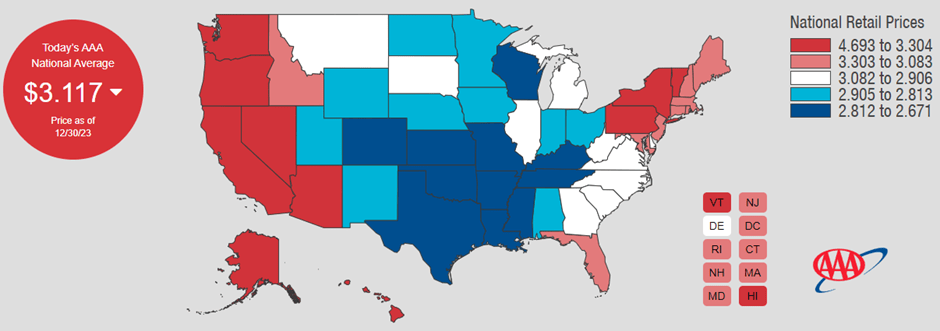
Gasoline prices dropped again in December, despite OPEC production cuts and the ongoing middle east turmoil. Regular unleaded gasoline is now averaging $3.12 per gallon, down from $3.25 last month. Mississippi has the cheapest gas currently, checking in at $2.67 a gallon. California has the most expensive gasoline at $4.69 per gallon with Hawaii a close second at $4.68. FYI, a year ago, we were paying $3.18.
Check out the prices at the pump in your area: AAA Gas Prices.
Outlook
Events on the horizon that could move the markets in the near term:
Fed & Inflation: After the last Fed meeting in December, pretty much everyone is banking on the Federal Reserve to start cutting interest rates in 2024. We have a pretty nice scenario shaping up for stocks in the new year. Job growth is still on the rise but not at the rates that we saw earlier in the year. Wage growth has fallen since late summer pretty steadily but still positive. Most importantly, according to the Fed, inflation has dropped down to 3.1%, very close to their goal of 2%. Based on the data, it looks like inflation could glide down to 2% without having to raise interest rates further. If this plays out as expected, it will definitely provide some boost for the stock market.
Savings Rates Peak: This may be a little farther out than a few months but if savings rates are close to peaking right now and start to come down, there could be a ton of money that will shift from money markets and maturing bonds into stocks. This could easily fund another leg up for stocks over the next 12-18 months.
There are still a few options you have to reduce your taxable income for 2023, even though we’re almost at the end of the year. Here are some strategies to consider:
Retirement Contributions
Max out your 401(k) or 403(b): For 2023, the limit for employee contributions is $22,500, with an additional $7,500 catch-up contribution if you’re aged 50 or older. Contributing to these accounts reduces your taxable income for the year.
Contribute to a traditional IRA: For 2023, the contribution limit for IRAs is $6,000, with an additional $1,000 catch-up contribution if you’re aged 50 or older. Depending on your adjusted gross income, contributions to traditional IRAs are tax-deductible, lowering your taxable income.
Consider a SEP IRA if you’re self-employed: The contribution limit for SEP IRAs in 2023 is 25% of your net self-employment income, up to $66,000. These contributions are tax-deductible, reducing your taxable income.
Other Pre-Tax Contributions
Health Savings Account (HSA): If you have a high-deductible health plan, you can contribute to an HSA. The contribution limit for 2023 is $3,850 for individuals and $7,750 for families. These contributions are tax-deductible, lowering your taxable income.
Pre-paying 2024 Deductions
Consider prepaying certain expenses: If possible, consider prepaying certain expenses that are typically due in January, such as property taxes or mortgage interest, into December 2023. This can help you bunch deductions into a single year and lower your taxable income.
Contribute to charities in December: If you plan to make charitable contributions, consider making them before the end of the year to claim the deduction in 2023.
Harvest Capital Losses
If you have investment losses in your portfolio, you can sell them before the end of the year to offset capital gains and reduce your taxable income.
Please comment or send an email if you have any questions.
December in the Northern Hemisphere is similar to June in the Southern Hemisphere.
Hanukkah starts on Thursday, the 7th, through Friday, the 15th.
Thursday, the 21st, is the winter solstice, which marks the shortest day of the year in the northern hemisphere. It is also the start of the winter season.
Christmas is on Monday, the 25th. All stock and bond markets are closed.
New Year’s Eve is on Sunday, the 31st.
Stocks broke their three-month losing streak and bolted higher this past month with one of their best showings for November in recent years. Q3 earnings have all been reported for almost all major corporations. Also, the battle in Gaza quieted down quickly and the Ukraine/Russia war has had no surprises recently, so investors have been focusing strictly on inflation and the Federal Reserve. Nearly all of the economic data coming in has been pointing to cooling inflation which is what the Fed intended with its rate hikes over the last few years. As such, investors are betting that the Fed is done raising rates and that has been the major catalyst for stocks rising in November.
The S&P 500 for the first time in five months, finishing up 8.9%. That is the best month for the index in 2023 so far and one of the best Novembers for the S&P 500 ever. For the year, it is up about 19.3%, By the way, the average return in November has been 0.90% since 1928.
Based on November, it looks like the Santa Claus rally has started early. Stocks have a couple of good things going for them right now. First, this is a good time of the year to be invested in the stock market, historically speaking. Second, the artificial intelligence (AI) revolution is legit, and the U.S. is home to some of the best companies to capitalize on it. Finally, if the Fed holds rates steady at their next meeting in mid-December, we could see a strong finish into the end of the year.
Take a look at the Outlook section below to see what events could move the markets over the short term.
Bond prices reversed course after a four-month decline and headed higher in November. This went for bonds across the entire debt universe as inflation continues to cool down across the globe. The Fed held steady on rates after their November meeting, and it looks like they are going to do the same at their last meeting of the year in a few weeks.
The 10-year US Treasury note yield dropped over 50 basis points to close out November at 4.34%. The 30-year bond yield fell about 50 bps, closing the month at 4.50%. We still have an inverted yield curve, which historically has preceded a recession, but there are some signs that point to a soft landing for the economy, which would be great for everybody and a huge pat on the back for the Federal Reserve.
Bond buyers should continue to focus on bonds with short-term maturities. I would keep maturities under 18 months and just plan on holding these bonds to maturity. That way, you won’t have to worry about selling at a discount if interest rates head higher. If rates do start to drop, you can sell the bonds at a profit since their price will rise as their yield drops.
Savings rates continued to rise in November, but only slightly. Are they at the top or just taking a breather? Only time will tell but if the data continues to show inflation has peaked, this could be the highs that we’ll see in savings rates for a while. Having said that, these rates are fantastic for our risk-averse investors out there and for anyone with cash in savings, money market, and CD accounts. These rates are a legitimate alternative to stocks and bonds and will keep pressure on those markets until we see this trend reverse.
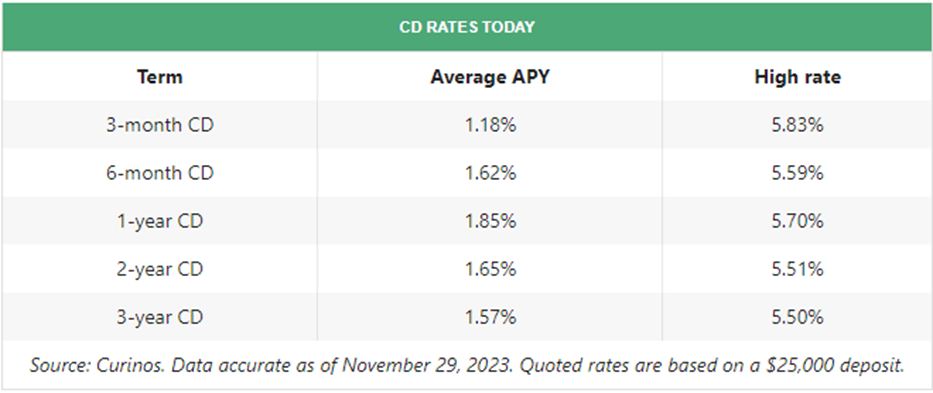
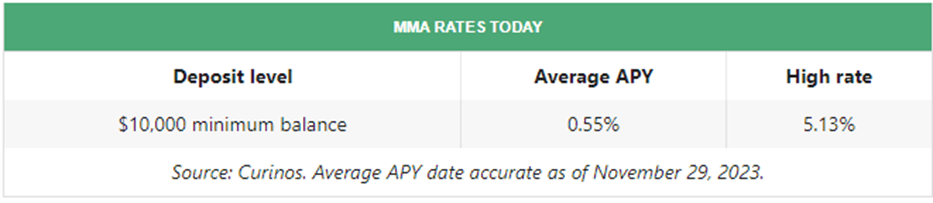
Now, take a look at the top rates for CDs and money market accounts (MMA):
The best 1-year CD interest rate is currently at 5.70%. The best 5-year CD rate right now is right around 5.65%. These rates are still inverted, but are close to even now, which means that they are continuing to normalize. We are getting closer to the point where buying longer-term maturity bonds and CDs will make sense but for now, I would still put my savings or emergency spending money into short-term CDs, 1 year or less, and reevaluate when they mature. If you’d rather have more liquidity, look into an MMA (still yielding over 5% currently). Keep the total under $250,000 per person at any one bank to ensure you are fully covered by the FDIC. As I mentioned above, CDs and MMAs have become nice alternatives for risk-averse investors and have drawn money away from stocks because of their relatively high rates that carry virtually no risk.
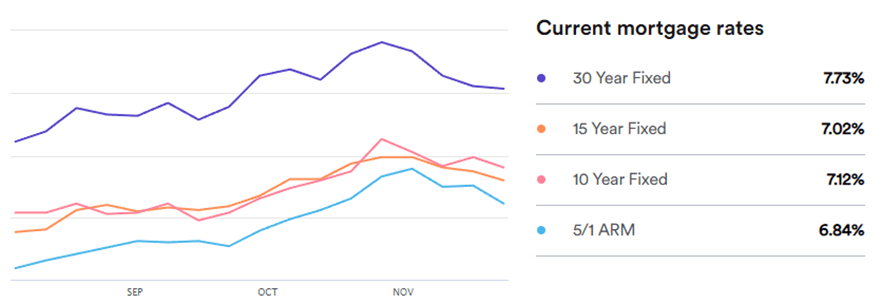
Mortgage rates finally took a breather and headed lower in November. Currently, the 30-year rate sits at 7.73%, much lower than what it was a month ago, at 8.09%. This trend looks like it could continue based on the current yield path of the 10-year treasury bond, which has the biggest influence on mortgage rates.
Even with this drop in mortgage rates, existing home sales are still going to be lower than normal since most homeowners who want to move are sitting tight with their 2-3% mortgage rate loans. For new homes, raw material prices, such as lumber and copper, have come down some so that should help lower pricing on newly built homes. Of course, location plays a big factor in pricing as well.
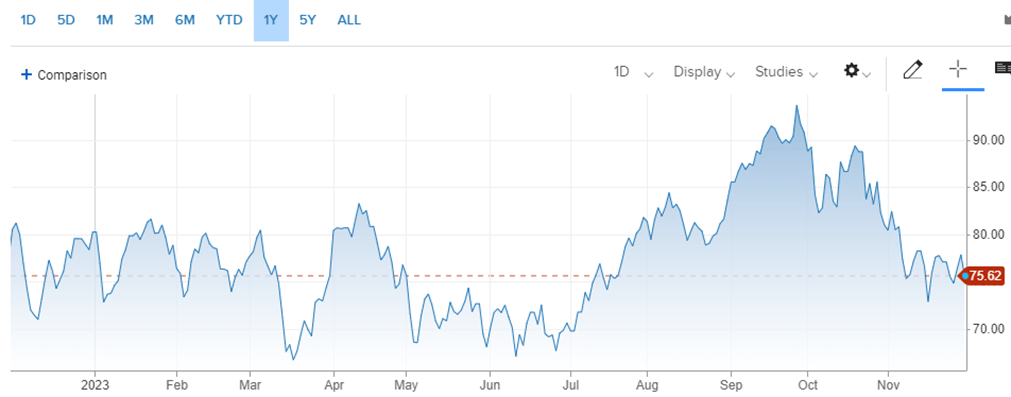
Oilprices declined for the second month in a row in November despite all of the chaos happening in the Middle East. I think the price may have run up too far in anticipation of China’s economy recovering faster than it has and has pulled back some to get more in line with reality. The U.S. doesn’t seem to have let up on fuel usage based on recent travel and shipping data. For the month, the price for a barrel of oil settled around $75.62, down from $81.20 at the beginning of November. Hopefully, we can keep this trend going and get prices down closer to $70.
Here’s a look at the one-year chart for U.S. oil:
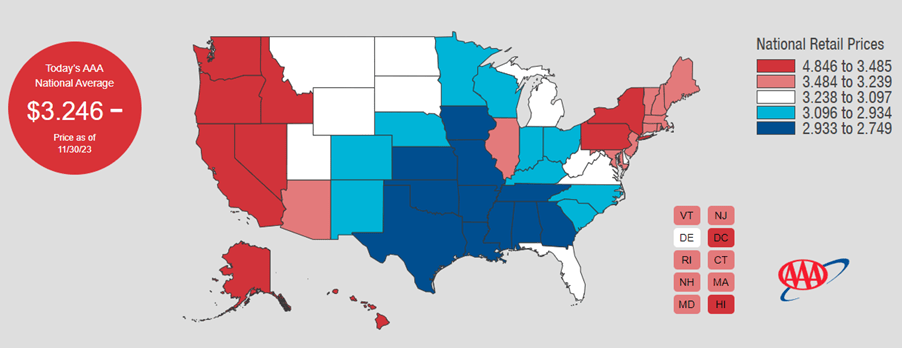
Gasoline prices continued to drop in November, to the delight of travelers during the Thanksgiving holiday. Regular unleaded gasoline is now averaging $3.25 per gallon, down from $3.48 last month. Texas has the cheapest gas currently, checking in at $2.75 a gallon. California has the most expensive gasoline at $4.85 per gallon. FYI, a year ago, we were paying $3.52.
Check out the prices at the pump in your area: AAA Gas Prices.
Outlook
Events on the horizon that could move the markets in the near term:
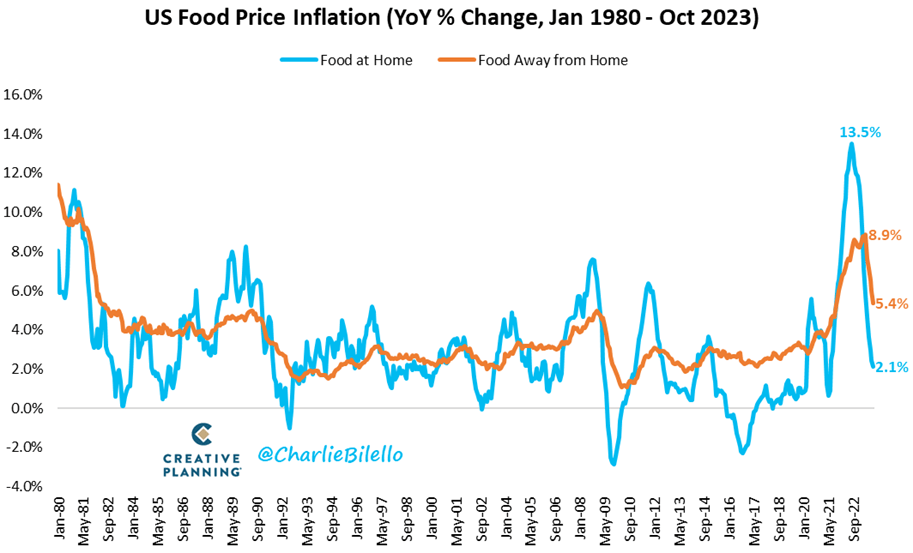
Fed & Inflation: The data coming in on inflation keeps looking better and better. For instance, here’s a chart showing food inflation over the last 43 years. As you can see, inflation for food-at-home prices (groceries) has dropped to 2.1% from a peak last year of 13.5%. Inflation for food-away-from-home prices (restaurants) has dropped quite a bit as well. If these rates stay at least flat, it will go a long way in convincing the Federal Reserve that their work is done fighting inflation, and we shouldn’t see any more interest rate increases in the near future. This is positive for both the stock and bond markets in the near term.
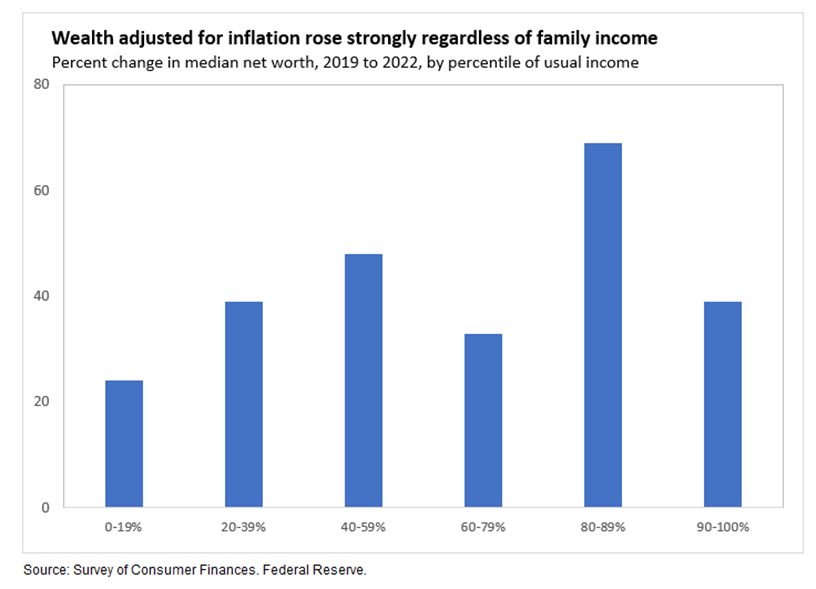
Green Shoots for Most Americans: Some encouraging data have recently come out showing that most Americans are better off financially now than before the pandemic and that’s true across all demographic and income groups. Here are some highlights:
Millions more good jobs.
Bigger paychecks, even after inflation.
Consumer spending is back to a strong pre-Covid trend.
Historic increases in wealth, including at the bottom.
All of this points to positive catalysts for stocks over the next six months and I don’t believe that this good news has been fully priced into the market yet.
Savings Rates Peak: This may be a little farther out than a few months but if savings rates are close to peaking right now and start to come down, there could be a ton of money that will shift from money markets and maturing bonds into stocks. This could easily fund the next leg up for stocks over the next 12-18 months.
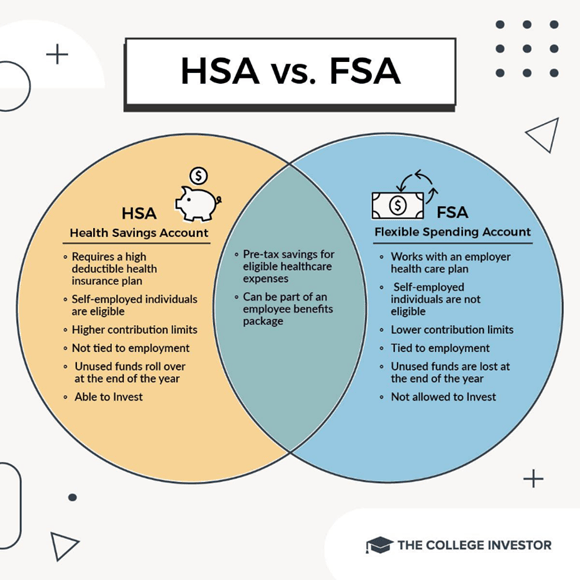
Health Savings Accounts (HSAs) and Flexible Spending Accounts (FSAs) are both tax-advantaged accounts that allow you to save money for eligible medical expenses. However, there are some key differences between the two accounts that you should be aware of before deciding which one is right for you. Here is a quick summary of those differences followed by details on both types of accounts:
HSA
FSA
Eligibility
Requires a high-deductible health plan (HDHP)
No restrictions on health plan
Contributions
Pre-tax or after-tax contributions from you and/or your employer
Pre-tax contributions from you
Contribution limits
Higher contribution limits
Lower contribution limits
Account rollover
Funds roll over year to year
Funds may or may not roll over year to year
Investment options
Many HSAs offer investment options
No investment options
Distribution rules
Funds can be used for eligible medical expenses at any time, tax-free
Funds must be used for eligible medical expenses within the plan year, or they may be forfeited
Non-medical withdrawals
Non-medical withdrawals are subject to income tax and a 10% penalty if you are under age 65
Non-medical withdrawals are subject to income tax, but there is no penalty
Tax Benefits
Both HSAs and FSAs offer tax benefits. Contributions to both accounts are made with pre-tax dollars, which means that they reduce your taxable income. This can save you a significant amount of money, especially if you are in a high tax bracket.
Contribution Limits
The annual contribution limits for HSAs and FSAs are set by the IRS. For 2023, the HSA contribution limit is $3,850 for individuals and $7,750 for families. The FSA contribution limit is $2,750 for individuals and $5,500 for families.
For 2024, the HSA contribution limits are $4,150 for individuals, $8,300 for families. For an FSA, they are $3,200 for individuals, $6,400 for families.
It is important to note that these are just the standard contribution limits. There are also catch-up contribution limits for individuals who are 55 or older. These catch-up contribution limits are $1,000 for both HSAs and FSAs.
Here are some additional things to keep in mind about HSA and FSA contribution limits:
The contribution limits are per plan, not per employer. This means that if you have multiple health insurance plans, you can contribute the maximum amount to each plan.
You can only contribute to an HSA if you are enrolled in a high-deductible health plan (HDHP). An HDHP is a health plan that has a high deductible but low monthly premiums.
You can only contribute to an FSA if your employer offers one. FSAs are typically offered by employers, but they are not required to offer them.
Account Rollover
One of the key benefits of HSAs is that funds roll over year to year. This means that you can save up money in your HSA over time and use it to pay for eligible medical expenses in the future. FSAs, on the other hand, typically have a “use it or lose it” rule, which means that you must use all of the funds in your account by the end of the plan year or they will be forfeited.
Investment Options
Many HSAs offer investment options, which means that you can earn interest or dividends on your money. This can help your HSA grow even faster. FSAs do not offer investment options.
Distribution Rules
HSAs and FSAs have different distribution rules. Funds in an HSA can be used for eligible medical expenses at any time, tax-free. Funds in an FSA must be used for eligible medical expenses within the plan year, or they may be forfeited.
Non-Medical Withdrawals
Non-medical withdrawals from an HSA are subject to income tax and a 10% penalty if you are under age 65. Non-medical withdrawals from an FSA are subject to income tax, but there is no penalty.
Which Account is Right for You?
The best account for you will depend on your individual circumstances. If you are healthy and have low medical expenses, an HSA may be a good option for you. You can save money in your HSA over time and use it to pay for eligible medical expenses in the future. If you have high medical expenses, an FSA may be a better option for you. You can use your FSA to pay for eligible medical expenses right away.
If you are looking to open one of these accounts, you should discuss your options with your tax adviser or financial adviser.
Please comment or send an email if you have any questions.
IRS just came out with the retirement plan contribution limits for 2024. You should take a look at these as you put together your budget for next year.
2024 Maximum Contribution
Traditional and Roth IRAs
IRA
$7,000
IRA Catch‐Up
$1,000
Simplified Employee Pension Plan
SEP
$69,000
SEP Catch-Up
N/A
SIMPLE Plans
SIMPLE Employee
$16,000
SIMPLE Catch‐Up
$3,500
401(k), 403(b), 457, Profit Sharing Plans, etc.
Employee
$23,000
Catch‐up
$7,500
Employee + Employer Contribution Limits
$69,000
Catch-Up allows you to contribute the additional amount, shown above, if you turn age 50 at any time in 2024.
Also, the social security tax that is withheld from your pay, which is 6.2%, is capped at earnings of $168,600 for 2024. This means that once you make this amount in gross earnings, this tax is no longer taken out of your pay for the rest of the year.
Please comment or send an email if you have any questions.