
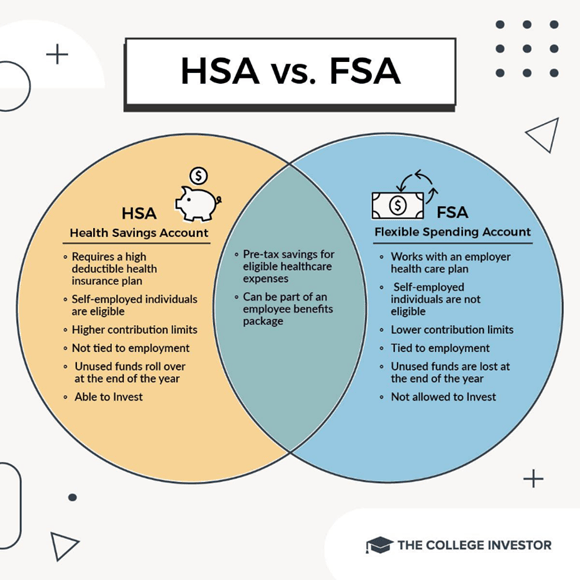
Health Savings Accounts (HSAs) and Flexible Spending Accounts (FSAs) are both tax-advantaged accounts that allow you to save money for eligible medical expenses. However, there are some key differences between the two accounts that you should be aware of before deciding which one is right for you. Here is a quick summary of those differences followed by details on both types of accounts:
| HSA | FSA | |
| Eligibility | Requires a high-deductible health plan (HDHP) | No restrictions on health plan |
| Contributions | Pre-tax or after-tax contributions from you and/or your employer | Pre-tax contributions from you |
| Contribution limits | Higher contribution limits | Lower contribution limits |
| Account rollover | Funds roll over year to year | Funds may or may not roll over year to year |
| Investment options | Many HSAs offer investment options | No investment options |
| Distribution rules | Funds can be used for eligible medical expenses at any time, tax-free | Funds must be used for eligible medical expenses within the plan year, or they may be forfeited |
| Non-medical withdrawals | Non-medical withdrawals are subject to income tax and a 10% penalty if you are under age 65 | Non-medical withdrawals are subject to income tax, but there is no penalty |
Tax Benefits
Both HSAs and FSAs offer tax benefits. Contributions to both accounts are made with pre-tax dollars, which means that they reduce your taxable income. This can save you a significant amount of money, especially if you are in a high tax bracket.
Contribution Limits
The annual contribution limits for HSAs and FSAs are set by the IRS. For 2023, the HSA contribution limit is $3,850 for individuals and $7,750 for families. The FSA contribution limit is $2,750 for individuals and $5,500 for families.
For 2024, the HSA contribution limits are $4,150 for individuals, $8,300 for families. For an FSA, they are $3,200 for individuals, $6,400 for families.
It is important to note that these are just the standard contribution limits. There are also catch-up contribution limits for individuals who are 55 or older. These catch-up contribution limits are $1,000 for both HSAs and FSAs.
Here are some additional things to keep in mind about HSA and FSA contribution limits:
- The contribution limits are per plan, not per employer. This means that if you have multiple health insurance plans, you can contribute the maximum amount to each plan.
- You can only contribute to an HSA if you are enrolled in a high-deductible health plan (HDHP). An HDHP is a health plan that has a high deductible but low monthly premiums.
- You can only contribute to an FSA if your employer offers one. FSAs are typically offered by employers, but they are not required to offer them.
Account Rollover
One of the key benefits of HSAs is that funds roll over year to year. This means that you can save up money in your HSA over time and use it to pay for eligible medical expenses in the future. FSAs, on the other hand, typically have a “use it or lose it” rule, which means that you must use all of the funds in your account by the end of the plan year or they will be forfeited.
Investment Options
Many HSAs offer investment options, which means that you can earn interest or dividends on your money. This can help your HSA grow even faster. FSAs do not offer investment options.
Distribution Rules
HSAs and FSAs have different distribution rules. Funds in an HSA can be used for eligible medical expenses at any time, tax-free. Funds in an FSA must be used for eligible medical expenses within the plan year, or they may be forfeited.
Non-Medical Withdrawals
Non-medical withdrawals from an HSA are subject to income tax and a 10% penalty if you are under age 65. Non-medical withdrawals from an FSA are subject to income tax, but there is no penalty.
Which Account is Right for You?
The best account for you will depend on your individual circumstances. If you are healthy and have low medical expenses, an HSA may be a good option for you. You can save money in your HSA over time and use it to pay for eligible medical expenses in the future. If you have high medical expenses, an FSA may be a better option for you. You can use your FSA to pay for eligible medical expenses right away.
If you are looking to open one of these accounts, you should discuss your options with your tax adviser or financial adviser.
Please comment or send an email if you have any questions.
Joe Baker, CFP®
Baker Asset Management, LLC
joebaker@bakerassetmanagement.com

