

Calendar Notes
- New Year’s Day: Monday, January 1st. The stock market is closed.
- Martin Luther King, Jr. Day: Monday, January 15th. The stock market is closed.
Stocks finished the year with a strong December as data continued to come in showing inflation dropping while the job market remains relatively strong. Recession fears are slowly fading away for now as the Federal Reserve continues to try and orchestrate a soft landing for the economy.
The S&P 500 rose for nine straight weeks to end the year, its best win streak since 2004. For December, the index was up about 4.2%, capping off a surprisingly good year. For 2023, the S&P 500 had a gain of 26.3%.
I think there was some FOMO with investment managers that missed out on this rally earlier in the year that helped the markets finish the year strong. Having said that, stocks sure seem like they are over bought right now. So, I wouldn’t be surprised that there could be some profit taking to start the new year off but if interest rates continue to drop, there should be a lot of money flowing out of bonds and CDs and moving into stocks, which could be the catalyst for the next leg up for stocks.
Take a look at the Outlook section below to see what events could move the markets over the short term.
Bond prices continued to rise in December as investors ramped up their buying with inflation data and the Fed both pointing to lower interest rates in the coming year.
The 10-year US Treasury note yield dropped almost 50 basis points to close out December at 3.87%. The 30-year bond yield fell about 50 bps as well, closing the month at 4.02%. These are huge moves in the bond world and suggest rates have made a definitive shift in direction in the short term. We still have an inverted yield curve, which historically has preceded a recession, but there are some signs that point to a soft landing for the economy, which would be great for everybody and a huge pat on the back for the Federal Reserve.
Bond buyers should continue to focus on bonds with short-term maturities. I would keep maturities under 18 months and just plan on holding these bonds to maturity. That way, you won’t have to worry about selling at a discount if interest rates head higher. If rates continue to drop, you can sell the bonds at a profit since their price will rise as their yield drops.
Savings rates went up again in December but look like they are about to rollover and start dropping, which makes sense since interest rates for treasury bills, notes, and bonds are all moving lower already. Still, current rates for CDs and MMAs are a great place to park your cash and your emergency fund. These rates continue to be a legitimate alternative to stocks and bonds and will keep pressure on those markets until we see this trend reverse, which may be happening sooner than later.
Now, take a look at the top rates for CDs and money market accounts (MMA):
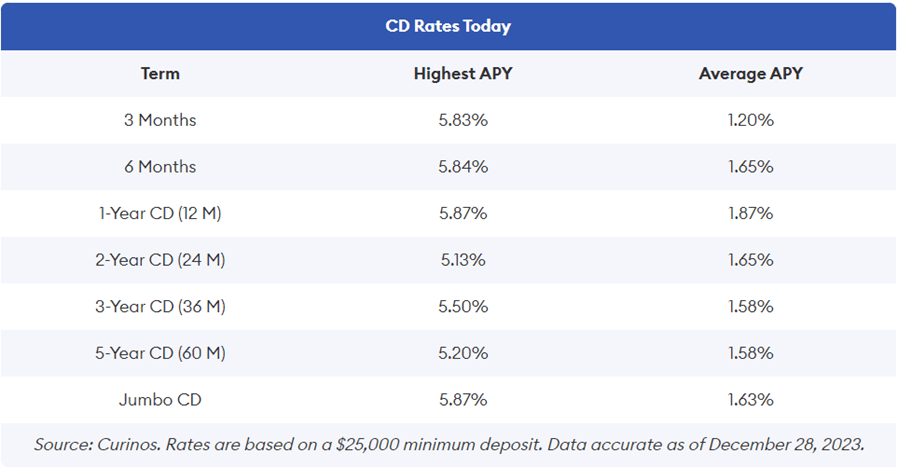
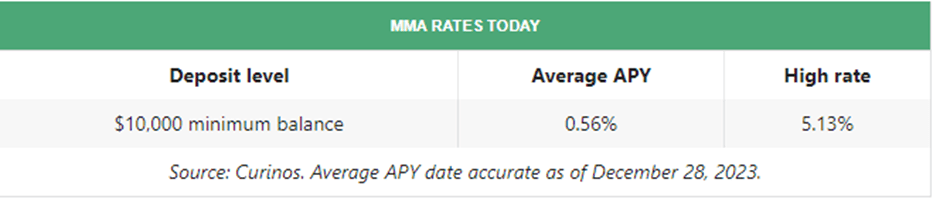
The best 1-year CD interest rate is currently at 5.87%. The best 5-year CD rate right now is right around 5.20%. These rates are still inverted, but are close to even now, which means that they are continuing to normalize. We are getting closer to the point where buying longer-term maturity bonds and CDs will make sense but for now, I would still put my savings or emergency spending money into short-term CDs, 1 year or less, and reevaluate when they mature. If you’d rather have more liquidity, look into an MMA (still yielding over 5% currently). Keep the total under $250,000 per person at any one bank to ensure you are fully covered by the FDIC. As I mentioned above, CDs and MMAs have become nice alternatives for risk-averse investors and have drawn money away from stocks because of their relatively high rates that carry virtually no risk.
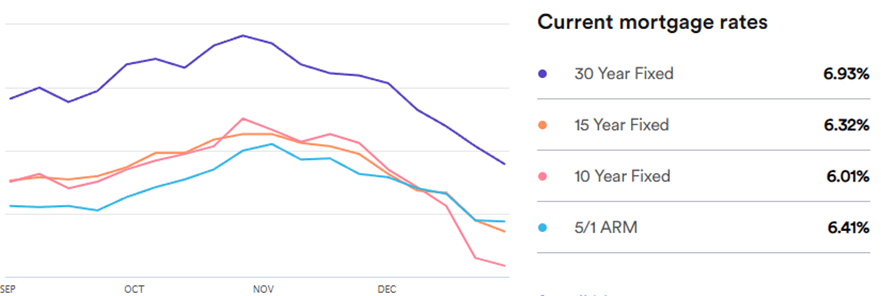
Mortgage rates took a tumble in December as the Fed showed no signs of raising rates again and more hints that they will be cutting rates in 2024. Currently, the 30-year rate sits at 6.93%, much lower than what it was a month ago, at 7.73%. This trend looks like it could continue based on the current yield path of the 10-year treasury bond, which has the biggest influence on mortgage rates.
Mortgage rates have come down quite a bit and we should see that get more buyers into the market as we head into the spring, especially for new home sales. It is still going to be a tough market for existing home sales because potential sellers are going to have a hard time letting go of their 2.5% – 3.5% mortgage, but if they do want to sell, there will probably be multiple bids coming in for them.
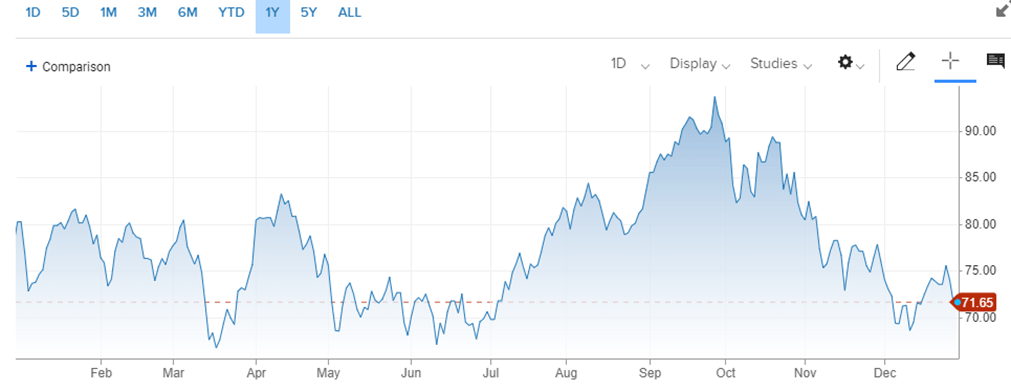
Oil prices declined for the third month in a row in December. Supply has been keeping up with demand, which is surprising given how much we are consuming just here in the states. For the month, the price for a barrel of oil settled around $71.65, down from $75.62 at the beginning of December. Oil prices are going in the right direction and will help profitability for almost all companies if this trend continues.
Here’s a look at the one-year chart for U.S. oil:
Gasoline prices dropped again in December, despite OPEC production cuts and the ongoing middle east turmoil. Regular unleaded gasoline is now averaging $3.12 per gallon, down from $3.25 last month. Mississippi has the cheapest gas currently, checking in at $2.67 a gallon. California has the most expensive gasoline at $4.69 per gallon with Hawaii a close second at $4.68. FYI, a year ago, we were paying $3.18.
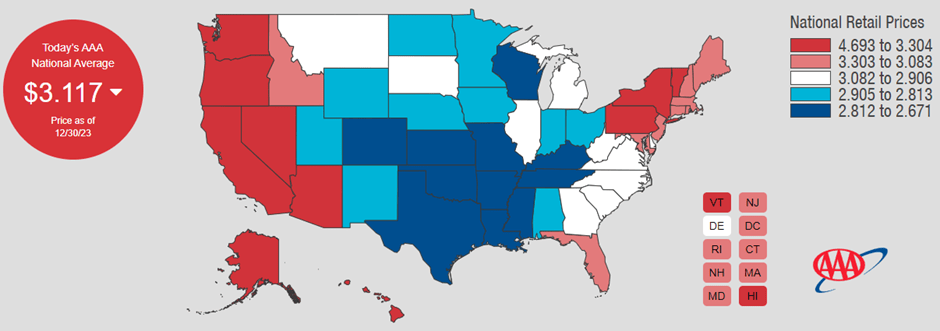
Check out the prices at the pump in your area: AAA Gas Prices.
Outlook
Events on the horizon that could move the markets in the near term:
- Fed & Inflation: After the last Fed meeting in December, pretty much everyone is banking on the Federal Reserve to start cutting interest rates in 2024. We have a pretty nice scenario shaping up for stocks in the new year. Job growth is still on the rise but not at the rates that we saw earlier in the year. Wage growth has fallen since late summer pretty steadily but still positive. Most importantly, according to the Fed, inflation has dropped down to 3.1%, very close to their goal of 2%. Based on the data, it looks like inflation could glide down to 2% without having to raise interest rates further. If this plays out as expected, it will definitely provide some boost for the stock market.
- Savings Rates Peak: This may be a little farther out than a few months but if savings rates are close to peaking right now and start to come down, there could be a ton of money that will shift from money markets and maturing bonds into stocks. This could easily fund another leg up for stocks over the next 12-18 months.
Joe Baker, CFP®
Baker Asset Management, LLC
joebaker@bakerassetmanagement.com

