

Calendar Notes
- February 2nd: Groundhog Day
- February 11th: Superbowl!
- February 13th: Mardi Gras (Fat Tuesday)
- February 14th: Valentine’s Day
- February 19th: Presidents’ Day – The stock market is closed.
- February 29th: Leap Day
Stocks started off the year on the right foot, continuing their climb higher from the big rally at the end of 2023. Much of the gains of the S&P 500 index can be attributed to the sharp rise in the large technology companies, such as, Microsoft, Nvidia, Alphabet, Meta, and Amazon.
For January, the index was up about 1.6%. Historically, this is an encouraging sign for stocks because since the early 1940’s, if the market is up in January, it has continued to rise in the remaining 11 months of the year more than 85% of the time with an average gain of about 11.5 %.
There are some headwinds out there, such as getting more heavily involved in the mid-east turmoil, but if we don’t put more boots on the ground than we already have out there, it shouldn’t be an issue. The biggest catalyst for stocks is still interest rates. If they continue to drop and/or the Federal Reserve starts cutting them, there should be a lot of money flowing out of bonds and CDs and moving into stocks, which could give a nice boost for the markets.
Take a look at the Outlook section below to see what events could move the markets over the short term.
Bond prices were kind of a mixed bag this January. Longer term treasury bonds reversed course and headed lower but short-term treasuries and corporate bonds all headed higher in price. This price action helped the yield curve on its path back to normal, but it still has a ways to go. After yesterday’s meeting, there is more clarity on where interest rates are heading in the near future.
The 10-year US Treasury note yield rose slightly to 3.94%, just above where it closed at the beginning of the month. The 30-year bond yield closed out the month at 4.19%, slightly higher as well from a month ago. After the big yield moves at the end of last year, January was a month for bond investors to catch their breath. We still have an inverted yield curve (for instance, the six-month T-bill is yielding 5.50%), which historically has preceded a recession, but there is more and more data that point to a soft landing for the economy, which would be great for everybody and a huge pat on the back for the Federal Reserve.
Bond buyers should continue to focus on bonds with short-term maturities. I would keep maturities under 18 months and just plan on holding these bonds to maturity. That way, you won’t have to worry about selling at a discount if interest rates head higher. If rates continue to drop, you can sell the bonds at a profit since their price will rise as their yield drops.
Savings rates moved very little in January despite December’s drop in short-term bond yields. Savings rates typically follow, but lag, the direction of bond yields. Regardless, they are still relatively high, especially with respect to inflation. So, CDs and MMAs continue to be a great place to park your cash and your emergency fund. These rates continue to be a legitimate alternative to stocks and bonds and will keep pressure on those markets until we see this trend reverse, which may be starting to happen.
Now, take a look at the top rates for CDs and money market accounts (MMA):
| CD RATES TODAY | ||
| Term | Average APY | High rate |
| 3-month CD | 1.23% | 5.39% |
| 6-month CD | 1.69% | 5.84% |
| 1-year CD | 1.88% | 5.87% |
| 2-year CD | 1.66% | 5.35% |
| 3-year CD | 1.58% | 5.00% |
| Source: Curinos. Data accurate as of January 30, 2024. Quoted rates are based on a $25,000 deposit. | ||
| MMA RATES TODAY | ||
| Deposit level | Average APY | High rate |
| $10,000 minimum balance | 0.57% | 5.13% |
| Source: Curinos. Average APY date accurate as of January 30, 2024. | ||
The best 1-year CD interest rate is currently at 5.87%. The best 5-year CD rate right now is around 5.50%. These rates are still inverted, but are close to even now, which means that they are continuing to normalize. We are getting closer to the point where buying longer-term maturity bonds and CDs will make sense but for now, I would still put my savings or emergency spending money into short-term CDs, 1 year or less, and reevaluate when they mature. If you’d rather have more liquidity, look into an MMA (still yielding over 5% currently). Keep the total under $250,000 per person at any one bank to ensure you are fully covered by the FDIC. As I mentioned above, CDs and MMAs have become nice alternatives for risk-averse investors and have drawn money away from stocks because of their relatively high rates that carry virtually no risk.
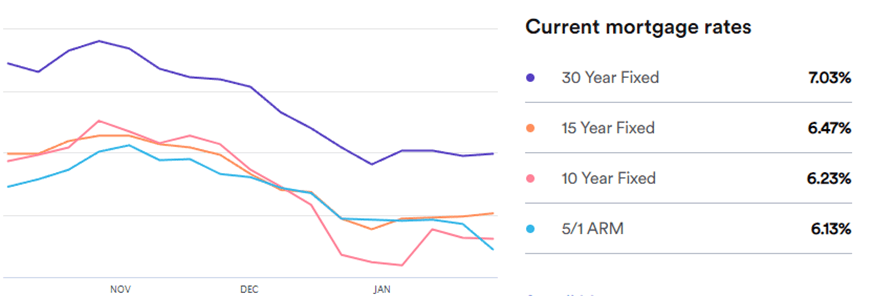
Mortgage rates creeped higher in January, reversing a three month down trend. This was mainly due to higher demand but also the uncertainty of the Fed’s actions over the next several months. Currently, the 30-year rate sits at 7.03%, slightly higher than a month ago, at 6.93%.
Although rates ticked higher in January, the trend since October has been down and that should continue based on the results of the Federal Reserve meeting yesterday. It probably won’t help with existing home sales but should help new home buyers heading into the spring peak buying season.
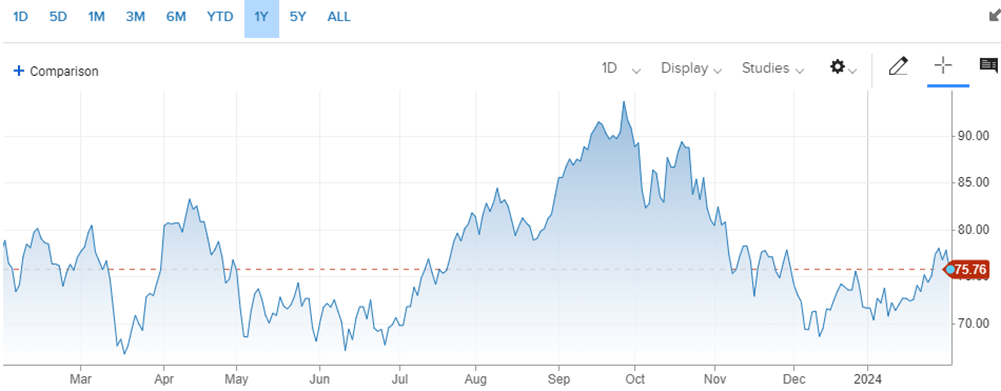
Oil prices stopped their descent in January and headed higher. There still seems to be ample supply out there but the potential of war escalating in the Middle East as well as Saudi Arabia halting plans to increase oil supply has tilted the scales towards higher prices for now.
For the month, the price for a barrel of oil settled around $75.76, up from $71.65 at the beginning of January. The mid-east turmoil is probably going to keep oil prices from falling further, especially if the Saudis keep tightening their spigots.
Here’s a look at the one-year chart for U.S. oil:
Gasoline prices stayed pretty flat in January, even with oil prices rising. I’m not sure how long that will last once we thaw out. Regular unleaded gasoline is now averaging $3.14 per gallon, up from $3.12 last month. Wyoming has the cheapest gas currently, checking in at $2.69 a gallon. Hawaii has the most expensive gasoline at $4.67 per gallon. FYI, a year ago, we were paying $3.51.
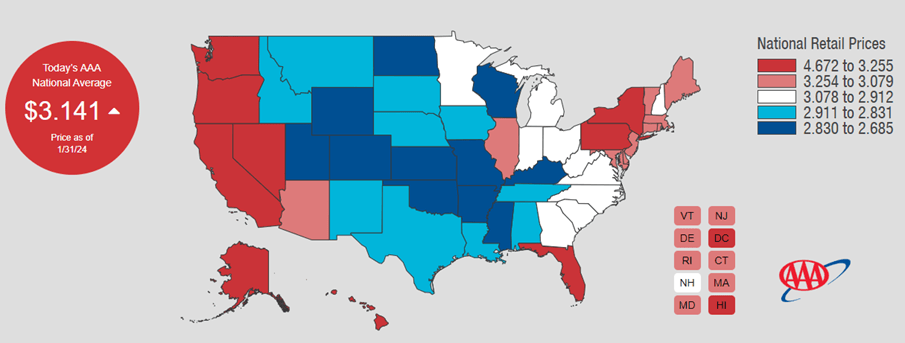
Check out the prices at the pump in your area: AAA Gas Prices.
Outlook
Events on the horizon that could move the markets in the near term:
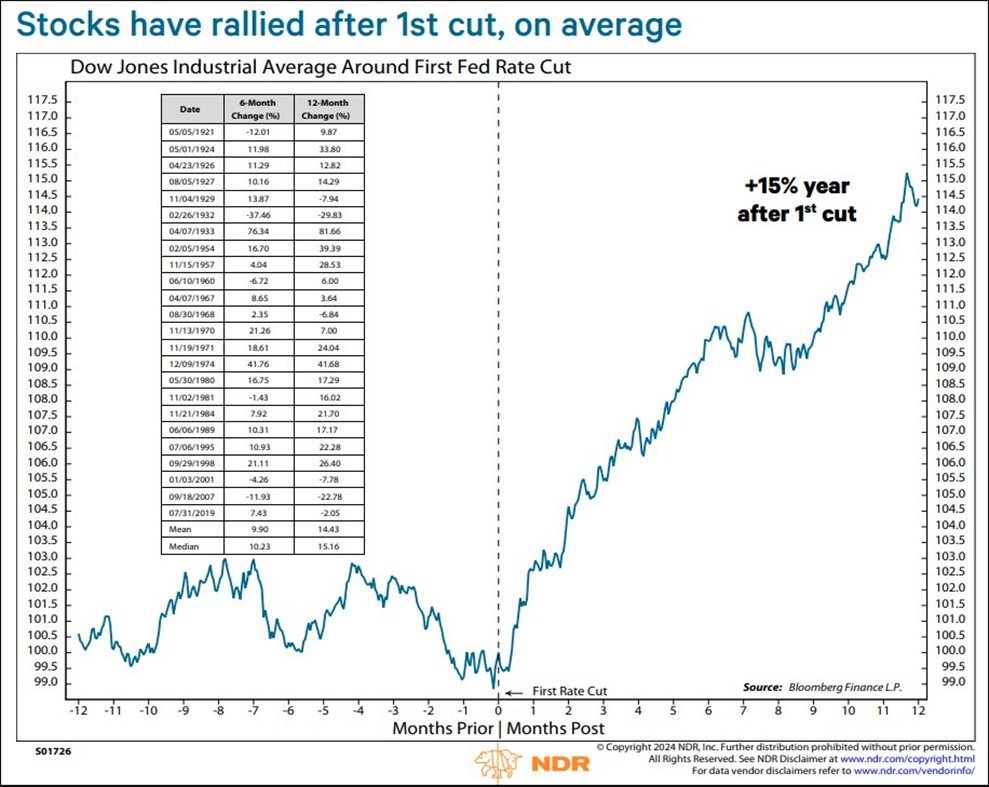
- Fed & Inflation: The Fed concluded their first meeting of 2024 yesterday and decided to keep interest rates where they are for now, which was exactly what everyone expected. The data coming in keeps pointing to lower inflation so if that continues, I expect that they’ll cut rates starting in March.
I thought the following illustration would be helpful in seeing how Fed rate cuts affect the stock market. The chart below shows how the Dow Jones Industrial Average (DJIA) has performed the year before and the year after the Federal Reserve cut rates. Note that when the DJIA has a positive return during the past six months prior to the Fed cutting rates for the first time, the following twelve months have always been positive for stocks with the exception of two times: 1968 and 2019. So, when we see the Federal Reserve cut rates (hopefully at their next meeting in March), we should feel confident that stocks will perform well in the twelve months.
- Savings Rates Peak: This is still in play as savings rates seemed to have stalled and could be heading lower. If the Fed cuts rates in March, we should see money flowing out of money markets and CDs and back into stocks. This could fund another leg up for stocks over the next 12-18 months.
Joe Baker, CFP®
Baker Asset Management, LLC
joebaker@bakerassetmanagement.com

