With a vast array of health and wellness apps available, seniors can significantly improve their quality of life. There are hundreds of apps out there that cater to seniors looking to improve and monitor their health wellness. The “best” app often depends on individual needs and tech comfort level, but here are five that could get you started:
Medication Management & Reminders:
Medisafe: Consistently highly rated by pharmacists and physicians, Medisafe provides visual and auditory reminders, tracks medication intake, warns about dangerous drug interactions, and allows family members or caregivers to monitor adherence. It has a user-friendly interface with clear, large text. https://www.medisafe.com/
Physical Activity & Fitness:
MyFitnessPal: A popular all-in-one app for tracking nutrition and fitness goals. It helps users log meals, count calories, and track activity, and can sync with wearable fitness trackers. https://www.myfitnesspal.com/
Daily Yoga: App offering guided yoga sessions, which are excellent for flexibility, balance, and gentle exercise, tailored for various skill levels. https://www.dailyyoga.com/
Mental Wellness & Cognitive Health:
Headspace: This widely recognized meditation and mindfulness app offers guided meditations, sleep stories, breathing programs, and relaxing music. It is designed to reduce stress, improve focus, and promote better sleep, with a user-friendly interface suitable for beginners. https://www.headspace.com/
Lumosity: This brain-training app offers a variety of games and exercises designed to improve cognitive skills like memory, attention, problem-solving, and mental agility. https://www.lumosity.com/
Tips for Seniors Choosing and Using Apps:
Simplicity is Key: Look for apps with clear, large text, intuitive navigation, and minimal clutter.
Trial Periods: Many paid apps offer free trials, allowing seniors to test them out before committing.
Accessibility Features: Check for features like voice commands, adjustable font sizes, and compatibility with assistive technologies.
Caregiver Involvement: Many apps allow caregivers or family members to monitor and support seniors, which can provide peace of mind.
Start Small: Begin with one or two apps that address the most immediate needs and gradually explore others as comfort with technology grows.
Consult Healthcare Providers: Always discuss any health-related app usage with a doctor to ensure it aligns with a personalized care plan.
By leveraging these helpful apps, seniors can take a more active role in managing their health, staying connected, and maintaining a higher quality of life.
Please comment or send an email if you have any questions.
Thursday, June 19th – Juneteenth National Independence Day, stock market is closed
Stocks ended their losing streak with a strong performance in May, its first positive month since January. This was mainly due to the Trump administration delaying when additional tariffs will go into effect. But I also think that some of the bounce back can be attributed to investors getting a clearer picture of how big a player that AI is going to be in nearly all sectors of the world’s economy.
In May, the S&P 500 gained a whopping 6.2%, the index’s best May since 1990. That was enough to get stocks back into positive territory for the year, about 0.51%.
The biggest headwind for stocks right now is the hap hazard, shoot-from-the-hip tariff policy. As history has shown, there are no winners in a tariff war, even more so in the intertwined global economy that we operate in today. If these levies persist on our companies and our consumers, our economy can easily be thrown into a stagflation scenario of higher prices and higher unemployment. The good news is that getting rid of the tariff insanity would be the stock market’s biggest tailwind and since we created the problem, we can solve it pretty easily and quickly.
Historically, June is one of the weaker months for stocks. Since 1957, the S&P 500 has had an average June return of about 0.06%, making it the second-weakest month of the year. It is normally a pretty boring month for stocks, but we are in the midst of a trade war, so anything could happen!
Take a look at the Outlook section below to see what events could move the markets over the short term.
Bond prices fell again in May as the expectation of higher prices due to tariffs and a rare bond downgrade drove yields higher across the bond market spectrum. The Federal Open Market Committee (FOMC) kept the federal funds rate unchanged when they met in early May, citing the increased uncertainty of their economic outlook, particularly due to tariffs.
The 10-year US Treasury note yield finished higher in May, settling at 4.40%, above the 4.15% that it was at the beginning of the month. The 30-year bond yield closed out the month at 4.92%, about 25 basis points higher than a month ago.
Treasury bond investors got hit with an extremely rare downgrade in May. On May 16, 2025, Moody’s Ratings downgraded the U.S. government’s credit rating from Aaa to Aa1, citing concerns about rising debt and interest payments. This downgrade means the U.S. is no longer at the highest credit rating level, and it’s the first time ever that all three major credit rating agencies (Moody’s, Fitch, and S&P Global Ratings) have downgraded the U.S. credit rating below the top level.
As a federal government bond investor, that downgrade is certainly something to be concerned about, but there is opportunity to capitalize on it. Most importantly, stick to short-term maturities and hold to maturity to minimize risk.
Savings rates increased slightly in May although the national averages are still ridiculously low relative to short-term rates controlled by the Federal Reserve. Money market rates and bank savings accounts are averaging only about 0.62% but many online rates are well above 4%. It certainly pays to do some research here. With rates staying above 4%, I think more money is going to be funneled into the safe havens of money markets and CDs as the stock market continues to show signs of more volatility, despite its strong showing in May. Currently, you can get around 4.0% return on your money if you look hard enough. So, CDs and MMAs continue to be a great place to put your cash and your emergency fund, for now. Knowing this, it makes sense in most situations to put cash that you don’t immediately need into CDs with up to 2-year maturities. For emergency cash, stick to high yielding money market and savings accounts, of which the best are yielding about 4.4%. As always, keep the total under $250,000 per person at any one bank to ensure you are fully covered by the FDIC.
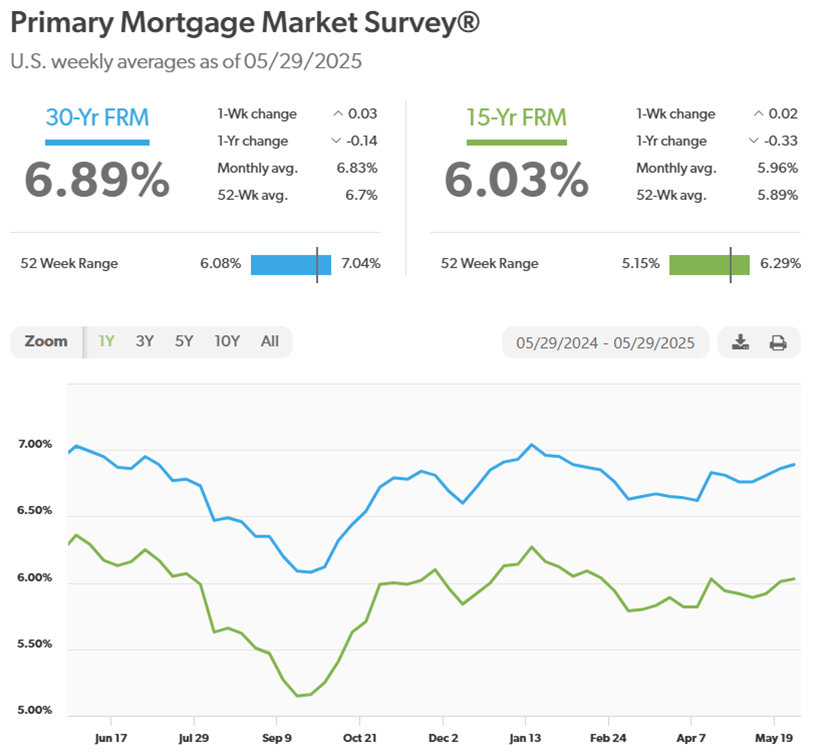
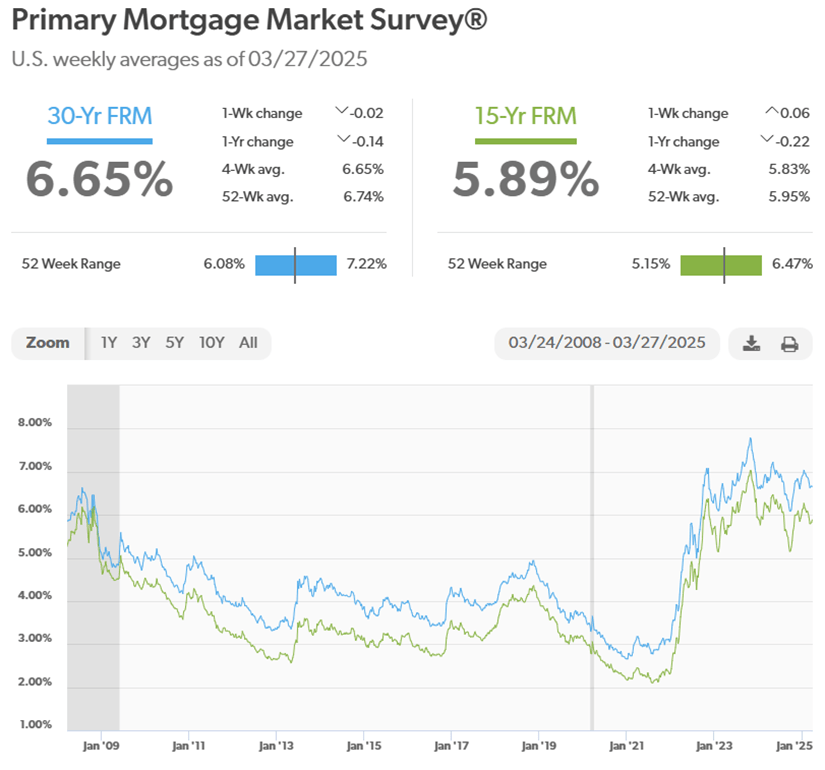
Mortgage rates crept up once again in May, as interest rates on nearly every loan instrument rose this past month. The 30-year rate has been in a pretty narrow band of 6.5% and 7% since October of last year. It is fast approaching that upper band once again. The higher rates, coupled with the economic uncertainty, could turn the housing market into one that favors the buyers, but only for those that can afford it. Home prices are still near record highs, making a home purchase out of reach for many, especially first-timers.
Currently, the 30-year rate sits at 6.89%, higher than a month ago, at 6.81%. The trade and immigration policies look like they are starting to show up in home prices now, but we should know for sure by mid-summer, if they are still in place.
Here is a look at the one-year chart of the 15- and 30-year mortgage rates from Freddie Mac.
Oil prices recovered a little bit in May after the pummeling they took in April. The delay in implementing tariffs and the weakening dollar most likely provided the boost.
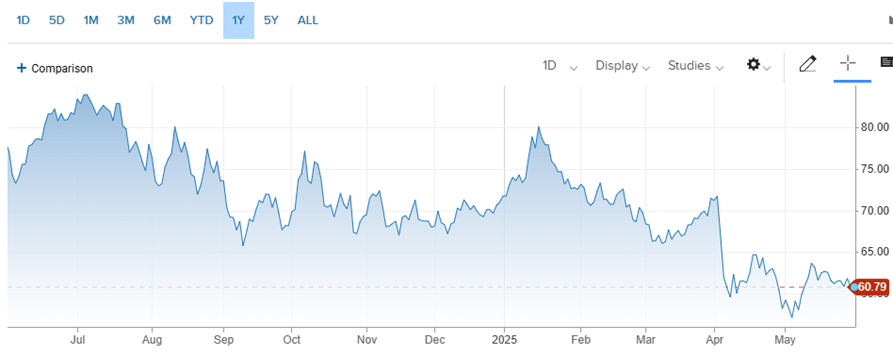
For the month, the price for a barrel of oil closed at $60.79, up from $58.20 at the beginning of May. As I stated last month, if the current oil prices could be sustained for a while, it could help offset some of the price increases that are expected from the tariffs that are being implemented. Overall, there are more catalysts putting downward pressure on prices than upward, for sure. Regardless, having oil prices down around $60 is a good thing for the country as a whole.
Here’s a look at the one-year chart for U.S. oil:
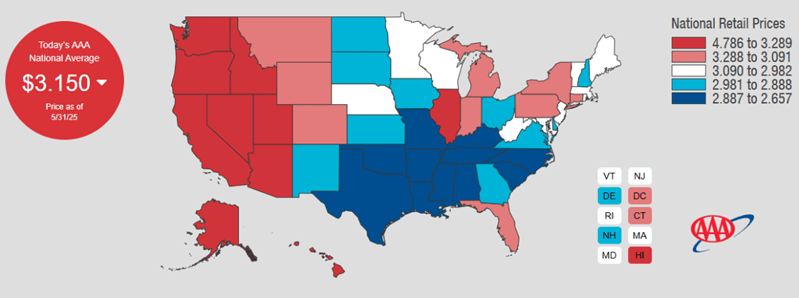
Gasoline prices dropped slightly in May. Regular unleaded gasoline is now averaging $3.15 per gallon, down three cents from last month. Gas prices continue to stay high in 2025 despite oil prices dropping. They usually trend with each other, with gas prices slightly lagging oil prices, so the price action this year is a little unusual. Some of this unusual activity may be due to seasonal factors (warmer weather = more driving) and possibly the 10% tariffs imposed in March, which raised prices on almost everything coming into the U.S. Mississippi has the cheapest gas currently, checking in at $2.66 a gallon. California has the most expensive gasoline at $4.79 per gallon. FYI, a year ago, we were paying $3.56.
Check out the prices at the pump in your area: AAA Gas Prices.
Outlook
Events on the horizon that could move the markets in the near term:
Fed & Inflation: The Federal Reserve is in full wait-and-see mode. I feel like they have no choice since they have to wait and see how the tariff and immigration policies as well as the DOGE actions actually impact the economy. They can’t really speculate since almost all of these policies and actions are being challenged in court and could all go away. If everything clears the courts and goes ahead as planned, we can expect stagflation (rising prices and rising unemployment) followed by a recession. If most gets reversed, we could see lower inflation and unemployment stabilize. Suffice it to say, this will not be the typical quiet summer for investors this year.
DOGE Action: Honestly, it is hard for me to track what has been accomplished by The Department of Government Efficiency. Their website shows an estimated savings of $175 billion. There are also reports showing that DOGE’s actions could cost us $135 billion this year due to lost productivity, legal challenges, and service disruptions. This doesn’t include the costs of defending multiple lawsuits against DOGE’s actions or potential lost tax collections from IRS staff cuts. Also, DOGE actions have been attributed to 280,253 layoffs of federal workers and contractors, impacting 27 agencies. This is the number that I am most concerned about because if most of these people can’t find another job, that’s going to make the unemployment line a lot longer.
Trump Administration Policies: It feels like we are in a bit of a truce with the trade war. The implementation dates for some of the harshest tariffs have been delayed until July, which gives some time for us to make trade deals. However, there are supposed to be tariff letters going out before then to countries with a tariff rate to be determined which may or may not be different from the ones that were set back in early April. This is confusing to large corporations and small businesses alike. However, unlike the big boys, small businesses don’t have the resources to weather this uncertainty for much longer. That is what is most concerning to me, since they are such a large part of our economy. Stock prices of large corporations dropping is one thing, but small business going under en masse is a totally different animal.
For as long as I can remember, one of the standard ingredients in a diversified stock portfolio has always included small-cap stock mutual funds or ETFs. As a refresher, small-cap stocks are shares in publicly traded companies with a market capitalization between $250 million and $2 billion and are considered to have higher growth potential but also higher risk compared to larger companies, such as those in the S&P 500 index.
Some of the risks that differentiate small-cap stocks from their large-cap siblings are:
Lower Liquidity: Small-cap stocks often have lower trading volumes. This means it can be difficult to buy or sell a large number of shares quickly without significantly impacting the stock’s price. In times of market stress, this lack of liquidity can make it challenging to exit a position, potentially exacerbating losses.
Greater Risk of Failure: Many small-cap companies are still in their early growth stages, with unproven business models and limited financial resources. This makes them more susceptible to business failures, competition, and economic shocks. Investors in these companies face a higher risk of losing their entire investment compared to investing in established, larger firms.
Sensitivity to Economic Conditions: Small-cap companies tend to be more sensitive to macroeconomic factors like interest rates, inflation, and recessions. They often have higher debt burdens and shorter debt cycles, making them more vulnerable to rising interest rates, which increase borrowing costs. During economic downturns, small businesses can be hit harder and take longer to recover than larger, more diversified corporations.
Because of these increased risks, most investors like to use small-cap mutual funds or ETFs to meet their diversification goals because it allows them to invest in a basket of small-cap stocks which normally helps reduce some of the risk. Recently, however, this has not been the best strategy and another reason why too much diversification can lead to diworsification when setting up your stock portfolio.
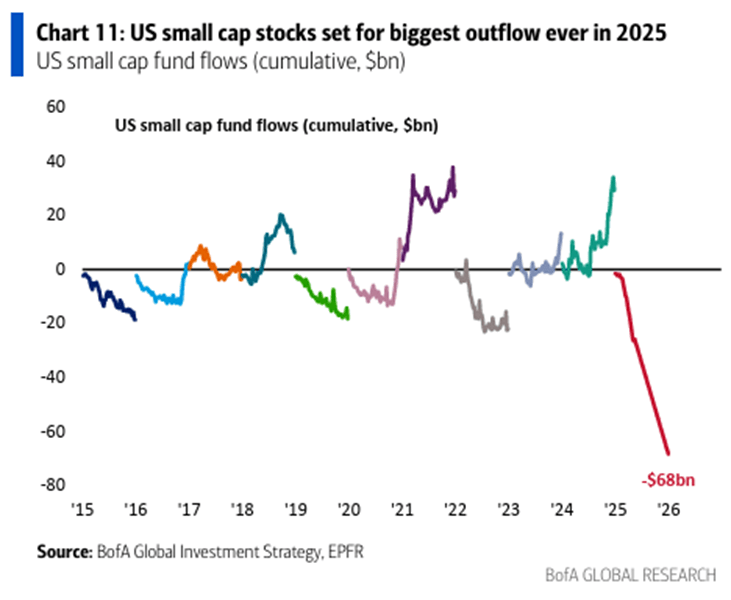
The biggest problem with small-cap funds is that when a small-cap company does well, it either gets bought by a larger company or becomes too big to stay in the small-cap world. Either way, it gets taken out of the small-cap fund, leaving the lower performing companies in it and it looks like investors are starting to realize this:
This illustration shows flow of money into and out of small-cap funds over the last ten years. As you can see, money is moving out big-time this year due to underperformance for the reasons stated above.
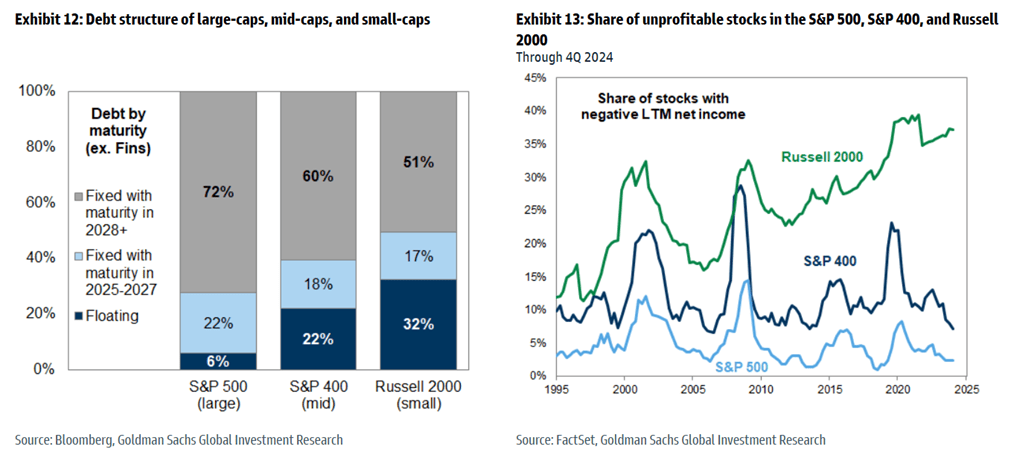
Here’s a few more charts that should scare you away from small-caps:
The chart on the left shows that small companies hold a larger portion of their debt in floating rate loans, which can be a huge risk in a rising interest-rate environment that we are starting to see as the tariffs start to kick in. The graph on the right shows that the number of unprofitable small-cap stocks is increasing while larger companies are becoming more profitable.
While it can pay off investing in small-cap stocks, it just seems like there is too much risk for the reward, especially in the current economic environment.
Please comment or send an email if you have any questions.
Retirement marks a significant financial transition, and with it comes a shift in how federal income taxes are managed. Unlike the years of employment where taxes were typically withheld from each paycheck, retirees often find that their income sources, such as distributions from retirement accounts, investment earnings, and even Social Security benefits, may not have taxes automatically deducted. This necessitates understanding and potentially paying estimated federal taxes, a system designed to ensure that income tax is paid throughout the year rather than in a single lump sum at the time of filing. Navigating these obligations is crucial for retirees to avoid potential penalties and interest imposed by the Internal Revenue Service (IRS) for underpayment.
Many individuals transitioning into retirement may find the concept of estimated taxes unfamiliar, especially if their primary income source for most of their working lives was through wages with automatic withholding. This change in tax responsibility can be a significant adjustment, requiring a proactive approach to tax planning and payment. Furthermore, the diverse nature of retirement income, which can include pensions, annuities, investment portfolios, and Social Security benefits, often makes tax obligations more intricate than during active employment. Each of these income streams has its own set of tax rules and varying degrees of potential withholding, demanding careful management of one’s overall tax situation. By taking a proactive stance in understanding and managing estimated tax obligations, retirees can achieve greater financial security and enjoy their retirement years with the assurance of having met their tax responsibilities, thereby avoiding unexpected tax bills.
How do retirees know if they have to pay estimated taxes?
The fundamental question for retirees is whether they are required to pay estimated federal income taxes. Generally, the rule is that a retiree must pay estimated tax if they anticipate owing at least $1,000 in federal income tax for the year, after accounting for any withholding and refundable credits. Here is a list of the most common forms of income that are not subject to automatic federal income tax withholding:
Taxable distributions from traditional IRAs, 401(k) plans, and other pre-tax retirement accounts may not have sufficient withholding to cover total tax liability.
Interest income, excluding tax-free municipal bonds, generally lacks automatic withholding.
Dividend income, whether ordinary or qualified, typically does not have automatic withholding either.
Capital gains from sales of investments like stocks, bonds, or real estate are usually not subject to withholding at the point of sale.
Rental income often requires estimated tax payments as it is treated as self-employment income for tax purposes.
Self-employed retirees, including freelancers and consultants, should also make estimated tax payments for both income tax and self-employment tax.
Retirees can choose to have federal taxes withheld from Social Security benefits; otherwise, the taxable portion may need estimated tax payments.
How do retirees calculate payments for estimated taxes?
Calculating estimated federal income tax requires retirees to project their expected income, deductions, and credits for the entire current tax year. The primary tool for this process is IRS Form 1040-ES, “Estimated Tax for Individuals”. This form includes worksheets designed to guide taxpayers through the necessary calculations.
Here is a quick summary of the steps to calculate estimated taxes for retirees:
The first step in calculating estimated tax is to estimate total income from all taxable sources anticipated for the year.
Next, estimate any adjustments to income they may be eligible for, such as deductions for contributions to a traditional IRA (if applicable, for instance, for a non-working spouse), health savings account (HSA) contributions, and if self-employed, the deduction for one-half of their self-employment tax.
Following this, retirees need to estimate their deductions, deciding whether to take the standard deduction or to itemize deductions. Seniors who are age 65 or older may be entitled to a higher standard deduction.
Once total deductions are estimated, they are subtracted from the estimated adjusted gross income (AGI) to arrive at the estimated taxable income.
The next step involves calculating the estimated income tax based on the estimated taxable income and the applicable tax brackets for their filing status for the current tax year.
After estimating their total tax liability, retirees should then estimate any tax credits they may be eligible for, such as the Credit for the Elderly or the Disabled , or other credits like the retirement savings contributions credit (Saver’s Credit) if they are still contributing to retirement accounts. These credits directly reduce the amount of tax owed. The total estimated tax is then calculated by subtracting the total estimated tax credits from the total estimated tax liability.
Finally, retirees need to account for any anticipated tax withholding from sources like pensions, annuities, or Social Security benefits throughout the year. If the remaining tax liability, after subtracting withholding, is $1,000 or more, this is the estimated tax payment that will likely need to be made in four quarterly installments.
The worksheets included with the instructions for Form 1040-ES provide a structured framework to assist retirees in performing these calculations. Additionally, the IRS offers an online tool called the Tax Withholding Estimator, which can be particularly helpful for retirees in estimating the tax on their Social Security benefits and pension payments. Given the complexities involved, especially in the initial years of retirement or if a retiree’s financial situation is multifaceted, seeking guidance from a qualified tax advisor is highly recommended.
How do retirees pay their estimated taxes?
Estimated federal income taxes are generally due in four installments throughout the year :
Payment Period
Due Date
January 1–March 31
April 15
April 1–May 31
June 15
June 1–August 31
September 15
September 1–Dec. 31
January 15 of next year
Retirees have several options for paying their estimated federal income taxes to the IRS. One convenient method is IRS Direct Pay, which allows for electronic funds withdrawal directly from a checking or savings account without any fees. Payments can also be made using a debit card, credit card, or digital wallet through third-party payment processors authorized by the IRS, although these processors may charge a small convenience fee. For those who prefer traditional methods, payments can be made by mail by sending the Form 1040-ES payment voucher along with a check or money order payable to the U.S. Treasury to the address specified in the form instructions for their state.
Regardless of the payment method chosen, it is crucial to ensure that payments are made on time to avoid potential penalties for underpayment. Even if a retiree later overpays their taxes, penalties may still be assessed for underpayments made earlier in the year. While the standard payment schedule is quarterly, retirees have the option to pay more frequently, such as monthly or bi-weekly, as long as the total amount due for each quarter is paid by the respective deadline. This can aid in budgeting and managing cash flow throughout the year.
To summarize, understanding how to calculate and pay estimated federal taxes is a critical aspect of financial management for retirees. By determining whether estimated taxes are necessary, accurately calculating the estimated amount, paying on time through the various available methods, and exploring alternatives like adjusting withholding, retirees can fulfill their tax obligations effectively. Also, implementing smart tax planning strategies throughout retirement can potentially reduce their overall tax liability and simplify their tax management. Utilizing the wealth of resources provided by the IRS and considering professional advice when needed will empower retirees to navigate their tax responsibilities successfully and enjoy their retirement with greater financial peace of mind.
Please comment or send an email if you have any questions.
Monday, May 26th – Memorial Day, stock market is closed
Stocks whipsawed this past month in response to the on again, off again tariff policy. The S&P 500 ultimately settled lower for the third consecutive month.
In April, the S&P 500 only lost about 0.70%. Historically, April is the second-best month for the index, averaging 1.32% return over the last 100 years. For the year, it is down 5.3%. Adding fuel to the fire, GDP for the first quarter of 2025 came in negative for the first time since Q1 of 2022 while prices are beginning to increase due to tariffs. This negative growth with rising inflation is indicative of stagflation, which is an environment no economy wants to be in.
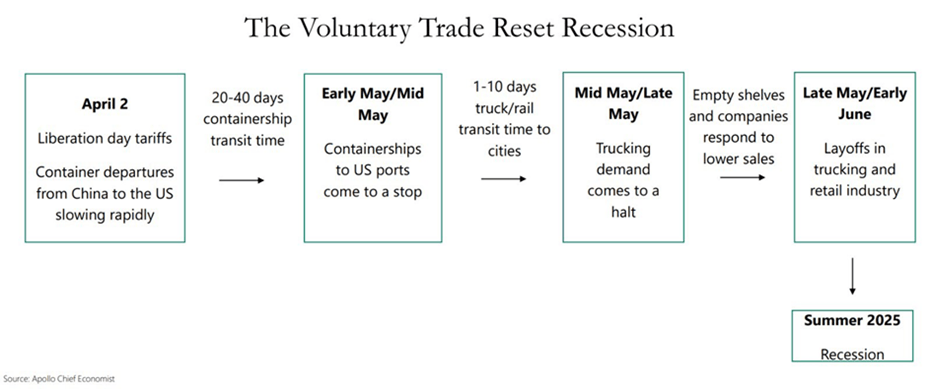
Looking ahead, this first week in May is loaded with companies reporting Q1 numbers but the trade war is by far the biggest issue for stocks. The following timeline is a powerful illustration from Apollo Academy of a potential outcome of the current trade war for the U.S. economy if nothing changes from the current policy:
Let’s hope we can get some trade deals done to avoid this scenario.
Historically, May is one of only three months that has averaged a negative return, -0.06%, since 1928. February and September are the other two. This May could be all over the place with the trade wars in full swing.
Take a look at the Outlook section below to see what events could move the markets over the short term.
Bond prices were mostly lower this past month with the exception of short-term government bonds, which ended the month higher. This is what happened last month as well. Investors are heading to safety and concentrating their buying in the shortest-term government bonds to minimize the interest rate risk of holding bonds with longer maturities. Since it is not clear how the Federal Reserve is going to respond to the effects of tariffs on the economy, there is too much uncertainty and risk to put money into anything long term. As mentioned above, it is possible that we may be entering a period of stagflation, which is when the economy is not growing, unemployment is increasing, and prices are rising. This would be bad for most bonds with the exception of the short-term government bonds held to maturity. Obviously, this is not a good environment to be in, but it is possible with the unique combination of tariffs and government sector layoffs. Hopefully, we can avoid this scenario or at least minimize our time in it.
The 10-year US Treasury note yield finished lower in April, settling at about 4.15%, below the 4.22% that it was at the beginning of the month. The 30-year bond yield closed out the month at 4.67%, about 16 basis points higher than a month ago.
Bond investors have done well so far this year but will have to stay vigilant, especially with signs of stagflation in the hard economic data coming out. Staying in short-term government bonds and holding to maturity will certainly help.
Savings rates have been steady although the national averages are still ridiculously low relative to short-term rates controlled by the Federal Reserve. Money market rates and bank savings accounts are averaging only about 0.41% but many online rates are well above 4% and some offering 5%. The Fed is no longer on track to cut rates this year. They will probably hold rates steady at their next meeting in a week, but it will be very interesting to hear what they say now that some hard data has backed up the soft data regarding unemployment, tariffs, and inflation. Regardless, rates are still attractive, and I think more money is going to be heading back into the safe havens of money markets and CDs as the stock market shows signs of more volatility. Currently, you can get around 4.0% return on your money if you do your research. So, CDs and MMAs continue to be a great place to put your cash and your emergency fund, for now. Knowing this, it makes sense in most situations to put cash that you don’t immediately need into CDs with up to 2-year maturities. For emergency cash, stick to high yielding money market and savings accounts, of which the best are yielding up to 5%. As always, keep the total under $250,000 per person at any one bank to ensure you are fully covered by the FDIC.
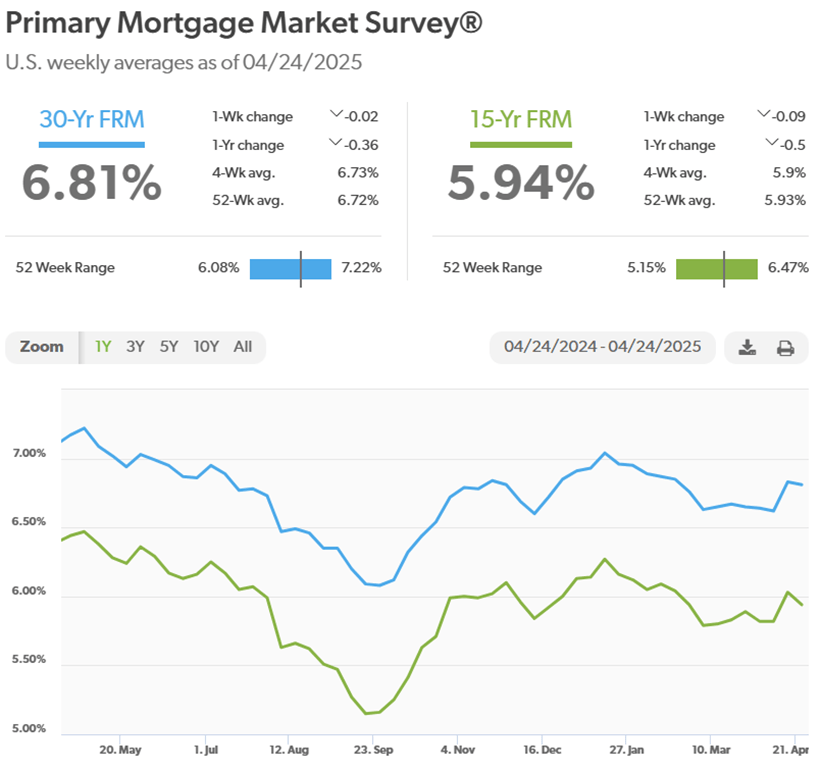
Mortgage rates crept up in April, possibly due to the inflationary effects of the tariffs but will need more data to confirm if this is the cause. Over the past year, rates have been relatively stable, fluctuating between 6.5% and 7.0% (see chart below). Housing inventory has risen, and sales have slowed because I believe there is a lot of economic uncertainty out there giving both buyers and sellers concern. Also, home prices are still near record highs, making a home purchase out of reach for many, especially first-timers.
Currently, the 30-year rate sits at 6.81%, higher than a month ago, at 6.65%. The trade and immigration policies haven’t shown up in home prices or mortgage rates yet but should by mid-summer if they are still in place.
Here is a look at the one-year chart of the 15- and 30-year mortgage rates from Freddie Mac.
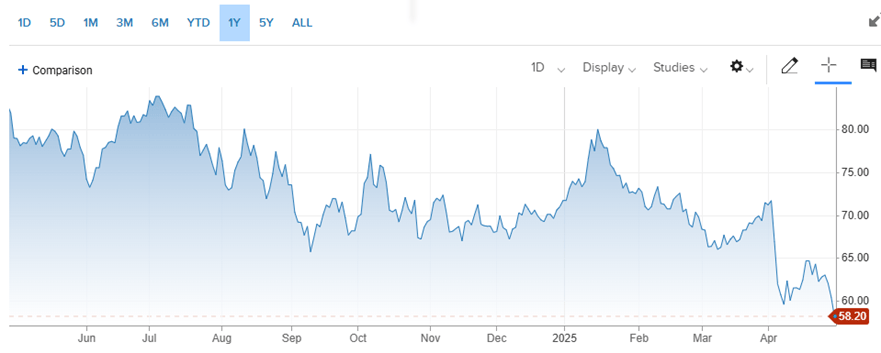
Oil prices took an absolute beating this past April. After starting off the month around $72 per barrel, the price dropped sharply until finding support at $60. It is getting hit with a double whammy of a global economic slowdown due to tariffs and OPEC accelerating supply faster than originally anticipated.
For the month, the price for a barrel of oil closed at $58.20, down from $71.90 at the beginning of April. If the current oil prices could be sustained for a while, it could help offset some of the price increases that are expected from the tariffs that are being implemented. Overall, there are more catalysts putting downward pressure on prices than upward, for sure. Regardless, having oil prices down around $60 is a good thing for the country as a whole. FYI, this was the worst April in history for the energy stocks in the S&P 500.
Here’s a look at the one-year chart for U.S. oil:
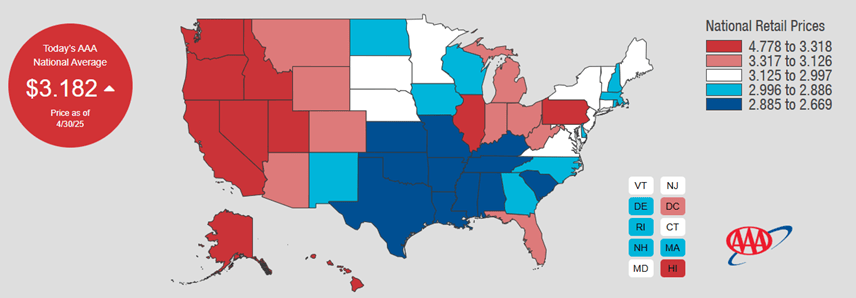
Gasoline prices headed up just a bit in April. Regular unleaded gasoline is now averaging $3.18 per gallon, up only a penny from last month. Gas prices continue to stay high in 2025 despite oil prices dropping. They usually trend with each other, with gas prices slightly lagging oil prices, so the price action this year is a little unusual. Some of this unusual activity may be due to seasonal factors (warmer weather = more driving) and possibly the 10% tariffs imposed in March, which raised prices on almost everything coming into the U.S. Mississippi has the cheapest gas currently, checking in at $2.67 a gallon. California has the most expensive gasoline at $4.78 per gallon. FYI, a year ago, we were paying $3.66.
Check out the prices at the pump in your area: AAA Gas Prices.
Outlook
Events on the horizon that could move the markets in the near term:
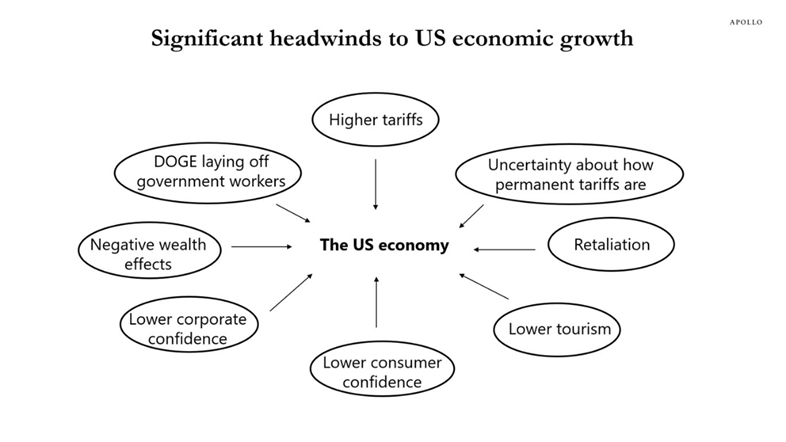
Here is a powerful illustration of the headwinds currently affecting our economy:
On the flip side, a significant tailwind could be the more rapid adoption of artificial intelligence than expected by corporations to optimize their costs. This could help offset some of the tariff costs without having to pass on these levies to the consumer. Unfortunately, a casualty of AI adoption is labor – less workers needed – which takes some of the wind out of this tailwind.
Also, another potential tailwind is that the self-inflicted damage of tariffs can be quickly reversed with the stroke of a pen. But the longer they last, the harder it will be to reverse.
Fed & Inflation: The Federal Reserve is in a pickle. They had the economy heading in the right direction but once the tariffs were thrown into the mix, their job became much tougher. They now have to contend with higher prices as well as slower growth and job losses, aka stagflation. There was no meeting this past month, but there sure was a lot of talk from most of the Federal Open Market Committee members. It looks like they are still in a wait-and-see approach on interest rates with the on again, off again tariff chaos. We are already seeing prices for many imported products (mostly clothing, footwear, tools, kitchenware, etc.) going up. Also, shipments from China have fallen off a cliff (down 44% YOY through April 14th ), which will most likely result in empty store shelves in a few months. The subsequent job losses (port workers, truckers, retail workers, etc.) will be brutal for the employment numbers but could act as an effective interest rate cut, if that’s any consolation (certainly not for the workers who may lose their jobs). This nasty combination of negative economic growth with rising prices is not normal and is a tough environment to navigate for the Fed. Their meeting next week will be must-watch TV for everybody, not just the financial world. Be prepared for more market volatility.
DOGE Action: The Department of Government Efficiency has been out of the headlines recently. Elon Musk has said that he will be stepping back from DOGE to focus on his businesses. Regarding the federal payroll, it looks like there have been about 121,000 government employees fired or laid off Since Trump’s second term began. This doesn’t count those placed on administrative leave or who took voluntary buyouts. It also doesn’t account for government contractor jobs, which some estimate could be anywhere from 1 contractor for 1 government worker all the way up to 3 for 1. Either way, that’s going to be a bunch of people looking for work during the rest of this year and could have a negative impact on the markets.
Trump Administration Policies: Hard data has started to roll in confirming what was expected from the Trump administration’s policies enacted at the beginning of this year. Regarding immigration, illegal border crossings have dropped dramatically, 95% year-over-year. There have also been about 57,000 illegal immigrants deported so far in 2025, as reported by U.S. Immigration and Customs Enforcement . It’s still too early to tell how this could affect our economy, particularly the construction, farming, and leisure/hospitality sectors but it will almost certainly be negative for growth due to how many illegals are typically employed in these industries. Regarding trade policy, “tariffing” everything coming into our country is going to have devastating effects on our economy, especially for small businesses, which I talked about in detail here: Why Small Businesses Will Be Hurt Most by Tariffs. Many of these policies are being challenged in court and also are being delayed or stopped temporarily. The resultant uncertainty is preventing businesses from adjusting to these changes, which may or may not happen, and uncertainty is the stock market’s kryptonite.
In my last post, I talked about how our tariffs could adversely affect the 33+ million small businesses in the U.S. Today, I want to continue that discussion but go into a little more detail with some interesting illustrations that show the contribution that our small businesses have to our economy.
Tariffs have been used throughout history to protect domestic industries. When implemented tactically on certain materials or products within a broader, strategic economic plan, they have had some success. However, when you carpet-bomb everything simultaneously that is imported into our country with tariffs without letting our companies prepare and plan, it results in chaos, as we have seen already.
When our government implements very high tariffs suddenly, they impact many businesses, particularly small businesses, because the tariff must be paid by the business when the imported goods arrive in the US. Small businesses that have relied on a stable US system for decades need to adjust quickly and may not have the working capital to pay tariffs. Ships might remain offshore, orders could be canceled, and many small businesses may face bankruptcy.
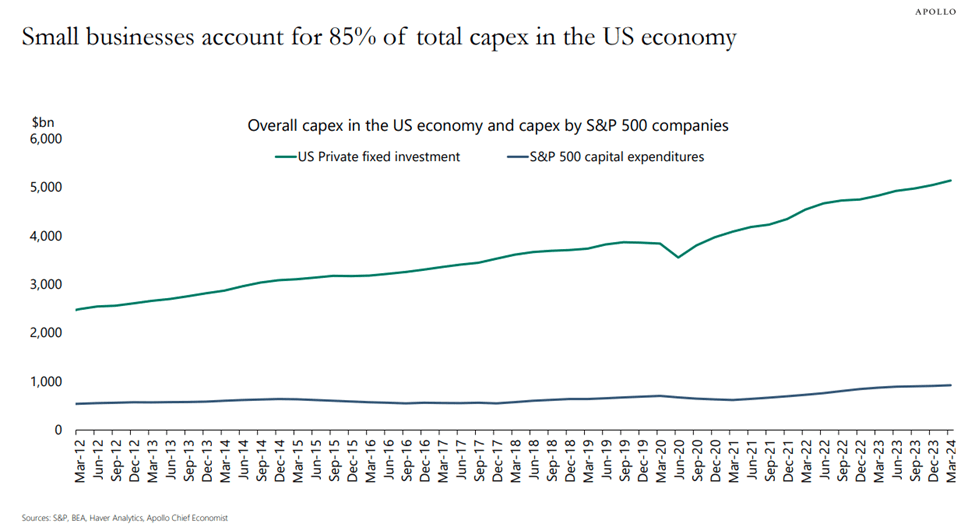
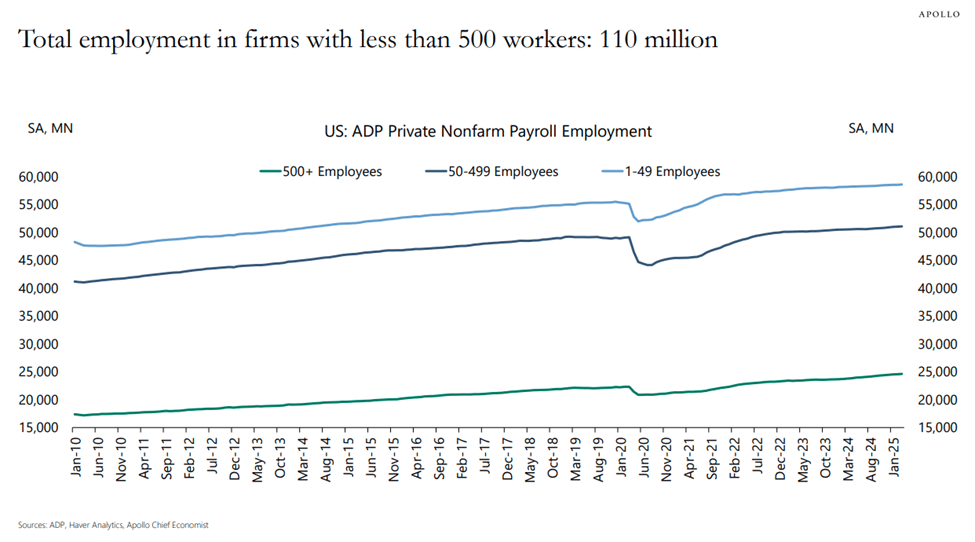
There have been some exceptions for large businesses, but they are the companies that need them the least. These massive corporations have the flexibility and the resources to handle unforeseen expenses. Not giving the same breaks to small businesses does not make any sense. Just look at these charts below to see why:
This shows that 85% of the capital expenditures, basically the money that businesses reinvest into themselves to expand and grow, in the US economy comes from small businesses. These guys should be getting the tariff exemptions.
Here we see that small businesses (less than 500 employees) account for 110 million workers of the labor force, approximately 75% of the total number of workers employed in the country. Damage to this large of a swath of the economy would be devastating.
So now, the challenges for small companies have become a big problem for the US economy. Even if tariffs get knocked down substantially from their current high levels, many small businesses will not be able to absorb the costs and will have to pass the costs onto their customers, reduce their payroll, or worse, shut down.
Let’s hope we abandon the blanket tariff policy and instead develop a long-term plan along with our trading partners that will benefit all parties.
Please comment or send an email if you have any questions.
I thought I’d take a look at how the current trade war could affect the small business community here in the U.S.
First , let’s look at some numbers. There are 33.27 million small businesses in the U.S. with fewer than 500 employees. These businesses employ 61.6 million people, which is 45.9% of the U.S. workforce, and account for 33% of the country’s imports.
For those that don’t know, the tariffs that we have implemented so far this year are levies, or fees, on imported goods to the U.S. that have to be paid by the company that imports them. These tariffs are hitting small businesses particularly hard, since they almost all rely on some quantity of imported materials. Unlike large corporations, small businesses often lack the financial cushion to absorb rising costs, forcing them to either raise prices or take a financial hit. Also, many small retailers and manufacturers are struggling with uncertainty, as tariffs have been fluctuating, making it difficult to plan ahead.
Here’s a detailed breakdown on how the imposition of tariffs can significantly impact small businesses:
Increased Costs of Goods:
Imported Materials and Goods: Many small businesses rely on imported raw materials, components, or finished goods. Tariffs, being taxes on these imports, directly increase their cost. For example, a local furniture maker importing wood or hardware will face higher expenses.
Reduced Profit Margins: Unless small businesses can pass these increased costs entirely to their customers, their profit margins will likely shrink. Small businesses often operate with tighter margins than larger corporations and have less capacity to absorb these additional expenses.
Cash Flow Strain: Higher upfront costs for imported goods can strain the cash flow of small businesses, potentially affecting their ability to manage day-to-day operations and invest in growth.
Price Increases for Customers:
Passing on Costs: To maintain profitability, small businesses may need to increase the prices of their products or services. This can make them less competitive compared to larger businesses that might absorb some of the tariff costs or domestic producers not subject to these import taxes.
Loss of Customers: Price-sensitive customers might opt for cheaper alternatives from competitors, leading to a decrease in sales volume and customer loyalty for the small business.
Supply Chain Disruptions:
Difficulty in Sourcing: Tariffs can disrupt established global supply chains, making it harder for small businesses to obtain the necessary goods or materials. This could lead to production delays, an inability to fulfill orders, and a loss of customer trust.
Finding Alternative Suppliers: While businesses might look for domestic suppliers or suppliers in countries not affected by tariffs, this shift can be time-consuming, costly, and may not always offer the same quality or price. For instance, a small electronics repair shop that relies on specific imported components might struggle to find suitable local alternatives quickly.
Reduced Competitiveness:
Against Larger Businesses: Larger companies often have more leverage to negotiate with suppliers, find alternative sourcing, or absorb tariff costs due to their scale. This can put small businesses at a significant competitive disadvantage.
In Export Markets: When the U.S. imposes tariffs, other countries often retaliate with their own tariffs on U.S. exports, which we have already seen. This can harm small businesses that export their products, making them more expensive for foreign buyers. For example, a local artisan food producer exporting to a country that imposes a retaliatory tariff will see their goods become pricier in that market.
Uncertainty and Investment:
Difficulty in Planning: Fluctuating tariff policies create uncertainty, making it difficult for small businesses to plan for the future, make investments, or forecast their financials accurately.
Hesitation in Growth: The unpredictable economic climate caused by tariffs can make small business owners hesitant to expand their operations, hire new employees, or invest in new equipment.
To summarize, tariffs pose significant challenges for small businesses, primarily through increased costs, potential price hikes, supply chain disruptions, and reduced competitiveness. Finally, as history has taught us, there are no winners in a trade war. Hopefully, we can get that message through to the Trump administration sooner rather than later.
Please comment or send an email if you have any questions. Thanks!
The stock and bond markets have been giving me 2008 vibes recently. The volatility has been almost off the charts as the trade war escalates. The S&P 500 index is back to levels last seen in May of 2024 after making all-time highs this past February.
The good news is that this crash is much different than the one in 2008, the tech wreck of 2000, and even the Covid crash in 2020, and here’s why. Those took time and a lot of pain (bankruptcies, foreclosures, job losses, etc.) to recover from. The main reason that it is different this time is that this crash is self-inflicted, meaning we inserted the catalyst, tariffs, across all imported goods from both friend and foe (and penguins!). The good news is that it is easily fixable and quickly reversible by simply pausing the tariffs and negotiating new trading terms with our trading partners.
Today, we saw that this will actually work when a rumor hit the wires that The White House was considering a 90-day pause on tariffs to allow for negotiations. Stocks immediately spiked and added about $2.5 trillion to the S&P 500 market cap. Of course, once the word got out that this was a rumor, stocks sold off and gave it all back. But it did show that there’s a way to accomplish some of Trump’s objectives without plunging our economy into a recession.
Please comment or send an email if you have any questions. Thanks!
Friday, April 18th – Good Friday, stock market is closed
Sunday, April 20th – Easter Sunday
Stocks accelerated their descent in March as tariff speculation turned into a harsh reality for investors across the world. Piled on top of the trade war this past month was an increasing number of layoffs in the government sector for the U.S. These combination of factors helped the S&P 500 index drop for the second month in a row.
In March, the S&P 500 lost about 5.9%, its biggest monthly decline since December 2022. Historically, the index has averaged +1.1% in March. For the year, it is down 4.55% and is the first negative quarter for the index since Q3 of 2023.
Looking ahead, investors will have to figure out which companies will be least affected by the trade war, higher unemployment, and immigration deportations. With Q1 in the books, the numbers reported won’t be nearly as important as what companies will say about how they will be affected by the Trump administration policies.
Historically, April has been a very volatile month with big swings in both directions. However, the long-term average for the month has been about +0.58%.
Take a look at the Outlook section below to see what events could move the markets over the short term.
Bond prices were mostly lower this past month with the exception of short-term government bonds, which ended the month higher. The higher yielding corporate bonds dropped the most, which makes sense since they are more correlated to stocks than any other bond category. This unusual price action could be that investors are pricing in a stagflation environment. Stagflation is when the economy is not growing, unemployment is increasing, and prices are rising. This would be bad for most bonds with the exception of the short-term government bonds held to maturity. Obviously, this is not a good environment to be in, but it is possible with the unique combination of tariffs and government sector layoffs. Hopefully, we can avoid this scenario.
The 10-year US Treasury note yield finished nearly unchanged in March, settling at about 4.22%, slightly below the 4.25% that it was at the beginning of the month. The 30-year bond yield closed out the month at 4.62%, about 11 basis points higher than a month ago. This is helpful in getting back to a more normal yield curve.
Bond investors have done well so far this year but will have to stay vigilant, especially if stagflation rears its ugly head. Staying in short-term government bonds and holding to maturity will certainly help.
Savings rates have been holding steady although the national averages are still low relative to short-term rates controlled by the Federal Reserve. Money market rates and bank savings accounts are averaging only about 0.5% but many online rates are well above 4%. The Fed is still on track to cut rates this year, but they may have to wait if tariffs reignite inflation. Regardless, rates are still very attractive, and I think more money is going to be heading back into the safe havens of money markets and CDs as the stock market shows signs of more volatility. Currently, you can get around 4.5% return on your money if you do your research. So, CDs and MMAs continue to be a great place to put your cash and your emergency fund, for now. Knowing this, it makes sense in most situations to put cash that you don’t immediately need into CDs with up to 2-year maturities. For emergency cash, stick to high yielding money market and savings accounts, of which the best are yielding around 4.6%. As always, keep the total under $250,000 per person at any one bank to ensure you are fully covered by the FDIC.
Mortgage rates continued lower in March as the uncertainty in the financial markets seeped into the residential real estate sector. As far as national averages go, homes are taking longer to sell, and sellers are dropping prices more quickly. Currently, the 30-year rate sits at 6.65%, lower than a month ago, at 6.76%. We are heading into peak buying season so we could see this trend reverse sooner rather than later. Looking a little farther out, tariffs and the reduced number of migrant workers (both legal and illegal) could raise new home prices significantly later this year and that should put downward pressure on mortgage rates.
Here is a look at the one-year chart of the 15- and 30-year mortgage rates from Freddie Mac.
Oil prices reversed course and headed higher this past month, breaching through the $70 level on the last day of the month. I still don’t see many catalysts that could cause U.S. oil prices to go up much higher besides the trade war. There are more negative catalysts to pressure prices lower than the other way around. Prices may return to their downward trend with the help of an economic slowdown and possible recession here in the states. There is a lot less business travel, both in the government and private sector due to the DOGE layoffs. Consumers are also tightening their belts, which should help move prices lower.
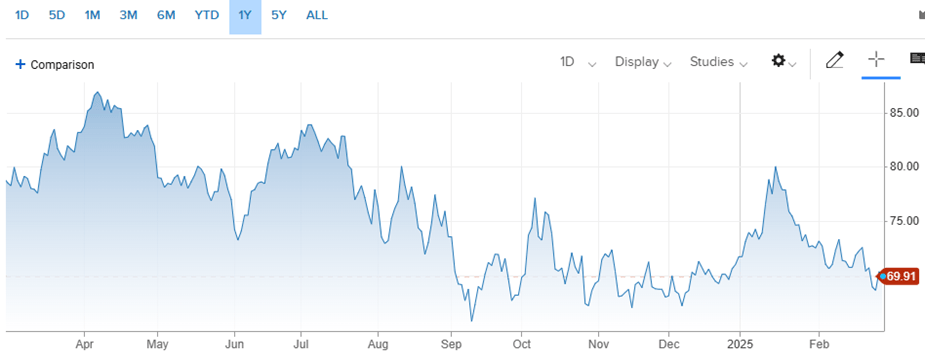
For the month, the price for a barrel of oil closed at $71.90, down from $69.91at the beginning of March. If this drop in oil prices could be sustained for a while, it could help offset some of the price increases that are expected from the tariffs that are being implemented. Regardless, getting oil prices back below $70 would be a good thing for the country as a whole.
Here’s a look at the one-year chart for U.S. oil:
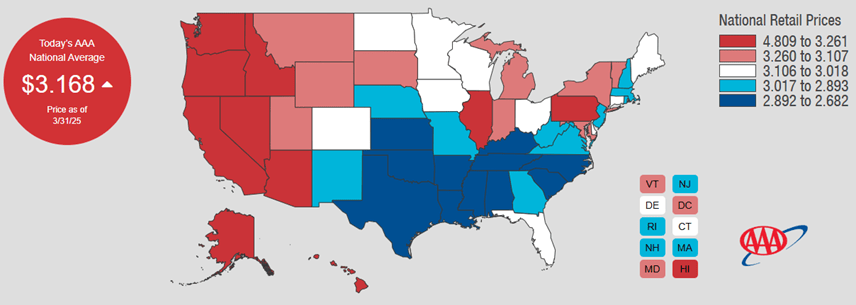
Gasoline prices bumped up just slightly in March. Regular unleaded gasoline is now averaging $3.17 per gallon, up about 6 cents from last month. Gas prices have moved up during the first quarter of 2025 while oil prices have dropped during the same period. They usually trend with each other, with gas prices slightly lagging oil prices, so the price action in Q1 is a little unusual. It may be due to seasonal trends like warmer weather, driving season, etc. and/or the current trade war but definitely something to keep an eye on. Mississippi has the cheapest gas currently, checking in at $2.68 a gallon. California has the most expensive gasoline at $4.81 per gallon. FYI, a year ago, we were paying $3.54.
Check out the prices at the pump in your area: AAA Gas Prices.
Outlook
Events on the horizon that could move the markets in the near term:
Fed & Inflation: Inflation data continues to come in hotter than expected. It’s possible prices have started to go up already to reflect the tariffs being charged to our companies that import products and materials. Although the Federal Reserve did keep short-term interest rates unchanged at their last meeting in March, they are still expecting to cut rates by the end of this year. I think we will probably see inflation jump due to the tariffs and loss of workers in the construction, agriculture and hospitality industries. But that might be offset somewhat by the job losses in the government sector and the private sector contractor jobs tied to government contracts. If the expected job losses are realized and the tariffs stay in place for a sustained period of time, then we will probably see prices drop due to lack of demand. The Fed would most likely step in at this time and cut rates and start quantitative easing (increase money supply). They have a tough job ahead of them due to all of the uncertainty of these competing forces on inflation and the markets do not like uncertainty.
DOGE Action: The Department of Government Efficiency has slashed and burned through most of the government’s biggest budget-consuming departments. Many of their actions are being challenged in court and may not make the final cut but it is nevertheless creating a lot of chaos and uncertainty. If these job cuts do go through, they could help push the economy towards a recession, resulting in a negative catalyst for the markets. It looks like stocks have already begun pricing in a downturn in the economy based on the last two months of returns for the S&P 500 index.
Trump Administration Policies: Tariffs and government layoffs will have economic effects that we can be pretty certain of: higher consumer prices (inflation) and/or lower corporate earnings for businesses, and higher unemployment. But the one policy change that I am uncertain about is immigration. On the surface, it looks like it will be inflationary because workers are being removed from the labor pool for many industries – construction, agriculture, and hospitality and leisure. This will reduce supply and if demand stays the same, cause prices to increase. But, if we can get workers to replace the ones deported, it could keep prices stable if wages stay relatively the same. That’s a big “if” right there. Regardless, uncertainty is still in the air and that doesn’t bode well for both stocks and bonds in the near term.
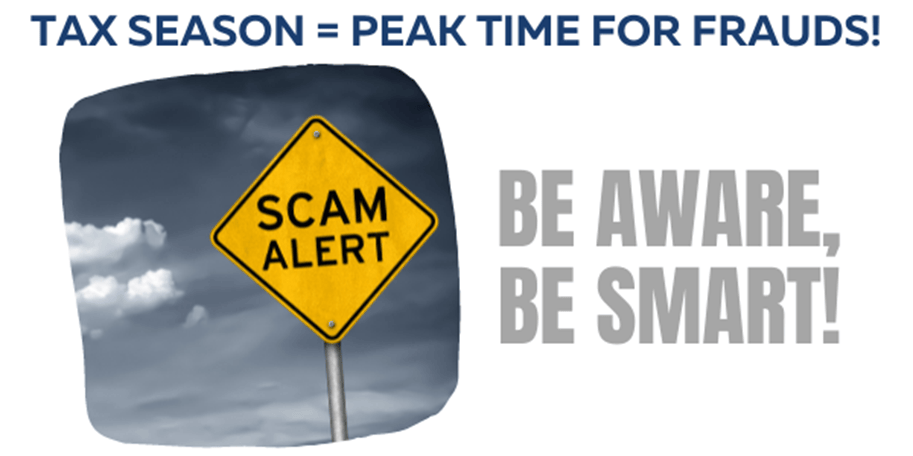
Tax time is one of the most active times of year for fraud scams—in addition to the high volume of tax-related transactions, they also leverage taxpayers’ fear of the IRS to pressure investors for money and information, pretending they work for the tax authorities. Even the most diligent and well-informed tax professionals can fall victim to these scams.
For those reasons, remaining calm, alert, and aware of common tax season scams is vital. Please review the facts below to help educate yourself about these threats.
Be sure you know these facts about the IRS:
The IRS contacts taxpayers by mail first; it does not initiate contact via unexpected phone call, voicemail, text, email, or social media.
The IRS does not request personal or financial information.
You can look up the names of official notices and letters on the IRS website.
The IRS cannot revoke driver’s licenses, business licenses, or immigration status.
The IRS cannot threaten to immediately bring in local law enforcement.
Avoid any mailing or online offers to help set up a taxpayer’s IRS Online account, as well as transacting with fake charities, sites or groups offering misleading tax information or bogus tax forms and any tax preparers promising huge tax refunds, or especially those who will not provide their IRS PTIN. Carefully review misleading offers of fuel tax credit, Form 8944, compromise ‘mills’, or Employee Retention Credit (ERC), as these programs are intended for limited groups and specific criteria must be met.
AI scams are on the rise—be on the lookout this tax season
Artificial Intelligence (AI) is technology that enables machines to mimic certain human-like behaviors. Three types of AI are particularly useful to scammers:
Chatbots: AI-powered bots can engage in realistic, long-term conversations, tricking victims in romance and phishing scams.
Voice Cloning: AI can mimic real voices, making family emergency scams more believable.
Deepfakes: AI-generated videos can impersonate real people, leading to fraud and misinformation.
Here are some AI-powered scams to watch out for:
Phishing attacks— watch this video prepared by Charles Schwab Corporation to learn what to watch out for with these common scams.
Family emergency scams and romance scams—to help you understand and fight these threats, check out this scam brochure.
Best practices for avoiding any scam:
It’s important to always verify the legitimacy of any communication; whether it is visiting a website, email, phone call or mailed letter.
Avoid clicking on links offering you something for nothing, any messages asking for log in credentials, and hang up on calls asking for personal information, charitable donations or offering unsolicited tech support.
If you receive a suspicious call, hang up, don’t send them money, don’t provide personal information.
Hang up on gift card scams. And never use a gift card to pay for any money request, whether it’s for the IRS, Social Security, a family member in trouble or any tech company.
Scammers will insert urgency in the situation – take your time and speak with someone you trust if unsure of the validity of the caller.
Please comment or send an email if you have any questions. Thanks!