

Calendar Notes
- Saturday, April 12th – Passover
- Friday, April 18th – Good Friday, stock market is closed
- Sunday, April 20th – Easter Sunday
Stocks accelerated their descent in March as tariff speculation turned into a harsh reality for investors across the world. Piled on top of the trade war this past month was an increasing number of layoffs in the government sector for the U.S. These combination of factors helped the S&P 500 index drop for the second month in a row.
In March, the S&P 500 lost about 5.9%, its biggest monthly decline since December 2022. Historically, the index has averaged +1.1% in March. For the year, it is down 4.55% and is the first negative quarter for the index since Q3 of 2023.
Looking ahead, investors will have to figure out which companies will be least affected by the trade war, higher unemployment, and immigration deportations. With Q1 in the books, the numbers reported won’t be nearly as important as what companies will say about how they will be affected by the Trump administration policies.
Historically, April has been a very volatile month with big swings in both directions. However, the long-term average for the month has been about +0.58%.
Take a look at the Outlook section below to see what events could move the markets over the short term.
Bond prices were mostly lower this past month with the exception of short-term government bonds, which ended the month higher. The higher yielding corporate bonds dropped the most, which makes sense since they are more correlated to stocks than any other bond category. This unusual price action could be that investors are pricing in a stagflation environment. Stagflation is when the economy is not growing, unemployment is increasing, and prices are rising. This would be bad for most bonds with the exception of the short-term government bonds held to maturity. Obviously, this is not a good environment to be in, but it is possible with the unique combination of tariffs and government sector layoffs. Hopefully, we can avoid this scenario.
The 10-year US Treasury note yield finished nearly unchanged in March, settling at about 4.22%, slightly below the 4.25% that it was at the beginning of the month. The 30-year bond yield closed out the month at 4.62%, about 11 basis points higher than a month ago. This is helpful in getting back to a more normal yield curve.
Bond investors have done well so far this year but will have to stay vigilant, especially if stagflation rears its ugly head. Staying in short-term government bonds and holding to maturity will certainly help.
Savings rates have been holding steady although the national averages are still low relative to short-term rates controlled by the Federal Reserve. Money market rates and bank savings accounts are averaging only about 0.5% but many online rates are well above 4%. The Fed is still on track to cut rates this year, but they may have to wait if tariffs reignite inflation. Regardless, rates are still very attractive, and I think more money is going to be heading back into the safe havens of money markets and CDs as the stock market shows signs of more volatility. Currently, you can get around 4.5% return on your money if you do your research. So, CDs and MMAs continue to be a great place to put your cash and your emergency fund, for now. Knowing this, it makes sense in most situations to put cash that you don’t immediately need into CDs with up to 2-year maturities. For emergency cash, stick to high yielding money market and savings accounts, of which the best are yielding around 4.6%. As always, keep the total under $250,000 per person at any one bank to ensure you are fully covered by the FDIC.
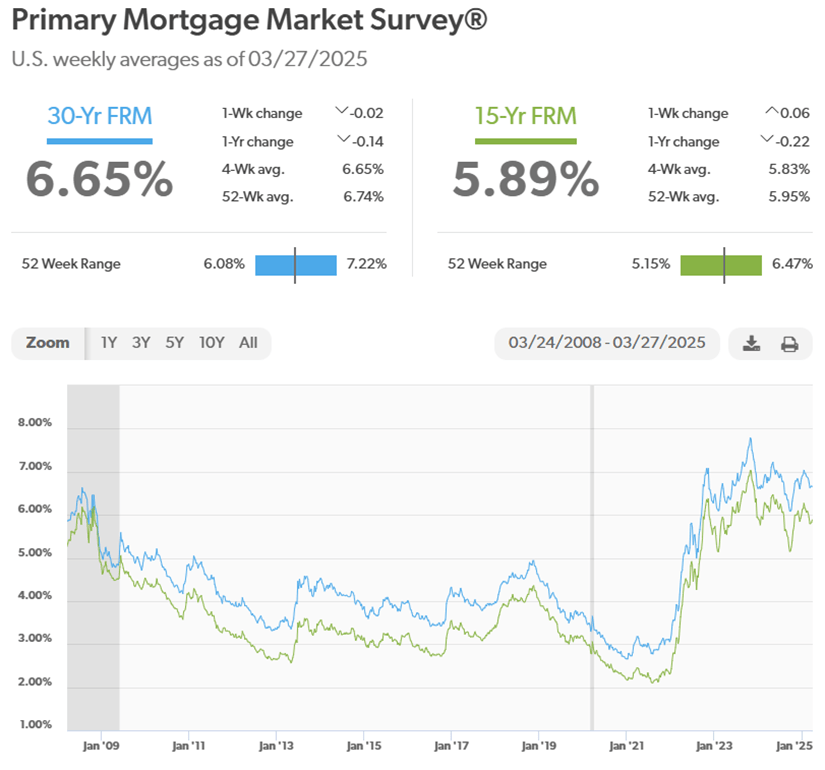
Mortgage rates continued lower in March as the uncertainty in the financial markets seeped into the residential real estate sector. As far as national averages go, homes are taking longer to sell, and sellers are dropping prices more quickly. Currently, the 30-year rate sits at 6.65%, lower than a month ago, at 6.76%. We are heading into peak buying season so we could see this trend reverse sooner rather than later. Looking a little farther out, tariffs and the reduced number of migrant workers (both legal and illegal) could raise new home prices significantly later this year and that should put downward pressure on mortgage rates.
Here is a look at the one-year chart of the 15- and 30-year mortgage rates from Freddie Mac.
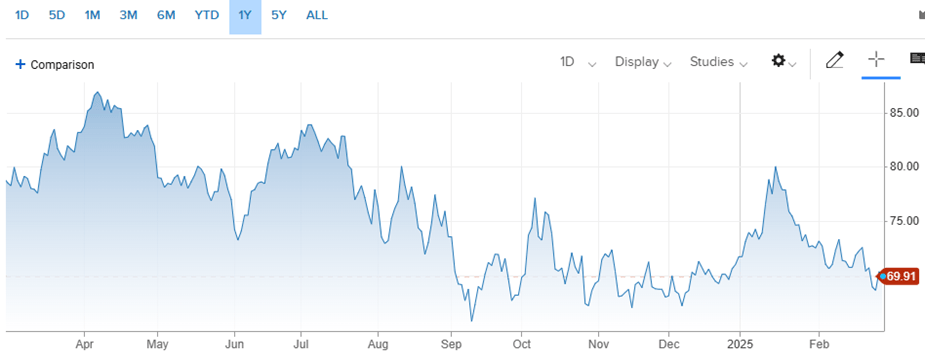
Oil prices reversed course and headed higher this past month, breaching through the $70 level on the last day of the month. I still don’t see many catalysts that could cause U.S. oil prices to go up much higher besides the trade war. There are more negative catalysts to pressure prices lower than the other way around. Prices may return to their downward trend with the help of an economic slowdown and possible recession here in the states. There is a lot less business travel, both in the government and private sector due to the DOGE layoffs. Consumers are also tightening their belts, which should help move prices lower.
For the month, the price for a barrel of oil closed at $71.90, down from $69.91at the beginning of March. If this drop in oil prices could be sustained for a while, it could help offset some of the price increases that are expected from the tariffs that are being implemented. Regardless, getting oil prices back below $70 would be a good thing for the country as a whole.
Here’s a look at the one-year chart for U.S. oil:
Gasoline prices bumped up just slightly in March. Regular unleaded gasoline is now averaging $3.17 per gallon, up about 6 cents from last month. Gas prices have moved up during the first quarter of 2025 while oil prices have dropped during the same period. They usually trend with each other, with gas prices slightly lagging oil prices, so the price action in Q1 is a little unusual. It may be due to seasonal trends like warmer weather, driving season, etc. and/or the current trade war but definitely something to keep an eye on. Mississippi has the cheapest gas currently, checking in at $2.68 a gallon. California has the most expensive gasoline at $4.81 per gallon. FYI, a year ago, we were paying $3.54.
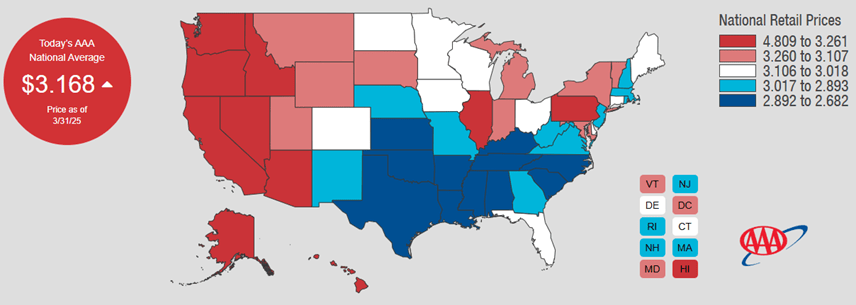
Check out the prices at the pump in your area: AAA Gas Prices.
Outlook
Events on the horizon that could move the markets in the near term:
- Fed & Inflation: Inflation data continues to come in hotter than expected. It’s possible prices have started to go up already to reflect the tariffs being charged to our companies that import products and materials. Although the Federal Reserve did keep short-term interest rates unchanged at their last meeting in March, they are still expecting to cut rates by the end of this year. I think we will probably see inflation jump due to the tariffs and loss of workers in the construction, agriculture and hospitality industries. But that might be offset somewhat by the job losses in the government sector and the private sector contractor jobs tied to government contracts. If the expected job losses are realized and the tariffs stay in place for a sustained period of time, then we will probably see prices drop due to lack of demand. The Fed would most likely step in at this time and cut rates and start quantitative easing (increase money supply). They have a tough job ahead of them due to all of the uncertainty of these competing forces on inflation and the markets do not like uncertainty.
- DOGE Action: The Department of Government Efficiency has slashed and burned through most of the government’s biggest budget-consuming departments. Many of their actions are being challenged in court and may not make the final cut but it is nevertheless creating a lot of chaos and uncertainty. If these job cuts do go through, they could help push the economy towards a recession, resulting in a negative catalyst for the markets. It looks like stocks have already begun pricing in a downturn in the economy based on the last two months of returns for the S&P 500 index.
- Trump Administration Policies: Tariffs and government layoffs will have economic effects that we can be pretty certain of: higher consumer prices (inflation) and/or lower corporate earnings for businesses, and higher unemployment. But the one policy change that I am uncertain about is immigration. On the surface, it looks like it will be inflationary because workers are being removed from the labor pool for many industries – construction, agriculture, and hospitality and leisure. This will reduce supply and if demand stays the same, cause prices to increase. But, if we can get workers to replace the ones deported, it could keep prices stable if wages stay relatively the same. That’s a big “if” right there. Regardless, uncertainty is still in the air and that doesn’t bode well for both stocks and bonds in the near term.
Joe Baker, CFP®
Baker Asset Management, LLC
joebaker@bakerassetmanagement.com

