
Calendar Notes
- Saturday, June 14th – Flag Day
- Sunday, June 15th – Father’s Day
- Thursday, June 19th – Juneteenth National Independence Day, stock market is closed
Stocks ended their losing streak with a strong performance in May, its first positive month since January. This was mainly due to the Trump administration delaying when additional tariffs will go into effect. But I also think that some of the bounce back can be attributed to investors getting a clearer picture of how big a player that AI is going to be in nearly all sectors of the world’s economy.
In May, the S&P 500 gained a whopping 6.2%, the index’s best May since 1990. That was enough to get stocks back into positive territory for the year, about 0.51%.
The biggest headwind for stocks right now is the hap hazard, shoot-from-the-hip tariff policy. As history has shown, there are no winners in a tariff war, even more so in the intertwined global economy that we operate in today. If these levies persist on our companies and our consumers, our economy can easily be thrown into a stagflation scenario of higher prices and higher unemployment. The good news is that getting rid of the tariff insanity would be the stock market’s biggest tailwind and since we created the problem, we can solve it pretty easily and quickly.
Historically, June is one of the weaker months for stocks. Since 1957, the S&P 500 has had an average June return of about 0.06%, making it the second-weakest month of the year. It is normally a pretty boring month for stocks, but we are in the midst of a trade war, so anything could happen!
Take a look at the Outlook section below to see what events could move the markets over the short term.
Bond prices fell again in May as the expectation of higher prices due to tariffs and a rare bond downgrade drove yields higher across the bond market spectrum. The Federal Open Market Committee (FOMC) kept the federal funds rate unchanged when they met in early May, citing the increased uncertainty of their economic outlook, particularly due to tariffs.
The 10-year US Treasury note yield finished higher in May, settling at 4.40%, above the 4.15% that it was at the beginning of the month. The 30-year bond yield closed out the month at 4.92%, about 25 basis points higher than a month ago.
Treasury bond investors got hit with an extremely rare downgrade in May. On May 16, 2025, Moody’s Ratings downgraded the U.S. government’s credit rating from Aaa to Aa1, citing concerns about rising debt and interest payments. This downgrade means the U.S. is no longer at the highest credit rating level, and it’s the first time ever that all three major credit rating agencies (Moody’s, Fitch, and S&P Global Ratings) have downgraded the U.S. credit rating below the top level.
As a federal government bond investor, that downgrade is certainly something to be concerned about, but there is opportunity to capitalize on it. Most importantly, stick to short-term maturities and hold to maturity to minimize risk.
Savings rates increased slightly in May although the national averages are still ridiculously low relative to short-term rates controlled by the Federal Reserve. Money market rates and bank savings accounts are averaging only about 0.62% but many online rates are well above 4%. It certainly pays to do some research here. With rates staying above 4%, I think more money is going to be funneled into the safe havens of money markets and CDs as the stock market continues to show signs of more volatility, despite its strong showing in May. Currently, you can get around 4.0% return on your money if you look hard enough. So, CDs and MMAs continue to be a great place to put your cash and your emergency fund, for now. Knowing this, it makes sense in most situations to put cash that you don’t immediately need into CDs with up to 2-year maturities. For emergency cash, stick to high yielding money market and savings accounts, of which the best are yielding about 4.4%. As always, keep the total under $250,000 per person at any one bank to ensure you are fully covered by the FDIC.
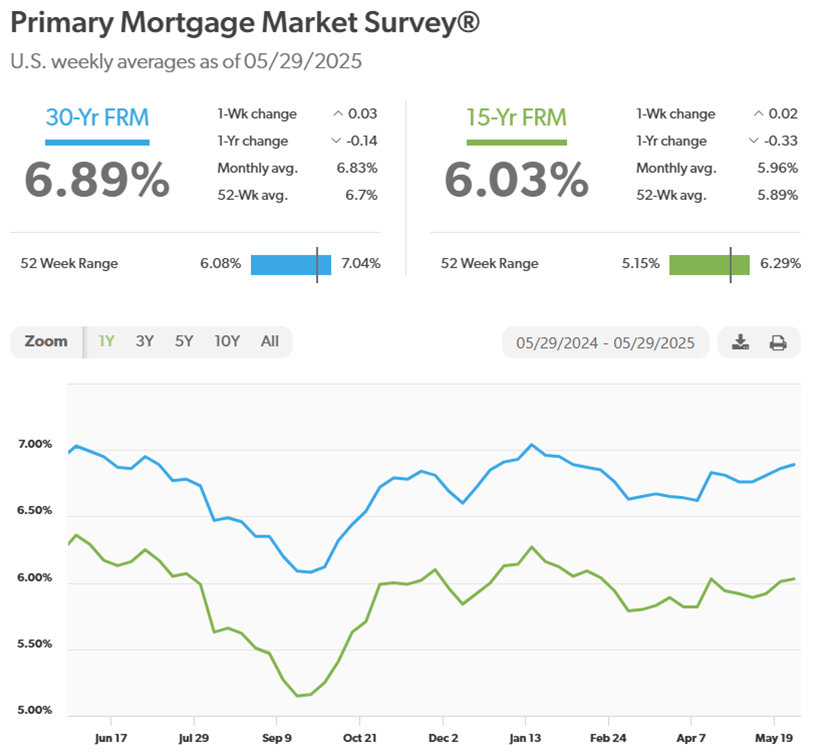
Mortgage rates crept up once again in May, as interest rates on nearly every loan instrument rose this past month. The 30-year rate has been in a pretty narrow band of 6.5% and 7% since October of last year. It is fast approaching that upper band once again. The higher rates, coupled with the economic uncertainty, could turn the housing market into one that favors the buyers, but only for those that can afford it. Home prices are still near record highs, making a home purchase out of reach for many, especially first-timers.
Currently, the 30-year rate sits at 6.89%, higher than a month ago, at 6.81%. The trade and immigration policies look like they are starting to show up in home prices now, but we should know for sure by mid-summer, if they are still in place.
Here is a look at the one-year chart of the 15- and 30-year mortgage rates from Freddie Mac.
Oil prices recovered a little bit in May after the pummeling they took in April. The delay in implementing tariffs and the weakening dollar most likely provided the boost.
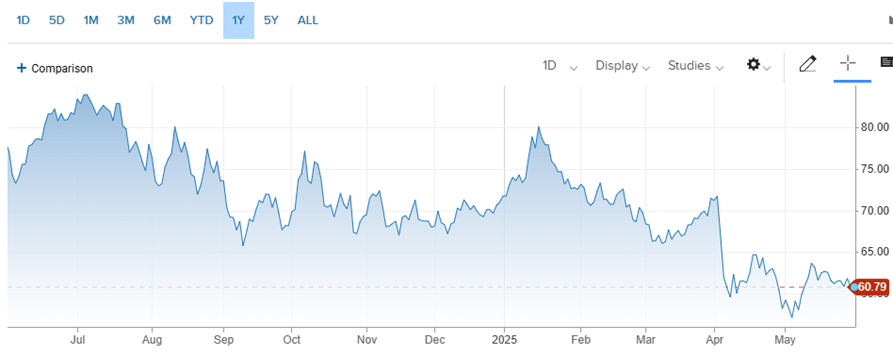
For the month, the price for a barrel of oil closed at $60.79, up from $58.20 at the beginning of May. As I stated last month, if the current oil prices could be sustained for a while, it could help offset some of the price increases that are expected from the tariffs that are being implemented. Overall, there are more catalysts putting downward pressure on prices than upward, for sure. Regardless, having oil prices down around $60 is a good thing for the country as a whole.
Here’s a look at the one-year chart for U.S. oil:
Gasoline prices dropped slightly in May. Regular unleaded gasoline is now averaging $3.15 per gallon, down three cents from last month. Gas prices continue to stay high in 2025 despite oil prices dropping. They usually trend with each other, with gas prices slightly lagging oil prices, so the price action this year is a little unusual. Some of this unusual activity may be due to seasonal factors (warmer weather = more driving) and possibly the 10% tariffs imposed in March, which raised prices on almost everything coming into the U.S. Mississippi has the cheapest gas currently, checking in at $2.66 a gallon. California has the most expensive gasoline at $4.79 per gallon. FYI, a year ago, we were paying $3.56.
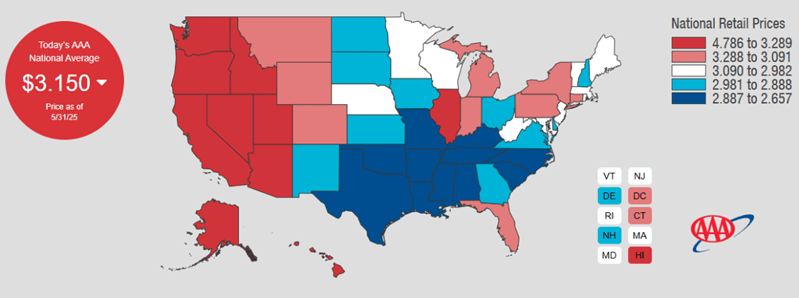
Check out the prices at the pump in your area: AAA Gas Prices.
Outlook
Events on the horizon that could move the markets in the near term:
- Fed & Inflation: The Federal Reserve is in full wait-and-see mode. I feel like they have no choice since they have to wait and see how the tariff and immigration policies as well as the DOGE actions actually impact the economy. They can’t really speculate since almost all of these policies and actions are being challenged in court and could all go away. If everything clears the courts and goes ahead as planned, we can expect stagflation (rising prices and rising unemployment) followed by a recession. If most gets reversed, we could see lower inflation and unemployment stabilize. Suffice it to say, this will not be the typical quiet summer for investors this year.
- DOGE Action: Honestly, it is hard for me to track what has been accomplished by The Department of Government Efficiency. Their website shows an estimated savings of $175 billion. There are also reports showing that DOGE’s actions could cost us $135 billion this year due to lost productivity, legal challenges, and service disruptions. This doesn’t include the costs of defending multiple lawsuits against DOGE’s actions or potential lost tax collections from IRS staff cuts. Also, DOGE actions have been attributed to 280,253 layoffs of federal workers and contractors, impacting 27 agencies. This is the number that I am most concerned about because if most of these people can’t find another job, that’s going to make the unemployment line a lot longer.
- Trump Administration Policies: It feels like we are in a bit of a truce with the trade war. The implementation dates for some of the harshest tariffs have been delayed until July, which gives some time for us to make trade deals. However, there are supposed to be tariff letters going out before then to countries with a tariff rate to be determined which may or may not be different from the ones that were set back in early April. This is confusing to large corporations and small businesses alike. However, unlike the big boys, small businesses don’t have the resources to weather this uncertainty for much longer. That is what is most concerning to me, since they are such a large part of our economy. Stock prices of large corporations dropping is one thing, but small business going under en masse is a totally different animal.
Joe Baker, CFP®
Baker Asset Management, LLC
joebaker@bakerassetmanagement.com

