
For as long as I can remember, one of the standard ingredients in a diversified stock portfolio has always included small-cap stock mutual funds or ETFs. As a refresher, small-cap stocks are shares in publicly traded companies with a market capitalization between $250 million and $2 billion and are considered to have higher growth potential but also higher risk compared to larger companies, such as those in the S&P 500 index.
Some of the risks that differentiate small-cap stocks from their large-cap siblings are:
- Lower Liquidity: Small-cap stocks often have lower trading volumes. This means it can be difficult to buy or sell a large number of shares quickly without significantly impacting the stock’s price. In times of market stress, this lack of liquidity can make it challenging to exit a position, potentially exacerbating losses.
- Greater Risk of Failure: Many small-cap companies are still in their early growth stages, with unproven business models and limited financial resources. This makes them more susceptible to business failures, competition, and economic shocks. Investors in these companies face a higher risk of losing their entire investment compared to investing in established, larger firms.
- Sensitivity to Economic Conditions: Small-cap companies tend to be more sensitive to macroeconomic factors like interest rates, inflation, and recessions. They often have higher debt burdens and shorter debt cycles, making them more vulnerable to rising interest rates, which increase borrowing costs. During economic downturns, small businesses can be hit harder and take longer to recover than larger, more diversified corporations.
Because of these increased risks, most investors like to use small-cap mutual funds or ETFs to meet their diversification goals because it allows them to invest in a basket of small-cap stocks which normally helps reduce some of the risk. Recently, however, this has not been the best strategy and another reason why too much diversification can lead to diworsification when setting up your stock portfolio.
The biggest problem with small-cap funds is that when a small-cap company does well, it either gets bought by a larger company or becomes too big to stay in the small-cap world. Either way, it gets taken out of the small-cap fund, leaving the lower performing companies in it and it looks like investors are starting to realize this:
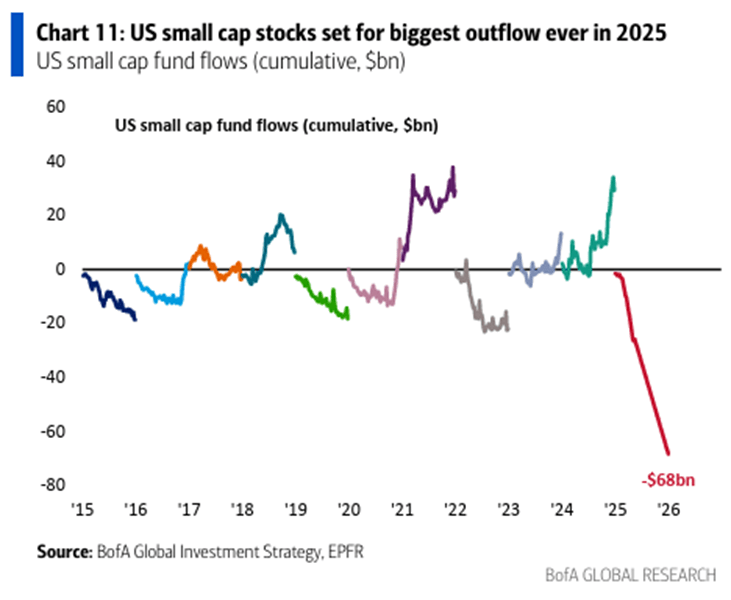
This illustration shows flow of money into and out of small-cap funds over the last ten years. As you can see, money is moving out big-time this year due to underperformance for the reasons stated above.
Here’s a few more charts that should scare you away from small-caps:
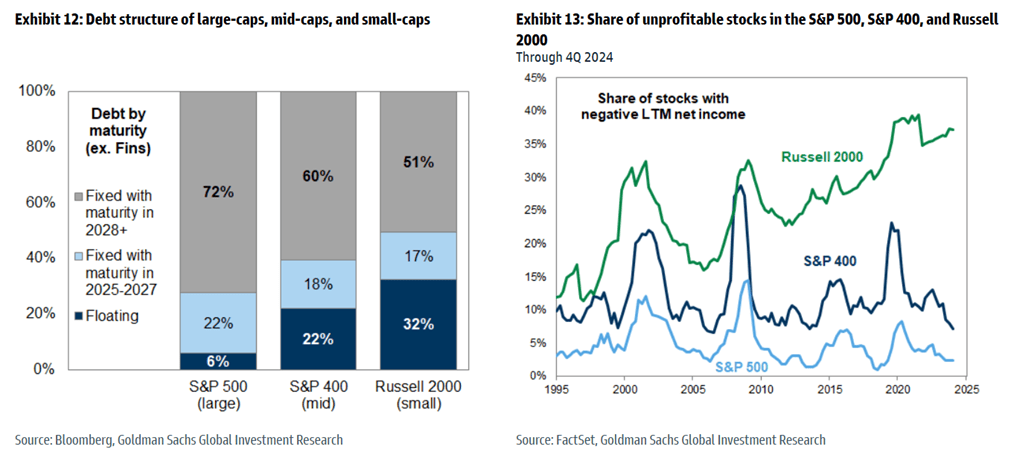
The chart on the left shows that small companies hold a larger portion of their debt in floating rate loans, which can be a huge risk in a rising interest-rate environment that we are starting to see as the tariffs start to kick in. The graph on the right shows that the number of unprofitable small-cap stocks is increasing while larger companies are becoming more profitable.
While it can pay off investing in small-cap stocks, it just seems like there is too much risk for the reward, especially in the current economic environment.
Please comment or send an email if you have any questions.
Joe Baker, CFP®
Baker Asset Management, LLC
joebaker@bakerassetmanagement.com

