
BAM Blog

Your Home Equity Loan Interest Deduction Is Gone. What To Do Now.

write-off-interest-HELOC

The new Tax Reform Law went into effect on January 1st.  The new law makes a number of significant changes to the tax code, including getting rid of the deduction for the interest paid on home equity loans. Here is what you need to know about that change.

First, let’s review what home equity loans are:

These are loans that can be taken out by homeowners using their home equity.  Home equity is the difference between a home’s market value and the remaining balance on the mortgage.  Homeowners have two options: they can take out a home equity loan (HEL), which is a one time loan with a fixed interest rate, or they can take out a home equity line of credit (HELOC), which acts like a credit card with a specific debt limit based on home equity.  The interest rate on a home equity line of credit typically varies with the market.

Here’s how the new tax law is going to affect home equity loans:

Before 2018, homeowners who took out home equity loans were able to deduct the loan’s interest up to $100,000 from their taxes. This deduction is now a thing of the past.

So, what should you do with that HEL or HELOC?

  • You really should consider paying it off, especially if you have money, in excess of your emergency reserve funds, that is not earning a rate of return exceeding the loan’s interest rate.
  • If you still want access to your home equity, you can do a cash out mortgage refinance.  This basically is a mortgage refi but the new loan is for a larger amount.  You’ll receive the difference between the two loans in cash and you can still deduct the interest.

In summary, there are a lot of moving parts when it comes to the tax code so talk to your tax adviser to see if it makes sense to pay down your HEL/HELOC.  
Joe Baker, CFP®
Baker Asset Management, LLC
joebaker@bakerassetmanagement.com

Monthly Update – January 2018

hellojanuary2015

Stocks were quiet going into the end of the year, even with the major tax reform bill getting signed into law.  This was already “baked into the cake” over the past few months and that is why stock prices didn’t see a huge jump.  However, they did finish the month up about 1% (S&P 500).

For the year, the S&P 500 returned about 20%, which I think took most everybody by surprise, considering all of the political tension, both home and abroad in 2017.  The best performing sector in 2017 was technology, returning about 37%.  The worst was energy at about -4%.

2017 Q4 numbers are going to be pretty good for US companies when they report over the next few months.  But the market moving news will be when they talk about how the new tax laws will affect their bottom line going forward.

Bonds were pretty much flat for December.  I think bond investors are feeling that the 40 year bull market in bonds is coming to an end as interest rates start to turn up as our economy improves.

There are a lot of forces in play here affecting interest rates: inflation is still pretty tame and the dollar continues to weaken against foreign currencies.  This is keeping rates extremely low here in the states.  I kind of like this scenario right now as it keeps the Fed from messing with interest rates.

Outside the states, we still have the odd negative interest rates in Germany, France, Japan, and even Italy and it doesn’t look like they will be raising rates anytime soon.  This gives us a little wiggle room when it comes to raising our rates, which is nice.

Speaking of interest rates, the Fed doesn’t meet again until the end of January.  They are expected to stand pat on rates.

For those who weren’t around in the late 70’s/early 80’s and think rates are getting too high, here’s a nice 55 year chart of the interest rate of the US Treasury 10 year note to put it into perspective how low rates are right now: http://www.macrotrends.net/2016/10-year-treasury-bond-rate-yield-chart.

On the savings side, rates are starting to creep up with a little more speed but they’re certainly in no hurry.

Currently, the average money market/savings account is paying 0.20%.

The 1 year CD interest rate is now averaging 1.70% (up from 1.64% last month) and the 5 year CD rate is at 2.20%(up from 2.17% last month).

The good news is that mortgage rates continue to stay extremely low, with the 30 year rate at 4.15%.  Depending on the loan terms, if you have a current mortgage with a loan rate over 5%, you should at least check out refinancing it.

Oil prices rose about 4.7% in December, continuing its upward trend since bottoming in June.  Price per barrel now sits at $60.10.

The current cold snap will probably cause prices, specifically heating oil and natural gas, to increase in the ear term.

Nationally, gasoline prices are averaging about $2.50 per gallon.  FYI, a year ago, we were paying $2.34.  Tucson, AZ has the cheapest gas in the country at $2.13.

Check out the prices at the pump in your area: Gas Buddy.

Outlook

Events on the horizon that could move the markets in the near term:

  • Russian Investigation: This took a break over the holidays but I’m sure it is going to be front and center once again.  It’s hard to keep up with this one.  There are so many moving pieces and distractions.  This could make for a pretty good movie one day.  Still, odds are slim that Mueller will indict President Trump, but it does appear that more of his aides and appointees will be in his crosshairs shortly.  Any market pullback from this should be short lived (less than 6 months) and will provide a buying opportunity for long term investors.
  • Escalating Tensions with North Korea: Kim Jong Nutbar continues to push Trump’s buttons by saying his nuke button is on his desk!  So far, stocks see this as two kids in a name-calling contest but it could escalate quickly considering the tempers on both sides. Hoping they’ll both simmer down.
  • Tax Law Effects: I’m very interested to see what companies will say in their earnings reports regarding how the new tax laws will affect their bottom lines.  Although this good news has been mostly priced in, their could be some surprises that will give stocks another boost in the positive direction.


Joe Baker, CFP®

Baker Asset Management, LLC

joebaker@bakerassetmanagement.com

 

1 Quick Way To Save A Bunch Of Tax Money Before End Of 2017

tax reform

We don’t have much time to take advantage of the current tax code before the new tax bill goes into effect on 01/01/18 so here you go:

Currently, you can deduct the total amount of your state and local taxes (income tax, property tax, etc.) from your federal taxes.  The new tax law will cap this deduction at $10,000 starting next year.

So, prepay your property taxes and your estimated state income taxes prior to the end of this year if you expect the total to be over $10,000 for 2017.

The savings can be significant.  For example, if your total state and local taxes will be $15,000 for 2017 and you pay it all in 2017, you’ll save $1,750 in taxes, assuming a 35% tax bracket.

This strategy will benefit the highest taxed states, California, New York, Connecticut, etc.  Please contact your tax preparer to get an accurate calculation of your potential savings.

Thanks and have a great rest of the holiday season!

Joe Baker, CFP®
Baker Asset Management, LLC
joebaker@bakerassetmanagement.com

Get An X-ray Of Your Investments

bone-xray-hands

The latest stats show that about 45% of American households own a mutual fund or an Exchange-Traded Fund (ETF) as part of their retirement accounts.

I can make a pretty safe bet that 95% of those households have no idea what their 5 biggest stocks are that they hold inside those investments.  But it is something that you should be looking at periodically, especially if you don’t have an adviser monitoring that stuff for you.

The good news is that there are several websites that allow you to take an “x-ray” of your portfolio so you can see the actual companies that you are invested in.  More importantly, you can also see which of your mutual funds and ETFs that own the same stocks/bonds.

The reason that this is so important is so you know if you are properly diversified.

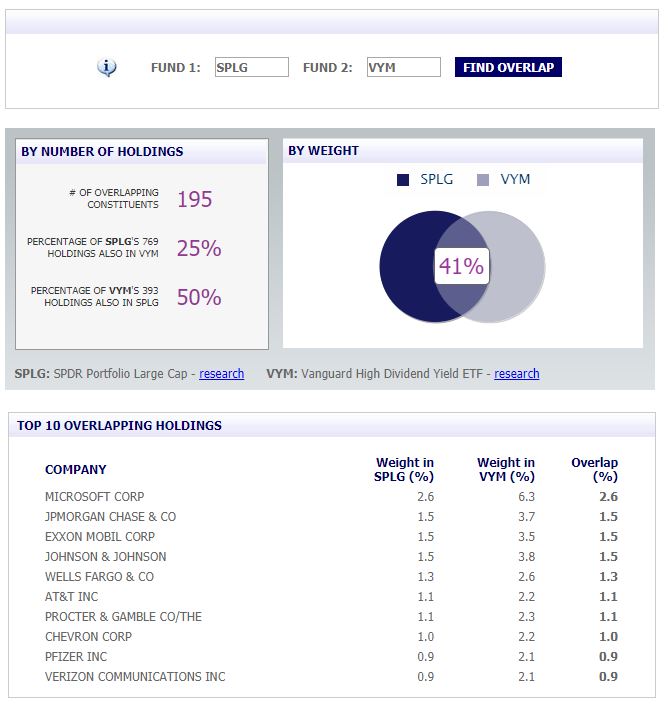
Here’s a great example of 2 ETFs that show a huge amount of overlap in their investments.  That is, they each own many of the same stocks and so you would not be as diversified as you might have thought if you owned both of these.

portfolio xray
I used the ETF Research Center’s Overlap Analysis Tool to illustrate this x-ray.  As you can see, if you owned these ETFs, you would not be as diversified as you might have thought, since SPLG holds many of the same stocks as VYM.

For mutual funds, www.morningstar.com does a nice job of x-raying your portfolio.  Also, you most likely will have tools similar to these on the site where your account is held.  

Whatever tools you use, I suggest definitely taking a peek at your holdings about twice a year, just to make sure you don’t get too heavily concentrated in any one sector or stock.

Let me know if you need any assistance in taking an x-ray of your portfolio.


Joe Baker, CFP®
Baker Asset Management, LLC
joebaker@bakerassetmanagement.com

Retirement Plan Contribution Deadlines – You Still Have Time

IRA-deadlines

At the end of every year, there is always a rush to get contributions into retirement plans.  While some of it is justified, there is some flexibility as to when contributions must be deposited into your retirement account.  Here’s a table that summarizes deadlines and amounts that you can contribute for most types of plans:

Plan Type Contribution Max (Employee) Deadline Contribution Max (Employer) Deadline
IRA $5,500 or $6,500 if > age 50 Date you file your 2017 taxes N/A N/A
SEP IRA N/A N/A 25% of salary up to $54,000 Date company files 2017 taxes
SIMPLE IRA $12,500 or $15,500 if > age 50 12/31/17 3% of salary Date company files 2017 taxes
401k $18,000 or $24,000 if > age 50 12/31/17 $54,000 or $60,000 if > age 50

Note: these are totals for both employee and employer contributions

Date company files taxes

As with everything with the IRS, there are caveats, exemptions, and loopholes associated with these limits so please consult your tax advisor or contact me with any questions.  Thanks!

Joe Baker, CFP®

Baker Asset Management, LLC

joebaker@bakerassetmanagement.com

Monthly Update – December 2017

218308-Hello-December-Quote-With-Snow

Stocks woke up from its tryptophan-induced Thanksgiving nap and pushed to new highs.  The S&P 500 gained another 2.5% and most major market indexes notched another all-time high during November.

We’re still waiting on Congress to get a tax bill on the President’s desk before the end of the year.  Optimism that this could actually happen has put investors in the holiday spirit and, as a result, the markets might have already “baked” tax reform into the cake.  If there’s no deal, we could see a market drop for a Christmas present this year.

Bonds were a mixed bag this past month as interest rates crept up ever so slightly.  U.S. government bonds rose while corporate bond prices dipped slightly.

Outside the states, we still have the odd negative interest rates in Germany, France, and Japan, and it doesn’t look like they will be raising rates anytime soon.  This gives us a little wiggle room when it comes to raising our rates, which is nice.

Speaking of interest rates, the Fed is expected to raise rates again after they meet in December.  This is expected and shouldn’t affect the markets much.

For those who weren’t around in the late 70’s/early 80’s and think rates are getting high, here’s a nice 55 year chart of the interest rate of the US Treasury 10 year note to put it into perspective: http://www.macrotrends.net/2016/10-year-treasury-bond-rate-yield-chart.

On the savings side, rates are starting to creep up with a little more speed but they’re certainly in no hurry.

Currently, the average money market/savings account is paying 0.73%.

The 1 year CD interest rate is now averaging 1.64% (up from 1.51% last month) and the 5 year CD rate is at 2.17%(up from 2.14% last month).

The good news is that mortgage rates continue to stay extremely low, with the 30 year refi rate at 4.04%.  Depending on the loan terms, if you have a current mortgage with a loan rate over 5%, you should at least check out refinancing it.

Oil prices rose about 5.7% in November, continuing its upward trend since bottoming in June.  Price per barrell now sits at $57.30.

Hurricane season is now officially over.  That means a colder than expected winter is the most likely factor that will cause a price increase between now and Spring 2018.

Nationally, gasoline prices are averaging about $2.49 per gallon.  FYI, a year ago, we were paying $2.16.  San Antonio, TX has the cheapest gas in the country at $2.14.

Check out the prices at the pump in your area: Gas Buddy.

Outlook

Events on the horizon that could move the markets in November:

  • Russian Investigation: It’s hard to keep up with this one.  There are so many moving pieces and distractions.  This could make for a pretty good movie one day.  Still, odds are slim that Mueller will indict President Trump, but it does appear that more of his aides and appointees will be in his crosshairs shortly.  Any market pullback from this should be short lived (less than 6 months) and will provide a buying opportunity for long term investors.
  • Escalating Tensions with North Korea: The stock market doesn’t believe anything will come of this, as evidenced by its muted reaction when Kim launched another rocket a few days ago.  However, if Kim keeps pushing Trump’s buttons, this could escalate quickly.  Hoping it stays just a war of words.
  • Global Economy Strongest in Years: A big plus the stock market carries into 2018 is simply that the global economy appears to be stronger than it
    has been in years. According to OECD (the Organization of Economic Cooperation and Development), on a year-over-year basis,
    GDP in the OECD area grew a healthy 2.4%. Additionally, OECD reports that all of the world’s 45 largest economies grew in the quarter.  Good stuff.

Joe Baker, CFP
Baker Asset Management, LLC
joebaker@bakerassetmanagement.com
Should You Retire Your Mortgage Before You Retire?

payoff mortgage

This question pops up quite a bit when discussing retirement with clients.

Many would rather not have major debt hanging over their heads when they no longer have money coming in from work to pay the monthly mortgage nut.  Paying off their mortgage before retiring would give them the peace of mind that comes with being debt-free in retirement.  But does it make sense for them financially?

Whether it makes sense to pay off your mortgage before you retire really depends on your individual situation.

Here are some factors to consider when making this decision:

Reasons to retire your mortgage:

  • Limited or reduced income stream in retirement: Your monthly mortgage payment may represent a significant chunk of your income. Eliminating this payment can greatly reduce the amount of cash you need to meet monthly expenses.
  • Savings on interest: Depending on the length of your mortgage term and the size of your debt, you may pay thousands or tens of thousands of dollars in interest. Paying off your mortgage early frees up that future money for other uses. (While you would lose the mortgage interest tax deduction, the after-tax savings on the cost of the debt can still be substantial. Besides, as you get closer to paying off your loan, more of each monthly payment goes to principal and less to interest, so the amount you can deduct in taxes decreases.)
  • A predictable return: While there’s a potential upside to keeping the loan and investing your money elsewhere, market fluctuations could curtail the gains on your investments, or even reduce their value.
  • Peace of mind: For folks who feel it’s important to be debt-free, they know that numbers aren’t everything. If you do decide to pay off your mortgage before you retire, you should take money from taxable accounts first or a Roth IRA account. Taxes on this money should be minimal (no tax when withdrawing from a Roth), versus withdrawing from a retirement account, where withdrawals are taxed at ordinary income rates.

Reasons to keep your mortgage:

  • Not-so-full nest egg: If you haven’t contributed the maximum amount to your 401(k), IRA or other retirement accounts, you should put money here first instead of into the equity of your home.
  • Higher-interest debt: You should consider using extra cash to pay off other kinds of debt that carry higher interest rates, especially non-deductible debt, such as credit card balances, before you pay down the mortgage.
  • Lower cash reserves: The money you use to pay off your mortgage could significantly reduce the amount of cash you have available for general expenses, discretionary spending and emergencies.  Before retiring your mortgage, make sure you have enough cash to cover your needs, minus income you’ll receive from other sources such as Social Security or pensions. You don’t want to end up being house-rich and cash-poor.
  • Diversifying your investments: One of the best ways to try to increase opportunities for growth at a reasonable level of acceptable risk is to hold a variety of investments in different asset classes. Tying up a large chunk of your net worth in your home equity limits that possibility.  Even if your house appreciates in value, you would have to either sell or refinance it to tap into that equity.
  • A possible move: If you contemplate moving in the next few years, you might as well carry the existing mortgage until then.

The bottom line is that everyone’s situation is different so do the math to make sure that it makes sense financially to pay off your mortgage but also consider the intangibles, such as peace of mind, when making your final decision.

Joe Baker, CFP
Baker Asset Management, LLC
joebaker@bakerassetmanagement.com

5 Ways A Reverse Mortgage Can Upgrade Your Retirement Plan

reverse_mortgage

Before getting into the ways a reverse mortgage can help you in planning your retirement income, let’s just review what a reverse mortgage is all about.
Just like the name states, a reverse mortgage is pretty much the opposite of a regular mortgage. With a regular mortgage, you borrow money from a bank to buy a home. As you make monthly payments to the bank, you pay down the loan and increase your equity in your home.
With a reverse mortgage, the bank pays you to buy the equity in your home.
So, with a regular mortgage, ownership of your home shifts from the bank to you. With a reverse mortgage, ownership shifts from you to the bank.
To qualify for a reverse mortgage, you must be at least age 62 and live in your home.

That’s about as simple as I can make it. If you need a better explanation, just shoot me an email (joebaker@bakerassetmanagement.com).

Okay, now we know that a reverse mortgage basically unlocks the equity in your home (an illiquid asset) so you can use it for other purposes, like upgrading your retirement plan. Here’s a couple ways you can do that:

  1. You can delay Social Security and pension payouts. Instead of taking your social security benefits at age 62 or even your normal retirement age, you can use the cash from a reverse mortgage to help pay for expenses. Meanwhile, your social security payments will increase at about 8% per year until age 70. This will give you a much higher payment than if you started receiving it earlier.
  2. You can postpone withdrawing from your 401k or IRA, allowing them to grow tax-deferred. This is the same strategy as described above with social security.
  3. You can create an income stream to help fund your healthcare costs. Instead of having one of your biggest assets, your home, locking up a big chunk of your wealth, you can use a reverse mortgage to fund your health care. This can allow you to keep your retirement funds intact and prevent you from selling your investments when you don’t want to.
  4. You can have annuity-style payments using your home’s equity. With a reverse mortgage, you are able to choose the option of receiving your funds in annuity-style payments. This is perfect for people who would rather have a predictable income stream.
  5. You can replace cash reserves. Some people have less cash in reserve than they would like. A reverse mortgage gives you the chance to catch up and replace your cash reserves, getting you up to speed financially.

Now, don’t go signing up for a reverse mortgage just yet. You definitely need to speak to properly licensed reverse mortgage specialists to make an informed decision.
If it does make sense for you, a reverse mortgage could be just the strategy your retirement plan needs.

Joe Baker, CFP
Baker Asset Management, LLC
joebaker@bakerassetmanagement.com

 

Pros and Cons of Living Trusts

living trust

This is always a great time of the year to review your financial picture.

One of the items that you might be considering, or have considered before, is whether or not to establish a revocable living trust to hold your assets.

A revocable living trust is a legal document created by you (the grantor) while you are alive and of sound mind and body.  Just like a will, a living trust spells out exactly what your desires are with regard to your assets, your dependents, and your heirs.  But a will doesn’t go into effect until after you die, whereas a living trust is already in effect.

There is little difference to owning your assets in your name or in your living trust’s name while you are alive and well.  The benefits occur after you die or if you become incapable of handling your own affairs.

Here is a list of some of the benefits of having a living trust:

  • Avoids probate – This is probably the biggest reason people have a living trust.  The trust bypasses the costly and time-consuming process of probate, which is conducted by the state courts of your residence when you die and that decides how to divvy up your assets.
  • Provides privacy – a living trust is not made public, so upon your death, your estate will be distributed in private.  A will, on the other hand, is public record and so all transactions will be public as well.
  • Maintains control – If you become incapacitated in a way that you can no longer manage your assets, your handpicked successor trustee can manage your affairs without court intervention, and since the trust is revocable, if you dispute your incapacity, you can retain control yourself.

There are some disadvantages as well:

  • Cost – A living trust can cost anywhere between $1,000 – $3,000, depending on the complexity.  This is the price that you pay for the money saved by avoiding probate, which can typically run around 4% of your total estate value.
  • Bookkeeping – In order for your living trust to be of use, you have to transfer your assets into it.  that means opening new accounts with the trust as owner for your bank and investment accounts.  Also, transferring deeds and title for property into the trust name, which can be time consuming.

In summary, if you have a large family and/or a large number of assets, you may want to consider establishing a revocable living trust.  It could save you and your family not just a lot of money, but also a ton of undue stress and strain on you and your family during difficult times.

If you have questions or want to know if you should get a living trust, just shoot me an email.

Joe Baker, CFP
Baker Asset Management, LLC
joebaker@bakerassetmanagement.com

Monthly Update – November 2017

November 2017

Stocks continued their march higher in October, hitting all-time highs for most major market indexes.

The catalyst for this continued upswing right now is most likely the expectation of some tax reform getting passed through Congress.  However, they will be hard pressed to get anything approved before the end of the year, so that could be cause for a pullback, which is well overdue anyway.

Earnings reports have been excellent for the tech and banking sectors but not so hot for retail companies.  Q3 is always the weakest quarter for retail stocks so that is not a big surprise.

Historically speaking, we are going into the best six months to be invested in the stock market, November through April.  Possible events that could prove history wrong are war with North Korea and/or the Donald getting indicted in the Russian investigation.

Bonds took a little bit of a dip this past month as signs of a healthy economy pushed bond interest rates higher.

The Federal Reserve concludes their scheduled meeting today, November 1st, and is expected to bump interest rates another 25 basis points.  Rates still seem to be bottoming out from their 30 year decline.  Here’s a nice 55 year chart of the interest rate of the US Treasury 10 year note to put it into perspective: http://www.macrotrends.net/2016/10-year-treasury-bond-rate-yield-chart.

On the savings side, rates that banks are paying us just aren’t going up as fast as we’d like.

Currently, the average money market/savings account is paying 0.13%.

The 1 year CD interest rate is averaging only 1.51% and the 5 year CD rate is at 2.14%.

The good news is that mortgage rates continue to stay extremely low, with the 30 year refi rate at 3.92%.  Depending on the loan terms, if you have a current mortgage with a loan rate over 5%, you should at least check out refinancing it.

Oil prices rose about 5% in October.continuing its upward trend since bottoming in June.  Price per barrell now sits at $54.20.

Even though we still have 1 month left in the hurricane season, prices are reflecting a return-to-normal after the damage and disruption caused by Hurricane Harvey.

Prices should hold steady for the rest of the year.

Nationally, gasoline prices are averaging about $2.47 per gallon.  FYI, a year ago, we were paying $2.20.  Chattanooga, TN has the cheapest gas in the country at $2.10.

Check out the prices at the pump in your area: Gas Buddy.

Outlook

Events on the horizon that could move the markets in November:

  • Russian Investigation: Odds are slim that Mueller will indict President Trump, but it does appear that more of his aides and appointees will be in his crosshairs shortly.  Any market pullback from this should be short lived and will provide a buying opportunity for long term investors.
  • Escalating Tensions with North Korea: The stock market, so far, has shown little concern with the wing nut that rules NK.  However, he does no how to push Trump’s buttons. So, at some point, these two bullies may call for a fight in the playground after school.  Hopefully, the adults will show up for both sides and cooler heads will prevail.
Joe Baker, CFP
Baker Asset Management, LLC
joebaker@bakerassetmanagement.com