
Calendar Notes
- Saturday, May 3rd – Kentucky Derby
- Sunday, May 11th – Mother’s Day
- Monday, May 26th – Memorial Day, stock market is closed
Stocks whipsawed this past month in response to the on again, off again tariff policy. The S&P 500 ultimately settled lower for the third consecutive month.
In April, the S&P 500 only lost about 0.70%. Historically, April is the second-best month for the index, averaging 1.32% return over the last 100 years. For the year, it is down 5.3%. Adding fuel to the fire, GDP for the first quarter of 2025 came in negative for the first time since Q1 of 2022 while prices are beginning to increase due to tariffs. This negative growth with rising inflation is indicative of stagflation, which is an environment no economy wants to be in.
Looking ahead, this first week in May is loaded with companies reporting Q1 numbers but the trade war is by far the biggest issue for stocks. The following timeline is a powerful illustration from Apollo Academy of a potential outcome of the current trade war for the U.S. economy if nothing changes from the current policy:
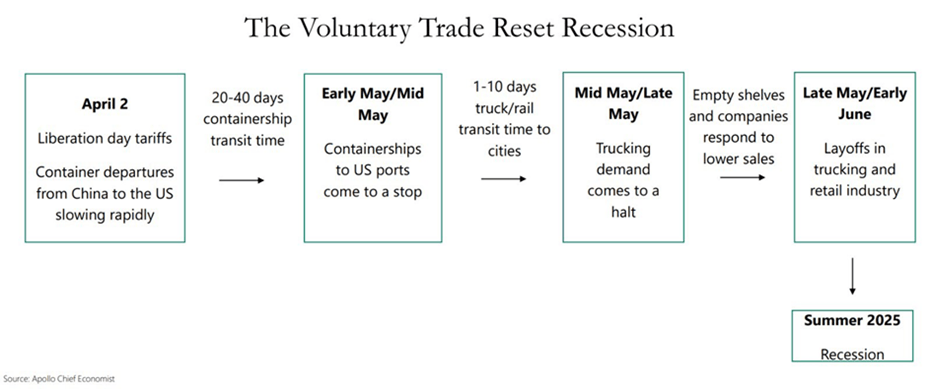
Let’s hope we can get some trade deals done to avoid this scenario.
Historically, May is one of only three months that has averaged a negative return, -0.06%, since 1928. February and September are the other two. This May could be all over the place with the trade wars in full swing.
Take a look at the Outlook section below to see what events could move the markets over the short term.
Bond prices were mostly lower this past month with the exception of short-term government bonds, which ended the month higher. This is what happened last month as well. Investors are heading to safety and concentrating their buying in the shortest-term government bonds to minimize the interest rate risk of holding bonds with longer maturities. Since it is not clear how the Federal Reserve is going to respond to the effects of tariffs on the economy, there is too much uncertainty and risk to put money into anything long term. As mentioned above, it is possible that we may be entering a period of stagflation, which is when the economy is not growing, unemployment is increasing, and prices are rising. This would be bad for most bonds with the exception of the short-term government bonds held to maturity. Obviously, this is not a good environment to be in, but it is possible with the unique combination of tariffs and government sector layoffs. Hopefully, we can avoid this scenario or at least minimize our time in it.
The 10-year US Treasury note yield finished lower in April, settling at about 4.15%, below the 4.22% that it was at the beginning of the month. The 30-year bond yield closed out the month at 4.67%, about 16 basis points higher than a month ago.
Bond investors have done well so far this year but will have to stay vigilant, especially with signs of stagflation in the hard economic data coming out. Staying in short-term government bonds and holding to maturity will certainly help.
Savings rates have been steady although the national averages are still ridiculously low relative to short-term rates controlled by the Federal Reserve. Money market rates and bank savings accounts are averaging only about 0.41% but many online rates are well above 4% and some offering 5%. The Fed is no longer on track to cut rates this year. They will probably hold rates steady at their next meeting in a week, but it will be very interesting to hear what they say now that some hard data has backed up the soft data regarding unemployment, tariffs, and inflation. Regardless, rates are still attractive, and I think more money is going to be heading back into the safe havens of money markets and CDs as the stock market shows signs of more volatility. Currently, you can get around 4.0% return on your money if you do your research. So, CDs and MMAs continue to be a great place to put your cash and your emergency fund, for now. Knowing this, it makes sense in most situations to put cash that you don’t immediately need into CDs with up to 2-year maturities. For emergency cash, stick to high yielding money market and savings accounts, of which the best are yielding up to 5%. As always, keep the total under $250,000 per person at any one bank to ensure you are fully covered by the FDIC.
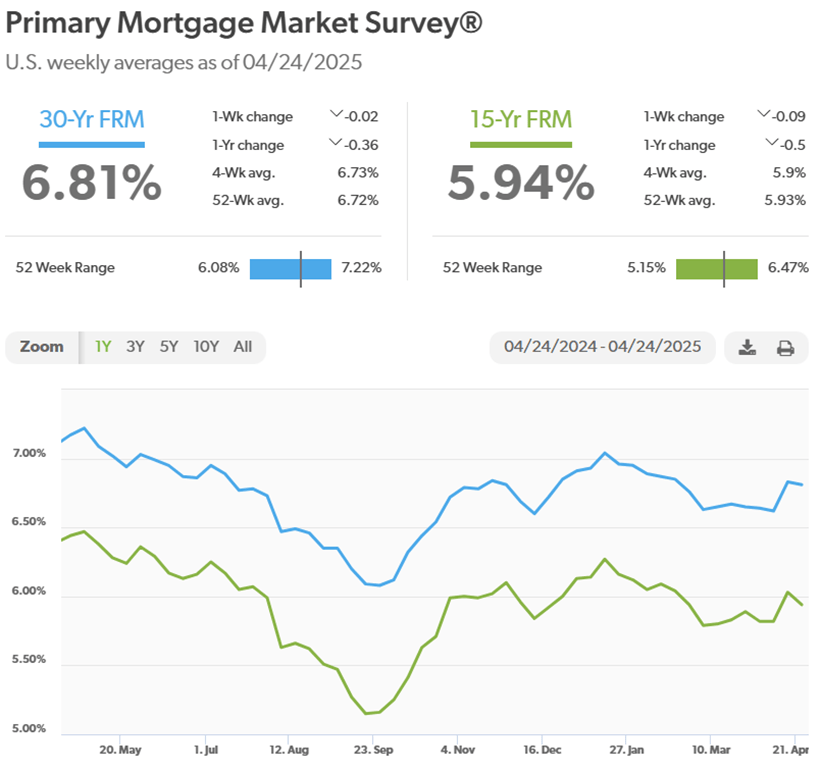
Mortgage rates crept up in April, possibly due to the inflationary effects of the tariffs but will need more data to confirm if this is the cause. Over the past year, rates have been relatively stable, fluctuating between 6.5% and 7.0% (see chart below). Housing inventory has risen, and sales have slowed because I believe there is a lot of economic uncertainty out there giving both buyers and sellers concern. Also, home prices are still near record highs, making a home purchase out of reach for many, especially first-timers.
Currently, the 30-year rate sits at 6.81%, higher than a month ago, at 6.65%. The trade and immigration policies haven’t shown up in home prices or mortgage rates yet but should by mid-summer if they are still in place.
Here is a look at the one-year chart of the 15- and 30-year mortgage rates from Freddie Mac.
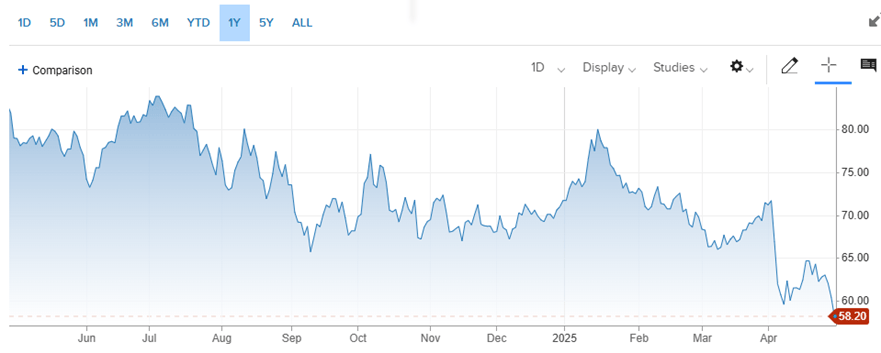
Oil prices took an absolute beating this past April. After starting off the month around $72 per barrel, the price dropped sharply until finding support at $60. It is getting hit with a double whammy of a global economic slowdown due to tariffs and OPEC accelerating supply faster than originally anticipated.
For the month, the price for a barrel of oil closed at $58.20, down from $71.90 at the beginning of April. If the current oil prices could be sustained for a while, it could help offset some of the price increases that are expected from the tariffs that are being implemented. Overall, there are more catalysts putting downward pressure on prices than upward, for sure. Regardless, having oil prices down around $60 is a good thing for the country as a whole. FYI, this was the worst April in history for the energy stocks in the S&P 500.
Here’s a look at the one-year chart for U.S. oil:
Gasoline prices headed up just a bit in April. Regular unleaded gasoline is now averaging $3.18 per gallon, up only a penny from last month. Gas prices continue to stay high in 2025 despite oil prices dropping. They usually trend with each other, with gas prices slightly lagging oil prices, so the price action this year is a little unusual. Some of this unusual activity may be due to seasonal factors (warmer weather = more driving) and possibly the 10% tariffs imposed in March, which raised prices on almost everything coming into the U.S. Mississippi has the cheapest gas currently, checking in at $2.67 a gallon. California has the most expensive gasoline at $4.78 per gallon. FYI, a year ago, we were paying $3.66.
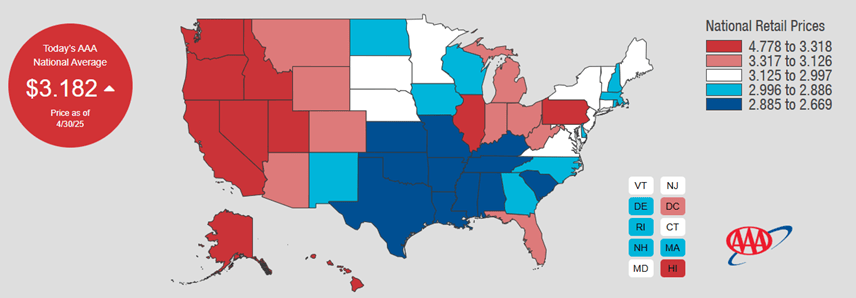
Check out the prices at the pump in your area: AAA Gas Prices.
Outlook
Events on the horizon that could move the markets in the near term:
Here is a powerful illustration of the headwinds currently affecting our economy:
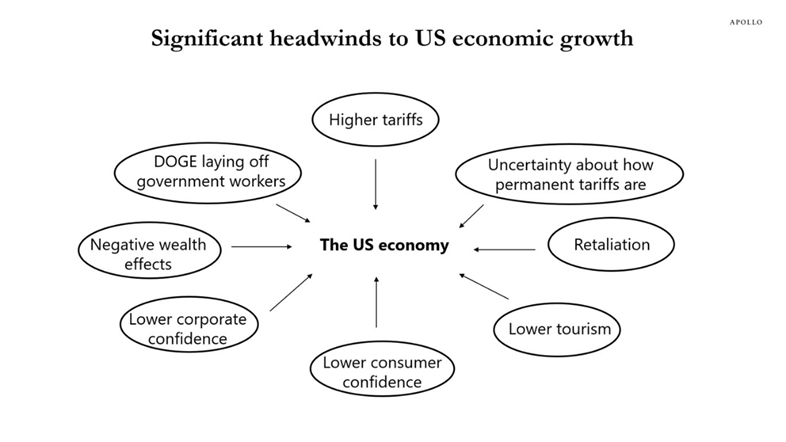
On the flip side, a significant tailwind could be the more rapid adoption of artificial intelligence than expected by corporations to optimize their costs. This could help offset some of the tariff costs without having to pass on these levies to the consumer. Unfortunately, a casualty of AI adoption is labor – less workers needed – which takes some of the wind out of this tailwind.
Also, another potential tailwind is that the self-inflicted damage of tariffs can be quickly reversed with the stroke of a pen. But the longer they last, the harder it will be to reverse.
- Fed & Inflation: The Federal Reserve is in a pickle. They had the economy heading in the right direction but once the tariffs were thrown into the mix, their job became much tougher. They now have to contend with higher prices as well as slower growth and job losses, aka stagflation. There was no meeting this past month, but there sure was a lot of talk from most of the Federal Open Market Committee members. It looks like they are still in a wait-and-see approach on interest rates with the on again, off again tariff chaos. We are already seeing prices for many imported products (mostly clothing, footwear, tools, kitchenware, etc.) going up. Also, shipments from China have fallen off a cliff (down 44% YOY through April 14th ), which will most likely result in empty store shelves in a few months. The subsequent job losses (port workers, truckers, retail workers, etc.) will be brutal for the employment numbers but could act as an effective interest rate cut, if that’s any consolation (certainly not for the workers who may lose their jobs). This nasty combination of negative economic growth with rising prices is not normal and is a tough environment to navigate for the Fed. Their meeting next week will be must-watch TV for everybody, not just the financial world. Be prepared for more market volatility.
- DOGE Action: The Department of Government Efficiency has been out of the headlines recently. Elon Musk has said that he will be stepping back from DOGE to focus on his businesses. Regarding the federal payroll, it looks like there have been about 121,000 government employees fired or laid off Since Trump’s second term began. This doesn’t count those placed on administrative leave or who took voluntary buyouts. It also doesn’t account for government contractor jobs, which some estimate could be anywhere from 1 contractor for 1 government worker all the way up to 3 for 1. Either way, that’s going to be a bunch of people looking for work during the rest of this year and could have a negative impact on the markets.
- Trump Administration Policies: Hard data has started to roll in confirming what was expected from the Trump administration’s policies enacted at the beginning of this year. Regarding immigration, illegal border crossings have dropped dramatically, 95% year-over-year. There have also been about 57,000 illegal immigrants deported so far in 2025, as reported by U.S. Immigration and Customs Enforcement . It’s still too early to tell how this could affect our economy, particularly the construction, farming, and leisure/hospitality sectors but it will almost certainly be negative for growth due to how many illegals are typically employed in these industries. Regarding trade policy, “tariffing” everything coming into our country is going to have devastating effects on our economy, especially for small businesses, which I talked about in detail here: Why Small Businesses Will Be Hurt Most by Tariffs. Many of these policies are being challenged in court and also are being delayed or stopped temporarily. The resultant uncertainty is preventing businesses from adjusting to these changes, which may or may not happen, and uncertainty is the stock market’s kryptonite.
Joe Baker, CFP®
Baker Asset Management, LLC
joebaker@bakerassetmanagement.com

