Monthly Update – August 2023

Fun Facts about August

  • Birthstone: Peridot
  • Flower: Gladiolus and Poppy
  • Zodiac signs: Leo and Virgo
  • August was named after Augustus Caesar (63 B.C.–A.D. 14). He was the first Roman emperor and grandnephew of the previous ruler Julius Caesar (who named July after himself).
  • August is the last month of summer and the hottest month of the year in the Northern Hemisphere.
  • August in the Northern Hemisphere is similar to February in the Southern Hemisphere.
  • Friday, August 4th, is Great American Outdoors Day. Entrance fees are waived for all national parks that day.

Stocks had a strong July as the appetite for big technology, banks, and drug makers’ stocks continued. They started off the second half of the year the same way they finished the first half of 2023, with pretty substantial gains.

The S&P 500 rose 3.3% during the month of July and is now up 19.7% for the year.

There is still plenty of cash on the sidelines that was parked there at the beginning of the year in fear of a recession. So far, that has not come to fruition. In fact, the economy has been growing above market expectations and is taking stock prices with it. Investors can stay out of the stocks and still get a decent return investing in short-term bonds and CDs. But, if they want to have the potential to get double digit returns, they’ll have to get back into stocks. The prudent investor will have a little of both.

There’s still plenty of Q2 earnings coming out over the next few weeks but other than that, there aren’t many catalysts on the horizon that will move the markets (that we know of).

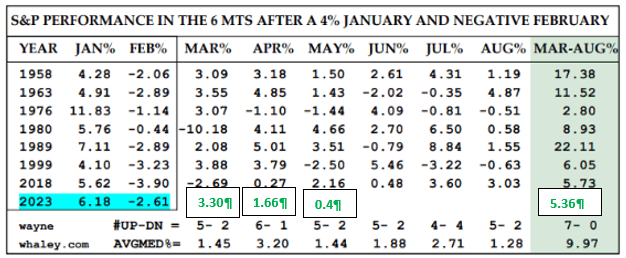
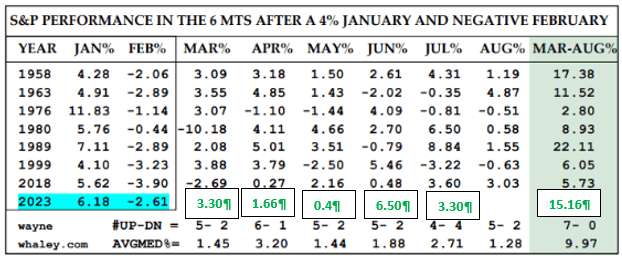
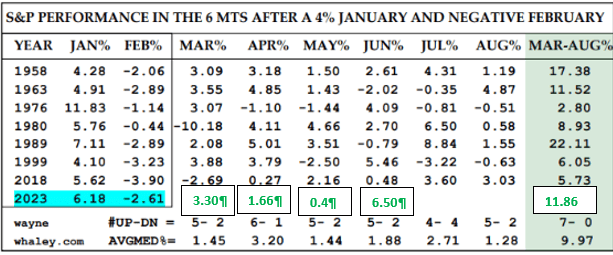
I’m leaving this table in the update through August to see if history repeats itself. We have one more month to go. There have been seven instances where a January with a 4% or higher return was followed by a negative February. 2023 is now the eighth. For each one of these years, the following six months had an average gain of almost 10%. Will 2023 keep this undefeated streak going?
Take a look at the Outlook section below to see what events could move the markets over the short term.

Bond prices headed lower in July, especially after a strong GDP report that came out at the end of the month. This helped shift the yield curve a little bit from a highly inverted curve towards a more normalized curve where long-term interest rates are higher than short-term rates.

The 10-year US Treasury note yield moved higher again in July, closing the month at 3.96%. The 30-year bond yield did the same, closing the month at 4.01%. It’s nice to finally see the 30-year bond yield higher than the 10-year bond yield. That said, these yields continue to remain below the yields of short-term treasuries. For example, the 6-month T-bill is currently yielding 5.50%, confirming a strong inversion of the yield curve and one of the best indicators of an impending recession. However, the gap is narrowing and if the Fed holds off on raising short-term rates for a while, we could see the yield curve revert back to its normal shape.

Bond buyers should continue to focus on bonds with short-term maturities. I would keep maturities under 18 months and just plan on holding these bonds to maturity. That way, you won’t have to worry about selling at a discount if interest rates head higher.

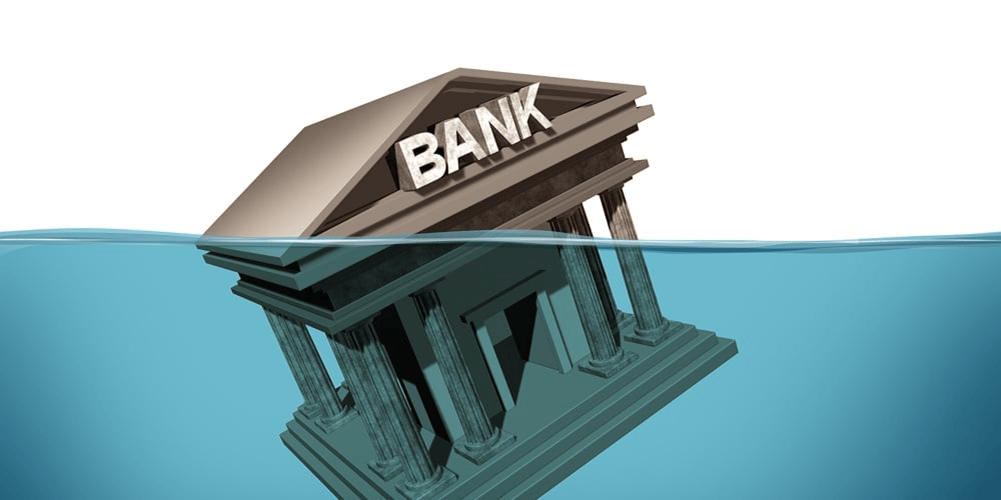
Savings rates continued to drift higher in July once again in response to the Federal Reserve raising short-term rates. Brick and mortar banks are having a tough time trying to match the rates that the online-only banks are offering. This could spell trouble for those smaller, regional banks that lent out mortgages in the 2-3% range a few years ago. They are losing money on those loans right now and could exacerbate their shrinking profit margins when they have to raise their depositors’ savings rates to help retain those customers. This is all good stuff for risk-averse investors and for our emergency reserves accounts. But do your research if you plan on investing in the smaller, regional banks.

The data for the average savings and CD rates was not accurate at the time of this writing so I don’t have those numbers or the chart. However, I can tell you that I am seeing FDIC-insured savings accounts online with rates as high as 4.80%.

The 1-year CD interest rate is hitting close to 5.40%. The 5-year CD rate high watermark right now is close to 4.65%. These rates are still inverted, just like the yield curve, meaning they are paying a higher rate to borrow your money for a shorter time period, which isn’t normal. These yield inversions are lasting longer than normal and have a lot to do with the Federal Reserve continuing to hike short-term rates as well as recession fears keeping pressure on long-term rates. That said, if you’re looking for a place to park your savings or emergency spending money, just buy short-term CDs, 1 year or less, and reevaluate when they mature. Keep the total under $250,000 per person at any one bank to ensure you are fully covered by the FDIC. CDs have become a nice alternative for risk-averse investors and have drawn money away from stocks because of their relatively high rates that carry virtually no risk.

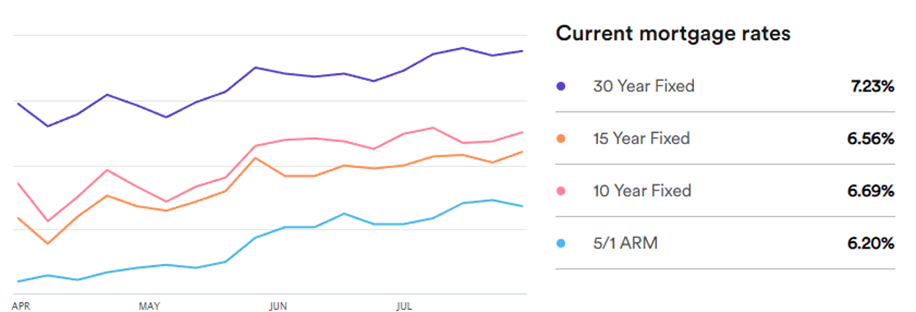
Mortgage rates remained above the 7% level once again in July as the Fed’s strategy really sinks into the consumer lending arena. Currently, the 30-year rate sits at 7.23%, a bit higher than what it was a month ago, at 7.10%. Nobody with a 2-4% mortgage rate is moving that doesn’t have to move. If they are, they are going to be downsizing and paying cash. This bodes well for homebuilders. Also, home building material prices have come down quite a bit, which will help both the builders and the home buyers.
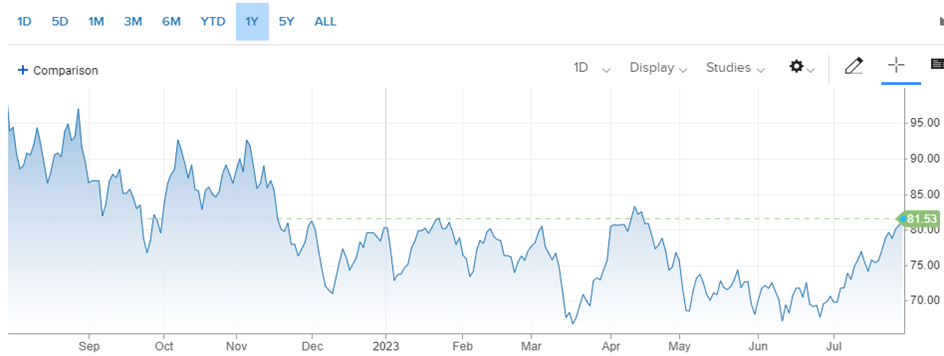
Oil prices headed higher in July with confidence, reaching prices that we haven’t seen since this past April. Demand appears to be increasing around the world that is more than offsetting the slowing Chinese economy. Also, we still have the big unknown that is Russian oil output. For the month, the price for a barrel of oil settled around 81.50, up from $70.46 at the beginning of July. Prices have breached the upper limit of the goldilocks range of oil prices ($55 to $70 per barrel range), so we’ll see if that puts some pressure on consumption here in the U.S. as well as worldwide.

Here’s a look at the one-year chart for U.S. oil. It looks like we may have bottomed out for the year:
Gasoline prices reversed their two-month drop and headed higher in July. It appears the rise is mainly due to seasonal demand (peak driving season). Regular unleaded gasoline is now averaging $3.78 per gallon, up $0.21 from last month. Mississippi has the cheapest gas for the fourth month in a row, at $3.25 a gallon. California is back on “top” with the most expensive gasoline at $5.00 per gallon. FYI, a year ago, we were paying $4.22.
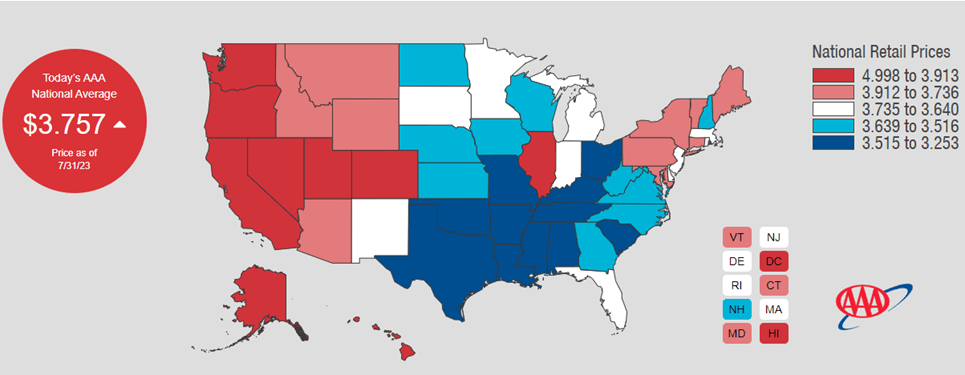
Check out the prices at the pump in your area: AAA Gas Prices.

Outlook

Events on the horizon that could move the markets in the near term:

  • Fed & Inflation: The Federal Reserve raised rates 25 basis points this past month after a pause in June. The rate increases are having their desired effect on our economy as evident in the most recent data. I would think that we are at a place now where rates can stay put for a little bit and we can see how inflation reacts. The Fed doesn’t need to strong-arm it and drive us into a recession when it is unnecessary. The market believes that they are done raising rates this year so if they continue to bump them up, it could force stocks and even some bonds into a reversal downward.

Joe Baker, CFP®

Baker Asset Management, LLC

joebaker@bakerassetmanagement.com

3 Best Places To Park Your Cash Right Now

High interest rates get a bad rap. Sure, it’s tough when you are the borrower, like when you buy a home or car, but it is pretty nice when you are the lender, like when you deposit in a bank or buy bonds. Right now is a great time to be a lender, and that includes those of us who are risk-averse investors and/or who like to maintain an emergency fund for unexpected expenses.

The main criteria for these savings vehicles would be liquidity (easy access to the cash if needed) and safety (either insured by FDIC or SIPC or backed by the U.S. government). With that said, here’s the three best places to park your cash, in no particular order:

  • Savings and Money Market Accounts – These are the savings accounts at your local bank as well as the money market accounts that banks offer. These are the most liquid of the accounts mentioned here so you would want to put any cash that you would need in a few days or less in one of these accounts. Be sure to check that they are FDIC insured. Currently, I can find rates as high as 5.15% with a minimum balance of $5,000 and 5.0% with no minimum balance.
  • U.S. Government Treasury Bills – These are issued by the U.S. with maturities of 1 year or less. You can buy these direct at treasurydirect.gov or with your brokerage account. You can buy and sell these quickly and easily. Six-month T-bills are yielding over 5.2% at this time. These yields change frequently throughout the day but rarely more than 20 basis points, 0.20%.
  • Certificates of Deposits (CDs) – With CDs, you lose a little liquidity so I would only buy CDs with a maximum maturity of six months. You can also put smaller amounts in several CDs with differing maturities, aka a CD ladder. Right now, some banks are offering six-month CDs at 5.4%.

If you don’t work with an investment advisor, you can do an internet search to find the best rates. One site that I like to use is bankrate.com but there are several others. Also, keep in mind that the rate you see is the annualized rate. So, if you buy a six-month CD or T-bill that pays 5% APY, you are only going to receive 2.5% on your investment for those six months.

Please comment or send an email if you have any questions. Thanks!

Joe Baker, CFP®

Baker Asset Management, LLC

joebaker@bakerassetmanagement.com

Now Is A Great Time to Review Your Beneficiaries

Talking about your beneficiaries means talking about death, specifically your death. Planning for your death may sound like the worst thing ever but it is really an incredibly thoughtful act on your part and will help to minimize stress for your family and loved ones when you ultimately check out.

Beneficiaries are typically assigned to retirement accounts (401k, IRAs, etc.), life insurance and annuity policies, as well as transfer-on-death (TOD) accounts. If you don’t name any beneficiaries, these accounts will be passed on to your estate where they will go through probate based on your state laws. Probate is a legal proceeding that determines who will get your stuff. It is a lengthy, complex process that can be pretty expensive. If you have a will, probate will use that to determine how your assets get divvied up. If you don’t have a will, the state will do the best they can to determine who gets what. Suffice it to say, naming beneficiaries is the way to go. Getting this done before you pass away will make things simpler, quicker, and cheaper for your heirs during a very stressful time.

You should name both primary and contingent beneficiaries. The primary beneficiary is first in line to receive your assets. If the primary beneficiary passes away before you, the contingent beneficiary will receive those assets, depending on your selection of per capita or per stirpes (see explanation below). You can have as many primary and contingent beneficiaries as you want.

Now, here is the most overlooked section of the beneficiary page: Choosing per stirpes or per capita.

Per stirpes (derived from the Latin word for roots) means that if a beneficiary dies before you die, the deceased beneficiary’s children inherit your money.

Per capita (Latin for each head) means that if a beneficiary dies before you die, their share of the inheritance goes back to the estate and gets divided among the other living beneficiaries.

Choosing which one of these for your beneficiaries is very important and should be considered carefully. In the most basic instance, you should elect per stirpes on your beneficiary designations to ensure that your heirs’ heirs receive their share.

I mentioned transfer-on-death (TOD) accounts earlier and just wanted to review what they are and when to use them. TOD is used for taxable accounts, and it allows you to assign beneficiaries just as you do with retirement accounts, annuities, and life insurance. This allows your taxable accounts to bypass the probate process, which is quicker, cheaper, and less stressful for your heirs.

Finally, remember to review your beneficiaries at least annually and certainly after any major life events, such as death, divorce, marriage, adoption, etc.

Please comment or send an email if you have any questions.

Joe Baker, CFP®

Baker Asset Management, LLC

joebaker@bakerassetmanagement.com

Monthly Update – July 2023

Fun Facts about July

  • Birthstone: Ruby
  • Flower: Larkspur and Water Lily
  • Zodiac signs: Cancer and Leo
  • The month of July was named by the Roman Senate in honor of Roman general Julius Caesar in 44 B.C. Before then it was called Quintilis.
  • It is the first full month of summer and normally the hottest.
  • July in the Northern Hemisphere is similar to January in the Southern Hemisphere.
  • Monday, July 3rd, the stock market closes early at 1p.m. EST.
  • Tuesday, July 4th, is Independence Day. All stock and bond markets in the U.S. are closed.

Stocks continued to climb a wall of worry throughout the month of June. They finished strong this past month to cap off a very impressive first half of the year. Anything to do with artificial intelligence (AI) led the way once again. The S&P 500 rose 6.5% during the month of June and is now up 15.9% for the year.

I’d be remiss without mentioning that the tech-heavy NASDAQ Composite has risen 31.7% year-to-date, its best showing since 1983.

Cash with investors has grown to $5.4 trillion from $4.7 trillion at the start of the year according to Fundstrat. This makes sense after all of the headlines earlier in the year talking about inflation, high interest rates, economic slowdown, etc., frightened investors and caused them to retreat to the safe haven of their money market funds. Those predictions have not panned out as of yet and those that stayed long and strong in their stock positions have been rewarded nicely over the first six months of the year. Now, we have investors with a ton of cash sitting on the sidelines trying to decide if they should stay in cash and get a decent rate of return with interest rates that are higher now or get back into the market for a chance to make much higher returns, aka FOMO (fear of missing out). Always a quandary for investors.

I’m leaving this table in the update through August to see if history repeats itself. We have a few more months to go. There have been seven instances where a January with a 4% or higher return was followed by a negative February. 2023 is now the eighth. For each one of these years, the following six months had an average gain of almost 10%. Will 2023 keep this undefeated streak going?

Take a look at the Outlook section below to see what events could move the markets over the short term.

Bond prices fell again in June for the second month in a row as yields moved higher mainly because of speeches by the members of the Federal Open Market Committee (FOMC) talking about their commitment to raise rates throughout 2023, despite their pause at June’s meeting.

The 10-year US Treasury note yield moved higher again in June, closing the month at 3.84%. The 30-year bond yield did the same, closing the month at 3.87%. These yields continue to remain well below the yields of short-term treasuries. For example, the 6-month T-bill is currently yielding 5.47%, confirming a strong inversion of the yield curve and one of the best indicators of an impending recession.

Bond buyers should continue to focus on bonds with short-term maturities. I would keep maturities under 18 months and just plan on holding these bonds to maturity. That way, you won’t have to worry about selling at a discount if interest rates head higher.

Savings rates continued to drift higher in June as competition grows for assets looking for a safe haven and a decent rate of return. Banks need to raise their savings rates offered to depositors to compete with treasury bonds and money market funds. This could hurt profit margins for the many banks that lent out mortgages in the 2-3% range a few years ago. They are losing money on those loans right now and could exacerbate their shrinking profit margins when they have to raise their depositors’ savings rates to help retain those customers. This is all good stuff for risk-averse investors and for our emergency reserves accounts. But do your research  if you plan on investing in the smaller, regional banks.

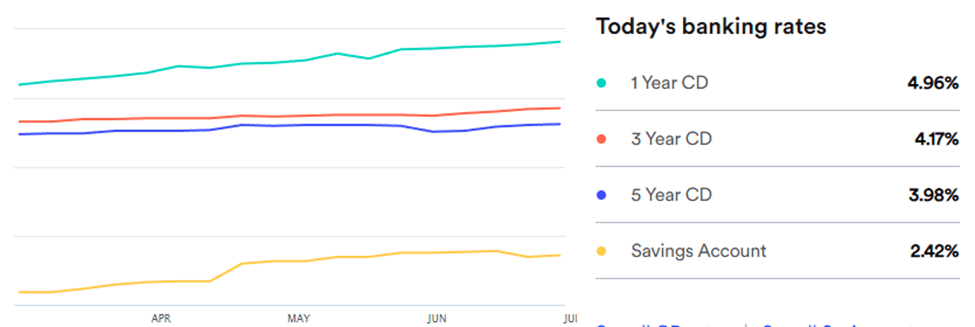
Currently, the average savings account is paying 2.42%, down slightly from 2.45% last month. There are some banks that are now paying close to 5% and are worth taking the time to research.

The 1-year CD interest rate is now averaging 4.96%, up from 4.87% last month. The 5-year CD rate is currently at 3.98%, about the same as last month. These rates are still inverted, just like the yield curve, meaning they are paying a higher rate to borrow your money for a shorter time period, which isn’t normal. These yield inversions are lasting longer than normal and have a lot to do with the Federal Reserve continuing to hike short-term rates and recession fears keeping pressure on long-term rates. That said, if you’re looking for a place to park your savings or emergency spending money, just buy short-term CDs, 1 year or less, and reevaluate when they mature. Keep the total under $250,000 per person at any one bank to ensure you are fully covered by the FDIC. CDs have become a nice alternative for risk-averse investors and have drawn money away from stocks because of their relatively high rates that carry virtually no risk.

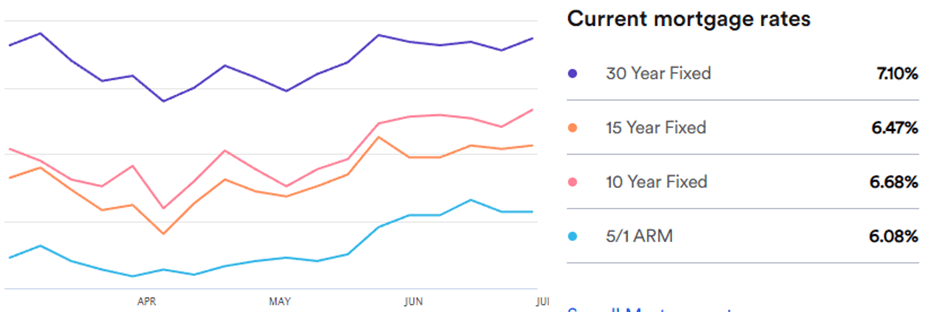
Mortgage rates remained above the 7% level in June even with demand slowing. Currently, the 30-year rate sits at 7.10%, just slightly lower than what it was a month ago, 7.12%. Prices for both new and existing homes appear to be bottoming out and could head higher if mortgage rates start to ease up. However, if the Fed continues to raise rates, that will most likely keep mortgage rates firmly above 7% for the near future, which could hurt home prices, even with the low inventories of available homes for sale.

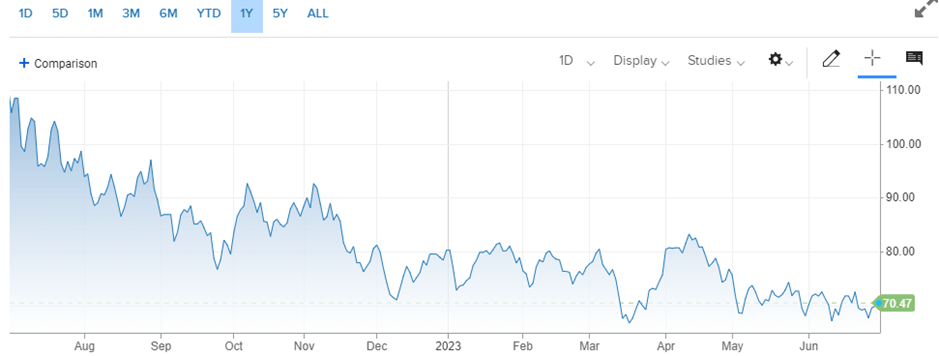
Oil prices continued their erratic heartbeat pattern, this time rising slightly in the month of June. There’s downward pressure on oil prices due to weak demand from China and upward pressure from OPEC cuts and peak travel season. For the month, the price for a barrel of oil settled at $70.46, up from $68.02 at the beginning of June. Prices are still close to the $55 to $70 per barrel range, which I think is a good range for both suppliers and users.

Although there has been a lot of short-term fluctuation in oil prices recently, the 1-year chart shows a steady decline from this time last year:

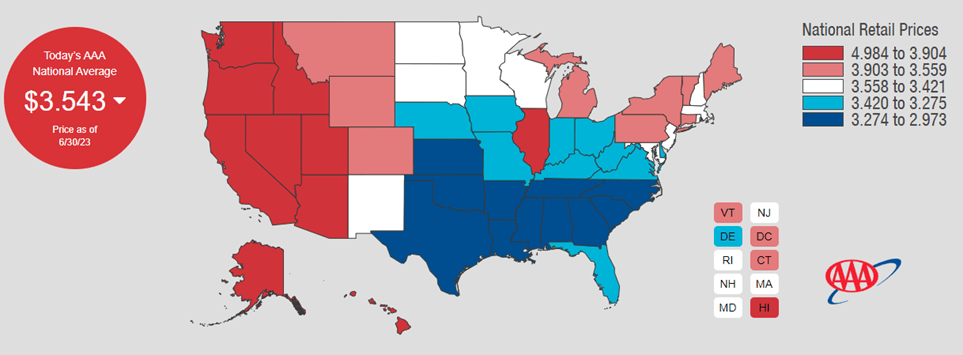
Gasoline prices followed oil and dropped slightly in June for the second month in a row. A surprise increase in inventories kept prices low even as the peak summer driving season gets into full swing. Regular unleaded gasoline is now averaging $3.54 per gallon, down just $0.04 from last month. Mississippi has the cheapest gas for the fourth month in a row, at $2.97 a gallon. Washington has the most expensive gasoline at $4.98 per gallon. FYI, a year ago, we were paying $4.86.

Check out the prices at the pump in your area: AAA Gas Prices.

Outlook

Events on the horizon that could move the markets in the near term:

  • Fed & Inflation: The Federal Reserve paused raising rates at their June meeting, but since then have reiterated that they are not done raising rates and will do so again in 2023. They have been doing a great job so far in containing inflation without forcing us into a recession. I know when they tell us what they are planning to do, despite not seeing the data first, they are just trying to reel in investors’ expectations. Regardless, I don’t think it is very helpful and it is not a good look for the Fed. I would still like to know why they don’t have a target range for inflation, say 2-3%, versus their sand-in-the-line 2% goal. Yes, the economy is doing much better than anyone expected, but that’s good, right? Maybe we are in a sweet spot with economic growth and interest rate levels where they are right now. Let’s be patient and see what the data tells us. It could be the best move to avoid a recession and give a nice boost to both the stock and bond markets.

Joe Baker, CFP®

Baker Asset Management, LLC

joebaker@bakerassetmanagement.com
These Two Laws Are Boosting Our Economy

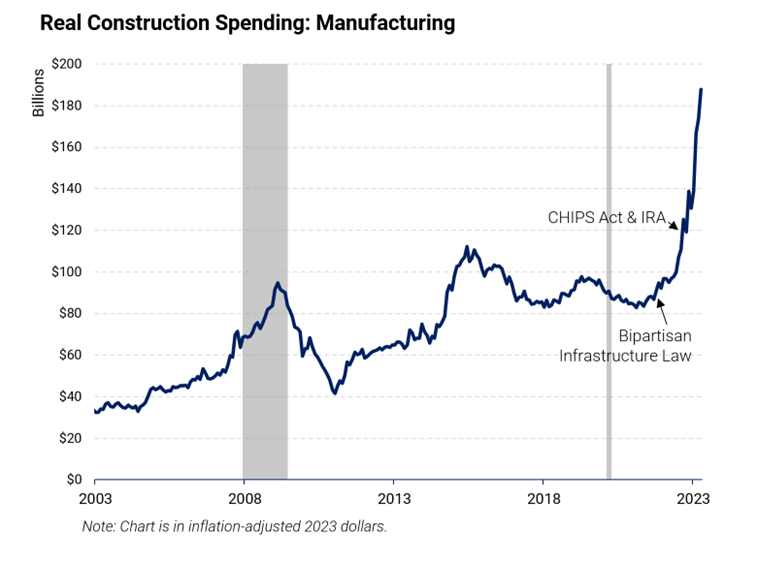
There were two very significant laws passed last year that could be just the fuel the economy needs to continue expanding and to avoid a recession. The Inflation Reduction Act (IRA) and the Creating Helpful Incentives to Produce Semiconductors (CHIPS) Act are two pieces of legislation that were passed in 2022. The IRA is designed to reduce inflation by increasing competition in the pharmaceutical industry and by providing tax breaks for energy-efficient appliances and vehicles. The CHIPS Act is designed to boost the U.S. semiconductor industry by providing subsidies for research and development, manufacturing, and workforce training.

Both the IRA and the CHIPS Act are expected to boost the U.S. economy by increasing investment, creating jobs, and reducing the deficit. The IRA is expected to have a more immediate impact, while the CHIPS Act is expected to have a more long-term impact.

Here are some of the specific ways in which the IRA and the CHIPS Act are boosting the U.S. economy:

  • Increasing investment: The IRA provides tax breaks for businesses that invest in clean energy and manufacturing. This is expected to lead to increased investment in these sectors, which will create jobs and boost economic growth.
  • Creating jobs: The IRA is expected to create 2.4 million jobs over the next decade. The CHIPS Act is expected to create 513,630 jobs and boost the U.S. semiconductor industry by $50 billion over the next decade.
  • Reducing the deficit: The IRA is expected to reduce the deficit by $1.8 trillion over the next decade. This will help to improve the government’s finances and make it more likely that the economy will continue to grow.
  • Boosting the semiconductor industry: The CHIPS Act provides subsidies for semiconductor manufacturing in the United States. This is expected to boost the U.S. semiconductor industry, which is critical to many other industries, such as the auto industry and the defense industry. Also, the reshoring of chip manufacturing plants will create a substantial number of new jobs right here in the states.

The chart below illustrates the impact that these Acts have already had on construction spending in manufacturing.

In addition to the economic benefits, the IRA and the CHIPS Act are also expected to have a number of other benefits. The IRA is expected to improve access to healthcare and to reduce greenhouse gas emissions. The CHIPS Act is expected to strengthen national security, a major benefit in my opinion, and to improve the U.S. position in the global economy.

Please comment or send an email if you have any questions. Thanks!

Joe Baker, CFP®

Baker Asset Management, LLC

joebaker@bakerassetmanagement.com
Work From Home Is Here To Stay

It looks like working from home (WFH) has secured its place in the domain of the American job force. Prior to 2020, WFH had been creeping into the workplace for quite some time but once the pandemic hit, its acceptance at companies accelerated much faster than anyone expected. Now, many companies are trying to get their office workers back to, well, the office, but employees are pushing back and have about three years of data to support their case for staying home.

I thought it would be interesting to take a look at the positive and negative impacts that WFH has on the economy:

Positives

For Employees

  • Increased flexibility: WFH gives employees more flexibility, which can be a major benefit for parents, caregivers, and those with disabilities. This flexibility can help employees to better balance their work and personal lives.
  • Reduced commuting costs: Employees who work from home save money on commuting costs, which can be significant. This can free up money for other expenses, such as housing, food, and entertainment.

Both of these positives can be backed up by this:

Liberty Street Economics, a blog that features writing from New York Fed analysts, reported last year that collectively, Americans now spend 60 million fewer hours per day traveling to work. That’s 60 million hours for which they weren’t being compensated that they can now spend exercising, taking care of their children, getting a bit more sleep and starting their workday earlier or ending it later.

For Employers

  • Increased employee productivity: Studies have shown that employees who work from home are more productive than those who work in an office. This is likely due to a number of factors, including a lack of distractions (this one is questionable), a more comfortable work environment, and the ability to set their own hours.
  • Higher profit margins: Office leases are not being renewed and/or smaller office spaces are being leased due to the reduced head count in offices.
  • Easier to recruit/retain quality personnel.

Negatives

For Employees

  • Reduced social interaction: Working from home can lead to decreased social interaction, which can be harmful to both mental and physical health. This is especially true for employees who are new to working from home or who do not have a strong support network in place.
  • Increased distractions: Working from home can be more distracting than working in an office. This is because there are more potential distractions at home, such as pets, children, and household chores.
  • Increased isolation: Working from home can lead to feelings of isolation, which can be harmful to mental health. This is especially true for employees who do not have a strong support network in place.

For Employers

• Difficult to monitor employees.
• Lose the feeling of being a part of a team among employees, which results in less loyalty to the company.

Both employers and employees have strong arguments for their stances. But it is hard to argue with WFH employees when companies’ financials are as strong as ever while having improved quality of life and big benefits to the environment with reduced commuter traffic and reduced air pollution.

It is likely that work from home will become more permanent, but it is unlikely that it will become the only way to work. Many companies are already adopting a hybrid model, where employees work from home part-time and in the office part-time. This model allows employees to get the benefits of both working from home and working in an office.

Please comment or send an email if you have any questions. Thanks!

Joe Baker, CFP®

Baker Asset Management, LLC

joebaker@bakerassetmanagement.com
Monthly Update – June 2023

Fun Facts about June

  • Birthstone: Pearl
  • Flower: Rose and Honeysuckle
  • Zodiac signs: Gemini and Cancer
  • The month of June was named for the Roman goddess, Juno. She is the goddess of marriage.
  • It is the first month of summer.
  • June in the Northern Hemisphere is similar to December in the Southern Hemisphere.
  • Wednesday, June 14th, is Flag Day.
  • Father’s Day is Sunday, June 18th.
  • Juneteenth is Monday, June 19th. All stock and bond markets in the U.S. are closed.
  • The first day of summer is Wednesday, June 21st, also known as the summer solstice. It is also the longest day of the year.

Stocks managed to eke out another positive month in May despite all of the chatter about the debt ceiling. Leading the way were the big tech stocks and anything to do with artificial intelligence, or AI. The S&P 500 rose 0.4% during the month of May and is now up 9.1% for the year heading into the summer.

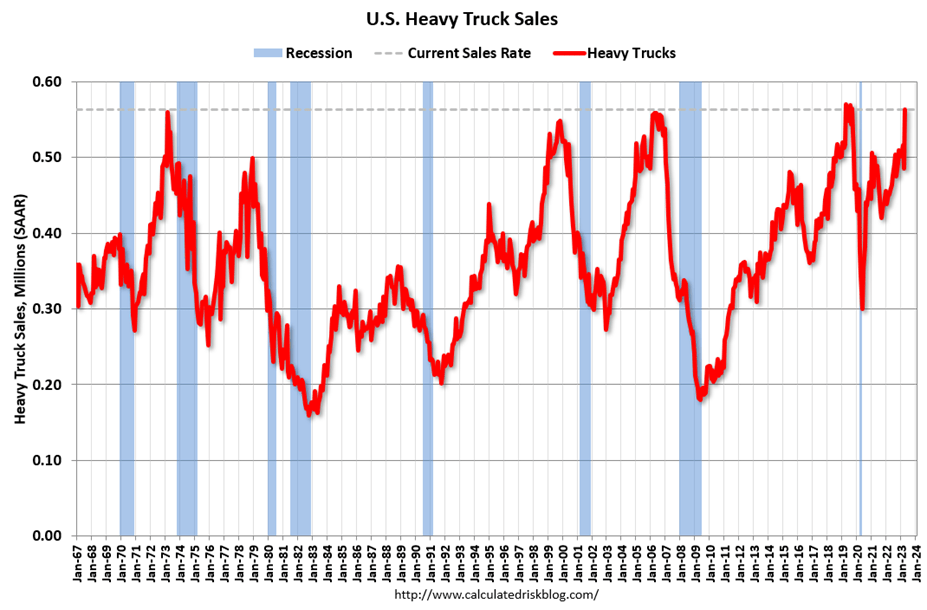
Earnings surprised to the upside for many retailers, which certainly wasn’t expected, showing the resiliency of the American consumer. The banking crisis went away as quickly as it appeared, and we continue to see conflicting data coming in that points to a healthy economy as well as a looming slowdown. Speaking of conflicting data, take a look at this chart of heavy truck sales, which is a forward-looking indicator of the health of the economy. By the way, a heavy truck is defined as any truck weighing over 14,000 lbs.

As you can see, every recession since 1974 has been preceded by a significant drop in heavy truck sales at least one year prior to the recession taking hold. If this is an accurate forecaster, then we still have at least a year to go before a recession hits our economy.

The Federal Reserve will be meeting in a few weeks and expectations are that they will raise interest rates once again. This could be a market-moving event if they deviate from what we are expecting so stay tuned.

I’m leaving this table in the update through August to see if history repeats itself. There have been seven instances where a January with a 4% or higher return was followed by a negative February. 2023 is now the eighth. For each one of these years, the following six months had an average gain of almost 10%. Will 2023 keep this undefeated streak going?

Take a look at the Outlook section below to see what events could move the markets over the short term.

Bond prices had a pretty significant drop in May, reversing course after a two-month rise. I think most of the drop was due to the possibility of the U.S. defaulting on its debt payments if they didn’t resolve the debt ceiling situation. It still isn’t resolved but we should know the answer in the next few days.

The 10-year US Treasury note yield headed higher in May, closing the month at 3.64%. The 30-year bond yield did the same, closing the month at 3.85%. These yields continue to remain well below the yields of short-term treasuries. For example, the 6-month T-bill is currently yielding 5.50%, confirming a strong inversion of the yield curve and one of the best indicators of an impending recession.

Bond buyers should continue to focus on bonds with short-term maturities. I would keep maturities under 18 months and just plan on holding these bonds to maturity. That way, you won’t have to worry about selling at a discount if interest rates head higher.

Savings rates moved higher once again in May and with the Fed expected to continue to raise short-term interest rates, we should see this trend continue through the summer. These rates have been getting more competitive as savers are moving their money to institutions with better interest rates. Traditional bank accounts are also having to sweeten their rates for depositors because many are moving their savings to brokerage money market accounts in the wake of the recent bank failures. Good stuff for risk averse investors and for our emergency reserves accounts.

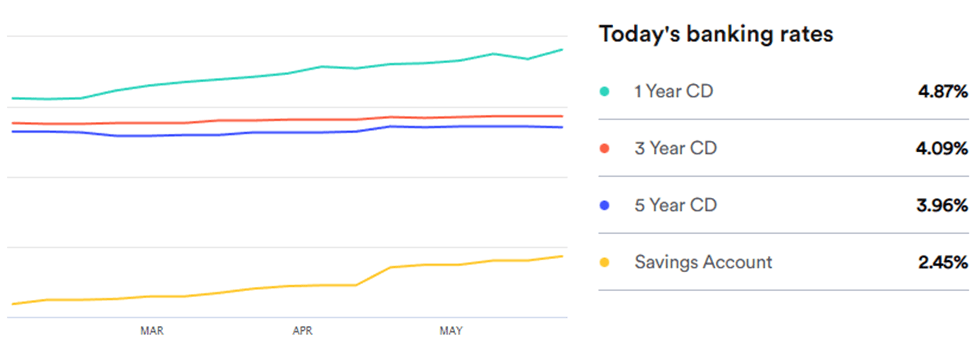
Currently, the average savings account is paying 2.45%, up from 2.35% last month. There are some banks that are now paying close to 5% and are worth taking the time to research.

The 1-year CD interest rate is now averaging 4.87%, up from 4.71% last month. The 5-year CD rate is currently at 3.96%, same as last month. These rates are still inverted, just like the yield curve, meaning they are paying a higher rate to borrow your money for a shorter time period, which isn’t normal. These inversions typically do not last longer than six months but that is about to be proven false, especially with the Fed expected to raise short-term rates again. That said, if you’re looking for a place to park your savings or emergency spending money, just buy short-term CDs, 1 year or less, and reevaluate when they mature. Keep the total under $250,000 per person at any one bank to ensure you are fully covered by the FDIC. CDs have become a nice alternative for risk-averse investors and have drawn money away from stocks because of their relatively high rates that carry virtually no risk. I wouldn’t mind if these rates stayed this high but do not want to see them heading up much further.

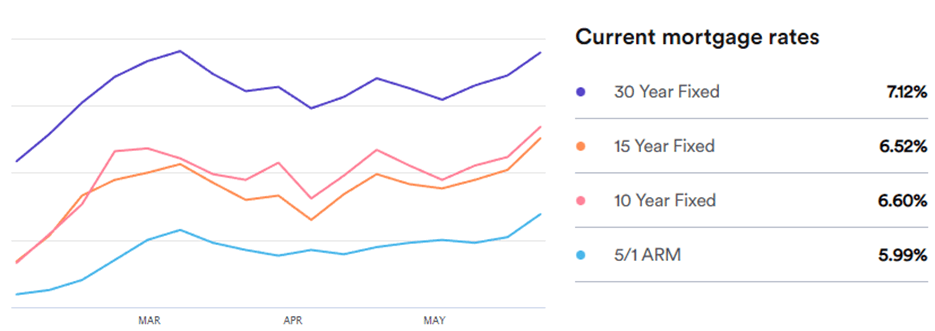
Mortgage rates headed higher in May as they typically follow the trajectory of the 10-year treasury bond yield. This pushed mortgage demand to its lowest point in three months. Nobody is refinancing and home inventory for sale continues to be constrained. This should help keep a lid on mortgage rates and turn them lower over the summer. Currently, the 30-year rate sits at 7.12%, up from 6.87% a month ago. Prices for both new and existing homes seem to have stabilized and could start heading higher. This would also put pressure on mortgage rates, but it shows that there is still solid demand.

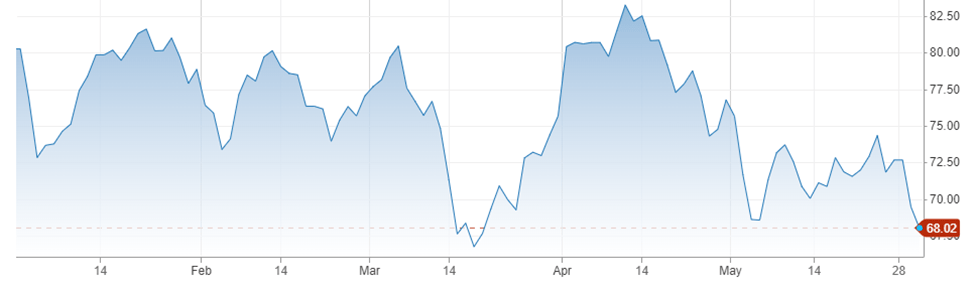
Oil prices headed lower in May, continuing their up and down roller coaster ride since the beginning of the year. Recession and debt ceiling concerns are forcing prices lower while tight supplies and a big increase in travel have put in a solid floor under fuel prices. For the month, the price for a barrel of oil settled at $68.02, down from $69.41 at the beginning of May. My hope to see prices drop into the $55 to $70 range became a reality in May. But now, they will have upward pressure from the seasonal summer travel season and hurricane season along with the occasional surprise OPEC supply cut and the strong dollar.

The year-to-date chart for the price of oil continues to toss and turn:

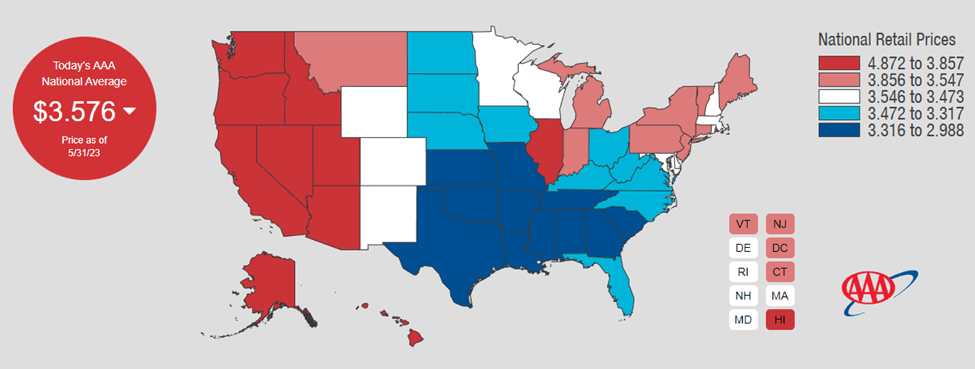
Gasoline prices took a breather in May and reversed course lower. Tight supplies and seasonal demand are being more than offset by the slowing economy. Although, if you were traveling this past Memorial Day weekend, you would beg to differ. Regular unleaded gasoline is now averaging $3.58 per gallon, down just $0.04 from last month. Mississippi has the cheapest gas for the third month in a row, at $2.99 a gallon. California has the most expensive gasoline at $4.87 per gallon. FYI, a year ago, we were paying $4.62.

Check out the prices at the pump in your area: AAA Gas Prices.

Outlook

Events on the horizon that could move the markets in the near term:

  • Fed & Inflation: Everyone seems to be resigned to the fact that we are heading into a recession. Despite this, the Fed plans on raising rates once again when they meet this month. I know they have a tough job of balancing economic growth with inflation, but they just don’t seem flexible enough with their 2% inflation mandate. Why don’t they have a range instead of a specific value? Also, let’s have a little more patience and let these interest rate raises work their way into the economy before bumping them ever higher. Past history has shown that they have always over corrected. We can still avoid a recession, but every rate increase hurts our chances and will eventually move the stock market lower.

Joe Baker, CFP®

Baker Asset Management, LLC

joebaker@bakerassetmanagement.com
Keep Politics Out Of Your Investment Decisions

Keeping your political preferences out of your investment decisions is harder than it sounds, especially in today’s 24/7 news cycle. I have seen politics become more influential almost every year since I started in this business back in the late 1990’s. The sad thing is that it has only been a drag on investors trying to reach their financial goals.

This is particularly true when it comes to an upcoming presidential election, like the one that is scheduled about 18 months from now. During the runup to the election, investors will fret over the possibility that the candidate from the party they don’t support could win the election. This will cause them to make irrational decisions, like putting all of their investments in cash. Then, when the market doesn’t react the way they think it should have, they miss out on those subsequent gains. Now, they also have to guess when to get back into the market, and that usually backfires on them as well.

Being in the investment world lo these many years, I’ve seen first-hand that how the market performs is not affected by who is in the White House. Regardless, political affiliations tend to blur the line between perception and reality for many investors and it has never been more evident than it is right now. Survey results from Republicans are the complete opposite of Democrats when asked about the health of our economy. It’s crazy because everyone is looking at the same numbers. Yet, we are so influenced by our political beliefs that we believe in two distinct, but entirely different realities.

When this happens, investors tend to let their politics steer their investing, and this almost always results in falling short of their investment objectives.

Also, you have to remember that well-run companies are going to do well regardless of who is in the White House. Sure, a change in the political landscape could force certain industries to evolve, but that doesn’t mean you should sell your investments and hide your cash under the mattress. Great companies will adapt and thrive.

Finally, you have to understand that the stock market is forward-looking, which means it has probably already priced in the things that you’re worrying about. So, stop worrying about them. The key takeaway from this little chat is that politics have little effect on your financial success.

Please comment or send an email if you have any questions. Thanks!

Joe Baker, CFP®

Baker Asset Management, LLC

joebaker@bakerassetmanagement.com
The Future of Electric Vehicles in the U.S.

Ever since the first Tesla rolled off the assembly line in 2008, I wondered how long it would take before electric vehicles overtook gasoline-powered cars, in terms of sales, here in the U.S. It’s been fifteen years and only about 5% of new car sales are EVs. So, it’s safe to say that we have been slow to adopt electric vehicles here in the States.

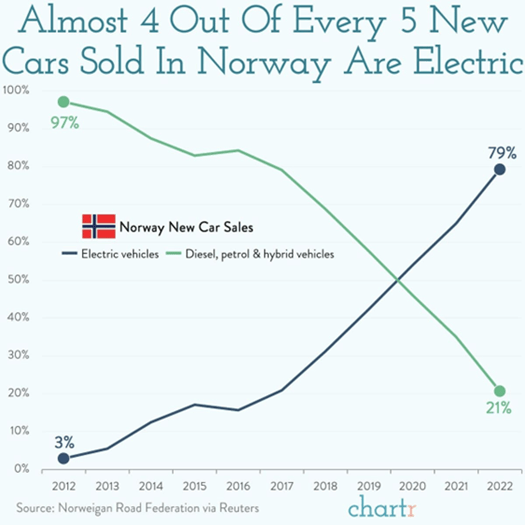
But that is not the case around the world. For instance, Norway is adopting electric vehicles at a very fast pace. In 2022, 80% of new cars sold in Norway were electric, and the country is on track to phase out gas-powered cars entirely by 2025. This is a significant increase from just a few years ago, when electric vehicles accounted for less than 1% of new car sales. This rapid adoption is due to a number of factors, including government incentives, a favorable tax structure, and a growing number of electric vehicle models available on the market, all offerings that are very similar to what we have here in the U.S.

One of the strong selling points for adopting electric vehicles is the reduction in greenhouse gas emissions and a cleaner, more breathable environment. They can already see the benefits in Norway. That country is now an observatory for figuring out what the electric vehicle revolution might mean for the environment, workers, and life in general. Levels of nitrogen oxides, byproducts of burning gasoline and diesel that cause smog, asthma and other ailments, have fallen sharply as electric vehicle ownership has risen.

Some studies show that we are about ten years behind Norway with regards to electric vehicle adoption. It’s possible, but here are some factors that might take us a little longer:

  • The U.S. is much, much bigger, both geographically and people-wise (the population of Norway is 5.41 million, about 1.7% of the U.S.). The infrastructure build out to support EVs will take many years.
  • Public transportation is more readily available, cheaper, and reliable than here. You can buy an electric car in Norway for your short trips and take the train everywhere else if you have EV range anxiety.
  • Having control of when we want to stay or leave is embedded in our culture. We don’t have to wait for a train or bus. We just park and go. This will be very hard to break in our society.
  • We love our cars. We spend so much time in them that we want to have a nice one. It’s not just a mode of transportation for us. It’s a part of our lifestyle.

Regardless, we are certainly on our way to accepting electric vehicles into our way of life. Recent studies show that the EV market in the U.S. is expected to continue to grow rapidly in the coming years. By 2030, it is estimated that EVs will account for 25% of new car sales in the U.S. By 2040, that number could rise to 50% or more. But we’ll need major cultural shifts to get us close to full adoption of EVs here in the States.

Please comment or send an email if you have any questions. Thanks!

Joe Baker, CFP®

Baker Asset Management, LLC

joebaker@bakerassetmanagement.com
I Thought The Banking Crisis Was Over?

Just when you thought it was safe to go back into investing in banks, there’s cause for a pause. The banking crisis that was supposed to be contained is still spreading like a windshield crack. So far this year, we have had four large, regional banks fail: Silvergate Bank, Silicon Valley Bank, Signature Bank, and the latest, First Republic Bank. Now, there are others that look like they may be next, especially based on their stock prices. Western Alliance Bancorp and PacWest Bancorp are a few banks whose stock prices are currently freefalling.

Risk factors that typically contribute to bank failures include:

  • Credit risk (loans and other assets turn bad and ceasing to perform)
  • Liquidity risk (withdrawals exceed the available funds)
  • Interest rate risk (rising interest rates reduce the value of bonds held by the bank and force the bank to pay relatively more on its deposits than it receives on its loans).

The recent bank failures weren’t really affected by credit risk (the main cause of the Great Financial Crisis of 2008). It was more of a combination of liquidity and interest rate risk, brought on by poor asset management by the banks themselves, coupled with poor oversight by their regulators. Also, the Federal Reserve raising interest rates did not help and is definitely not helping the banks currently in jeopardy.

This caused a loss in confidence by the banks’ depositors, and they subsequently withdrew their deposits, aka a run on the banks.

I’m not sure why the current regional banks are in trouble, but I can tell you depositors aren’t going to wait to find out. There’s a snowball effect happening, and customers are fleeing to the bigger banks or other financial institutions, such as brokerage houses (Schwab, Goldman Sachs, Fidelity, etc.).

With all this going on, I can’t imagine the Federal Reserve is going to raise interest rates any more this year. I guess that is a silver lining to come out of this mess. We’re certainly not in a systemic bank failure situation like we had in 2008/2009, but banks failing and causing a loss of depositor confidence across the country is never a good thing.

Please comment or send an email if you have any questions. Thanks!

Joe Baker, CFP®

Baker Asset Management, LLC

joebaker@bakerassetmanagement.com