
Ever since the first Tesla rolled off the assembly line in 2008, I wondered how long it would take before electric vehicles overtook gasoline-powered cars, in terms of sales, here in the U.S. It’s been fifteen years and only about 5% of new car sales are EVs. So, it’s safe to say that we have been slow to adopt electric vehicles here in the States.
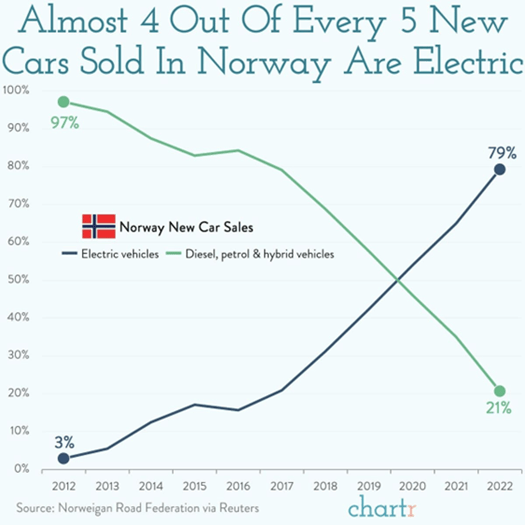
But that is not the case around the world. For instance, Norway is adopting electric vehicles at a very fast pace. In 2022, 80% of new cars sold in Norway were electric, and the country is on track to phase out gas-powered cars entirely by 2025. This is a significant increase from just a few years ago, when electric vehicles accounted for less than 1% of new car sales. This rapid adoption is due to a number of factors, including government incentives, a favorable tax structure, and a growing number of electric vehicle models available on the market, all offerings that are very similar to what we have here in the U.S.
One of the strong selling points for adopting electric vehicles is the reduction in greenhouse gas emissions and a cleaner, more breathable environment. They can already see the benefits in Norway. That country is now an observatory for figuring out what the electric vehicle revolution might mean for the environment, workers, and life in general. Levels of nitrogen oxides, byproducts of burning gasoline and diesel that cause smog, asthma and other ailments, have fallen sharply as electric vehicle ownership has risen.
Some studies show that we are about ten years behind Norway with regards to electric vehicle adoption. It’s possible, but here are some factors that might take us a little longer:
- The U.S. is much, much bigger, both geographically and people-wise (the population of Norway is 5.41 million, about 1.7% of the U.S.). The infrastructure build out to support EVs will take many years.
- Public transportation is more readily available, cheaper, and reliable than here. You can buy an electric car in Norway for your short trips and take the train everywhere else if you have EV range anxiety.
- Having control of when we want to stay or leave is embedded in our culture. We don’t have to wait for a train or bus. We just park and go. This will be very hard to break in our society.
- We love our cars. We spend so much time in them that we want to have a nice one. It’s not just a mode of transportation for us. It’s a part of our lifestyle.
Regardless, we are certainly on our way to accepting electric vehicles into our way of life. Recent studies show that the EV market in the U.S. is expected to continue to grow rapidly in the coming years. By 2030, it is estimated that EVs will account for 25% of new car sales in the U.S. By 2040, that number could rise to 50% or more. But we’ll need major cultural shifts to get us close to full adoption of EVs here in the States.
Please comment or send an email if you have any questions. Thanks!
Joe Baker, CFP®
Baker Asset Management, LLC

