

Fun Facts about July
- Birthstone: Ruby
- Flower: Larkspur and Water Lily
- Zodiac signs: Cancer and Leo
- The month of July was named by the Roman Senate in honor of Roman general Julius Caesar in 44 B.C. Before then it was called Quintilis.
- It is the first full month of summer and normally the hottest.
- July in the Northern Hemisphere is similar to January in the Southern Hemisphere.
- Monday, July 3rd, the stock market closes early at 1p.m. EST.
- Tuesday, July 4th, is Independence Day. All stock and bond markets in the U.S. are closed.
Stocks continued to climb a wall of worry throughout the month of June. They finished strong this past month to cap off a very impressive first half of the year. Anything to do with artificial intelligence (AI) led the way once again. The S&P 500 rose 6.5% during the month of June and is now up 15.9% for the year.
I’d be remiss without mentioning that the tech-heavy NASDAQ Composite has risen 31.7% year-to-date, its best showing since 1983.
Cash with investors has grown to $5.4 trillion from $4.7 trillion at the start of the year according to Fundstrat. This makes sense after all of the headlines earlier in the year talking about inflation, high interest rates, economic slowdown, etc., frightened investors and caused them to retreat to the safe haven of their money market funds. Those predictions have not panned out as of yet and those that stayed long and strong in their stock positions have been rewarded nicely over the first six months of the year. Now, we have investors with a ton of cash sitting on the sidelines trying to decide if they should stay in cash and get a decent rate of return with interest rates that are higher now or get back into the market for a chance to make much higher returns, aka FOMO (fear of missing out). Always a quandary for investors.
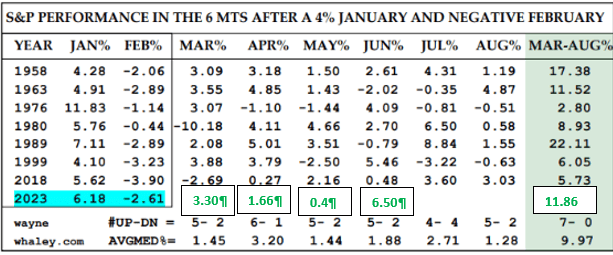
I’m leaving this table in the update through August to see if history repeats itself. We have a few more months to go. There have been seven instances where a January with a 4% or higher return was followed by a negative February. 2023 is now the eighth. For each one of these years, the following six months had an average gain of almost 10%. Will 2023 keep this undefeated streak going?
Take a look at the Outlook section below to see what events could move the markets over the short term.
Bond prices fell again in June for the second month in a row as yields moved higher mainly because of speeches by the members of the Federal Open Market Committee (FOMC) talking about their commitment to raise rates throughout 2023, despite their pause at June’s meeting.
The 10-year US Treasury note yield moved higher again in June, closing the month at 3.84%. The 30-year bond yield did the same, closing the month at 3.87%. These yields continue to remain well below the yields of short-term treasuries. For example, the 6-month T-bill is currently yielding 5.47%, confirming a strong inversion of the yield curve and one of the best indicators of an impending recession.
Bond buyers should continue to focus on bonds with short-term maturities. I would keep maturities under 18 months and just plan on holding these bonds to maturity. That way, you won’t have to worry about selling at a discount if interest rates head higher.
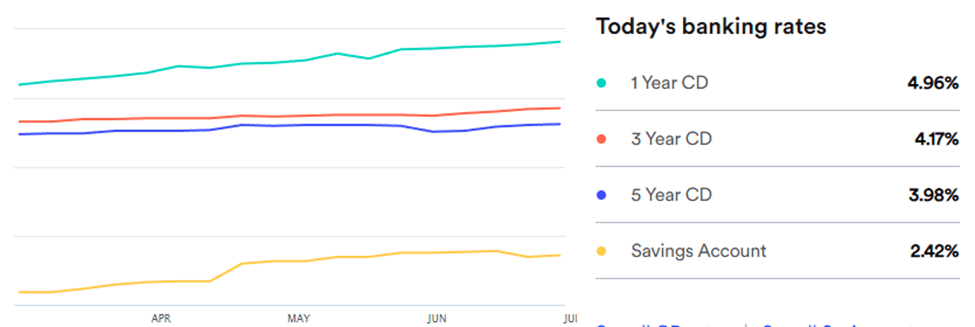
Savings rates continued to drift higher in June as competition grows for assets looking for a safe haven and a decent rate of return. Banks need to raise their savings rates offered to depositors to compete with treasury bonds and money market funds. This could hurt profit margins for the many banks that lent out mortgages in the 2-3% range a few years ago. They are losing money on those loans right now and could exacerbate their shrinking profit margins when they have to raise their depositors’ savings rates to help retain those customers. This is all good stuff for risk-averse investors and for our emergency reserves accounts. But do your research if you plan on investing in the smaller, regional banks.
Currently, the average savings account is paying 2.42%, down slightly from 2.45% last month. There are some banks that are now paying close to 5% and are worth taking the time to research.
The 1-year CD interest rate is now averaging 4.96%, up from 4.87% last month. The 5-year CD rate is currently at 3.98%, about the same as last month. These rates are still inverted, just like the yield curve, meaning they are paying a higher rate to borrow your money for a shorter time period, which isn’t normal. These yield inversions are lasting longer than normal and have a lot to do with the Federal Reserve continuing to hike short-term rates and recession fears keeping pressure on long-term rates. That said, if you’re looking for a place to park your savings or emergency spending money, just buy short-term CDs, 1 year or less, and reevaluate when they mature. Keep the total under $250,000 per person at any one bank to ensure you are fully covered by the FDIC. CDs have become a nice alternative for risk-averse investors and have drawn money away from stocks because of their relatively high rates that carry virtually no risk.
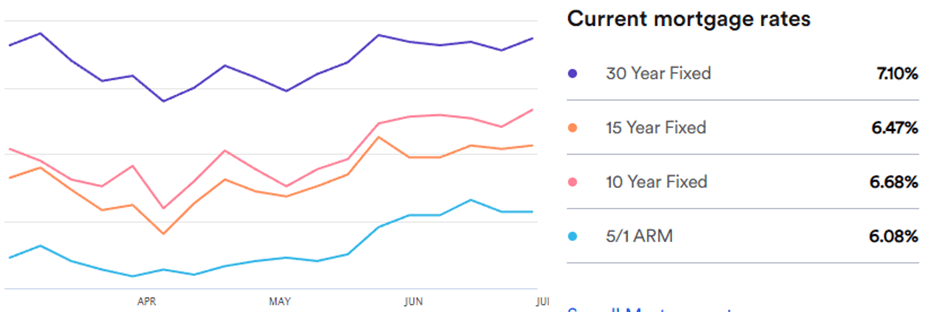
Mortgage rates remained above the 7% level in June even with demand slowing. Currently, the 30-year rate sits at 7.10%, just slightly lower than what it was a month ago, 7.12%. Prices for both new and existing homes appear to be bottoming out and could head higher if mortgage rates start to ease up. However, if the Fed continues to raise rates, that will most likely keep mortgage rates firmly above 7% for the near future, which could hurt home prices, even with the low inventories of available homes for sale.
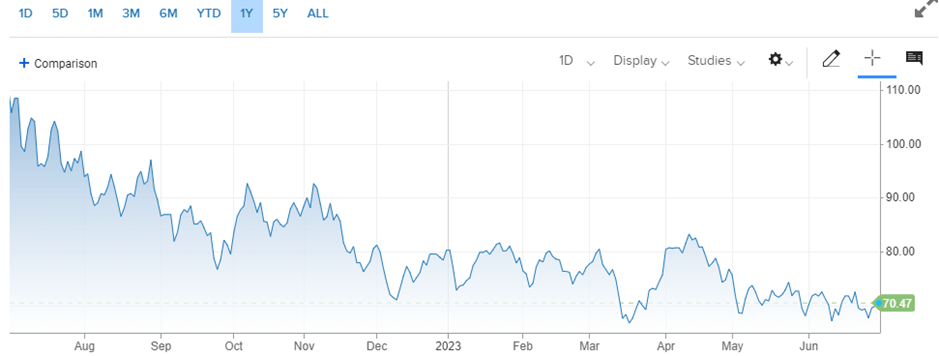
Oil prices continued their erratic heartbeat pattern, this time rising slightly in the month of June. There’s downward pressure on oil prices due to weak demand from China and upward pressure from OPEC cuts and peak travel season. For the month, the price for a barrel of oil settled at $70.46, up from $68.02 at the beginning of June. Prices are still close to the $55 to $70 per barrel range, which I think is a good range for both suppliers and users.
Although there has been a lot of short-term fluctuation in oil prices recently, the 1-year chart shows a steady decline from this time last year:
Gasoline prices followed oil and dropped slightly in June for the second month in a row. A surprise increase in inventories kept prices low even as the peak summer driving season gets into full swing. Regular unleaded gasoline is now averaging $3.54 per gallon, down just $0.04 from last month. Mississippi has the cheapest gas for the fourth month in a row, at $2.97 a gallon. Washington has the most expensive gasoline at $4.98 per gallon. FYI, a year ago, we were paying $4.86.
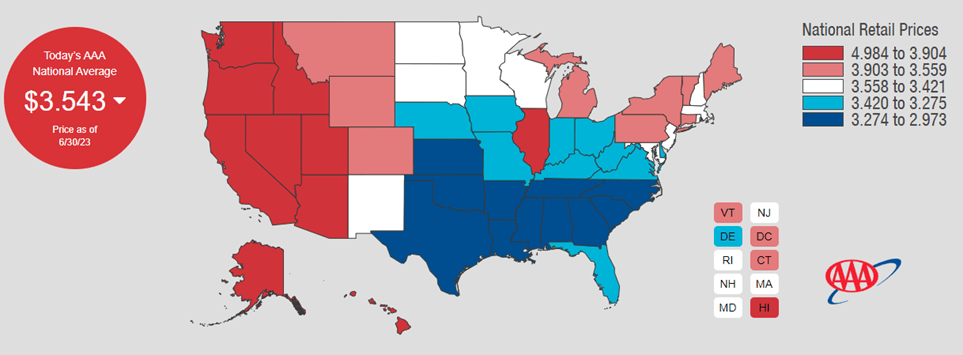
Check out the prices at the pump in your area: AAA Gas Prices.
Outlook
Events on the horizon that could move the markets in the near term:
- Fed & Inflation: The Federal Reserve paused raising rates at their June meeting, but since then have reiterated that they are not done raising rates and will do so again in 2023. They have been doing a great job so far in containing inflation without forcing us into a recession. I know when they tell us what they are planning to do, despite not seeing the data first, they are just trying to reel in investors’ expectations. Regardless, I don’t think it is very helpful and it is not a good look for the Fed. I would still like to know why they don’t have a target range for inflation, say 2-3%, versus their sand-in-the-line 2% goal. Yes, the economy is doing much better than anyone expected, but that’s good, right? Maybe we are in a sweet spot with economic growth and interest rate levels where they are right now. Let’s be patient and see what the data tells us. It could be the best move to avoid a recession and give a nice boost to both the stock and bond markets.
Joe Baker, CFP®
Baker Asset Management, LLC
joebaker@bakerassetmanagement.com

