

Fun Facts about June
- Birthstone: Pearl
- Flower: Rose and Honeysuckle
- Zodiac signs: Gemini and Cancer
- The month of June was named for the Roman goddess, Juno. She is the goddess of marriage.
- It is the first month of summer.
- June in the Northern Hemisphere is similar to December in the Southern Hemisphere.
- Wednesday, June 14th, is Flag Day.
- Father’s Day is Sunday, June 18th.
- Juneteenth is Monday, June 19th. All stock and bond markets in the U.S. are closed.
- The first day of summer is Wednesday, June 21st, also known as the summer solstice. It is also the longest day of the year.
Stocks managed to eke out another positive month in May despite all of the chatter about the debt ceiling. Leading the way were the big tech stocks and anything to do with artificial intelligence, or AI. The S&P 500 rose 0.4% during the month of May and is now up 9.1% for the year heading into the summer.
Earnings surprised to the upside for many retailers, which certainly wasn’t expected, showing the resiliency of the American consumer. The banking crisis went away as quickly as it appeared, and we continue to see conflicting data coming in that points to a healthy economy as well as a looming slowdown. Speaking of conflicting data, take a look at this chart of heavy truck sales, which is a forward-looking indicator of the health of the economy. By the way, a heavy truck is defined as any truck weighing over 14,000 lbs.
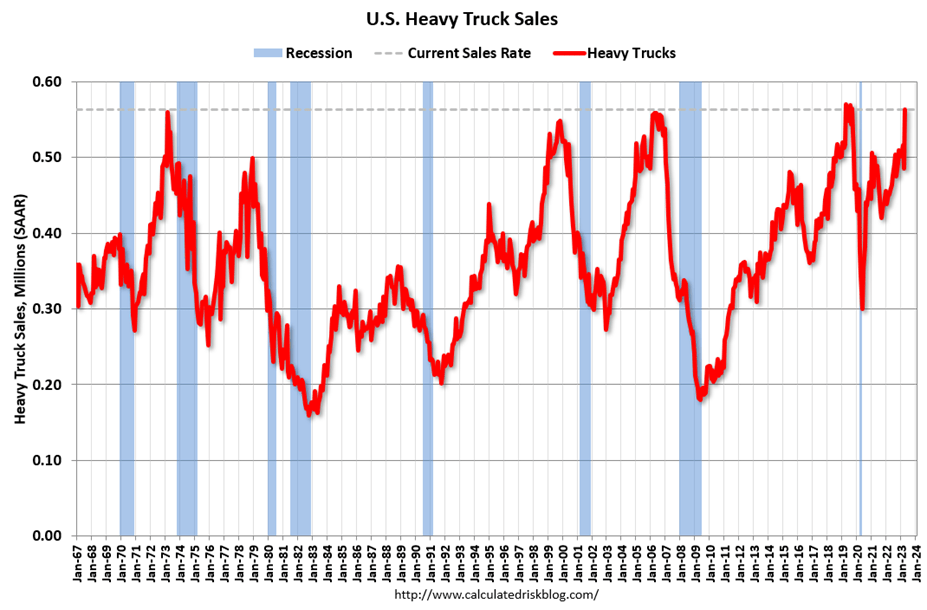
As you can see, every recession since 1974 has been preceded by a significant drop in heavy truck sales at least one year prior to the recession taking hold. If this is an accurate forecaster, then we still have at least a year to go before a recession hits our economy.
The Federal Reserve will be meeting in a few weeks and expectations are that they will raise interest rates once again. This could be a market-moving event if they deviate from what we are expecting so stay tuned.
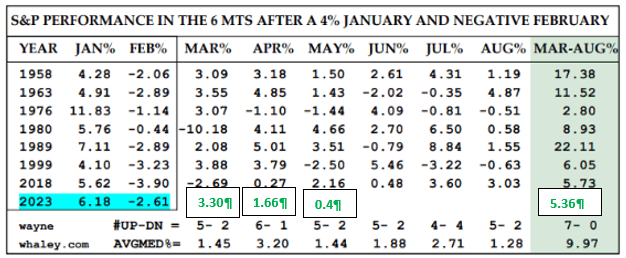
I’m leaving this table in the update through August to see if history repeats itself. There have been seven instances where a January with a 4% or higher return was followed by a negative February. 2023 is now the eighth. For each one of these years, the following six months had an average gain of almost 10%. Will 2023 keep this undefeated streak going?
Take a look at the Outlook section below to see what events could move the markets over the short term.
Bond prices had a pretty significant drop in May, reversing course after a two-month rise. I think most of the drop was due to the possibility of the U.S. defaulting on its debt payments if they didn’t resolve the debt ceiling situation. It still isn’t resolved but we should know the answer in the next few days.
The 10-year US Treasury note yield headed higher in May, closing the month at 3.64%. The 30-year bond yield did the same, closing the month at 3.85%. These yields continue to remain well below the yields of short-term treasuries. For example, the 6-month T-bill is currently yielding 5.50%, confirming a strong inversion of the yield curve and one of the best indicators of an impending recession.
Bond buyers should continue to focus on bonds with short-term maturities. I would keep maturities under 18 months and just plan on holding these bonds to maturity. That way, you won’t have to worry about selling at a discount if interest rates head higher.
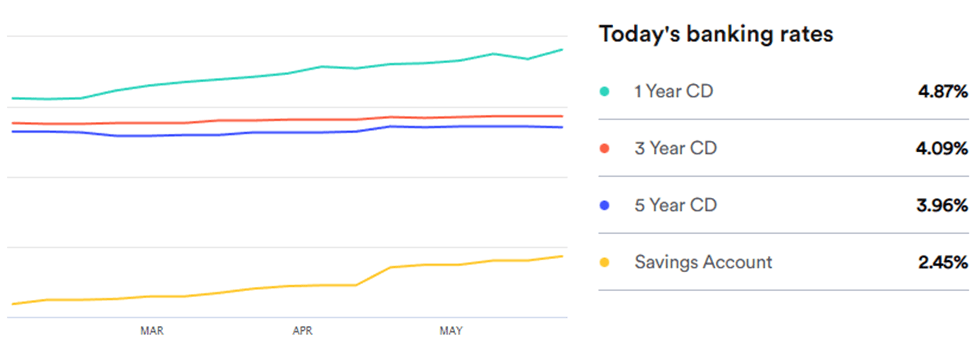
Savings rates moved higher once again in May and with the Fed expected to continue to raise short-term interest rates, we should see this trend continue through the summer. These rates have been getting more competitive as savers are moving their money to institutions with better interest rates. Traditional bank accounts are also having to sweeten their rates for depositors because many are moving their savings to brokerage money market accounts in the wake of the recent bank failures. Good stuff for risk averse investors and for our emergency reserves accounts.
Currently, the average savings account is paying 2.45%, up from 2.35% last month. There are some banks that are now paying close to 5% and are worth taking the time to research.
The 1-year CD interest rate is now averaging 4.87%, up from 4.71% last month. The 5-year CD rate is currently at 3.96%, same as last month. These rates are still inverted, just like the yield curve, meaning they are paying a higher rate to borrow your money for a shorter time period, which isn’t normal. These inversions typically do not last longer than six months but that is about to be proven false, especially with the Fed expected to raise short-term rates again. That said, if you’re looking for a place to park your savings or emergency spending money, just buy short-term CDs, 1 year or less, and reevaluate when they mature. Keep the total under $250,000 per person at any one bank to ensure you are fully covered by the FDIC. CDs have become a nice alternative for risk-averse investors and have drawn money away from stocks because of their relatively high rates that carry virtually no risk. I wouldn’t mind if these rates stayed this high but do not want to see them heading up much further.
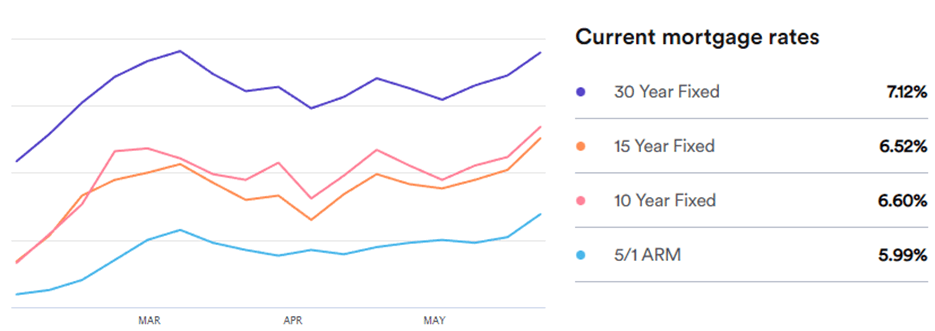
Mortgage rates headed higher in May as they typically follow the trajectory of the 10-year treasury bond yield. This pushed mortgage demand to its lowest point in three months. Nobody is refinancing and home inventory for sale continues to be constrained. This should help keep a lid on mortgage rates and turn them lower over the summer. Currently, the 30-year rate sits at 7.12%, up from 6.87% a month ago. Prices for both new and existing homes seem to have stabilized and could start heading higher. This would also put pressure on mortgage rates, but it shows that there is still solid demand.
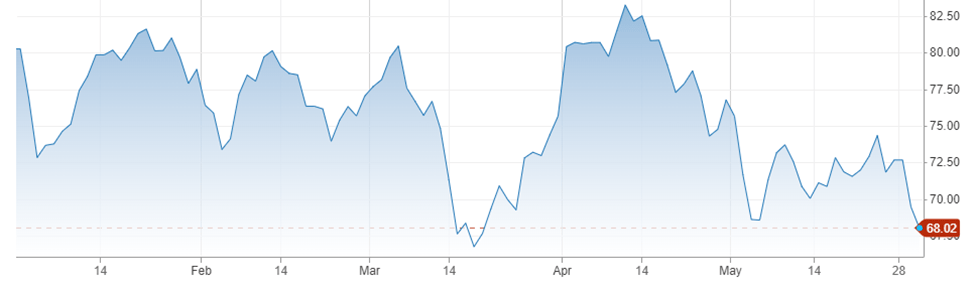
Oil prices headed lower in May, continuing their up and down roller coaster ride since the beginning of the year. Recession and debt ceiling concerns are forcing prices lower while tight supplies and a big increase in travel have put in a solid floor under fuel prices. For the month, the price for a barrel of oil settled at $68.02, down from $69.41 at the beginning of May. My hope to see prices drop into the $55 to $70 range became a reality in May. But now, they will have upward pressure from the seasonal summer travel season and hurricane season along with the occasional surprise OPEC supply cut and the strong dollar.
The year-to-date chart for the price of oil continues to toss and turn:
Gasoline prices took a breather in May and reversed course lower. Tight supplies and seasonal demand are being more than offset by the slowing economy. Although, if you were traveling this past Memorial Day weekend, you would beg to differ. Regular unleaded gasoline is now averaging $3.58 per gallon, down just $0.04 from last month. Mississippi has the cheapest gas for the third month in a row, at $2.99 a gallon. California has the most expensive gasoline at $4.87 per gallon. FYI, a year ago, we were paying $4.62.
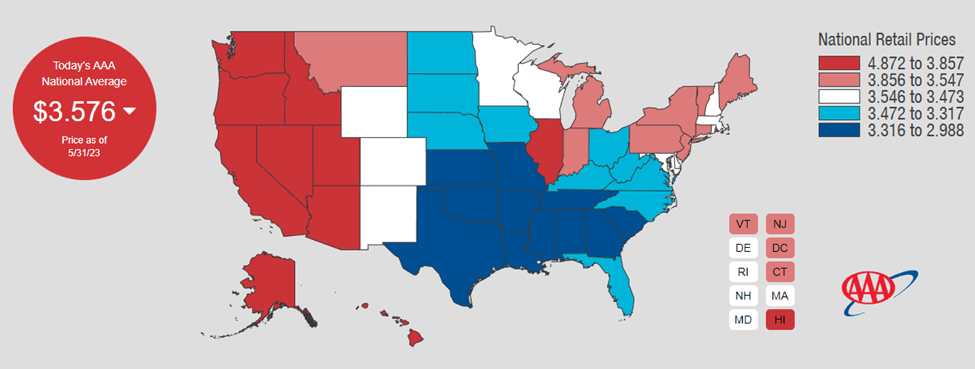
Check out the prices at the pump in your area: AAA Gas Prices.
Outlook
Events on the horizon that could move the markets in the near term:
- Fed & Inflation: Everyone seems to be resigned to the fact that we are heading into a recession. Despite this, the Fed plans on raising rates once again when they meet this month. I know they have a tough job of balancing economic growth with inflation, but they just don’t seem flexible enough with their 2% inflation mandate. Why don’t they have a range instead of a specific value? Also, let’s have a little more patience and let these interest rate raises work their way into the economy before bumping them ever higher. Past history has shown that they have always over corrected. We can still avoid a recession, but every rate increase hurts our chances and will eventually move the stock market lower.
Joe Baker, CFP®
Baker Asset Management, LLC
joebaker@bakerassetmanagement.com

