
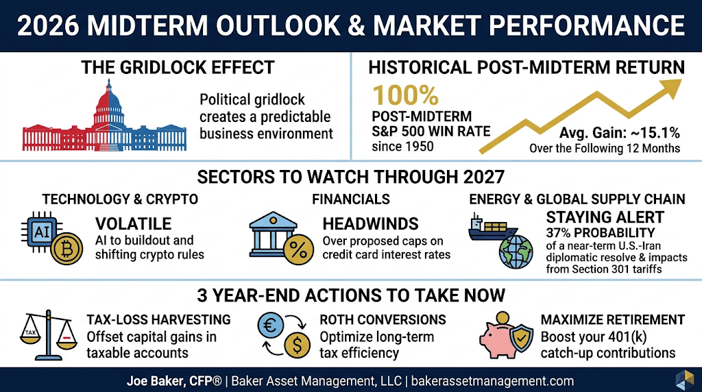
The 2026 midterms have concluded with Democrats taking control of Congress in a landslide victory, but that shouldn’t influence you to adjust your investment strategy. The historical data is clear: corporate earnings, inflation, and economic growth dictate long-term-market returns far more than which party holds power.
Here is exactly what the recent election results, combined with current geopolitical headwinds, mean for everyday investors’ portfolios through 2027.
The Broad Market Outlook: Gridlock is Good
Markets crave certainty. With a Democratic Congress and a Republican White House, we now have political gridlock. This limits the probability of sweeping legislative changes, creating the predictable environment that businesses prefer.
Historically, this is a bullish signal. In 1954, 1994, 2006, 2010, 2018, and 2022, the sitting president’s party lost control of Congress. Following these midterms, the market has historically performed exceptionally well. Since 1950, the S&P 500 has delivered positive returns in the 12 months following every single midterm election, with an average gain of around 15%.
Sector Impacts to Watch
While the broader market typically thrives on gridlock, specific sectors will experience targeted volatility based on regulatory shifts and global events:
- Technology & Data: The pace of AI data center buildouts and potential new regulations impacting the cryptocurrency industry under new congressional committees will be key drivers of tech valuations.
- Financials: Consumer finance institutions may face temporary headwinds as congressional proposals to cap credit card interest rates gain renewed traction.
- Energy & Supply Chains: A near-term resolution to the Iran conflict remains unlikely—prediction markets price a U.S. diplomatic meeting before January 2027 at only 37%. Combined with the new 10% to 12.5% Section 301 tariffs implemented in July 2026, supply chain costs and inflation may remain sticky, directly impacting manufacturing and energy.
Year-End Tax Planning
Investors should not alter their asset allocations based on election headlines or geopolitical noise. To offset these macro headwinds and protect real returns, the focus should be on maximizing tax advantages before year-end. Whether that means completing 401(k) catch-up contributions, running the numbers on a strategic Roth conversion, or executing tax-loss harvesting in taxable accounts to offset capital gains, now is the time to act.
Please comment or send an email if you have any questions.
Joe Baker, CFP®
Baker Asset Management, LLC
joebaker@bakerassetmanagement.com

