BAM Blog

Monthly Update – November 2023

Fun Facts about November

  • Birthstone: Topaz and Citrine
  • Flower: Chrysanthemum
  • Zodiac signs: Scorpio and Sagittarius
  • November in the Northern Hemisphere is similar to May in the Southern Hemisphere.
  • Tuesday, November 7th, is Election Day.
  • Saturday, November 11th, is Veteran’s Day.
  • Thursday, November 23rd, is Thanksgiving. Stock markets are closed. Markets will also close early, at 1:00 PM, on Friday, November 24th.

Stocks continued their decline for a third month in a row as geopolitical risks rose across the globe following the horrific attack on Israel by Hamas. Meanwhile at home, investors are still worried about the Federal Reserve raising interest rates even further. High interest rates coupled with conflicts in Europe and the Middle East are luring equity (stock) investors to bonds, crypto, and precious metals.

The S&P 500 dropped for the fourth consecutive month, finishing down 2.2%. For the year, it is still up, but only about 10.6%. Looking ahead to this month, November has historically been a positive month for stocks, averaging a small positive gain of+0.90% since 1928.

Q3 earnings have been rolling out over the last few weeks and have shown that the economy is still quite strong. But these numbers have been overshadowed by the Federal Reserve and its mission to get inflation below 2%. I’m pretty sure they will be successful, but it could be costly if they plunge the economy into a recession unnecessarily.

Take a look at the Outlook section below to see what events could move the markets over the short term.

Bond prices headed lower for a fourth straight month in October with the exception of treasury bills with short maturities. Their prices rose just a bit. This trend might end abruptly this week when the Federal Reserve concludes their meeting tomorrow. Investor sentiment points to the Fed holding steady on interest rates. If they raise rates or plan on raising rates anymore this year, we could see some wild swings in the bond and stock markets over the next few days.

The 10-year US Treasury note yield moved up about 30 basis points to close out October at 4.88%. The 30-year bond yield rose nearly the same amount as well, closing the month at 5.03%. Although these yields have been increasing, they continue to remain below the yields of short-term treasuries. For example, the 6-month T-bill is currently yielding 5.56%. The good news is that the gap is narrowing between long-term and short-term bond yields. If the Fed holds off on raising short-term rates for a while, we could see the yield curve revert back to its normal shape and possibly avoid a damaging recession.

Bond buyers should continue to focus on bonds with short-term maturities. I would keep maturities under 18 months and just plan on holding these bonds to maturity. That way, you won’t have to worry about selling at a discount if interest rates head higher. If rates do start to drop, you can sell the bonds at a profit since their price will rise as their yield drops.

Savings rates remained at multi-year highs in October, which is great for our risk-averse investors out there and for anyone with cash in savings, money market, and CD accounts. These rates are a legitimate alternative to stocks and bonds and will keep pressure on those markets until we see this trend reverse.

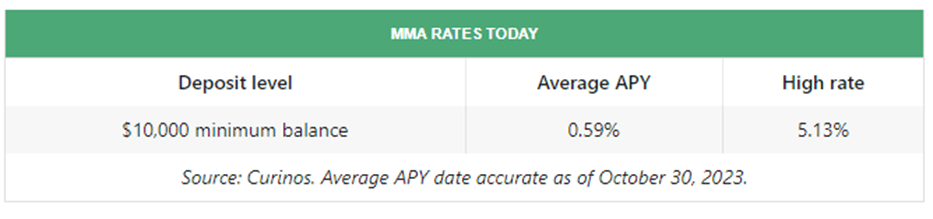
Now, take a look at the top rates for CDs and money market accounts (MMA):
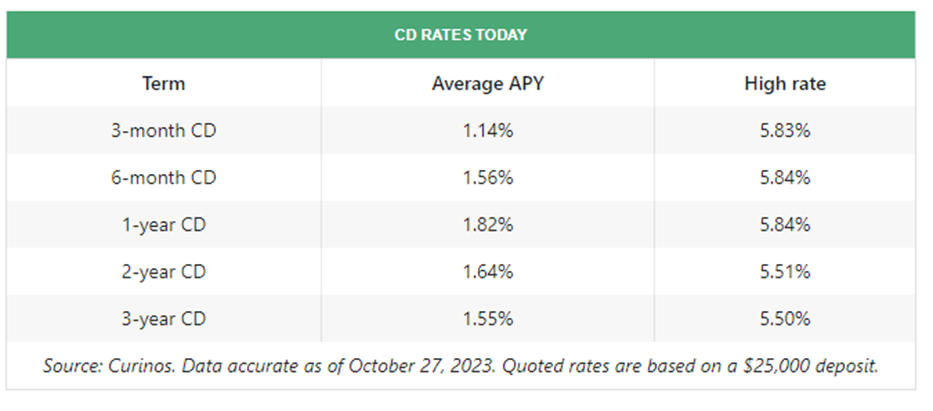
The best 1-year CD interest rate is peaking at 5.84%. The best 5-year CD rate right now is at 5.20%. These rates are still inverted, but are narrowing their spread, which means that they are normalizing. We are getting closer to the point where buying longer-term maturity bonds and CDs will make sense but for now, I would still put my savings or emergency spending money into short-term CDs, 1 year or less, and reevaluate when they mature. If you’d rather have more liquidity, look into an MMA (yielding over 5% currently). Keep the total under $250,000 per person at any one bank to ensure you are fully covered by the FDIC. As I mentioned above, CDs and MMAs have become nice alternatives for risk-averse investors and have drawn money away from stocks because of their relatively high rates that carry virtually no risk.

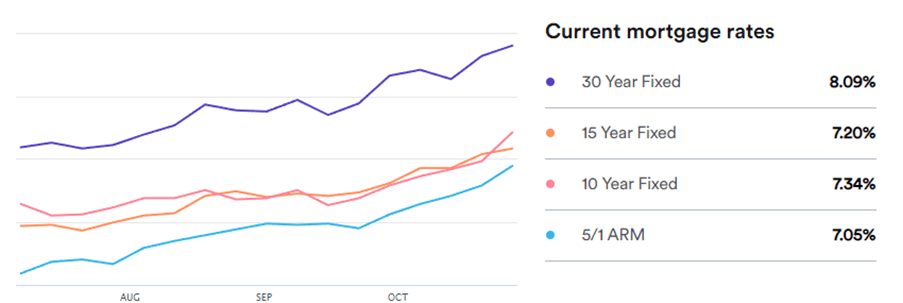
Mortgage rates continued to move higher in October, surging past the 8% mark. Currently, the 30-year rate sits at 8.09%, higher than what it was a month ago, at 7.83%. Rates are now at levels not seen since August of 2000.

With rates this high, most homeowners who want to move are sitting tight and prospective homeowners looking to buy are finding slim pickings to choose from. Plus, if they do find something, they are likely not going to be able to afford the mortgage payments. It’s a tough market for buyers, sellers, mortgage brokers, and real estate agents and it probably won’t get better until mortgage rates get below 7%. Hopefully, the Federal Reserve is taking note.

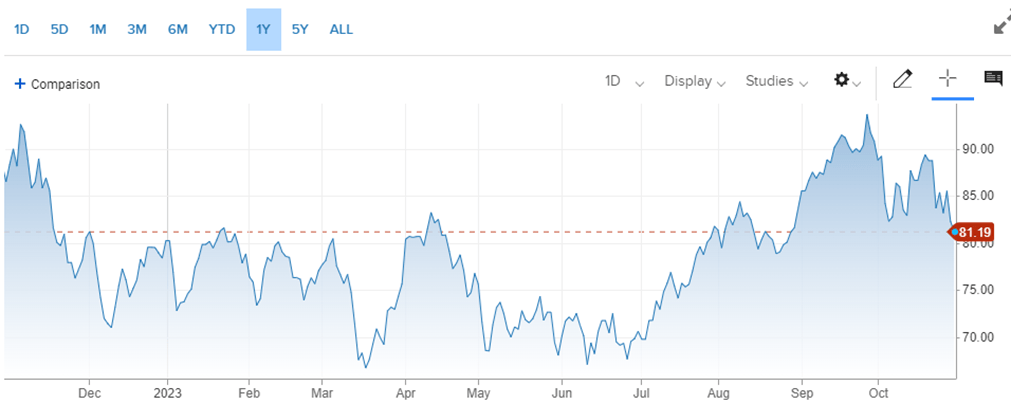
Oil prices took an abrupt U-turn and headed lower in October, despite the turmoil in the Middle East. It seems that the slowing of the economy due to the Federal Reserve’s actions to combat inflation has more than offset any tensions in the Middle East as well as supply tightening by OPEC. For the month, the price for a barrel of oil settled around $81.20, down from $90.70 at the beginning of October. Hopefully, we can keep this trend going and get prices down to the sweet spot, below $70.

Here’s a look at the one-year chart for U.S. oil:

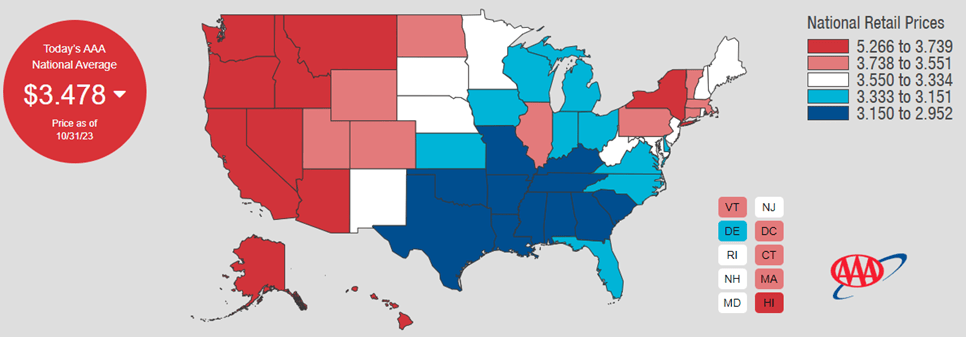
Gasoline prices took a well-needed dip in October, catching up with the recent drop in oil prices. Regular unleaded gasoline is now averaging $3.48 per gallon, down from $3.83 last month. Georgia has the cheapest gas currently, checking in at $2.95 a gallon. California has the most expensive gasoline at $5.27 per gallon. FYI, a year ago, we were paying $3.77.

Check out the prices at the pump in your area: AAA Gas Prices.

Outlook

Events on the horizon that could move the markets in the near term:

  • Fed & Inflation: When the Fed finishes their meeting tomorrow afternoon, we should have a good picture of what they plan on doing for the rest of the year with regards to their outlook on inflation. If they plan on no more interest rate hikes for the rest of the year, that could be the catalyst needed for a year-end rally for stocks and bonds. I would really like them to change their inflation target from 2% to a range of 2% to 3%. That seems like a more reasonable goal versus a specific number and gives them a much better chance of not overshooting their target and causing the economy to go into a recession. Regardless, tomorrow should be a volatile one for the markets.
  • Israel/Hamas: If the U.S. gets involved in this conflict more than our current supporting role for Israel, it could continue to send the stock market lower in the near-term. Hopefully, we can steer clear from getting any deeper in this battle.

Joe Baker, CFP®

Baker Asset Management, LLC

joebaker@bakerassetmanagement.com

Another Nice Raise Coming From Social Security in 2024

One of the few benefits of inflation is the increase in the Cost-of-Living Adjustment (COLA) that is used to calculate our social security benefit payments. For 2023, we had a huge increase of 8.7%, which was the highest increase in benefits since 1981.

For 2024, our pay raise is not going to be as good, but benefits are still going to go up by 3.2%, which is better than nothing. This means that benefit payments will increase by more than $50 per month, on average, according to the Social Security Administration.

Of course, someone has to pay for these benefits and that’s everyone who is still working. The government pulls the funding for social security out of our paychecks, and you should see it on your pay stub on the line item that’s labeled as FICA Social Security tax, OASDI tax, or something similar. It is a 6.2% tax (12.4% if self-employed) up to a certain amount of your pay. In 2023, the maximum amount of your pay subject to this deduction is $160,200.

In 2024, the maximum amount of earnings subject to the Social Security tax will increase to $168,600.

Please comment or send an email if you have any questions.

Joe Baker, CFP®

Baker Asset Management, LLC

joebaker@bakerassetmanagement.com

Stocks Are No Longer The Only Game In Town

From 2009 until halfway through 2022, if you wanted to get any kind of decent return on your money and keep it liquid, you had to invest in stocks, plain and simple. That’s because the Federal Reserve had dropped interest rates to zero to get our economy restarted after the worst financial crisis this country had experienced since the Great Depression. This meant that bonds, money market accounts, savings accounts and CDs were paying almost no interest during that period. So, investors looking for meaningful gains had to find them in the stock market. This strategy turned out working quite well but investors did have to take on much more risk than what they would have in a more normal interest-rate environment.

Well, times have changed. Since last year, interest rates have gone up considerably and are at a point now where we can invest in a variety of fixed income assets that carry very low risk but offer a meaningful rate of return. In fact, if you are apprehensive about the stock market currently, it would make sense to change your portfolio holdings to include some bonds and/or CDs, especially with the rates that are being offered currently.

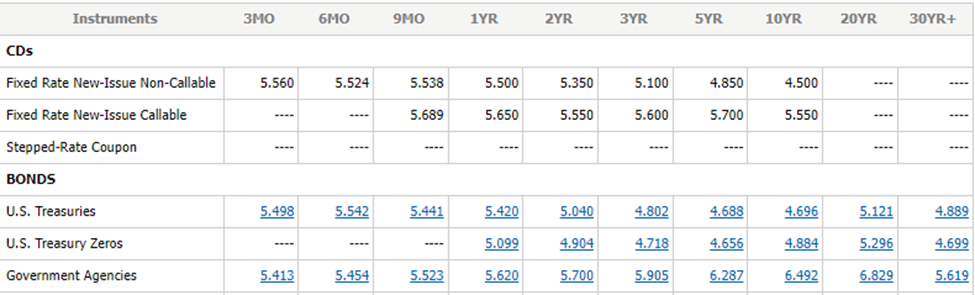
With that said, take a look at some current yields in the fixed income markets:

As you can see, most of the above assets that mature in under two years are paying at or near 5.5%. That is not bad for a near risk-free investment. Plus, you can now have a more balanced portfolio (mix of bonds and stocks) versus everything piled into the stock market. It’s also not a bad strategy to ladder your fixed income investments based on maturities. This means spread your fixed income allocation across CDs and bonds with different maturity dates so you can always have money liquid (available) in case you need it or for other investment opportunities. If you don’t, then you can just roll that money into more bonds/CDs with later maturities.

Everyone’s situation is different, so don’t look for a cookie cutter solution to your portfolio allocation. If you need to, work with an investment adviser to construct your portfolio to meet your financial goals.

Please comment or send an email if you have any questions.

Joe Baker, CFP®

Baker Asset Management, LLC

joebaker@bakerassetmanagement.com

Monthly Update – October 2023

Fun Facts about October

  • Birthstone: Opal and Tourmaline
  • Flower: Marigold and Cosmos
  • Zodiac signs: Libra and Scorpio
  • October comes from the Latin word octo which means eight. In ancient Rome, October was the eighth month of the year. When the Gregorian calendar was adopted, it became the tenth month of the year, but it has retained its original name.
  • October in the Northern Hemisphere is similar to April in the Southern Hemisphere.
  • Monday, October 9th, is Columbus Day. Stock and bond markets are open.
  • Tuesday, October 31st is Halloween!

Stocks stuck to their historical performance of negative returns in the month of September, marking their worst month of the year so far. The weight of more interest rate hikes and the possibility of a government shutdown was too much to bear this past month.

The S&P 500 dropped for the second month in a row, finishing down 4.9%. For the year, it is still up, but only about 13%. Historically, October has been pretty flat, averaging just a small positive gain of+0.60%.

With interest rates this high and the ongoing stock market volatility, investors don’t mind putting some of their cash into bonds or even CDs that are getting over 5% annualized interest. That’s pretty tough competition for stocks.

Q3 earnings will be coming out in earnest in the next few weeks. I am sure that we will be hearing company execs talking about the negative effects of high interest rates on their revenue, but their stock prices will move based on what they think will happen over the next six months or so. I am sure the Federal Reserve will be listening as well.

Take a look at the Outlook section below to see what events could move the markets over the short term.

Bond prices headed lower for a third straight month in September across the entire bond universe for the same reasons as stocks: higher interest rates and a possible government shutdown. Even with data pointing to inflation coming down, the Fed continues to push for higher rates by its members when they are out at speaking events.

The 10-year US Treasury note yield moved almost a half of a percentage point higher in September, closing the month at 4.58%. The 30-year bond yield rose the same amount as well, closing the month at 4.71%. Although these yields have been increasing, they continue to remain below the yields of short-term treasuries. For example, the 6-month T-bill is currently yielding 5.55%. The good news is that the gap is narrowing between long-term and short-term bond yields. If the Fed holds off on raising short-term rates for a while, we could see the yield curve revert back to its normal shape and possibly avoid a damaging recession.

Bond buyers should continue to focus on bonds with short-term maturities. I would keep maturities under 18 months and just plan on holding these bonds to maturity. That way, you won’t have to worry about selling at a discount if interest rates head higher. If rates do start to drop, you can sell the bonds at a profit since their price will rise as their yield drops.

Savings rates continue to head higher, which is great for our risk-averse investors out there and for anyone with cash in savings, money market, and CD accounts. These rates are a legitimate alternative to stocks and bonds and will keep pressure on those markets until we see this trend reverse.

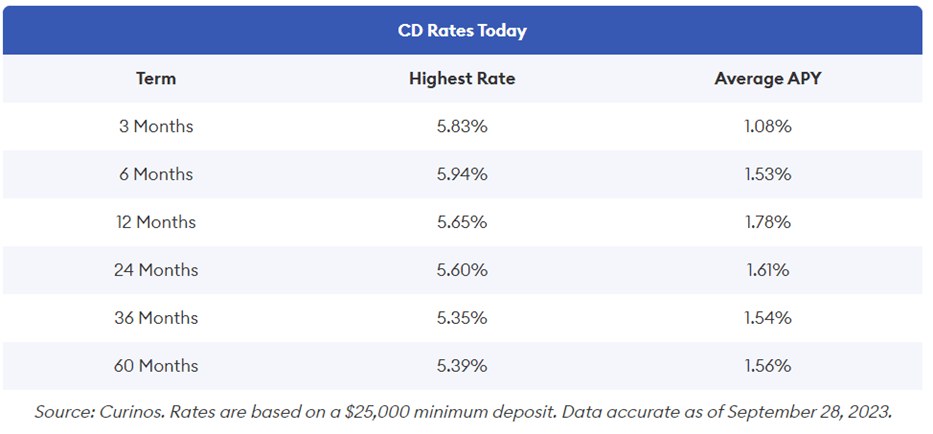
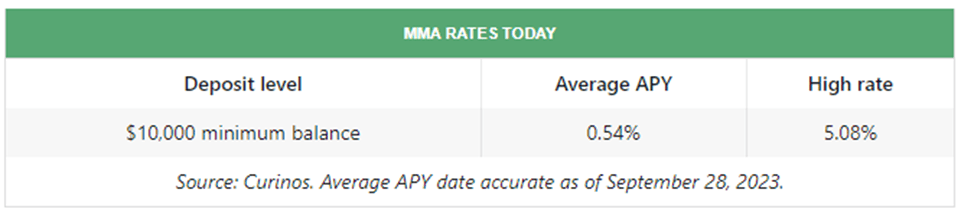
Now, take a look at the top rates for CDs and money market accounts (MMA):
As you can see, the best 1-year CD interest rate is peaking at 5.65%. The best 5-year CD rate right now is at 5.39%. These rates are still inverted, but are narrowing their spread, which means that they are normalizing. We are getting closer to the point where buying longer-term maturity bonds and CDs will make sense but for now, I would still put my savings or emergency spending money into short-term CDs, 1 year or less, and reevaluate when they mature. If you’d rather have more liquidity, look into an MMA (yielding over 5% currently). Keep the total under $250,000 per person at any one bank to ensure you are fully covered by the FDIC. As I mentioned above, CDs and MMAs have become nice alternatives for risk-averse investors and have drawn money away from stocks because of their relatively high rates that carry virtually no risk.

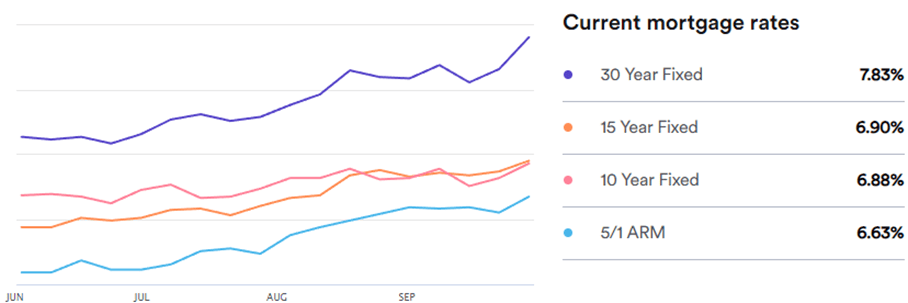
Mortgage rates are jumping higher again, hitting levels not seen since 2000. Currently, the 30-year rate sits at 7.83%, a bit higher than what it was a month ago, at 7.58%.

Not surprisingly, pending home sales for August dropped 7.1% from the month before, and were down 18.7% on a yearly basis, according to the National Association of Realtors. Every region in the country recorded a monthly and year-over-year drop. These elevated mortgage rates are keeping homeowners from selling and pricing out buyers as well. Fed, please take note.

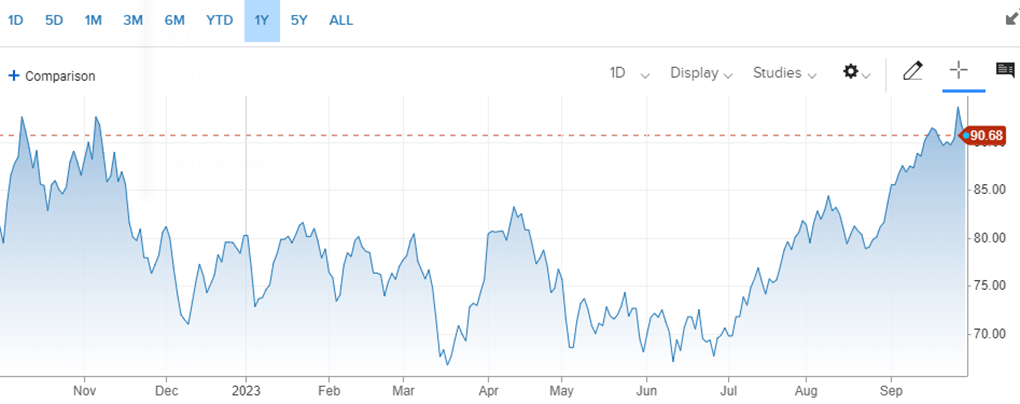
Oil prices continued to move higher in September, as supplies dry up here and globally. This is a bad sign for lowering inflation as it is a primary input cost for almost all goods and services. For the month, the price for a barrel of oil settled around $90.70, up from $83.06 at the beginning of September and about where they were a year ago. Prices are reaching a point that could cause some demand destruction, which would help turn prices lower. As always, the best cure for high oil prices is high oil prices.

Here’s a look at the one-year chart for U.S. oil. Would love to see it head back below $70:

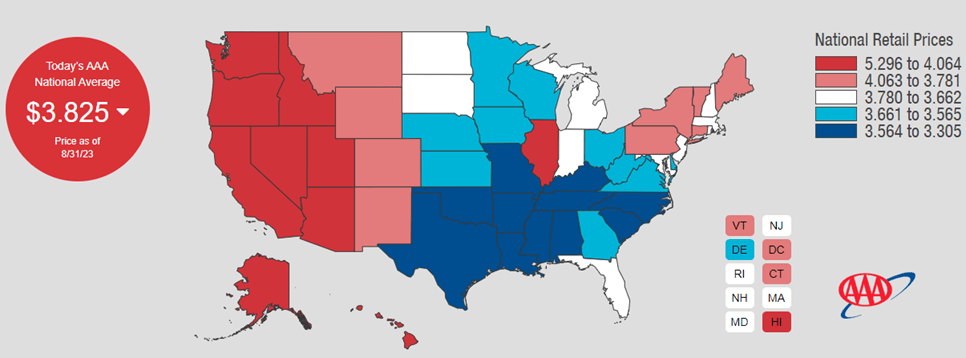
Gasoline prices remained flat in September. I felt like gas prices never came down as much as oil prices did in the summer so it’s possible that this rise in oil prices was already factored into gas prices. Regardless, prices are high, and it is the one price that is constantly displayed and that consumers equate with inflation. Regular unleaded gasoline is now averaging $3.83 per gallon, same as last month. Mississippi is hanging in there with the cheapest gas for the sixth month in a row, at $3.25 a gallon. California has the most expensive gasoline at $6.08 per gallon. FYI, a year ago, we were paying $3.78.

Check out the prices at the pump in your area: AAA Gas Prices.

Outlook

Events on the horizon that could move the markets in the near term:

  • Fed & Inflation: There’s no doubt now that the Fed’s actions to curb inflation are working. It’s very expensive to borrow money right now. That leads to less buying by both businesses and individuals. Less demand then leads to lower prices. We are not there yet, especially when it comes to travel and leisure, but I am starting to see deals out there, indicating sellers trying to attract buyers. The Fed held off on raising rates at their last meeting in September but have mentioned that they plan on raising rates again this year. That pause had little effect on the markets as it was already priced in. Now, the markets are expecting another rate hike this year and the recent market declines indicate that this Fed action is already being priced in. A nice upside surprise for the markets would be if they did not raise rates again this year. Time to wait and see once more.
  • Government shutdown: Congress is such a mess. It’s like two stubborn kids that won’t play nice. Anyway, if the government does shut down, as it has many times before, it typically does not have any real impact on the markets. Remember the last shutdown in 2018? Me either! The timing of this one, combined with a prolonged auto workers strike, could actually help do the work of the Federal Reserve, by slowing the economy, thereby reducing inflation. The problem is the data to show this may not be available because the government will be shut down. This may cause some near-term volatility in the markets but should be an overall positive catalyst for stocks and bonds.

Joe Baker, CFP®

Baker Asset Management, LLC

joebaker@bakerassetmanagement.com

The 4 Borrowing Rates We Have To Watch

With inflation hitting the front pages, I thought that it would be interesting to take a look at where the borrowing rates are for consumers and how they affect our spending habits.

I selected four of the most common loans that we use: credit cards, mortgages, auto loans, and student loans. The rates on these type of loans have increased dramatically over the past eighteen months due to the Federal Reserve raising the overnight lending rate to banks. This, in turn, raises the prime lending rate (currently at 8.50%) and that trickles down to all other lending rates in our financial system.

Credit Cards

The average interest rate for credit cards is now about 23% and there are some as high as 36%. These are all-time highs. Of course, you can avoid paying these astronomical rates by paying off your statement balances every month.

Auto Loans

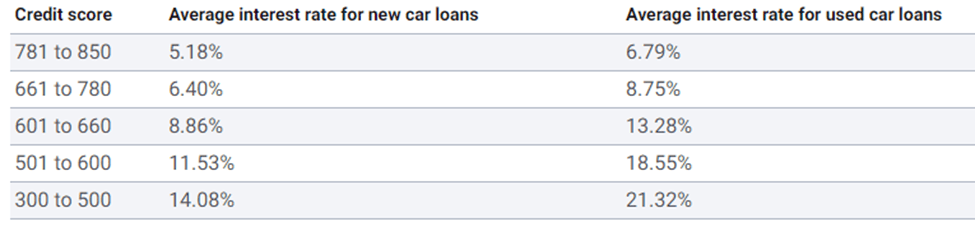
Interest rates for new auto loans now average 7.4%, the highest they’ve been in over 15 years, per Edmunds. The rates on these loans are highly influenced by the borrower’s credit scores, as you can see in this table:

If you have a credit score below 600, you should consider improving your credit score before applying for a loan to buy a car. You can improve your score by paying down any existing debt, making timely bill payments, especially for credit cards, and hold off on submitting any other credit applications, such as for mortgages or credit cards.

Mortgage Loans

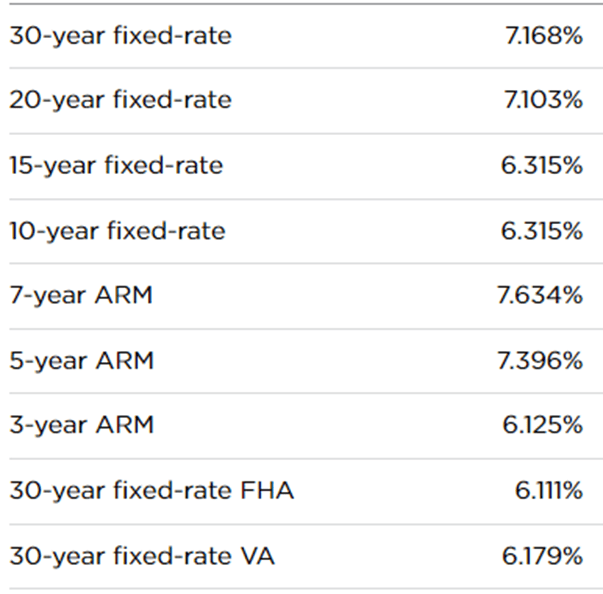
The average rate on 30-year mortgages rose to 7.62 percent last week, their highest rate since December 2000. Here’s the current averages for various terms:

Fun fact: 30-year mortgage rate was 19% in 1981!

These high rates have caused a big drop in mortgage applications as home buyers wait it out on the sidelines for lower rates. There is also a low inventory of houses for sale that is also contributing to this drop in applications.

If you believe that rates have peaked, you may want to apply for an adjustable-rate mortgage (ARM) loan so you can take advantage of declining rates in the future. This is a big IF right now.

Student Loans

The average student loan interest rate for undergrads has risen from 4.99% during the 2022-2023 school year to 5.5% for the 2023-2024 school year, according to the U.S. Department of Education. This rate is surprisingly low compared to historical rates that I have seen.


The trends for these rates have been upward for well over a year now and where they head in the near future is dependent on what the Fed says and does at their next meeting, slated for September 20th. The consensus is that they will hold off on raising rates at this meeting. I agree because the rates that we talked about today are increasing the amount of money that we need to service our debt which means that we have less disposable income for everything else. This has been reducing demand for products and services which should bring prices down for consumers. This is the Fed’s basic strategy to combat inflation and it is working but takes time, usually up to twelve months, for an interest rate hike to be felt across the economy. That’s why they should hold off on any more raises and let these already-high rates do their job.

Please comment or send an email if you have any questions.

Joe Baker, CFP®

Baker Asset Management, LLC

joebaker@bakerassetmanagement.com
Make Sure You’re Maxing Out Your Retirement Plan Contributions

We are fast approaching the final quarter of 2023, so I wanted to make sure that you are on track to maximize your contributions to your retirement plan(s).

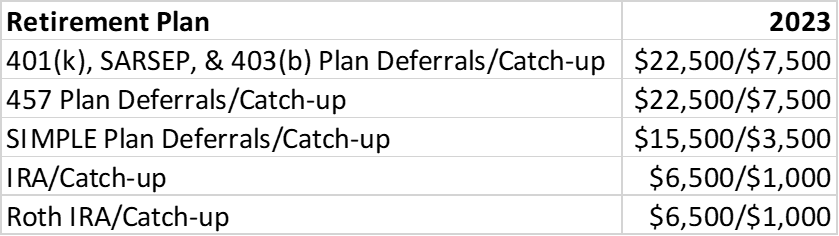
For all W-2 employees, the quickest way to check if you are on track is to take a look at your last paystub. Find the amount that you have contributed to your plan so far this year. Take that amount and subtract it from the maximum contribution shown in the table below that corresponds with your retirement plan. Be sure to include the catch-up amount if you are age 50 or over as of December 31st of 2023. The result is the remaining amount needed to max out your employee contributions for the year. If you take this number and divided it by the number of pay periods that you have left in the year, you will get the amount that needs to come out of each of your remaining paychecks to hit your 2023 contribution limit. Compare this number with what is actually being taken out and if the current amount being taken out is greater, then you’re good to go. If it is less, then you should adjust your contributions accordingly. Here’s a quick example:

Mary is age 55 and has contributed $20,000 to her 401k through September 30th, or $1,111.11 per paycheck ($20,000/18 pay periods). She has 6 pay periods left in 2023, which equates to a total of $6,666.66 in contributions for the rest of the year, giving her a total of $26,666.66 in contributions for 2023.

To maximize her contributions, Mary can contribute a total of $30,000 in 2023. So, she will be short $3,333.34 ($30,000.00 – $26,666.66) unless she increases her contributions. Therefore, she should change her contributions to $1,666.66 per pay period if she wants to maximize her annual contributions.

Maximum Employee Contributions for Retirement Plans

Note: Catch-up contributions are allowed for those employees that turn age 50 at any time in the year that they are contributing.

Check with your retirement plan advisor or your payroll department to confirm how much you need to contribute by the end of the year to max out your 2023 contributions.

Please comment or email me if you have any questions.

Joe Baker, CFP®

Baker Asset Management, LLC

joebaker@bakerassetmanagement.com
Monthly Update – September 2023

Fun Facts about September

  • Birthstone: Sapphire
  • Flower: Asters and Morning Glory
  • Zodiac signs: Virgo and Libra
  • September derives its name from the Latin word “septem,” which means “seven”. This is because, in the original Roman calendar, September was actually the seventh month of the year. It was only later that the calendar was adjusted to include the months of January and February.
  • September in the Northern Hemisphere is similar to March in the Southern Hemisphere.
  • Monday, September 4th, is Labor Day. Stock and bond markets are closed.
  • The first day of fall this year is Saturday, September 23rd.
  • Football gets into full swing!!

Stocks played two different halves in their August game. The first half was abysmal as the S&P 500 lost about five percent of its value but then it rallied in the second half of the month to finish down less than two percent. By the way, the average return of the S&P 500 in August since 1928 has been 0.6%, which makes sense since August includes the dog days of summer, with little activity in the financial world.

The S&P 500 dropped 1.7% during the month of August but is still up 18% for the year.

Stocks are still getting a lot of competition from high-yielding money market accounts and CDs, which are paying over 5% on an annualized basis. You can make a case that rates have peaked here and if so, would help provide stocks with another leg up.

With most earnings reports already in the books for the second quarter of 2023, the only real catalyst that we know of that can move the markets in the near-term is the Federal Reserve. We might need the help because September is historically the worst month for stocks, with the S&P 500 returning an average of -1.1% in this month since 1928.

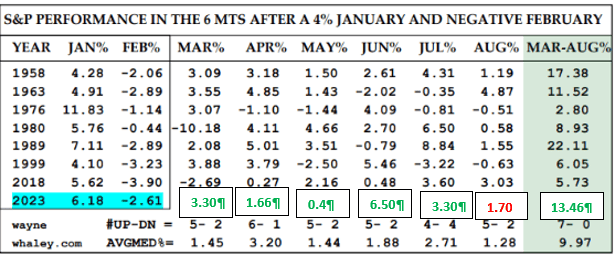
We reached the end of our test to see if history repeats itself. As we know, there have been seven instances where a January with a 4% or higher return was followed by a negative February. 2023 is now the eighth. For each one of these years, the following six months had an average gain of almost 10%. This year, the total return for those six months ended up being 13.46%. Still undefeated!

Take a look at the Outlook section below to see what events could move the markets over the short term.

Bond prices headed lower for a second straight month in August as fears grew that the Fed will continue to raise short-term interest rates higher before the end of the year. This came mostly from the speeches given by many of the Federal Reserve members at their annual Jackson Hole, WY retreat this past month. However, recent data coming out contradicts some of their statements and investors are betting that they will follow the data.

The 10-year US Treasury note yield moved higher again in August, closing the month at 4.09%. The 30-year bond yield did the same, closing the month at 4.21%. Although these yields have been increasing, they continue to remain below the yields of short-term treasuries. For example, the 6-month T-bill is currently yielding 5.51%, confirming a strong inversion of the yield curve and one of the best indicators of an impending recession. The good news is that the gap is narrowing and if the Fed holds off on raising short-term rates for a while, we could see the yield curve revert back to its normal shape and possibly avoid a damaging recession.

Bond buyers should continue to focus on bonds with short-term maturities. I would keep maturities under 18 months and just plan on holding these bonds to maturity. That way, you won’t have to worry about selling at a discount if interest rates head higher. If rates do start to drop, you can sell the bonds at a profit since their price will rise as their yield drops.

Savings rates are still drifting higher. Banks are trying to compete with treasury bonds and high-yield money market accounts for depositors’ cash. Brick and mortar banks are having a tough time trying to match the rates that the online-only banks are offering. This is causing some balance sheet pain for those smaller, regional banks that lent out mortgages in the 2-3% range a few years ago. They are losing money on those loans right now and could exacerbate their shrinking profit margins when they have to raise their depositors’ savings rates to help retain those customers. This is all good stuff for risk-averse investors and for our emergency reserves accounts. But do your research if you plan on investing in the smaller, regional banks.

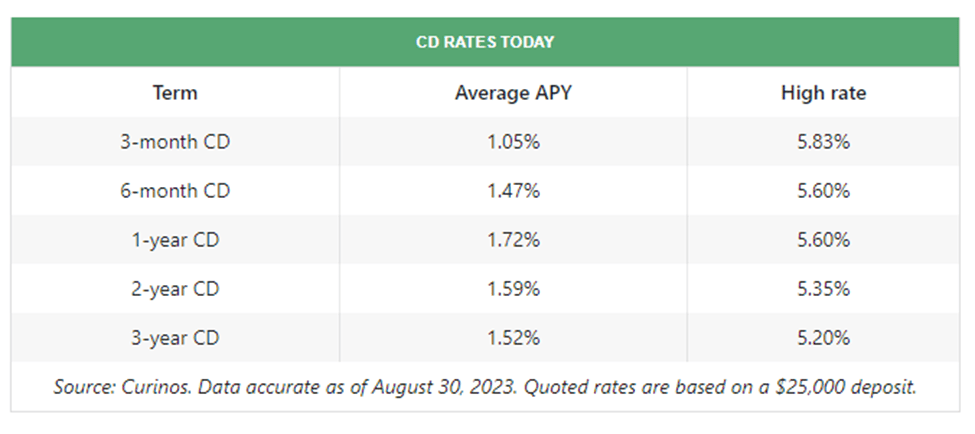
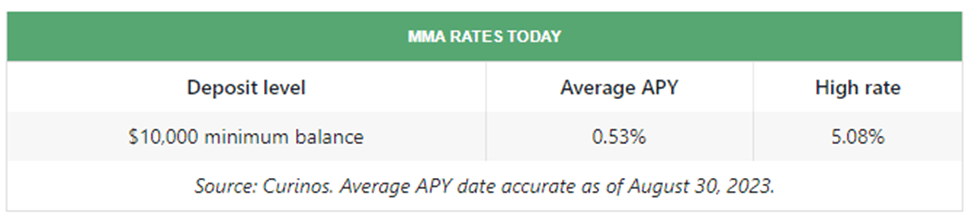
Now, take a look at the top rates for CDs and money market accounts (MMA):

As you can see, the best 1-year CD interest rate is peaking at 5.60%. The 5-year CD rate (not shown above) high watermark right now is at 4.67%. These rates are still inverted, just like the yield curve, meaning they are paying a higher rate to borrow your money for a shorter time period, which isn’t normal. These yield inversions are lasting longer than normal and have a lot to do with the Federal Reserve continuing to hike short-term rates as well as recession fears keeping pressure on long-term rates. That said, if you’re looking for a place to park your savings or emergency spending money, just buy short-term CDs, 1 year or less, and reevaluate when they mature. If you’d rather have more liquidity, look into an MMA (yielding as high as 5.08% currently). Keep the total under $250,000 per person at any one bank to ensure you are fully covered by the FDIC. CDs and MMAs have become nice alternatives for risk-averse investors and have drawn money away from stocks because of their relatively high rates that carry virtually no risk.

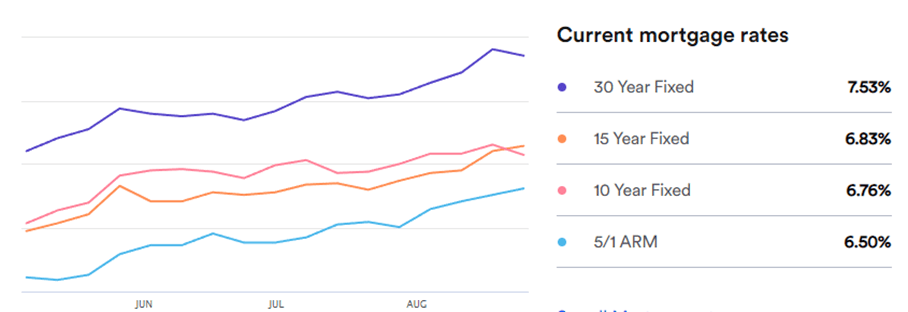
Mortgage rates continued climbing and remain at their highest levels in over twenty years. Currently, the 30-year rate sits at 7.53%, a bit higher than what it was a month ago, at 7.23%. Nobody with a 2-4% mortgage rate is moving that doesn’t have to move. If they are, they are going to be downsizing and paying cash. This bodes well for homebuilders because they are the only ones selling houses. Also, home building material prices have come down quite a bit, which will help both the builders and the home buyers. However, it is a tough market for existing home sales because of the lack of inventory and the lack of buyers, both due to very high mortgage rates.

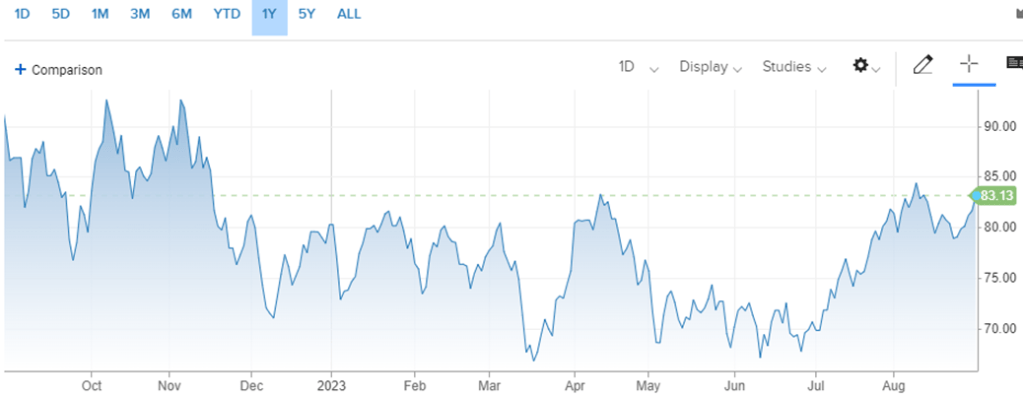
Oil prices headed higher once again in August, as demand and supply cuts take their toll. Also, there are signs of the Chinese economy bottoming out, which will put more upward pressure on prices. High oil prices are one of the sticky points of an otherwise shrinking inflation trend. For the month, the price for a barrel of oil settled around 83.06, up from $81.50 at the beginning of August. Prices have breached the upper limit of the goldilocks range of oil prices ($55 to $70 per barrel range), so we’ll see if that puts some pressure on consumption here in the U.S. as well as worldwide. As always, the best cure for high oil prices is high oil prices.

Here’s a look at the one-year chart for U.S. oil. Would love to see it head back below $70:

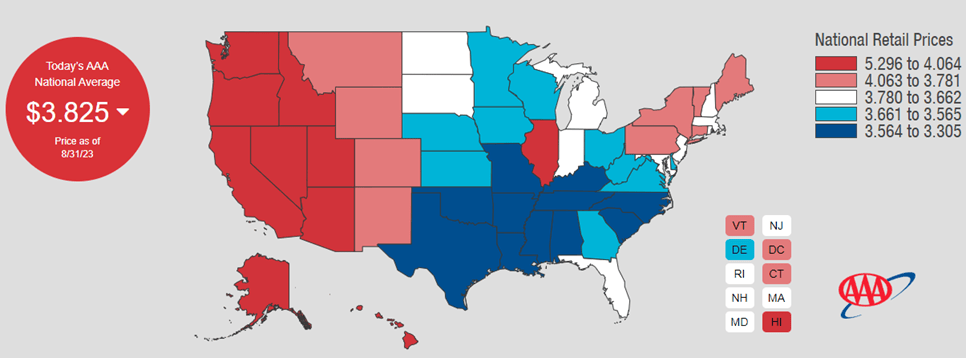
Gasoline prices moved slightly higher in August for the second month in a row. Lots of people traveling and OPEC continuing to close the spouts are the main factors keeping gas prices high. This is one of the stickier points of inflation right now, even as prices subside in other sectors of the economy. Regular unleaded gasoline is now averaging $3.83 per gallon, up $0.05 from last month. Mississippi has the cheapest gas for the fifth month in a row, at $3.31 a gallon. California has the most expensive gasoline at $5.30 per gallon. FYI, a year ago, we were paying $3.84.

Check out the prices at the pump in your area: AAA Gas Prices.

Outlook

Events on the horizon that could move the markets in the near term:

  • Fed & Inflation: Data continues to come in showing signs of inflation easing up. Also, there are certain areas of the economy that are slowing down as high interest rates established by the Fed are having their desired effect. Based on this information coming in recently, it appears that they will pause any rate hikes at their next meeting this month. This is a positive catalyst for stocks and bonds but could be baked in the cake already. We’ll just have to wait and see until after they meet on the twentieth of this month.

Joe Baker, CFP®

Baker Asset Management, LLC

joebaker@bakerassetmanagement.com

What To Know If You Inherit an IRA

If you are fortunate enough to be a beneficiary of an IRA, there are some important things that you should know before doing anything with it. The options available to you will depend on several factors, including the type of account you inherited, when you inherited it, your relationship to the deceased, and at what age the death occurred. But one wrong decision could lead to expensive consequences, mainly due to how inherited IRAs are taxed. So, let’s get right into what you should know about inheriting an IRA.

First, let’s review the definition of an inherited IRA, which is sometimes referred to as a beneficiary IRA. It is an IRA opened when you inherit any type of IRA: Traditional, Roth, SEP-IRA, SIMPLE IRA, and even an inherited IRA.

Now, let’s classify what type of beneficiary that you can be:

Beneficiary classifications – These categories are a key determinant of what options are available to you when you inherit an IRA:

  • Eligible designated beneficiaries (EDBs)
    • Surviving spouse
    • Disabled or chronically ill individual
    • An individual that is not more than 10 years younger than the IRA owner
    • Minor children
    • Certain trusts
  • Non-eligible designated beneficiaries (a.k.a. Designated Beneficiaries)
    • An individual that doesn’t meet the requirements for an eligible designated beneficiary (e.g., an adult child)
    • Certain trusts
  • Non-designated beneficiaries
    • Charities
    • Estates
    • Certain Trusts

Finally, let’s list the distribution options of the inherited IRA:

  • Lump-sum method – The beneficiary withdraws the entire balance of the account at once. Depending on the original retirement account type, the withdrawal may be subject to income taxes. For Roth IRAs, a lump-sum withdrawal will be tax-free so long as the 5-year rule has been met. All beneficiaries have the option to use the lump-sum method of distribution.
  • 5-year method – The beneficiary of an inherited IRA must distribute the entire balance of the account within five years of the death of the original owner.
  • 10-year method – This option requires the beneficiary of an inherited IRA to distribute the entire balance of the account within 10 years of the death of the original owner. If the original account owner was subject to RMDs at their passing (i.e., over age 73), then the beneficiary would have to continue those RMDs in years 1-9 and then ensure the account balance is fully distributed by the end of year 10.
  • Life expectancy method – The beneficiary of an inherited IRA must take RMDs each year. The life expectancy factor used to determine RMDs depends on your relationship with the original account owner and the age at death. This distribution method is an option for most IRA beneficiaries, but not all.

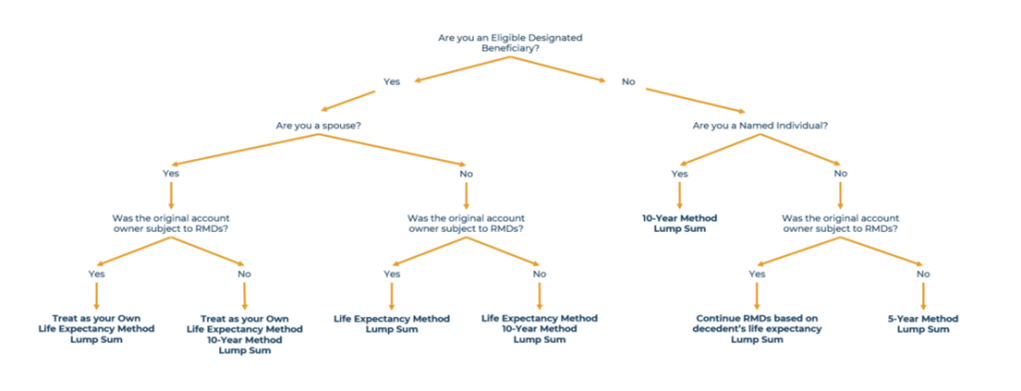
Are you confused yet? Hopefully, this flow chart can help you out a little bit:

In the majority of cases, beneficiaries are either the spouse or the children of the owner of the IRA that they will inherit. For beneficiaries that are the spouse of the owner of the IRA that is inherited, the most popular option is to simply roll the inherited IRA into your own IRA. That way, you can treat it as your own and these complex rules go away. For adult children that are beneficiaries, you’ll most likely want to take the 10-year method to minimize the tax impact (except for Roth IRAs) each year. In the Roth case, if you don’t need the money, then you should just leave it in there and let it grow for 10 more years before withdrawing it all at once, all tax-free.

These rules are complex and should be discussed with your financial adviser and/or your accountant before taking any action if you inherit an IRA. As always, please let me know if you have any questions.

Joe Baker, CFP®

Baker Asset Management, LLC

joebaker@bakerassetmanagement.com
Here’s What Could Move Stocks Higher Over The Next Year

With the S&P 500 up about 18% for the year, investors are wondering what the next catalyst will be to move the stock market higher. I believe there are at least two that can provide the fuel to move stocks higher over the next six to twelve months.

Here’s where I think those catalysts will come from:

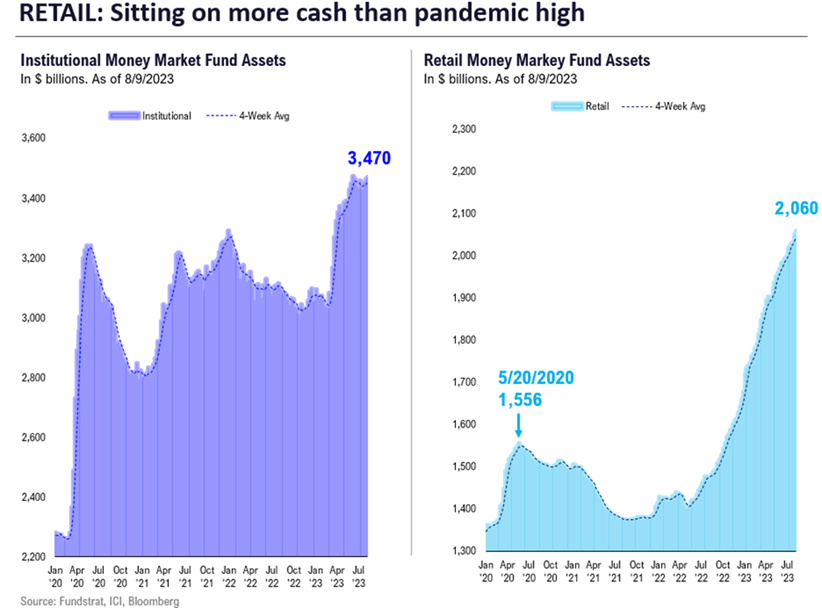
  • Cash on the sidelines – Currently, investors have $5 trillion of their investable assets in money market funds.

It is not a bad strategy, as many high-yield money market accounts are now earning an annual rate of 5%+. However, at some point, interest rates are going to move lower as inflation subsides. If the economy can keep up its impressive performance of high wages and low unemployment, then this combination of falling interest rates in a good economy should provide a nice boost for stocks.

  • Federal Reserve hits the brakes – With the most recent inflation data coming in better than expected and estimates showing that the Fed’s target rate of 2% inflation will be reached in early 2024, it looks more and more likely that the Fed will halt raising interest rates and may even begin to cut rates at some point next year. This will be a huge tailwind for stocks.

Please comment or send an email if you have any questions. Thanks!

Joe Baker, CFP®

Baker Asset Management, LLC

joebaker@bakerassetmanagement.com
The Double-Edged Sword of High Interest Rates

Over the past year or so, the financial news has been dominated by talk of the Federal Reserve and its strategy of raising interest rates to help slow inflation. This policy makes it more costly to borrow money and hurts economic growth. I also recently wrote about one of the benefits of higher interest rates in a recent blog post, 3 Best Places To Park Your Cash Right Now. Today, I wanted to take a look at how high interest rates both help and hurt our economy.

First, let’s take a look at some of the negatives of living with high interest rates:

  • Higher mortgage rates: Unless you’re buying a home with cash, it is going to be more expensive buying a home when mortgage rates are higher. Even if you already own your home, if you have an adjustable-rate mortgage, your monthly payment is going to go up.
  • Higher credit card rates: This can make it more expensive to borrow money for everyday expenses, which can put a strain on household budgets.
  • Higher costs to operate businesses: Businesses often have to borrow money to pay for things like inventory, payroll, and rent. When interest rates are high, these costs can go up, which can reduce businesses’ profits. Additionally, businesses with a lot of debt may find it more difficult to make their loan payments, which could lead to bankruptcy.

To summarize the downside, high interest rates make it harder to borrow money and less attractive to buy things, especially big-ticket items. Everybody and every business has to tighten their belts.

Now, let’s look on the bright side of high interest rates:

  • Great for savers: CDs, savings and money market accounts all pay higher interest rates, making it more attractive to save money in low-risk investment vehicles. This applies to both individuals and businesses.
  • Reduces inflation: When it costs more to borrow money, businesses may be less likely to invest and hire new workers. Additionally, consumers may be less likely to spend, which can lead to job losses and a decline in economic activity. This can help to bring down prices, which can benefit businesses that sell goods and services.

To summarize the upside, high interest rates make saving money worth it and without much risk. They also help drop prices, eventually, of almost all goods and services.

Please comment or send an email if you have any questions. Thanks!

Joe Baker, CFP®

Baker Asset Management, LLC

joebaker@bakerassetmanagement.com